Specialized Topics in Semantics
1302743
Lecture (1)
Semantics in Linguistics
Some things we know
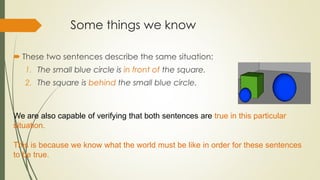
 These two sentences describe the same situation:
1. The small blue circle is in front of the square.
2. The square is behind the small blue circle.
We are also capable of verifying that both sentences are true in this particular
situation.
This is because we know what the world must be like in order for these sentences
to be true.
Some things we know
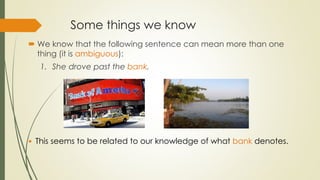
 We know that the following sentence can mean more than one
thing (it is ambiguous):
1. She drove past the bank.
 This seems to be related to our knowledge of what bank denotes.
Some things we know
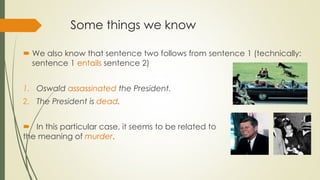
 We also know that sentence two follows from sentence 1 (technically:
sentence 1 entails sentence 2)
1. Oswald assassinated the President.
2. The President is dead.
 In this particular case, it seems to be related to
the meaning of murder.
types of linguistic knowledge
 One of the insights of modern linguistics is that speakers of a
language have different types of linguistic knowledge, including
• how to pronounce words,
• how to construct sentences,
• and about the meaning of individual words and sentences.
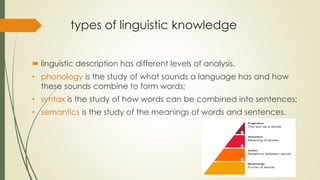
types of linguistic knowledge
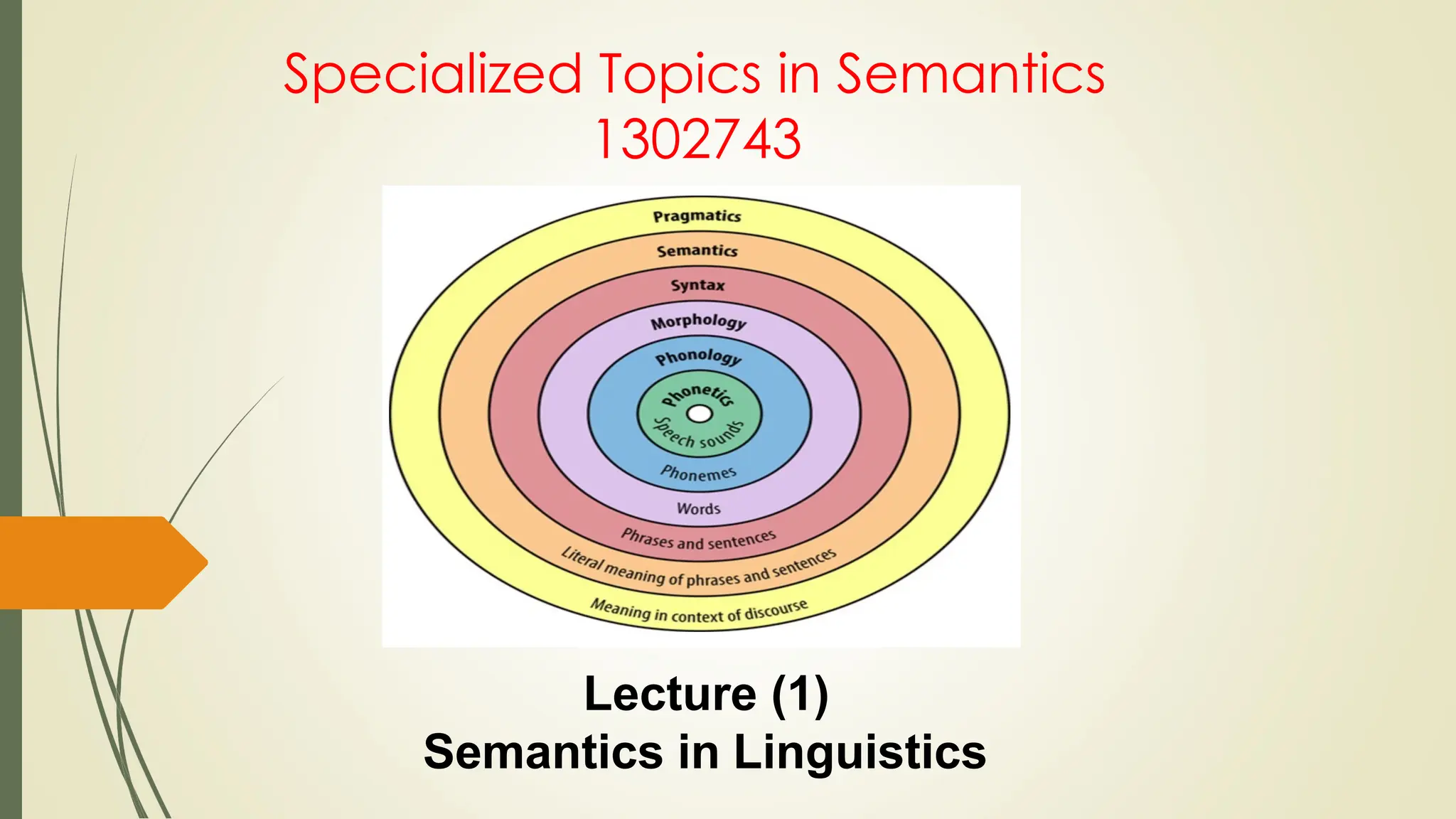
 linguistic description has different levels of analysis.
• phonology is the study of what sounds a language has and how
these sounds combine to form words;
• syntax is the study of how words can be combined into sentences;
• semantics is the study of the meanings of words and sentences.
Semantics
 Usually defined as that part of Linguistics that deals with meaning
word meaning
sentence meaning
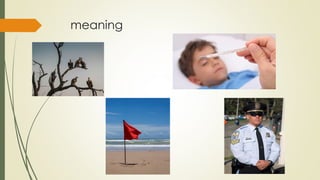
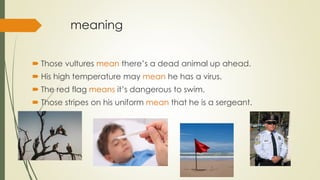
meaning
meaning
 Those vultures mean there’s a dead animal up ahead.
 His high temperature may mean he has a virus.
 The red flag means it’s dangerous to swim.
 Those stripes on his uniform mean that he is a sergeant.
Grammar
 Grammar (in the linguist’s sense) is a characterisation of the
knowledge of a speaker/hearer.
We ask: when a speaker “knows” a language, what does she
know exactly?
The linguist’s task is therefore to characterise what it takes for a
speaker/hearer to produce and comprehend her language.
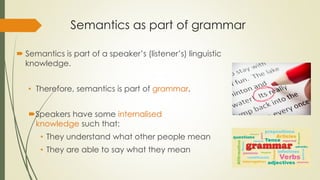
Semantics as part of grammar
 Semantics is part of a speaker’s (listener’s) linguistic
knowledge.
• Therefore, semantics is part of grammar.
Speakers have some internalised
knowledge such that:
• They understand what other people mean
• They are able to say what they mean
Knowledge of language is productive
 Open any book…
• How many of the sentences in it have you seen/heard before?
• Some, but certainly not all of them.
• But even if the sentences are completely “new”, you are still
able to understand them.
 To characterise our knowledge of language, we need to
characterise this ability people have to decode any new
utterance, so long as it conforms to the grammar of their language.
Knowledge of language is productive
The problem of knowledge
 Chomsky (1986) identified this as Plato’s problem:
A lot of what we hear or say is new
How do we manage to understand and produce
such an infinite variety of things, even if we’ve never
heard them before?
This is the basic motivation for much linguistic work
since the 1950’s.
The problem of knowledge
 Until the 1960s, the role of semantics in grammar was
somewhat obscure.
What can semantics contribute which is not accounted for by
other areas?
• syntax (phrase structure)
• morphology (word structure)
• phonology (sound structure)
• …
Katz and Fodor (1963)
 an early attempt to characterise what is required of a semantic
theory
• “semantics takes over the explanation of the speaker's ability to
produce and understand new sentences at the point where
grammar leaves off” (p. 172-3)
Katz and Fodor (1963)
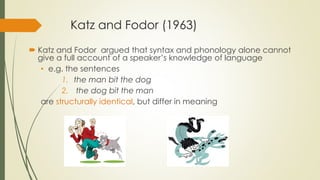
 Katz and Fodor argued that syntax and phonology alone cannot
give a full account of a speaker’s knowledge of language
• e.g. the sentences
1. the man bit the dog
2. the dog bit the man
are structurally identical, but differ in meaning
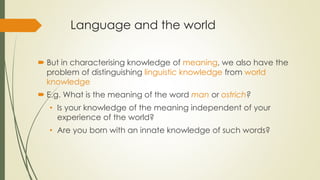
Language and the world
 But in characterising knowledge of meaning, we also have the
problem of distinguishing linguistic knowledge from world
knowledge
 E.g. What is the meaning of the word man or ostrich?
• Is your knowledge of the meaning independent of your
experience of the world?
• Are you born with an innate knowledge of such words?
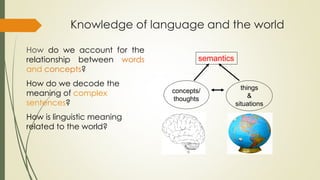
Knowledge of language and the world
semantics
concepts/
thoughts
things
&
situations
How do we account for the
relationship between words
and concepts?
How do we decode the
meaning of complex
sentences?
How is linguistic meaning
related to the world?
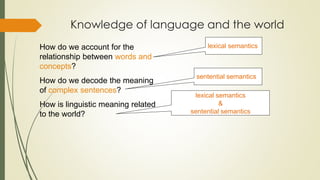
Knowledge of language and the world
How do we account for the
relationship between words and
concepts?
How do we decode the meaning
of complex sentences?
How is linguistic meaning related
to the world?
lexical semantics
sentential semantics
lexical semantics
&
sentential semantics
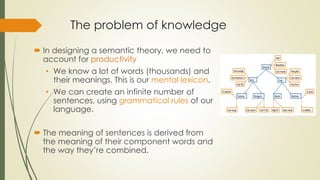
The problem of knowledge
 In designing a semantic theory, we need to
account for productivity
• We know a lot of words (thousands) and
their meanings. This is our mental lexicon.
• We can create an infinite number of
sentences, using grammatical rules of our
language.
 The meaning of sentences is derived from
the meaning of their component words and
the way they’re combined.
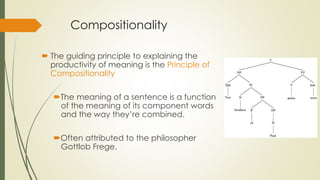
Compositionality
 The guiding principle to explaining the
productivity of meaning is the Principle of
Compositionality
The meaning of a sentence is a function
of the meaning of its component words
and the way they’re combined.
Often attributed to the philosopher
Gottlob Frege.
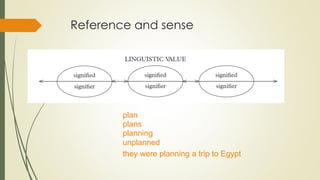
Reference and sense
plan
plans
planning
unplanned
they were planning a trip to Egypt
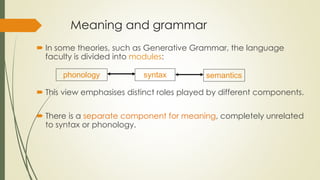
Meaning and grammar
 In some theories, such as Generative Grammar, the language
faculty is divided into modules:
 This view emphasises distinct roles played by different components.
 There is a separate component for meaning, completely unrelated
to syntax or phonology.
phonology syntax semantics
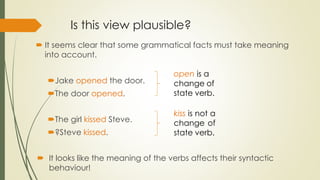
Is this view plausible?
 It seems clear that some grammatical facts must take meaning
into account.
Jake opened the door.
The door opened.
The girl kissed Steve.
?Steve kissed.
 It looks like the meaning of the verbs affects their syntactic
behaviour!
open is a
change of
state verb.
kiss is not a
change of
state verb.
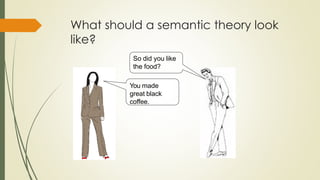
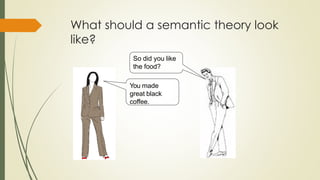
What should a semantic theory look
like?
So did you like
the food?
You made
great black
coffee.
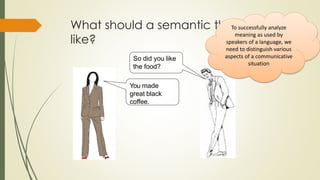
What should a semantic theory look
like?
So did you like
the food?
You made
great black
coffee.
To successfully analyze
meaning as used by
speakers of a language, we
need to distinguish various
aspects of a communicative
situation
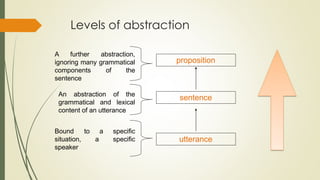
Levels of abstraction
proposition
sentence
utterance
a
to a specific
specific
Bound
situation,
speaker
A further abstraction,
ignoring many grammatical
components of the
sentence
An abstraction of the
grammatical and lexical
content of an utterance
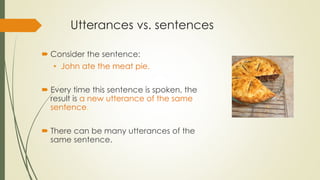
Utterances vs. sentences
 Consider the sentence:
• John ate the meat pie.
 Every time this sentence is spoken, the
result is a new utterance of the same
sentence.
 There can be many utterances of the
same sentence.
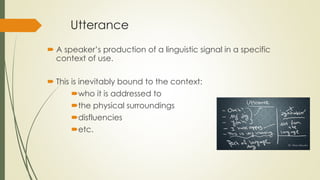
Utterance
 A speaker’s production of a linguistic signal in a specific
context of use.
 This is inevitably bound to the context:
who it is addressed to
the physical surroundings
disfluencies
etc.
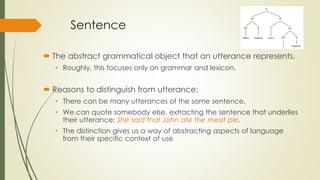
Sentence
 The abstract grammatical object that an utterance represents.
• Roughly, this focuses only on grammar and lexicon.
 Reasons to distinguish from utterance:
• There can be many utterances of the same sentence.
• We can quote somebody else, extracting the sentence that underlies
their utterance: She said that John ate the meat pie.
• The distinction gives us a way of abstracting aspects of language
from their specific context of use
Sentences vs. propositions
 A sentence is a linguistic construct. From a linguistic point of view,
these are (grammatically) different sentences:
• John ate the meat pie.
• The meat pie was eaten by John.
 A proposition is a logical construct, which abstracts away from
grammatical differences.
 If we simplify things, we could view the above sentences as
expressing the same proposition:
• “There is an x, and there is a y: x is a meat pie and y is a person
called John, and y ate x”
• Logicians would express the above using some form of notation.
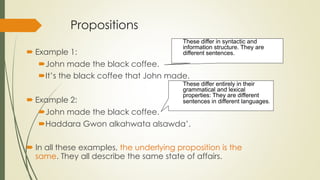
Propositions
 Example 1:
John made the black coffee.
 Example 2:
John made the black coffee.
Haddara Gwon alkahwata alsawda’.
 In all these examples, the underlying proposition is the
same. They all describe the same state of affairs.
These differ in syntactic and
information structure. They are
different sentences.
It’s the black coffee that John made.
These differ entirely in their
grammatical and lexical
properties: They are different
sentences in different languages.
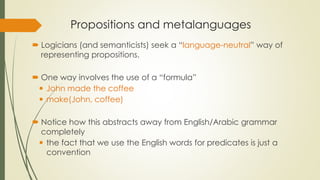
Propositions and metalanguages
 Logicians (and semanticists) seek a “language-neutral” way of
representing propositions.
 One way involves the use of a “formula”
 John made the coffee
 make(John, coffee)
 Notice how this abstracts away from English/Arabic grammar
completely
 the fact that we use the English words for predicates is just a
convention
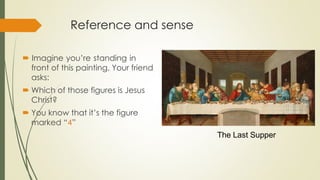
Reference and sense
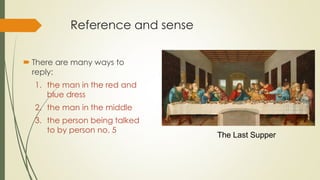
 Imagine you’re standing in
front of this painting. Your friend
asks:
 Which of those figures is Jesus
Christ?
 You know that it’s the figure
marked “4”
The Last Supper
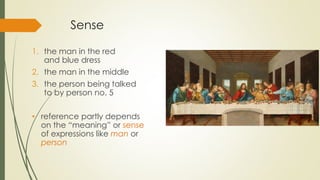
Reference and sense
 There are many ways to
reply:
1. the man in the red and
blue dress
2. the man in the middle
3. the person being talked
to by person no. 5
The Last Supper
Reference
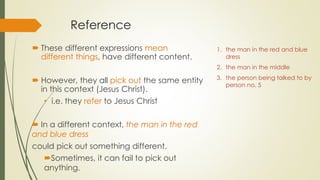
 These different expressions mean
different things, have different content.
 However, they all pick out the same entity
in this context (Jesus Christ).
• i.e. they refer to Jesus Christ
 In a different context, the man in the red
and blue dress
could pick out something different.
Sometimes, it can fail to pick out
anything.
1. the man in the red and blue
dress
2. the man in the middle
3. the person being talked to by
person no. 5
Reference
 an action on the part of a speaker
 it is context-bound
 but how do we pull it off?
Sense
1. the man in the red
and blue dress
2. the man in the middle
3. the person being talked
to by person no. 5
• reference partly depends
on the “meaning” or sense
of expressions like man or
person
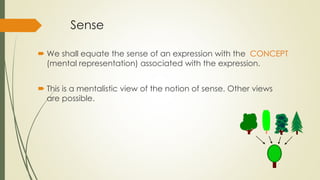
Sense
 We shall equate the sense of an expression with the CONCEPT
(mental representation) associated with the expression.
 This is a mentalistic view of the notion of sense. Other views
are possible.
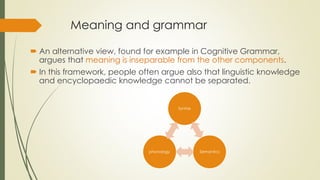
Meaning and grammar
 An alternative view, found for example in Cognitive Grammar,
argues that meaning is inseparable from the other components.
 In this framework, people often argue also that linguistic knowledge
and encyclopaedic knowledge cannot be separated.
Syntax
Semantics
phonology
What should a semantic theory look
like?
So did you like
the food?
You made
great black
coffee.
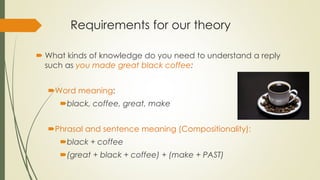
Requirements for our theory
 What kinds of knowledge do you need to understand a reply
such as you made great black coffee:
Word meaning:
black, coffee, great, make
Phrasal and sentence meaning (Compositionality):
black + coffee
(great + black + coffee) + (make + PAST)
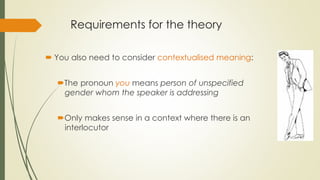
Requirements for the theory
 You also need to consider contextualised meaning:
The pronoun you means person of unspecified
gender whom the speaker is addressing
Only makes sense in a context where there is an
interlocutor
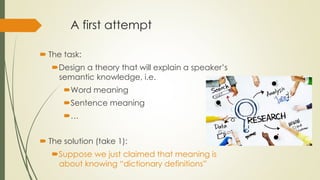
A first attempt
 The task:
Design a theory that will explain a speaker’s
semantic knowledge, i.e.
Word meaning
Sentence meaning
…
 The solution (take 1):
Suppose we just claimed that meaning is
about knowing “dictionary definitions”
Problem 1: Circularity
 Knowing the meaning of a word = knowing the definition
• E.g. coffee = a beverage consisting of an infusion of ground
coffee beans
 We need to know the meaning of the words making up the
definition (infusion, coffee beans)!
• This involves giving further definitions…
• Where would this process stop?
 The problem here is trying to define word meaning using other
words…
Problem 2: World knowledge vs. Linguistic
Knowledge
 Suppose you think of coffee as:
• black, hot, bitter…
 Suppose I think of coffee as:
• black, hot, ground from coffee beans, grown in Brazil…
 Which of the two conceptions is correct?
 Which of these aspects belongs to language, and which are
“encyclopaedic knowledge”?
 How much do we need to agree on in order to understand each
other’s uses of the word?
Problem 3: Individual differences
 Suppose we agree that coffee is typically black.
• We might not agree precisely on the true meaning of the word
black:
• How dark must something be to qualify?
• When does black become dark brown?
 People often differ on the boundaries
• This doesn’t seem to stop them understanding each other
Problem 3: Individual differences
 Two possible goals of a semantic theory:
o to identify aspects of meaning independent of individual
variation.
o to account for how speakers manage to understand
each other even where there is such variation
Interim summary
 Thinking of meaning as “definition” is problematic because:
1. Definitions are linguistic, and so their components will
themselves need definition.
 Therefore, we need to try to formulate our account of
meaning without recourse to words.
2. People won’t necessarily agree on definitions.
The need for a metalanguage
 To meet these problems, we need to characterise linguistic
meaning independently of words:
This involves using a semantic metalanguage
A way of “translating” meaning into a form that is language-
neutral.
 We might assume that speakers have a stock of concepts in their
heads
E.g. the meaning of coffee is the concept COFFEE
The concept is not tied to its “English” usage. An Arab speaker
has the same concept when she uses kahwa
Such concepts might be argued to exist in a speaker’s mental
lexicon
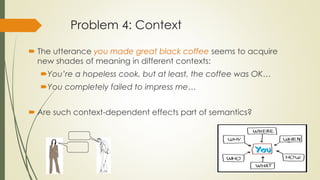
Problem 4: Context
 The utterance you made great black coffee seems to acquire
new shades of meaning in different contexts:
You’re a hopeless cook, but at least, the coffee was OK…
You completely failed to impress me…
 Are such context-dependent effects part of semantics?
Semantics vs. pragmatics
 Many linguists make a distinction between
Literal/conventionalised meaning
• “core meaning”, independent of context
• This belongs to semantics proper
Speaker meaning & context
• What a speaker means when they say something, over and
above the literal meaning.
• This and other “contextual” effects belong to pragmatics
 NB. The distinction between semantics and pragmatics is not hard
and fast
• Is the context-dependent meaning of you a matter for semantics
or pragmatics?
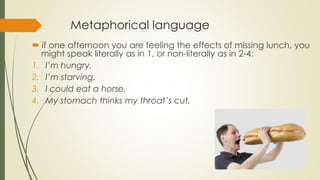
Metaphorical language
 if one afternoon you are feeling the effects of missing lunch, you
might speak literally as in 1, or non-literally as in 2-4:
1. I’m hungry.
2. I’m starving.
3. I could eat a horse.
4. My stomach thinks my throat’s cut.
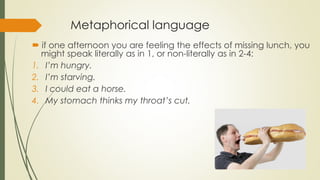
Metaphorical language
 if one afternoon you are feeling the effects of missing lunch, you
might speak literally as in 1, or non-literally as in 2-4:
1. I’m hungry.
2. I’m starving.
3. I could eat a horse.
4. My stomach thinks my throat’s cut.
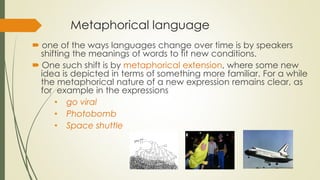
Metaphorical language
 one of the ways languages change over time is by speakers
shifting the meanings of words to fit new conditions.
 One such shift is by metaphorical extension, where some new
idea is depicted in terms of something more familiar. For a while
the metaphorical nature of a new expression remains clear, as
for example in the expressions
• go viral
• Photobomb
• Space shuttle
Metaphorical language
 The vocabulary of a language is littered with fossilized
metaphors such as these, and this continuing process makes it
difficult to decide the point at which the use of a word is literal
rather than figurative.
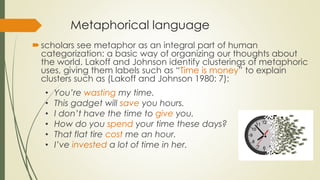
Metaphorical language
scholars see metaphor as an integral part of human
categorization: a basic way of organizing our thoughts about
the world. Lakoff and Johnson identify clusterings of metaphoric
uses, giving them labels such as “Time is money” to explain
clusters such as (Lakoff and Johnson 1980: 7):
• You’re wasting my time.
• This gadget will save you hours.
• I don’t have the time to give you.
• How do you spend your time these days?
• That flat tire cost me an hour.
• I’ve invested a lot of time in her.
Summary
 Semantics is part of linguistic knowledge
 This is productive and systematic
• Compositionality of meaning helps us to explain how people
can interpret a potentially infinite number of sentences
 Theories of linguistic meaning must account for distinctions
between:
• Linguistic knowledge and world knowledge
• Literal meaning vs. contextualised or non-literal meaning
End of Lecture 01

Presentation 01_Semantics in Linguistics.pdf

  • 1.
    Specialized Topics inSemantics 1302743 Lecture (1) Semantics in Linguistics
  • 2.
    Some things weknow  These two sentences describe the same situation: 1. The small blue circle is in front of the square. 2. The square is behind the small blue circle. We are also capable of verifying that both sentences are true in this particular situation. This is because we know what the world must be like in order for these sentences to be true.
  • 3.
    Some things weknow  We know that the following sentence can mean more than one thing (it is ambiguous): 1. She drove past the bank.  This seems to be related to our knowledge of what bank denotes.
  • 4.
    Some things weknow  We also know that sentence two follows from sentence 1 (technically: sentence 1 entails sentence 2) 1. Oswald assassinated the President. 2. The President is dead.  In this particular case, it seems to be related to the meaning of murder.
  • 5.
    types of linguisticknowledge  One of the insights of modern linguistics is that speakers of a language have different types of linguistic knowledge, including • how to pronounce words, • how to construct sentences, • and about the meaning of individual words and sentences.
  • 6.
    types of linguisticknowledge  linguistic description has different levels of analysis. • phonology is the study of what sounds a language has and how these sounds combine to form words; • syntax is the study of how words can be combined into sentences; • semantics is the study of the meanings of words and sentences.
  • 7.
    Semantics  Usually definedas that part of Linguistics that deals with meaning word meaning sentence meaning
  • 8.
  • 9.
    meaning  Those vulturesmean there’s a dead animal up ahead.  His high temperature may mean he has a virus.  The red flag means it’s dangerous to swim.  Those stripes on his uniform mean that he is a sergeant.
  • 10.
    Grammar  Grammar (inthe linguist’s sense) is a characterisation of the knowledge of a speaker/hearer. We ask: when a speaker “knows” a language, what does she know exactly? The linguist’s task is therefore to characterise what it takes for a speaker/hearer to produce and comprehend her language.
  • 11.
    Semantics as partof grammar  Semantics is part of a speaker’s (listener’s) linguistic knowledge. • Therefore, semantics is part of grammar. Speakers have some internalised knowledge such that: • They understand what other people mean • They are able to say what they mean
  • 12.
    Knowledge of languageis productive  Open any book… • How many of the sentences in it have you seen/heard before? • Some, but certainly not all of them. • But even if the sentences are completely “new”, you are still able to understand them.  To characterise our knowledge of language, we need to characterise this ability people have to decode any new utterance, so long as it conforms to the grammar of their language.
  • 13.
    Knowledge of languageis productive
  • 14.
    The problem ofknowledge  Chomsky (1986) identified this as Plato’s problem: A lot of what we hear or say is new How do we manage to understand and produce such an infinite variety of things, even if we’ve never heard them before? This is the basic motivation for much linguistic work since the 1950’s.
  • 15.
    The problem ofknowledge  Until the 1960s, the role of semantics in grammar was somewhat obscure. What can semantics contribute which is not accounted for by other areas? • syntax (phrase structure) • morphology (word structure) • phonology (sound structure) • …
  • 16.
    Katz and Fodor(1963)  an early attempt to characterise what is required of a semantic theory • “semantics takes over the explanation of the speaker's ability to produce and understand new sentences at the point where grammar leaves off” (p. 172-3)
  • 17.
    Katz and Fodor(1963)  Katz and Fodor argued that syntax and phonology alone cannot give a full account of a speaker’s knowledge of language • e.g. the sentences 1. the man bit the dog 2. the dog bit the man are structurally identical, but differ in meaning
  • 18.
    Language and theworld  But in characterising knowledge of meaning, we also have the problem of distinguishing linguistic knowledge from world knowledge  E.g. What is the meaning of the word man or ostrich? • Is your knowledge of the meaning independent of your experience of the world? • Are you born with an innate knowledge of such words?
  • 19.
    Knowledge of languageand the world semantics concepts/ thoughts things & situations How do we account for the relationship between words and concepts? How do we decode the meaning of complex sentences? How is linguistic meaning related to the world?
  • 20.
    Knowledge of languageand the world How do we account for the relationship between words and concepts? How do we decode the meaning of complex sentences? How is linguistic meaning related to the world? lexical semantics sentential semantics lexical semantics & sentential semantics
  • 21.
    The problem ofknowledge  In designing a semantic theory, we need to account for productivity • We know a lot of words (thousands) and their meanings. This is our mental lexicon. • We can create an infinite number of sentences, using grammatical rules of our language.  The meaning of sentences is derived from the meaning of their component words and the way they’re combined.
  • 22.
    Compositionality  The guidingprinciple to explaining the productivity of meaning is the Principle of Compositionality The meaning of a sentence is a function of the meaning of its component words and the way they’re combined. Often attributed to the philosopher Gottlob Frege.
  • 23.
  • 24.
    Meaning and grammar In some theories, such as Generative Grammar, the language faculty is divided into modules:  This view emphasises distinct roles played by different components.  There is a separate component for meaning, completely unrelated to syntax or phonology. phonology syntax semantics
  • 25.
    Is this viewplausible?  It seems clear that some grammatical facts must take meaning into account. Jake opened the door. The door opened. The girl kissed Steve. ?Steve kissed.  It looks like the meaning of the verbs affects their syntactic behaviour! open is a change of state verb. kiss is not a change of state verb.
  • 26.
    What should asemantic theory look like? So did you like the food? You made great black coffee.
  • 27.
    What should asemantic theory look like? So did you like the food? You made great black coffee. To successfully analyze meaning as used by speakers of a language, we need to distinguish various aspects of a communicative situation
  • 28.
    Levels of abstraction proposition sentence utterance a toa specific specific Bound situation, speaker A further abstraction, ignoring many grammatical components of the sentence An abstraction of the grammatical and lexical content of an utterance
  • 29.
    Utterances vs. sentences Consider the sentence: • John ate the meat pie.  Every time this sentence is spoken, the result is a new utterance of the same sentence.  There can be many utterances of the same sentence.
  • 30.
    Utterance  A speaker’sproduction of a linguistic signal in a specific context of use.  This is inevitably bound to the context: who it is addressed to the physical surroundings disfluencies etc.
  • 31.
    Sentence  The abstractgrammatical object that an utterance represents. • Roughly, this focuses only on grammar and lexicon.  Reasons to distinguish from utterance: • There can be many utterances of the same sentence. • We can quote somebody else, extracting the sentence that underlies their utterance: She said that John ate the meat pie. • The distinction gives us a way of abstracting aspects of language from their specific context of use
  • 32.
    Sentences vs. propositions A sentence is a linguistic construct. From a linguistic point of view, these are (grammatically) different sentences: • John ate the meat pie. • The meat pie was eaten by John.  A proposition is a logical construct, which abstracts away from grammatical differences.  If we simplify things, we could view the above sentences as expressing the same proposition: • “There is an x, and there is a y: x is a meat pie and y is a person called John, and y ate x” • Logicians would express the above using some form of notation.
  • 33.
    Propositions  Example 1: Johnmade the black coffee.  Example 2: John made the black coffee. Haddara Gwon alkahwata alsawda’.  In all these examples, the underlying proposition is the same. They all describe the same state of affairs. These differ in syntactic and information structure. They are different sentences. It’s the black coffee that John made. These differ entirely in their grammatical and lexical properties: They are different sentences in different languages.
  • 34.
    Propositions and metalanguages Logicians (and semanticists) seek a “language-neutral” way of representing propositions.  One way involves the use of a “formula”  John made the coffee  make(John, coffee)  Notice how this abstracts away from English/Arabic grammar completely  the fact that we use the English words for predicates is just a convention
  • 35.
    Reference and sense Imagine you’re standing in front of this painting. Your friend asks:  Which of those figures is Jesus Christ?  You know that it’s the figure marked “4” The Last Supper
  • 36.
    Reference and sense There are many ways to reply: 1. the man in the red and blue dress 2. the man in the middle 3. the person being talked to by person no. 5 The Last Supper
  • 37.
    Reference  These differentexpressions mean different things, have different content.  However, they all pick out the same entity in this context (Jesus Christ). • i.e. they refer to Jesus Christ  In a different context, the man in the red and blue dress could pick out something different. Sometimes, it can fail to pick out anything. 1. the man in the red and blue dress 2. the man in the middle 3. the person being talked to by person no. 5
  • 38.
    Reference  an actionon the part of a speaker  it is context-bound  but how do we pull it off?
  • 39.
    Sense 1. the manin the red and blue dress 2. the man in the middle 3. the person being talked to by person no. 5 • reference partly depends on the “meaning” or sense of expressions like man or person
  • 40.
    Sense  We shallequate the sense of an expression with the CONCEPT (mental representation) associated with the expression.  This is a mentalistic view of the notion of sense. Other views are possible.
  • 41.
    Meaning and grammar An alternative view, found for example in Cognitive Grammar, argues that meaning is inseparable from the other components.  In this framework, people often argue also that linguistic knowledge and encyclopaedic knowledge cannot be separated. Syntax Semantics phonology
  • 42.
    What should asemantic theory look like? So did you like the food? You made great black coffee.
  • 43.
    Requirements for ourtheory  What kinds of knowledge do you need to understand a reply such as you made great black coffee: Word meaning: black, coffee, great, make Phrasal and sentence meaning (Compositionality): black + coffee (great + black + coffee) + (make + PAST)
  • 44.
    Requirements for thetheory  You also need to consider contextualised meaning: The pronoun you means person of unspecified gender whom the speaker is addressing Only makes sense in a context where there is an interlocutor
  • 45.
    A first attempt The task: Design a theory that will explain a speaker’s semantic knowledge, i.e. Word meaning Sentence meaning …  The solution (take 1): Suppose we just claimed that meaning is about knowing “dictionary definitions”
  • 46.
    Problem 1: Circularity Knowing the meaning of a word = knowing the definition • E.g. coffee = a beverage consisting of an infusion of ground coffee beans  We need to know the meaning of the words making up the definition (infusion, coffee beans)! • This involves giving further definitions… • Where would this process stop?  The problem here is trying to define word meaning using other words…
  • 47.
    Problem 2: Worldknowledge vs. Linguistic Knowledge  Suppose you think of coffee as: • black, hot, bitter…  Suppose I think of coffee as: • black, hot, ground from coffee beans, grown in Brazil…  Which of the two conceptions is correct?  Which of these aspects belongs to language, and which are “encyclopaedic knowledge”?  How much do we need to agree on in order to understand each other’s uses of the word?
  • 48.
    Problem 3: Individualdifferences  Suppose we agree that coffee is typically black. • We might not agree precisely on the true meaning of the word black: • How dark must something be to qualify? • When does black become dark brown?  People often differ on the boundaries • This doesn’t seem to stop them understanding each other
  • 49.
    Problem 3: Individualdifferences  Two possible goals of a semantic theory: o to identify aspects of meaning independent of individual variation. o to account for how speakers manage to understand each other even where there is such variation
  • 50.
    Interim summary  Thinkingof meaning as “definition” is problematic because: 1. Definitions are linguistic, and so their components will themselves need definition.  Therefore, we need to try to formulate our account of meaning without recourse to words. 2. People won’t necessarily agree on definitions.
  • 51.
    The need fora metalanguage  To meet these problems, we need to characterise linguistic meaning independently of words: This involves using a semantic metalanguage A way of “translating” meaning into a form that is language- neutral.  We might assume that speakers have a stock of concepts in their heads E.g. the meaning of coffee is the concept COFFEE The concept is not tied to its “English” usage. An Arab speaker has the same concept when she uses kahwa Such concepts might be argued to exist in a speaker’s mental lexicon
  • 52.
    Problem 4: Context The utterance you made great black coffee seems to acquire new shades of meaning in different contexts: You’re a hopeless cook, but at least, the coffee was OK… You completely failed to impress me…  Are such context-dependent effects part of semantics?
  • 53.
    Semantics vs. pragmatics Many linguists make a distinction between Literal/conventionalised meaning • “core meaning”, independent of context • This belongs to semantics proper Speaker meaning & context • What a speaker means when they say something, over and above the literal meaning. • This and other “contextual” effects belong to pragmatics  NB. The distinction between semantics and pragmatics is not hard and fast • Is the context-dependent meaning of you a matter for semantics or pragmatics?
  • 54.
    Metaphorical language  ifone afternoon you are feeling the effects of missing lunch, you might speak literally as in 1, or non-literally as in 2-4: 1. I’m hungry. 2. I’m starving. 3. I could eat a horse. 4. My stomach thinks my throat’s cut.
  • 55.
    Metaphorical language  ifone afternoon you are feeling the effects of missing lunch, you might speak literally as in 1, or non-literally as in 2-4: 1. I’m hungry. 2. I’m starving. 3. I could eat a horse. 4. My stomach thinks my throat’s cut.
  • 56.
    Metaphorical language  oneof the ways languages change over time is by speakers shifting the meanings of words to fit new conditions.  One such shift is by metaphorical extension, where some new idea is depicted in terms of something more familiar. For a while the metaphorical nature of a new expression remains clear, as for example in the expressions • go viral • Photobomb • Space shuttle
  • 57.
    Metaphorical language  Thevocabulary of a language is littered with fossilized metaphors such as these, and this continuing process makes it difficult to decide the point at which the use of a word is literal rather than figurative.
  • 58.
    Metaphorical language scholars seemetaphor as an integral part of human categorization: a basic way of organizing our thoughts about the world. Lakoff and Johnson identify clusterings of metaphoric uses, giving them labels such as “Time is money” to explain clusters such as (Lakoff and Johnson 1980: 7): • You’re wasting my time. • This gadget will save you hours. • I don’t have the time to give you. • How do you spend your time these days? • That flat tire cost me an hour. • I’ve invested a lot of time in her.
  • 59.
    Summary  Semantics ispart of linguistic knowledge  This is productive and systematic • Compositionality of meaning helps us to explain how people can interpret a potentially infinite number of sentences  Theories of linguistic meaning must account for distinctions between: • Linguistic knowledge and world knowledge • Literal meaning vs. contextualised or non-literal meaning
  • 60.