Content Words &
Functions Words.
                                 Presenter,
                       Pavitra a/p Mathurai
                       Ranjini a/p Kunalan
                   Ras Ameliya Binti Ramli
Lexical categories
 In lexical categories (open word & closed word classes) :
   every word is a member of a category.

   a word‟s category type determines the kind of phrase it can form

   a phrase is a word or string of words that functions as a unit in a
    sentence, built around a head

   Every language has specific phrase structure rules determining
    how phrases can be combined to form sentences
Semi-lexical categories
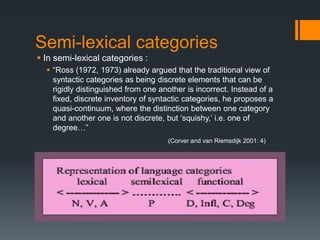
 In semi-lexical categories :
   “Ross (1972, 1973) already argued that the traditional view of
    syntactic categories as being discrete elements that can be
    rigidly distinguished from one another is incorrect. Instead of a
    fixed, discrete inventory of syntactic categories, he proposes a
    quasi-continuum, where the distinction between one category
    and another one is not discrete, but „squishy,‟ i.e. one of
    degree…”
                                     (Corver and van Riemsdijk 2001: 4)
Semi-lexical categories
 In semi-lexical categories, prepositions are consider a semi-
  lexical which means that it has lexical and functional
  properties at once.

        a. the book on the table
        b. John’s reliance on his own ingenuity

 In (a) the PP on the table functions as modifier of the non-
  relational nominal head table; in this construction the
  preposition with its own argument structure.

 In (b), PP on his own ingenuity is generally taken to be the
  complement of the relational (deverbal) head reliance; in this
  construction the prepositions on does not indicate location
  and its typically analysed as purely grammatical element,
  without argument structure.
Semi-lexical categories
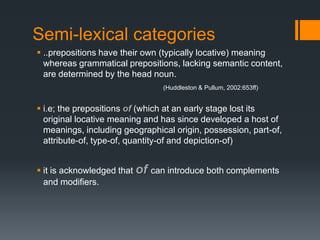
 ..prepositions have their own (typically locative) meaning
  whereas grammatical prepositions, lacking semantic content,
  are determined by the head noun.
                                (Huddleston & Pullum, 2002:653ff)


 i.e; the prepositions of (which at an early stage lost its
  original locative meaning and has since developed a host of
  meanings, including geographical origin, possession, part-of,
  attribute-of, type-of, quantity-of and depiction-of)


 it is acknowledged that of can introduce both complements
  and modifiers.
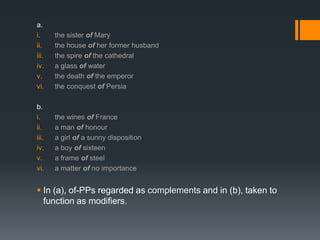
a.
i.     the sister of Mary
ii.    the house of her former husband
iii.   the spire of the cathedral
iv.    a glass of water
v.     the death of the emperor
vi.    the conquest of Persia

b.
i.     the wines of France
ii.    a man of honour
iii.   a girl of a sunny disposition
iv.    a boy of sixteen
v.     a frame of steel
vi.    a matter of no importance


 In (a), of-PPs regarded as complements and in (b), taken to
  function as modifiers.

Semi lexical categories1

  • 1.
    Content Words & FunctionsWords. Presenter, Pavitra a/p Mathurai Ranjini a/p Kunalan Ras Ameliya Binti Ramli
  • 2.
    Lexical categories  Inlexical categories (open word & closed word classes) :  every word is a member of a category.  a word‟s category type determines the kind of phrase it can form  a phrase is a word or string of words that functions as a unit in a sentence, built around a head  Every language has specific phrase structure rules determining how phrases can be combined to form sentences
  • 3.
    Semi-lexical categories  Insemi-lexical categories :  “Ross (1972, 1973) already argued that the traditional view of syntactic categories as being discrete elements that can be rigidly distinguished from one another is incorrect. Instead of a fixed, discrete inventory of syntactic categories, he proposes a quasi-continuum, where the distinction between one category and another one is not discrete, but „squishy,‟ i.e. one of degree…” (Corver and van Riemsdijk 2001: 4)
  • 4.
    Semi-lexical categories  Insemi-lexical categories, prepositions are consider a semi- lexical which means that it has lexical and functional properties at once. a. the book on the table b. John’s reliance on his own ingenuity  In (a) the PP on the table functions as modifier of the non- relational nominal head table; in this construction the preposition with its own argument structure.  In (b), PP on his own ingenuity is generally taken to be the complement of the relational (deverbal) head reliance; in this construction the prepositions on does not indicate location and its typically analysed as purely grammatical element, without argument structure.
  • 5.
    Semi-lexical categories  ..prepositionshave their own (typically locative) meaning whereas grammatical prepositions, lacking semantic content, are determined by the head noun. (Huddleston & Pullum, 2002:653ff)  i.e; the prepositions of (which at an early stage lost its original locative meaning and has since developed a host of meanings, including geographical origin, possession, part-of, attribute-of, type-of, quantity-of and depiction-of)  it is acknowledged that of can introduce both complements and modifiers.
  • 6.
    a. i. the sister of Mary ii. the house of her former husband iii. the spire of the cathedral iv. a glass of water v. the death of the emperor vi. the conquest of Persia b. i. the wines of France ii. a man of honour iii. a girl of a sunny disposition iv. a boy of sixteen v. a frame of steel vi. a matter of no importance  In (a), of-PPs regarded as complements and in (b), taken to function as modifiers.