

















MOTIVATION, ATTITUDE & APTITUDE
               IN
  SECOND LANGUAGE LEARNING


             Presenters:
        Bibiana Siah Hui Nien
       Dhamayanthi Bhaskaran
          Ras Ameliya Ramli
       Samantha Desonia Andy
           Wong Sze Yeen
INTRODUCTION
   In SLA, some L2 learners never become
    native : -Some would make slow progress
    ;
    -Some learners could progress rapidly
    through
      certain stages of learning.
   Several characteristics contributing to
    successful language learning : motivation,
    aptitude, attitude, personality,
    intelligence and learner preferences.
   Main focus : relation among motivation,
    attitude and aptitude in SLA.
MOTIVATION

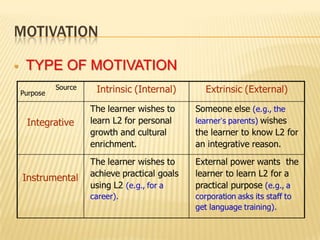
   TYPE OF MOTIVATION
MOTIVATION
ATTITUDE

   A set of beliefs developed in a due course of
    time in a given socio-cultural setting.

   Positive attitude facilitates learning.

   No positive attitude, not able to produce any
    result.
ATTITUDE
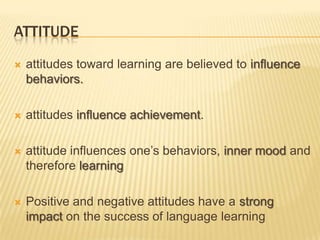
   attitudes toward learning are believed to influence
    behaviors.

   attitudes influence achievement.

   attitude influences one’s behaviors, inner mood and
    therefore learning

   Positive and negative attitudes have a strong
    impact on the success of language learning
ATTITUDE

 The characteristics of affective domain-
  interest, values and tendency, most of these
  shape our attitudes.
 Expectations, and behaviors influence both
  student’ s self, image and academic
  performance.
RELATIONSHIP BETWEEN ATTITUDE AND
ACHIEVEMENT

 A positive relationship between affective
  characteristics and foreign language
  achievement.
 Students’ attitudes differ according to the
  type of high school.
 Graduates showed negative attitude towards
  foreign language at the university level.
RELATION BETWEEN KNOWING SECOND
FOREIGN LANGUAGE & ATTITUDE


   Bilingual children have markedly more
    favorable attitudes toward another language
    and culture.

   “Bilingualism increases positive attitudes
    towards foreign language”
ATTITUDE

Teacher’s Attitude:

     Teacher’s role- controller facilitator.

     Learners’ learning outcomes are influenced by the
      interpretation of teachers’ interpersonal behavior.
ATTITUDE
   Student’s Attitude towards Teachers:
       An L2 learner needs to be psychologically prepared to
        acquire a second or a foreign language as it is a part of
        different ethno-linguistic community.

       An L2 learner is required to impose elements of another
        culture into one’s own life space.

       When a language is learnt only for the utilitarian
        purposes, the success in a second language is supposed
        to be lower than if it is learnt for the integrative purpose.
APTITUDE
   Aptitude consistently been linked as one of the
    central individual differences in language learning.

   Aptitude is a specific talent for language, its innate,
    fixed, and invariable in the course of L2 development,
    different from general intelligence.

   individual has different aptitude. Some may have high
    some may possess low aptitude.

   Aptitude does not account for the failure or success
    of learners but it can justify why some learners learn
    language more quickly than others.
APTITUDE
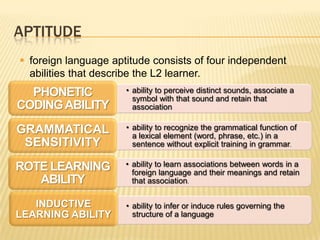
 foreign language aptitude consists of four independent
  abilities that describe the L2 learner.
  PHONETIC            • ability to perceive distinct sounds, associate a
                        symbol with that sound and retain that
CODING ABILITY          association

GRAMMATICAL           • ability to recognize the grammatical function of
                        a lexical element (word, phrase, etc.) in a
 SENSITIVITY            sentence without explicit training in grammar.

ROTE LEARNING         • ability to learn associations between words in a
                        foreign language and their meanings and retain
   ABILITY              that association.

   INDUCTIVE          • ability to infer or induce rules governing the
LEARNING ABILITY        structure of a language
RESEARCH RELATED TO THE
MOTIVATION, ATTITUDE & APTITUDE
IN (SLA)
   Aptitude, attitude & motivation are most strongly associated
    with learners' L2 achievement.

   L2 learners with positive attitudes toward the target culture
    and people will learn the target language more effectively.

   Every learner has an Individual-difference variables that
    affect their motivation in language learning.

   Its influenced by antecedent factors and interact with both
    formal (nurture) & informal language (naturally) acquisition
    contexts therefore influence both linguistic and nonlinguistic
    outcomes.
   Researchers predicts that students' degree of
    success affects their and that both types of
    outcomes (positive/negative) because of the
    influence on individual-difference variables on
    language attitudes and motivation.

   A “motivated learner” defined as
       (a) eager to learn the language,
       (b) willing to expend effort on the learning activity
       (c) willing to sustain the learning activity
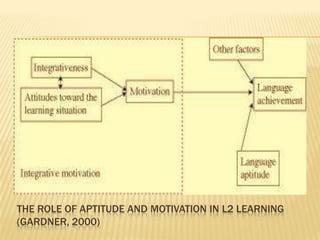
THE ROLE OF APTITUDE AND MOTIVATION IN L2 LEARNING
(GARDNER, 2000)
   Students who had positive motivation and
    attitudes toward language study tend to do
    well on the module tests and to participate
    actively.

   Motivated students studied regularly and
    productively in order to take every
    opportunity to perfect their language skills.
   Crookes and Schmidt conduct a new research agenda
    involving L2 learning motivation. They criticized Gardner's
    socioeducational model for not focusing sufficiently on the
    L2 instructional context and for being too limited in two
    ways:

    i.   Despite the large sample of subjects with whom Gardner
         and his associates usually work, their research is always
         based on one-shot questionnaires (i.e., data collected at one
         point in time) that are then examined in relation to the final
         achievement measures.

    i.   Integrativeness is not equally important for L2 achievement
         in classroom-based.
   An interest in learning a foreign language
    develops because of emotional involvement
    with the target language’s community or
    because the learner has a direct interest in
    the language.

   Research findings show that attitudes and
    motivation are indeed related to successful
    L2 learning but it has not been indicated how
    they do so.
   Researchers point out that learners are motivated if
     i.   they need to learn the language in order to achieve a
          goal
     ii.  if they want to communicate with speakers of the target
          language
     iii. learn about the country where the language is spoken


   Brown distinguishes three different types of motivation:
    i.   global; a general orientation for learning;
    ii.  situational; relates to the situation in which learning
         takes place
    iii. task motivation which relates to specific tasks.
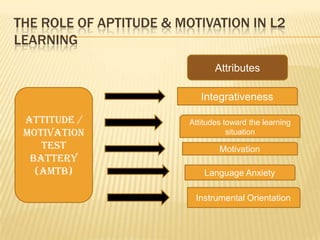
THE ROLE OF APTITUDE & MOTIVATION IN L2
LEARNING
                                Attributes

                            Integrativeness

 Attitude /              Attitudes toward the learning
 Motivation                         situation
    Test                         Motivation
  Battery
   (AMTB)                    Language Anxiety

                          Instrumental Orientation
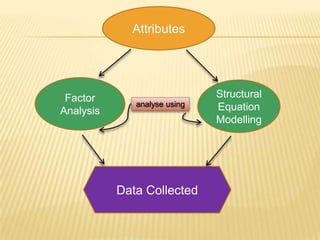
Attributes


 Factor                       Structural
              analyse using   Equation
Analysis
                              Modelling


           Data Collected
L2 proficiency
                      Language aptitude


                    Motivation & attitudes
  Data
Collected
                        Self-confidence


            Attitudes toward the language course &
                       classroom anxiety


            Attitudes, motivation & language anxiety

Llt slides (latest)

  • 1.
    MOTIVATION, ATTITUDE &APTITUDE IN SECOND LANGUAGE LEARNING Presenters: Bibiana Siah Hui Nien Dhamayanthi Bhaskaran Ras Ameliya Ramli Samantha Desonia Andy Wong Sze Yeen
  • 2.
    INTRODUCTION  In SLA, some L2 learners never become native : -Some would make slow progress ; -Some learners could progress rapidly through certain stages of learning.  Several characteristics contributing to successful language learning : motivation, aptitude, attitude, personality, intelligence and learner preferences.  Main focus : relation among motivation, attitude and aptitude in SLA.
  • 3.
    MOTIVATION  TYPE OF MOTIVATION
  • 4.
  • 5.
    ATTITUDE  A set of beliefs developed in a due course of time in a given socio-cultural setting.  Positive attitude facilitates learning.  No positive attitude, not able to produce any result.
  • 6.
    ATTITUDE  attitudes toward learning are believed to influence behaviors.  attitudes influence achievement.  attitude influences one’s behaviors, inner mood and therefore learning  Positive and negative attitudes have a strong impact on the success of language learning
  • 7.
    ATTITUDE  The characteristicsof affective domain- interest, values and tendency, most of these shape our attitudes.  Expectations, and behaviors influence both student’ s self, image and academic performance.
  • 8.
    RELATIONSHIP BETWEEN ATTITUDEAND ACHIEVEMENT  A positive relationship between affective characteristics and foreign language achievement.  Students’ attitudes differ according to the type of high school.  Graduates showed negative attitude towards foreign language at the university level.
  • 9.
    RELATION BETWEEN KNOWINGSECOND FOREIGN LANGUAGE & ATTITUDE  Bilingual children have markedly more favorable attitudes toward another language and culture.  “Bilingualism increases positive attitudes towards foreign language”
  • 10.
    ATTITUDE Teacher’s Attitude:  Teacher’s role- controller facilitator.  Learners’ learning outcomes are influenced by the interpretation of teachers’ interpersonal behavior.
  • 11.
    ATTITUDE  Student’s Attitude towards Teachers:  An L2 learner needs to be psychologically prepared to acquire a second or a foreign language as it is a part of different ethno-linguistic community.  An L2 learner is required to impose elements of another culture into one’s own life space.  When a language is learnt only for the utilitarian purposes, the success in a second language is supposed to be lower than if it is learnt for the integrative purpose.
  • 12.
    APTITUDE  Aptitude consistently been linked as one of the central individual differences in language learning.  Aptitude is a specific talent for language, its innate, fixed, and invariable in the course of L2 development, different from general intelligence.  individual has different aptitude. Some may have high some may possess low aptitude.  Aptitude does not account for the failure or success of learners but it can justify why some learners learn language more quickly than others.
  • 13.
    APTITUDE  foreign languageaptitude consists of four independent abilities that describe the L2 learner. PHONETIC • ability to perceive distinct sounds, associate a symbol with that sound and retain that CODING ABILITY association GRAMMATICAL • ability to recognize the grammatical function of a lexical element (word, phrase, etc.) in a SENSITIVITY sentence without explicit training in grammar. ROTE LEARNING • ability to learn associations between words in a foreign language and their meanings and retain ABILITY that association. INDUCTIVE • ability to infer or induce rules governing the LEARNING ABILITY structure of a language
  • 14.
    RESEARCH RELATED TOTHE MOTIVATION, ATTITUDE & APTITUDE IN (SLA)
  • 15.
    Aptitude, attitude & motivation are most strongly associated with learners' L2 achievement.  L2 learners with positive attitudes toward the target culture and people will learn the target language more effectively.  Every learner has an Individual-difference variables that affect their motivation in language learning.  Its influenced by antecedent factors and interact with both formal (nurture) & informal language (naturally) acquisition contexts therefore influence both linguistic and nonlinguistic outcomes.
  • 16.
    Researchers predicts that students' degree of success affects their and that both types of outcomes (positive/negative) because of the influence on individual-difference variables on language attitudes and motivation.  A “motivated learner” defined as (a) eager to learn the language, (b) willing to expend effort on the learning activity (c) willing to sustain the learning activity
  • 17.
    THE ROLE OFAPTITUDE AND MOTIVATION IN L2 LEARNING (GARDNER, 2000)
  • 18.
    Students who had positive motivation and attitudes toward language study tend to do well on the module tests and to participate actively.  Motivated students studied regularly and productively in order to take every opportunity to perfect their language skills.
  • 19.
    Crookes and Schmidt conduct a new research agenda involving L2 learning motivation. They criticized Gardner's socioeducational model for not focusing sufficiently on the L2 instructional context and for being too limited in two ways: i. Despite the large sample of subjects with whom Gardner and his associates usually work, their research is always based on one-shot questionnaires (i.e., data collected at one point in time) that are then examined in relation to the final achievement measures. i. Integrativeness is not equally important for L2 achievement in classroom-based.
  • 20.
    An interest in learning a foreign language develops because of emotional involvement with the target language’s community or because the learner has a direct interest in the language.  Research findings show that attitudes and motivation are indeed related to successful L2 learning but it has not been indicated how they do so.
  • 21.
    Researchers point out that learners are motivated if i. they need to learn the language in order to achieve a goal ii. if they want to communicate with speakers of the target language iii. learn about the country where the language is spoken  Brown distinguishes three different types of motivation: i. global; a general orientation for learning; ii. situational; relates to the situation in which learning takes place iii. task motivation which relates to specific tasks.
  • 22.
    THE ROLE OFAPTITUDE & MOTIVATION IN L2 LEARNING Attributes Integrativeness Attitude / Attitudes toward the learning Motivation situation Test Motivation Battery (AMTB) Language Anxiety Instrumental Orientation
  • 23.
    Attributes Factor Structural analyse using Equation Analysis Modelling Data Collected
  • 24.
    L2 proficiency Language aptitude Motivation & attitudes Data Collected Self-confidence Attitudes toward the language course & classroom anxiety Attitudes, motivation & language anxiety