Semantics and
Pragmatics
Definitions and Scope
Prepared by
Kawthar A.Nahi
Introduction
• Meaning is not new as a concept since it lies beneath all
the actions human do, and all what they say.
• Hence the study of meaning is not new , but it
accompanies the development of human civilization.
• The first notions for studying meaning were associated
with Greece in the writings of Plato and Aristotle.
• Studying meaning in the ancient times was associated
with philosophy.
• Later on studying and analyzing meaning become a major
interest for linguistics.
• The theories of linguistics were differentiated according to
this criterion, i.e. handling meaning or not.
Definitions of Semantics
• According to Dinneen (1967) semantics is a criterion that
requires to associate an item of form with some unit or
combination of units on the content plane of language.
• Lyons (1995) add another aspect for the general definition of
semantics which is the study of meaning, this aspect is the
grammatical structure, such in:
It was raining yesterday.
Was it raining yesterday?
Definitions of Semantics
• Semantics is the field of the study of language dealing with
the conventional (or literal) meanings of words and sentences
and the relations between those meanings, and between
linguistic expressions and their denotations (Bianchi,2004).
• Semantics is related to the stable and context free aspects of
language in contrast to pragmatics. Also it illustrate the
relation between the linguistic forms to states of the worlds
(Johnson and Johnson,1999).
Semantics in linguistic schools
• Meaning as naming:
• This view that the meaning of an expression is what it refers
to, or names, is often called referential theory or naming
theory. It was proposed by the ancient Greek scholar Plato.
• Meaning as concept:
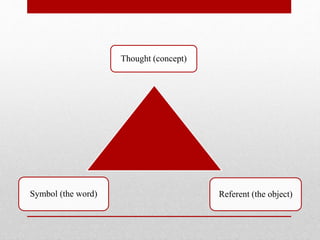
• Ogden and Richards suggested a model ‘semantic triangle’
illustrating the view of meaning as concept. It is also called
conceptual approach which believes the meaning of a
linguistic expression is the concept, or idea or impression
formed in the mind.
Thought (concept)
Symbol (the word) Referent (the object)
Semantics in linguistic schools
• According to de Saussure, the linguistic sign consists of a
signifier and a signified, these are, however, more strictly a
sound image and a concept, both linked by a psychological
'associative' bond.
• Meaning as behavior:
• This theory was proposed by the American linguist L.
Bloomfield by the well-known story of Jack and Jill. The
theory believes that the meaning of a word is defined by
observable behaviors. Or the meaning of a linguistic
expression relies on or comes from the consequences of the
behaviors triggered by the expression, which clearly draws on
psychology.
Semantics in linguistic schools
• Meaning as context:
• The theory was proposed by British linguist John R. Firth.
The theory believes that the meaning depends on both of the
linguistic and situational contexts.
• Meaning as truth conditions:
• The meaning of a word or expression is determined by the
truth conditions of the word, Such an approach to meaning is
called truth-conditional theorysemantics.
• Like in : Jack is married.
The Scope of Semantics
• Meaning in vocabulary organization (paradigmatic level)
• Meaning in linear sequence (in syntax) (syntagmatic level)
• LEXICOLOGY- study of lexemes
• Lexicography- art of dictionary-making
• STYLISTICS – stylistic variation in speech and writing
• achieving style: choice of words, use of
• metaphor
• Semantics has been of concern to philosophers,
anthropologists and psychologists.
• Communication theory
Pragmatics
• It is a subfield of linguistics which studies how the use of
language is based on the relationship established between
utterance, context and interlocutors.
• pragmatics has been mainly focused on
• the communicative use of language conceived as intentional
human action.
• pragmatics has been mainly focused on the communicative
use of language conceived as intentional human action.
• Pragmatics is the study of speaker meaning.
• the study of contextual meaning, and how more gets
communicated than is said.
• Pragmatics is a study of language in use.
Theories of Pragmatics
• Speech act theory by Searle:
• Words do not have meaning by themselves.
• Relevance Theory:
• The meaning of a concept is the subtotal of its
impication for possible observations and
actions.
Theories of Pragmatics
• Cooperation Theory:
• The way in which people try to make
conversations work.
• Argumentation Theory:
• Interdisciplinary study of how humans do
reach conclusions through logical reasoning
Scope of Pragmatics
• Charles Morris was concerned with the study of
the science of signs, which he called semiotic. He
distinguished three branches of semiotics:
• Syntax addresses the formal relations of signs to
one another,
• semantics the relation of signs to what they
denote,
• and pragmatics the relation of signs to their users
and interpreters.
Scope of Pragmatics
• Semiotics tries to separate “objective” definitions
of the structure and meaning of words and
sentences in syntax and semantics from
subjective and context dependent senses in
pragmatics.
• The goal of pragmatics is to explain how the gap
between sentence meaning and speaker’s
meaning is bridged.
References
• Bianchi, C. (ed.). (2004). The Semantics/Pragmatics Distinction. CSLI
Publications.
• Crystal, David. (2008). A dictionary of Linguistics and Phonetics.
Malden: Blackwell Publishing.
• Dinneen, Francis P. (1967). An Introduction to General Linguistics.
Washington: Georgetown University Press..
• Johnson, Keith. Johnson, Helen. (1998) .Encyclopedic Dictionary of
Applied Linguistics. Blackwell Publishing. UK
• Lyons, J. (1985). Linguistic Semantics. Cambridge: Cambridge
University Press.
• Searle, J.R. ; Kiefer, F. & Bierwisch, M. (1980). Speech act theory and
Pragmatics. Dordnecht; Holland.
• www.neoenglish.com
• www.ylplaanj, kkorta.sc.ehu.es

Semantics and pragmatics

  • 1.
    Semantics and Pragmatics Definitions andScope Prepared by Kawthar A.Nahi
  • 2.
    Introduction • Meaning isnot new as a concept since it lies beneath all the actions human do, and all what they say. • Hence the study of meaning is not new , but it accompanies the development of human civilization. • The first notions for studying meaning were associated with Greece in the writings of Plato and Aristotle. • Studying meaning in the ancient times was associated with philosophy. • Later on studying and analyzing meaning become a major interest for linguistics. • The theories of linguistics were differentiated according to this criterion, i.e. handling meaning or not.
  • 3.
    Definitions of Semantics •According to Dinneen (1967) semantics is a criterion that requires to associate an item of form with some unit or combination of units on the content plane of language. • Lyons (1995) add another aspect for the general definition of semantics which is the study of meaning, this aspect is the grammatical structure, such in: It was raining yesterday. Was it raining yesterday?
  • 4.
    Definitions of Semantics •Semantics is the field of the study of language dealing with the conventional (or literal) meanings of words and sentences and the relations between those meanings, and between linguistic expressions and their denotations (Bianchi,2004). • Semantics is related to the stable and context free aspects of language in contrast to pragmatics. Also it illustrate the relation between the linguistic forms to states of the worlds (Johnson and Johnson,1999).
  • 5.
    Semantics in linguisticschools • Meaning as naming: • This view that the meaning of an expression is what it refers to, or names, is often called referential theory or naming theory. It was proposed by the ancient Greek scholar Plato. • Meaning as concept: • Ogden and Richards suggested a model ‘semantic triangle’ illustrating the view of meaning as concept. It is also called conceptual approach which believes the meaning of a linguistic expression is the concept, or idea or impression formed in the mind.
  • 6.
    Thought (concept) Symbol (theword) Referent (the object)
  • 7.
    Semantics in linguisticschools • According to de Saussure, the linguistic sign consists of a signifier and a signified, these are, however, more strictly a sound image and a concept, both linked by a psychological 'associative' bond. • Meaning as behavior: • This theory was proposed by the American linguist L. Bloomfield by the well-known story of Jack and Jill. The theory believes that the meaning of a word is defined by observable behaviors. Or the meaning of a linguistic expression relies on or comes from the consequences of the behaviors triggered by the expression, which clearly draws on psychology.
  • 8.
    Semantics in linguisticschools • Meaning as context: • The theory was proposed by British linguist John R. Firth. The theory believes that the meaning depends on both of the linguistic and situational contexts. • Meaning as truth conditions: • The meaning of a word or expression is determined by the truth conditions of the word, Such an approach to meaning is called truth-conditional theorysemantics. • Like in : Jack is married.
  • 9.
    The Scope ofSemantics • Meaning in vocabulary organization (paradigmatic level) • Meaning in linear sequence (in syntax) (syntagmatic level) • LEXICOLOGY- study of lexemes • Lexicography- art of dictionary-making • STYLISTICS – stylistic variation in speech and writing • achieving style: choice of words, use of • metaphor • Semantics has been of concern to philosophers, anthropologists and psychologists. • Communication theory
  • 10.
    Pragmatics • It isa subfield of linguistics which studies how the use of language is based on the relationship established between utterance, context and interlocutors. • pragmatics has been mainly focused on • the communicative use of language conceived as intentional human action. • pragmatics has been mainly focused on the communicative use of language conceived as intentional human action. • Pragmatics is the study of speaker meaning. • the study of contextual meaning, and how more gets communicated than is said. • Pragmatics is a study of language in use.
  • 11.
    Theories of Pragmatics •Speech act theory by Searle: • Words do not have meaning by themselves. • Relevance Theory: • The meaning of a concept is the subtotal of its impication for possible observations and actions.
  • 12.
    Theories of Pragmatics •Cooperation Theory: • The way in which people try to make conversations work. • Argumentation Theory: • Interdisciplinary study of how humans do reach conclusions through logical reasoning
  • 13.
    Scope of Pragmatics •Charles Morris was concerned with the study of the science of signs, which he called semiotic. He distinguished three branches of semiotics: • Syntax addresses the formal relations of signs to one another, • semantics the relation of signs to what they denote, • and pragmatics the relation of signs to their users and interpreters.
  • 14.
    Scope of Pragmatics •Semiotics tries to separate “objective” definitions of the structure and meaning of words and sentences in syntax and semantics from subjective and context dependent senses in pragmatics. • The goal of pragmatics is to explain how the gap between sentence meaning and speaker’s meaning is bridged.
  • 15.
    References • Bianchi, C.(ed.). (2004). The Semantics/Pragmatics Distinction. CSLI Publications. • Crystal, David. (2008). A dictionary of Linguistics and Phonetics. Malden: Blackwell Publishing. • Dinneen, Francis P. (1967). An Introduction to General Linguistics. Washington: Georgetown University Press.. • Johnson, Keith. Johnson, Helen. (1998) .Encyclopedic Dictionary of Applied Linguistics. Blackwell Publishing. UK • Lyons, J. (1985). Linguistic Semantics. Cambridge: Cambridge University Press. • Searle, J.R. ; Kiefer, F. & Bierwisch, M. (1980). Speech act theory and Pragmatics. Dordnecht; Holland. • www.neoenglish.com • www.ylplaanj, kkorta.sc.ehu.es