Semantics
CONCEPTIONS OF
MEANING
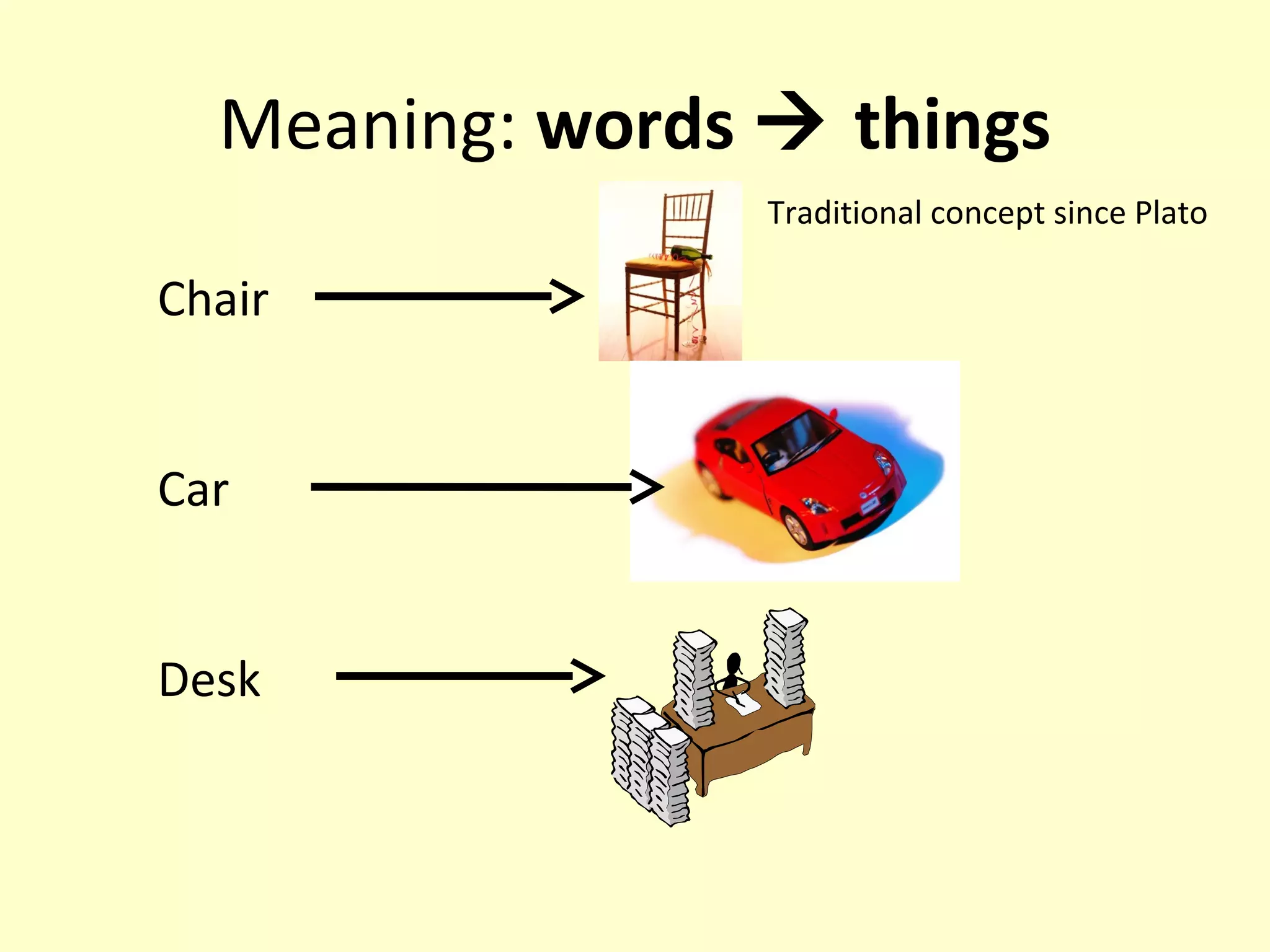
Meaning: words  things
Traditional concept since Plato

Chair
Car
Desk
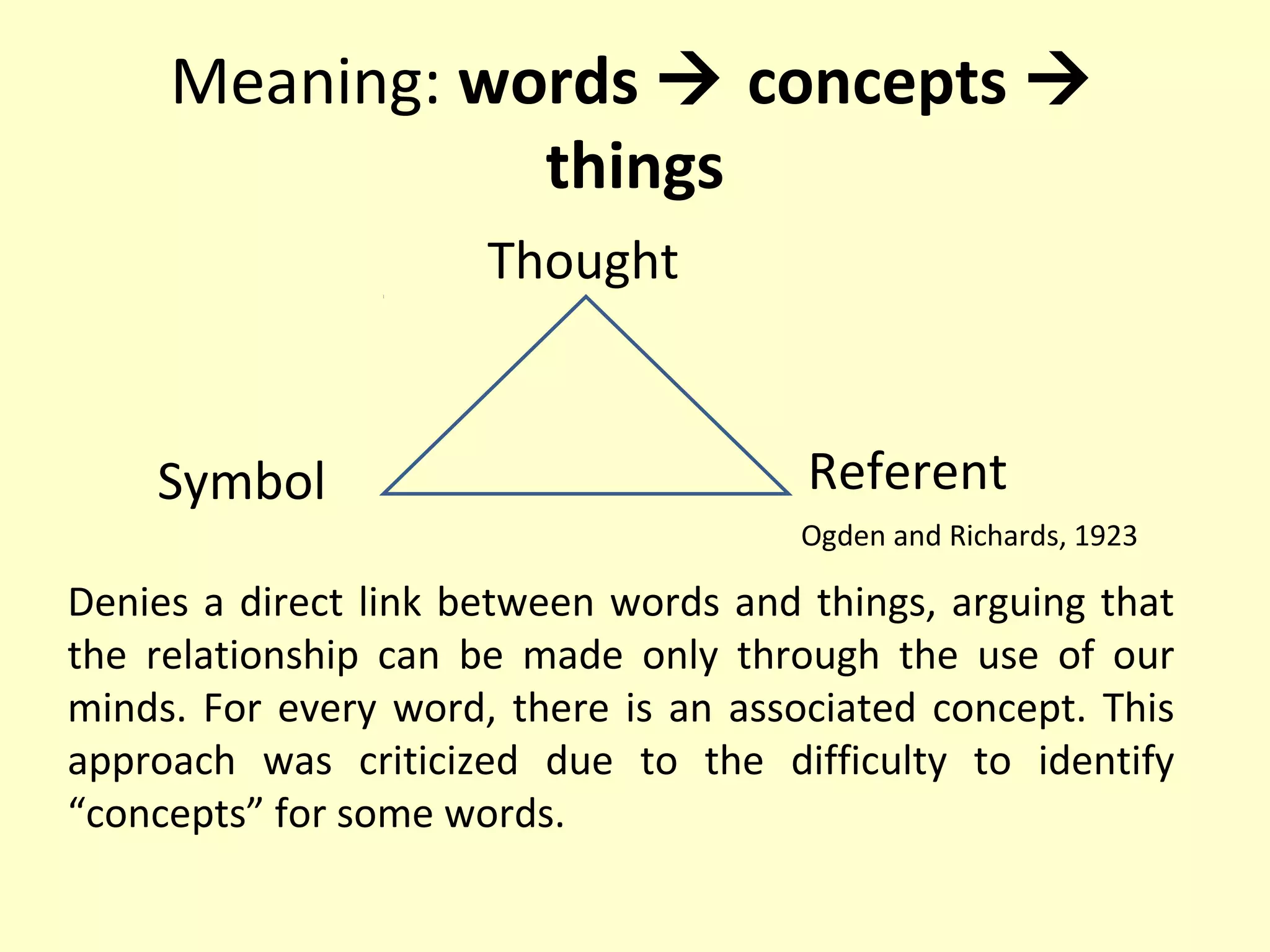
Meaning: words  concepts 
things
Thought

Symbol

Referent
Ogden and Richards, 1923

Denies a direct link between words and things, arguing that
the relationship can be made only through the use of our
minds. For every word, there is an associated concept. This
approach was criticized due to the difficulty to identify
“concepts” for some words.
Desk
"a piece of furniture a flat top and four legs, at
which one reads and writes"
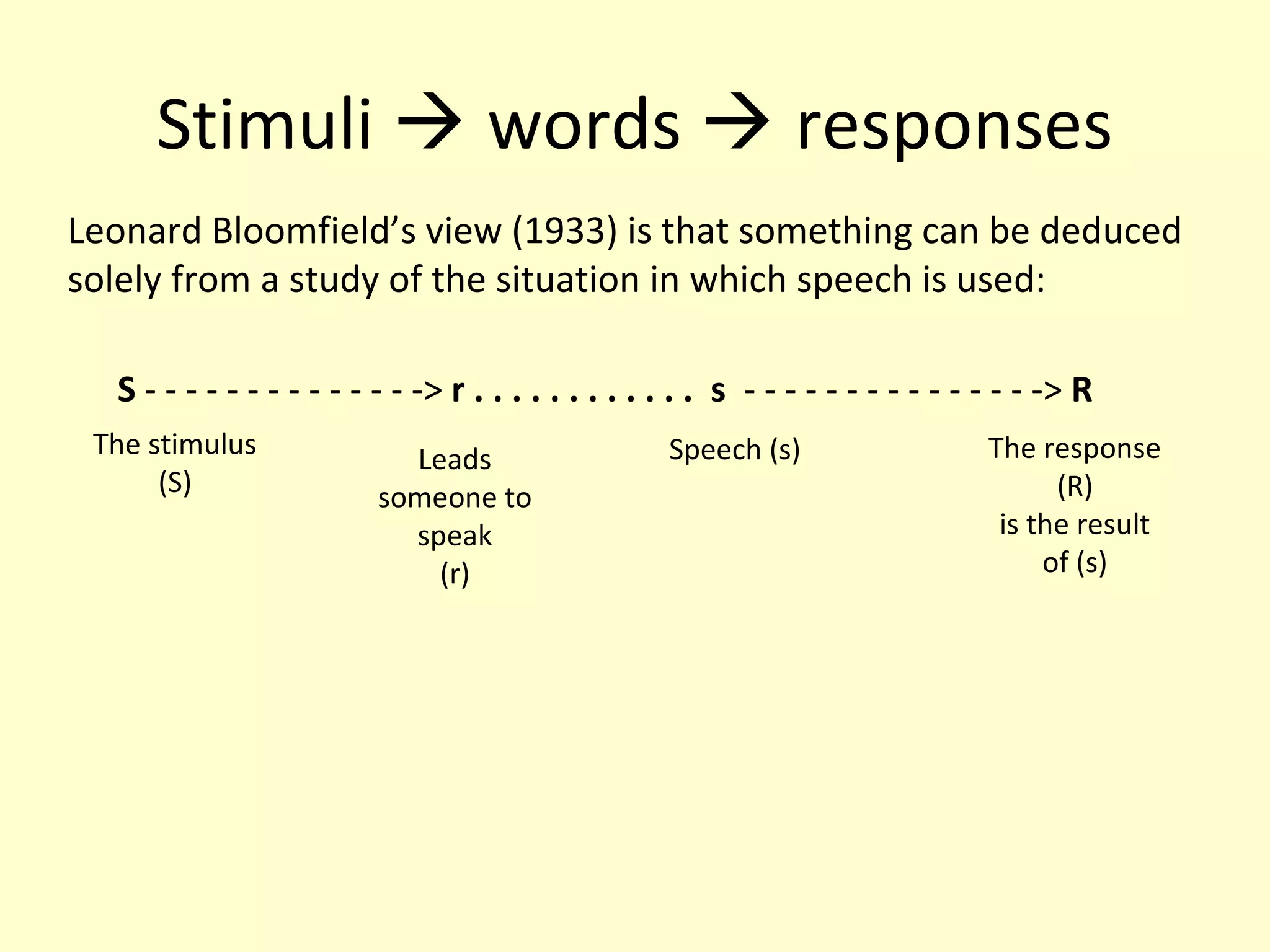
Stimuli  words  responses
Leonard Bloomfield’s view (1933) is that something can be deduced
solely from a study of the situation in which speech is used:
S - - - - - - - - - - - - - -> r . . . . . . . . . . . . s - - - - - - - - - - - - - - -> R
The stimulus
(S)

Leads
someone to
speak
(r)

Speech (s)

The response
(R)
is the result
of (s)
Traditional vs. Modern Linguistics
Words “have
meaning”, we can
examine the
meaning of
individual words
and sentences, but
there is no meaning
beyond that

Meaning is studied
by making detailed
analyses of the way
words are used in
specific contexts.
“The meaning of a word is
its use in the language”
Ludwing Wittgenstein (1889-1951)
G. Leech in a more moderate tone recognizes 7 types of
meaning his Semantics (p. 23), first published in 1974, as
follows:

• Conceptual meaning: Logical, cognitive, or denotative
content (what the words refers to)
• Connotative meaning: What is communicated by virtue of
what language refers to.
• Social meaning: What is communicated of the social,
circumstances of language use.
• Reflected meaning: What is communicated through
association with another sense of the same expression.
• Collocative meaning: What is communicated through
association with words which tend to occur in the
environment of another word.
• Thematic meaning: What is communicated by the way in
which the message is organized in terms of order and
emphasis.
• Affective meaning: What is communicated of the feelings
and attitudes of the speaker/writer.
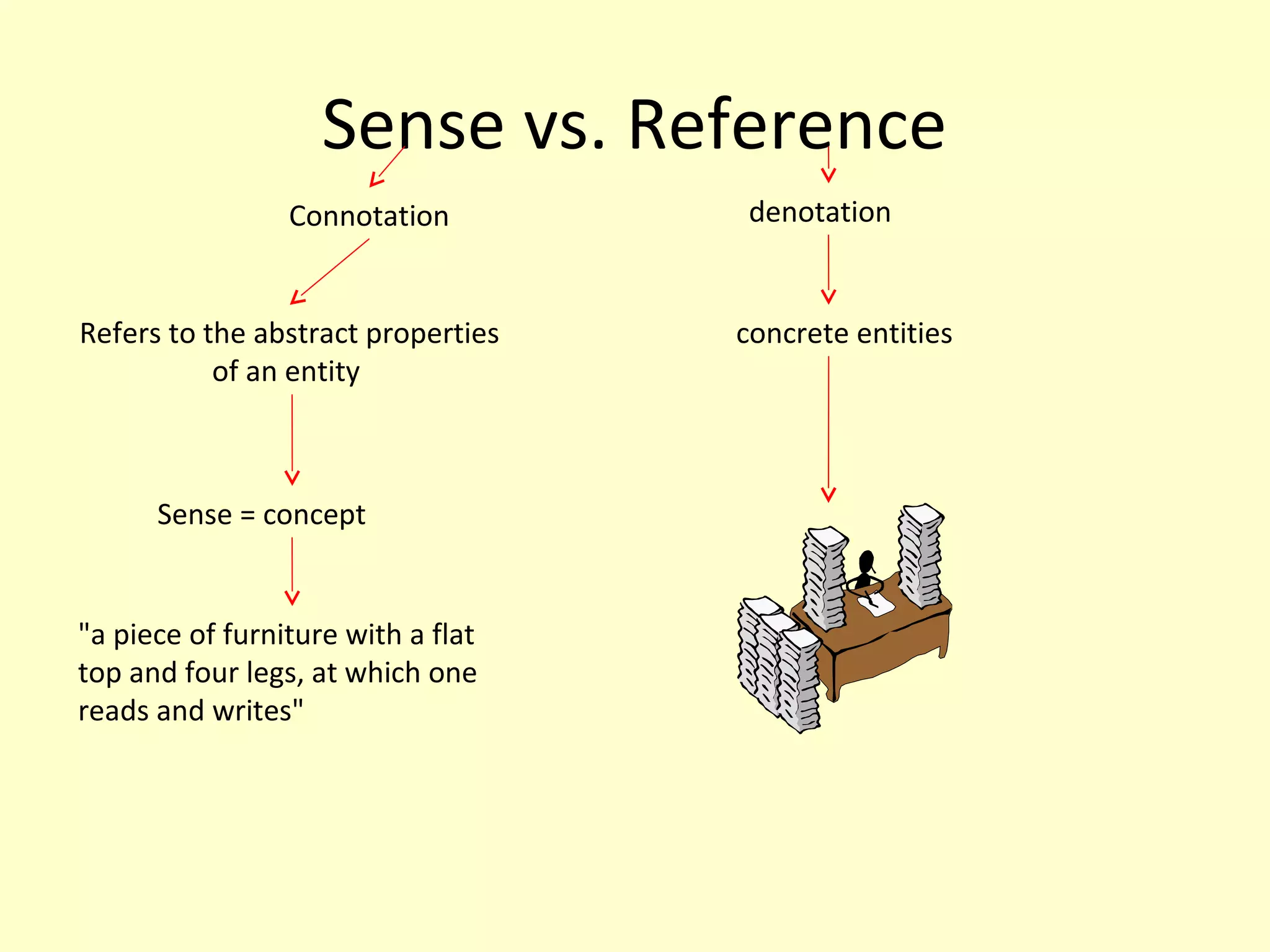
Sense vs. Reference
Connotation
Refers to the abstract properties
of an entity

Sense = concept

"a piece of furniture with a flat
top and four legs, at which one
reads and writes"

denotation

concrete entities
The referential theory
The idea is that linguistic expressions have the
meanings they do because they stand for things;
what they mean is what they stand for. On this
view, words are like labels; they are symbols
that represent, designate, name, denote or refer
to items in the world: the name “Adolf Hitler”
denotes (the person) Hitler.
Objections to the theory
• Objection 1: Not every word does name or
denote any actual object.
First, there are the “names” of nonexistent
items like Pegasus or the Easter Bunny.
“Pegasus” does not denote anything, because
there is in reality no winged horse for it to
denote.
• Objection 2: According to the Referential
theory, a sentence is a list of names. But a
mere list of names does not say anything.
Fred Martha Irving Phyllis
•

Objection 3: There are specific linguistic
phenomena that seem to show that there is
more to meaning than reference.
In
particular, coreferring terms are often not
synonymous; that is, two terms can share
their referent but differ in meaning -- “John
Paul” and “the Pope,” for example.
Sense vs. Reference
To some extent, we can say every word has a sense, i.e. some
conceptual content, otherwise we will not be able to use it or
understand it. But not every word has a reference.
Grammatical words like but, if, and do not refer to anything.
And words like God, ghost and dragon refer to imaginary
things, which do not exist in reality.
It is not convenient to explain the meaning of a word in terms
of the thing it refers to. The thing a word stands for may not
always be at hand at the time of speaking. Even when it is
nearby, it may take the listener some time to work out its
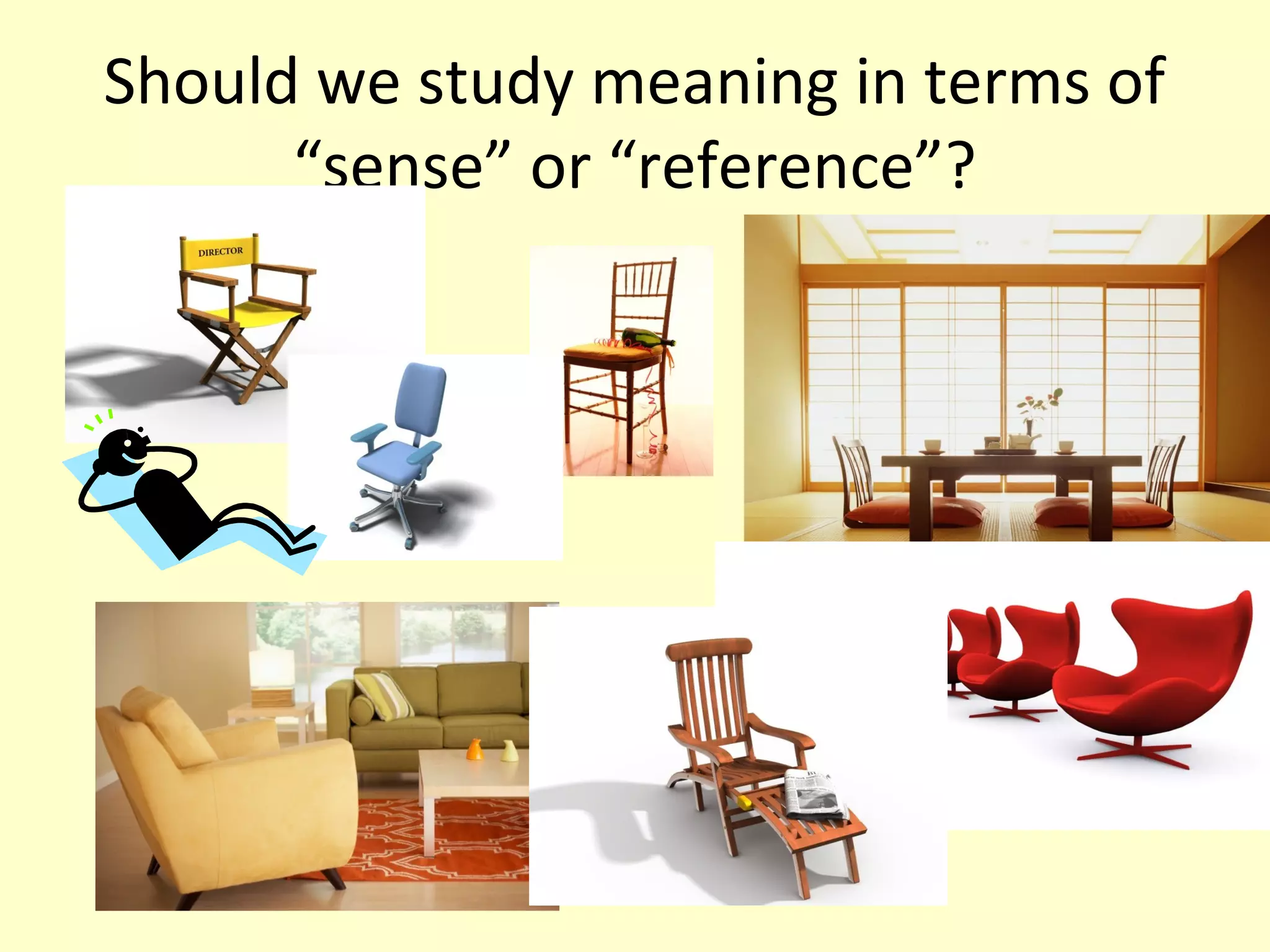
main features. For example, chair:
Should we study meaning in terms of
“sense” or “reference”?
Semantic Space
C. E. Osgood, G. Suci, 7 P. Tannenbaum, The
measurement of Meaning (1957). Studied
“affective” meaning – the emotional reactions
attached to a word through a game called “20
questions”
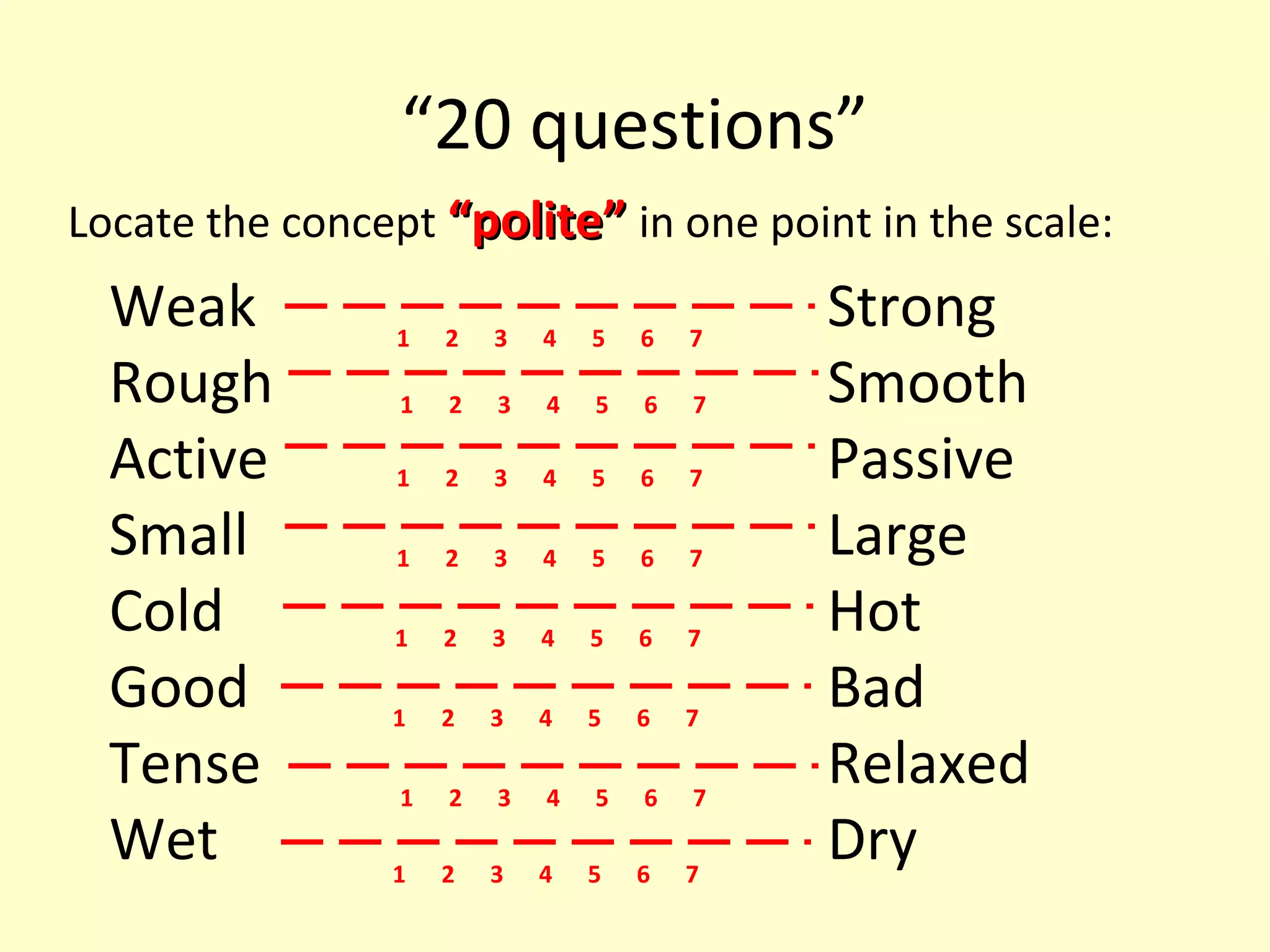
“20 questions”
Locate the concept “polite” in one point in the scale:

Weak
Rough
Active
Small
Cold
Good
Tense
Wet

1

2

3

4

5

6

7

1

2

3

4

5

6

7

1

2

3

4

5

6

7

1

2

3

4

5

6

7

1

2

3

4

5

6

7

1

2

3

4

5

6

7

1

2

3

4

5

6

7

1

2

3

4

5

6

7

Strong
Smooth
Passive
Large
Hot
Bad
Relaxed
Dry
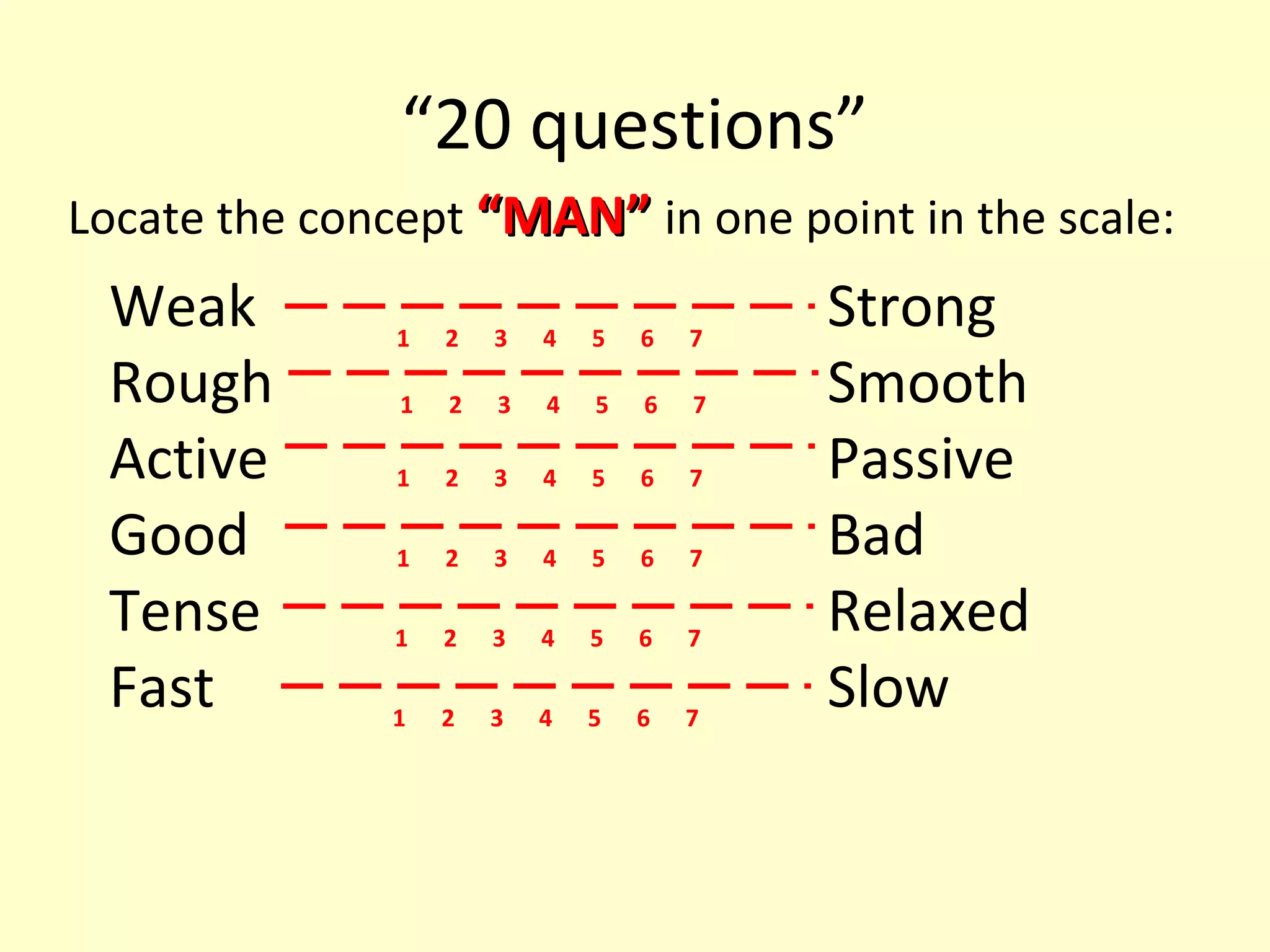
“20 questions”
Locate the concept “MAN” in one point in the scale:

Weak
Rough
Active
Good
Tense
Fast

1

2

3

4

5

6

7

1

2

3

4

5

6

7

1

2

3

4

5

6

7

1

2

3

4

5

6

7

1

2

3

4

5

6

7

1

2

3

4

5

6

7

Strong
Smooth
Passive
Bad
Relaxed
Slow
Semantic Structure:
Words or Lexemes?
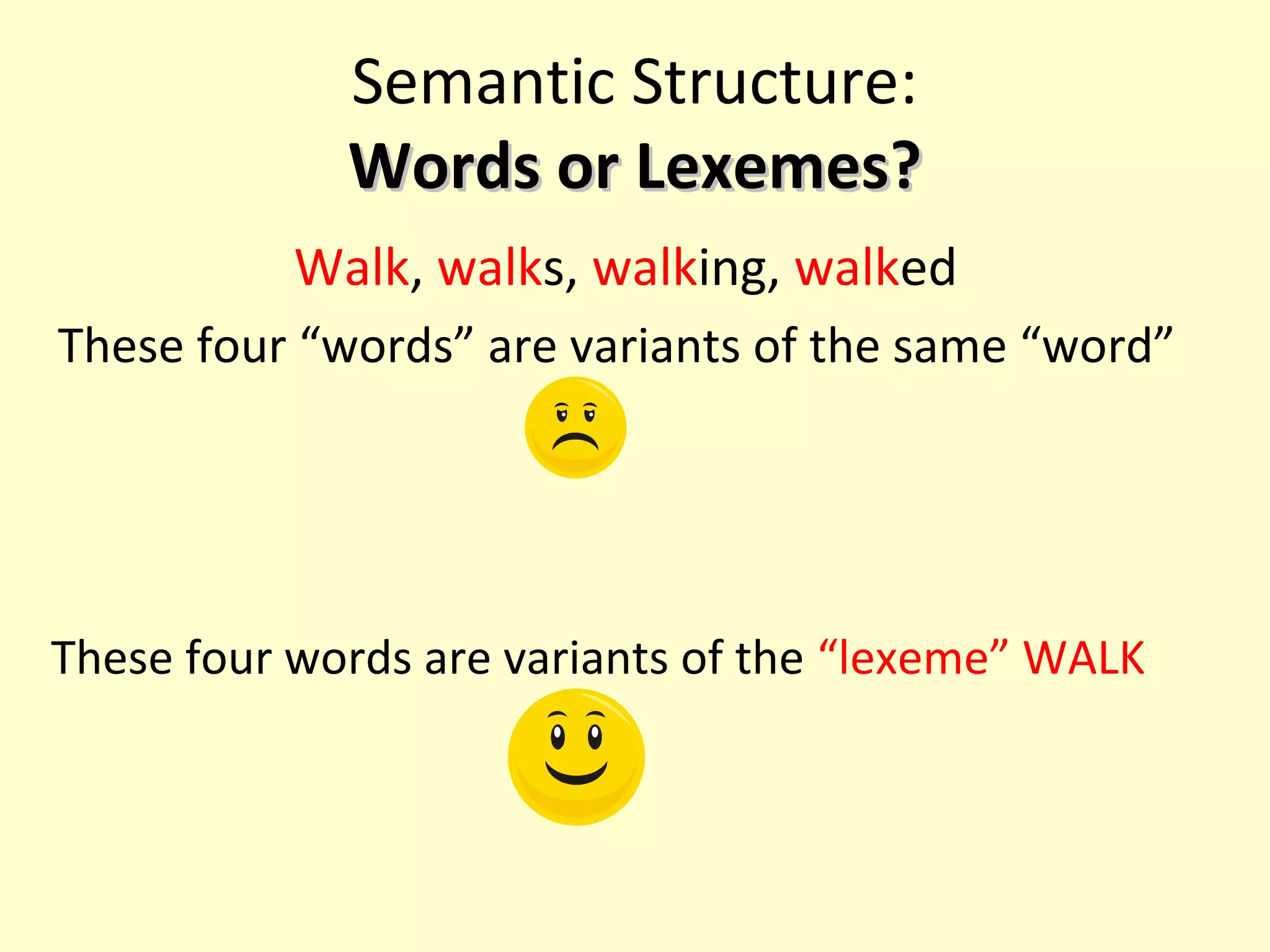
Walk, walks, walking, walked
These four “words” are variants of the same “word”

These four words are variants of the “lexeme” WALK
Semantic Structure:
Words or Lexemes?
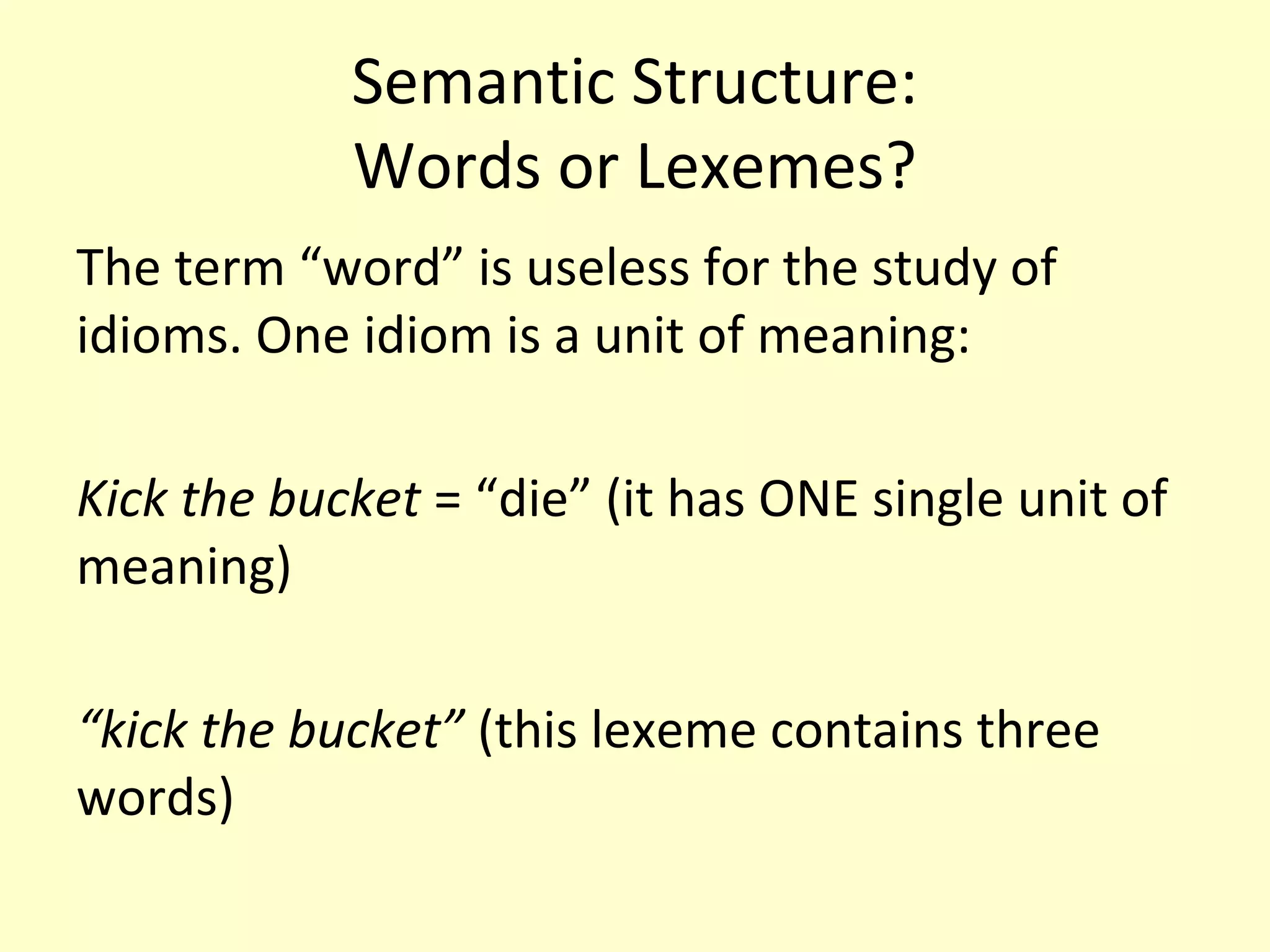
The term “word” is useless for the study of
idioms. One idiom is a unit of meaning:
Kick the bucket = “die” (it has ONE single unit of
meaning)
“kick the bucket” (this lexeme contains three
words)
Semantic fields

(A way to impose some order to vocabulary)

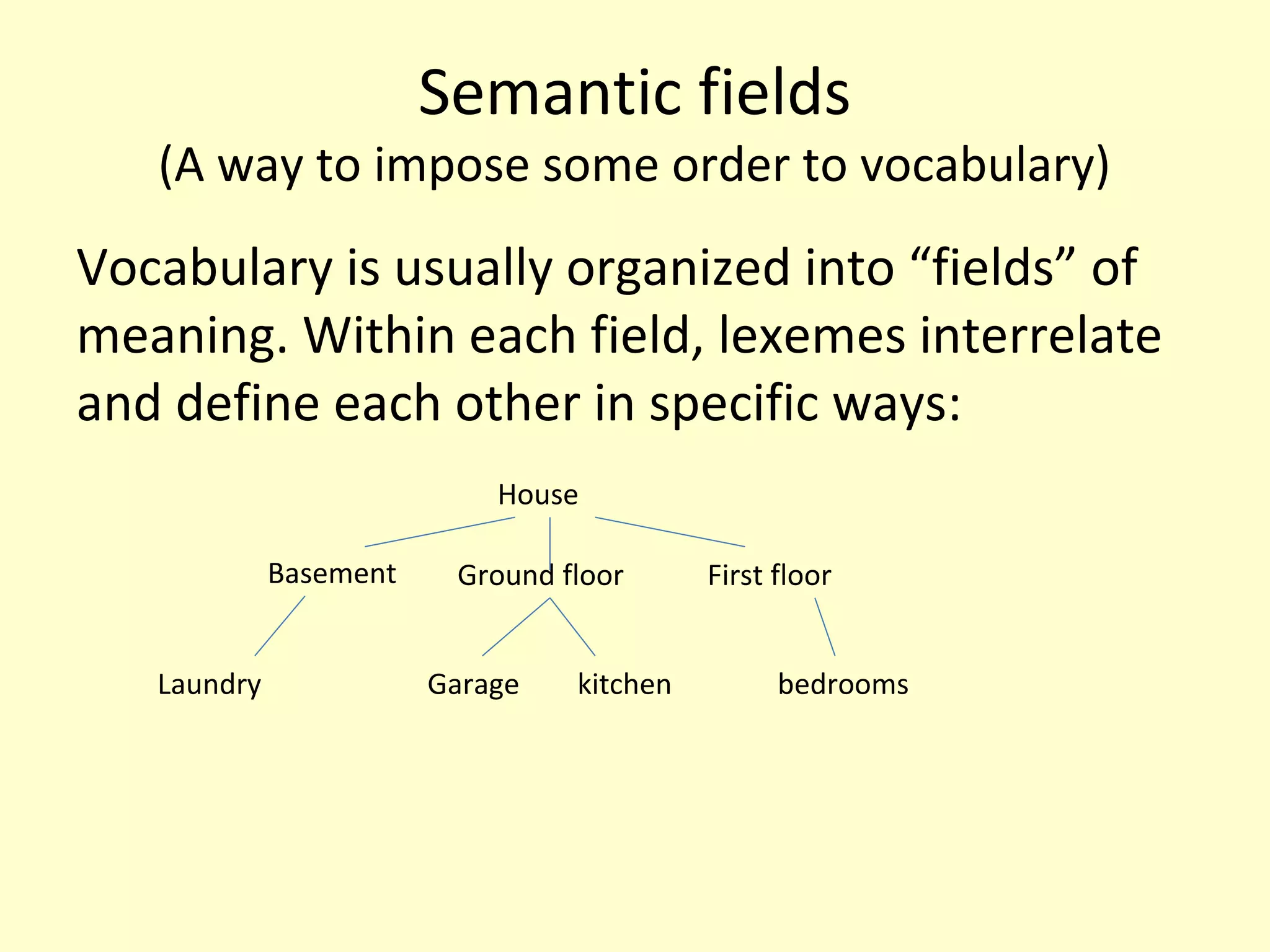
Vocabulary is usually organized into “fields” of
meaning. Within each field, lexemes interrelate
and define each other in specific ways:
House
Basement
Laundry

Ground floor
Garage

kitchen

First floor
bedrooms
Practice
Organize these words in semantic fields, add
more if necessary:
Living – vegetable – animal – human – tree –
plant – flower – bird – fish – animal – insect

3 the referential-theory2

  • 1.
  • 2.
  • 3.
    Meaning: words things Traditional concept since Plato Chair Car Desk
  • 4.
    Meaning: words concepts  things Thought Symbol Referent Ogden and Richards, 1923 Denies a direct link between words and things, arguing that the relationship can be made only through the use of our minds. For every word, there is an associated concept. This approach was criticized due to the difficulty to identify “concepts” for some words.
  • 5.
    Desk "a piece offurniture a flat top and four legs, at which one reads and writes"
  • 6.
    Stimuli  words responses Leonard Bloomfield’s view (1933) is that something can be deduced solely from a study of the situation in which speech is used: S - - - - - - - - - - - - - -> r . . . . . . . . . . . . s - - - - - - - - - - - - - - -> R The stimulus (S) Leads someone to speak (r) Speech (s) The response (R) is the result of (s)
  • 7.
    Traditional vs. ModernLinguistics Words “have meaning”, we can examine the meaning of individual words and sentences, but there is no meaning beyond that Meaning is studied by making detailed analyses of the way words are used in specific contexts.
  • 8.
    “The meaning ofa word is its use in the language” Ludwing Wittgenstein (1889-1951)
  • 9.
    G. Leech ina more moderate tone recognizes 7 types of meaning his Semantics (p. 23), first published in 1974, as follows: • Conceptual meaning: Logical, cognitive, or denotative content (what the words refers to) • Connotative meaning: What is communicated by virtue of what language refers to. • Social meaning: What is communicated of the social, circumstances of language use.
  • 10.
    • Reflected meaning:What is communicated through association with another sense of the same expression. • Collocative meaning: What is communicated through association with words which tend to occur in the environment of another word. • Thematic meaning: What is communicated by the way in which the message is organized in terms of order and emphasis. • Affective meaning: What is communicated of the feelings and attitudes of the speaker/writer.
  • 11.
    Sense vs. Reference Connotation Refersto the abstract properties of an entity Sense = concept "a piece of furniture with a flat top and four legs, at which one reads and writes" denotation concrete entities
  • 12.
    The referential theory Theidea is that linguistic expressions have the meanings they do because they stand for things; what they mean is what they stand for. On this view, words are like labels; they are symbols that represent, designate, name, denote or refer to items in the world: the name “Adolf Hitler” denotes (the person) Hitler.
  • 13.
    Objections to thetheory • Objection 1: Not every word does name or denote any actual object. First, there are the “names” of nonexistent items like Pegasus or the Easter Bunny. “Pegasus” does not denote anything, because there is in reality no winged horse for it to denote.
  • 14.
    • Objection 2:According to the Referential theory, a sentence is a list of names. But a mere list of names does not say anything. Fred Martha Irving Phyllis
  • 15.
    • Objection 3: Thereare specific linguistic phenomena that seem to show that there is more to meaning than reference. In particular, coreferring terms are often not synonymous; that is, two terms can share their referent but differ in meaning -- “John Paul” and “the Pope,” for example.
  • 16.
    Sense vs. Reference Tosome extent, we can say every word has a sense, i.e. some conceptual content, otherwise we will not be able to use it or understand it. But not every word has a reference. Grammatical words like but, if, and do not refer to anything. And words like God, ghost and dragon refer to imaginary things, which do not exist in reality. It is not convenient to explain the meaning of a word in terms of the thing it refers to. The thing a word stands for may not always be at hand at the time of speaking. Even when it is nearby, it may take the listener some time to work out its main features. For example, chair:
  • 17.
    Should we studymeaning in terms of “sense” or “reference”?
  • 18.
    Semantic Space C. E.Osgood, G. Suci, 7 P. Tannenbaum, The measurement of Meaning (1957). Studied “affective” meaning – the emotional reactions attached to a word through a game called “20 questions”
  • 19.
    “20 questions” Locate theconcept “polite” in one point in the scale: Weak Rough Active Small Cold Good Tense Wet 1 2 3 4 5 6 7 1 2 3 4 5 6 7 1 2 3 4 5 6 7 1 2 3 4 5 6 7 1 2 3 4 5 6 7 1 2 3 4 5 6 7 1 2 3 4 5 6 7 1 2 3 4 5 6 7 Strong Smooth Passive Large Hot Bad Relaxed Dry
  • 20.
    “20 questions” Locate theconcept “MAN” in one point in the scale: Weak Rough Active Good Tense Fast 1 2 3 4 5 6 7 1 2 3 4 5 6 7 1 2 3 4 5 6 7 1 2 3 4 5 6 7 1 2 3 4 5 6 7 1 2 3 4 5 6 7 Strong Smooth Passive Bad Relaxed Slow
  • 21.
    Semantic Structure: Words orLexemes? Walk, walks, walking, walked These four “words” are variants of the same “word” These four words are variants of the “lexeme” WALK
  • 22.
    Semantic Structure: Words orLexemes? The term “word” is useless for the study of idioms. One idiom is a unit of meaning: Kick the bucket = “die” (it has ONE single unit of meaning) “kick the bucket” (this lexeme contains three words)
  • 23.
    Semantic fields (A wayto impose some order to vocabulary) Vocabulary is usually organized into “fields” of meaning. Within each field, lexemes interrelate and define each other in specific ways: House Basement Laundry Ground floor Garage kitchen First floor bedrooms
  • 24.
    Practice Organize these wordsin semantic fields, add more if necessary: Living – vegetable – animal – human – tree – plant – flower – bird – fish – animal – insect