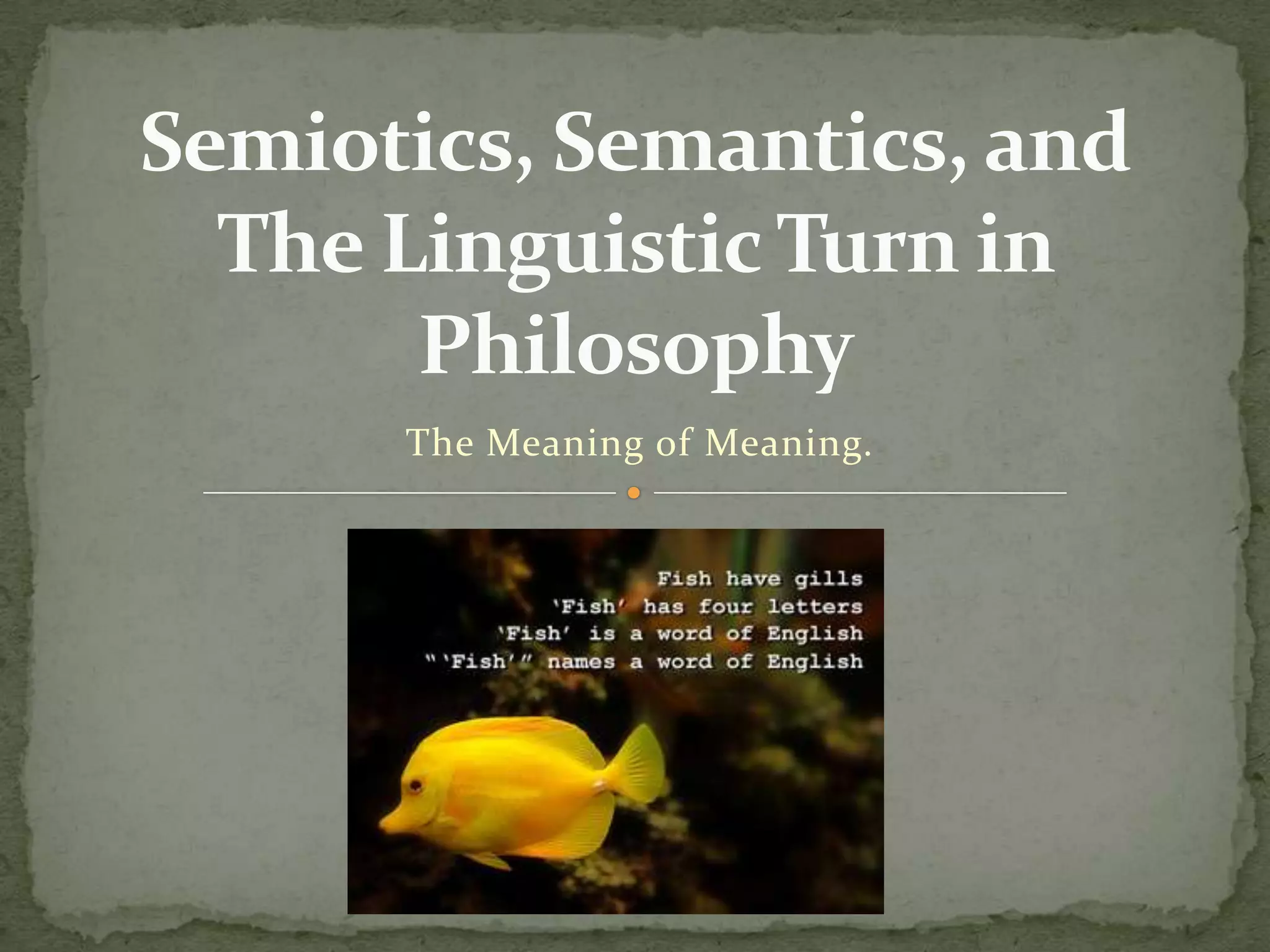
The Meaning of Meaning.
 A. What is Semantics?
 Formal definition
 Semiotics (a related study)
 Types of Semantic Study

 B. Theories of Meaning
 The Denotational Theory
 The Wittgenstein Theory
 The Mentalist Theory*
 “Semantics is the study of the meaning of linguistic

expressions...Meaning in natural languages is mainly
studied by linguists. In fact, semantics is one of the
main branches of contemporary linguistics...There are
strong connections to philosophy. Earlier in this
century, much work in semantics was done by
philosophers, and some important work is still done
by philosophers.” (Richard Thomason, University of Michigan)
 Semantics is important to not only linguistics but also

computer science. Why would this be important?

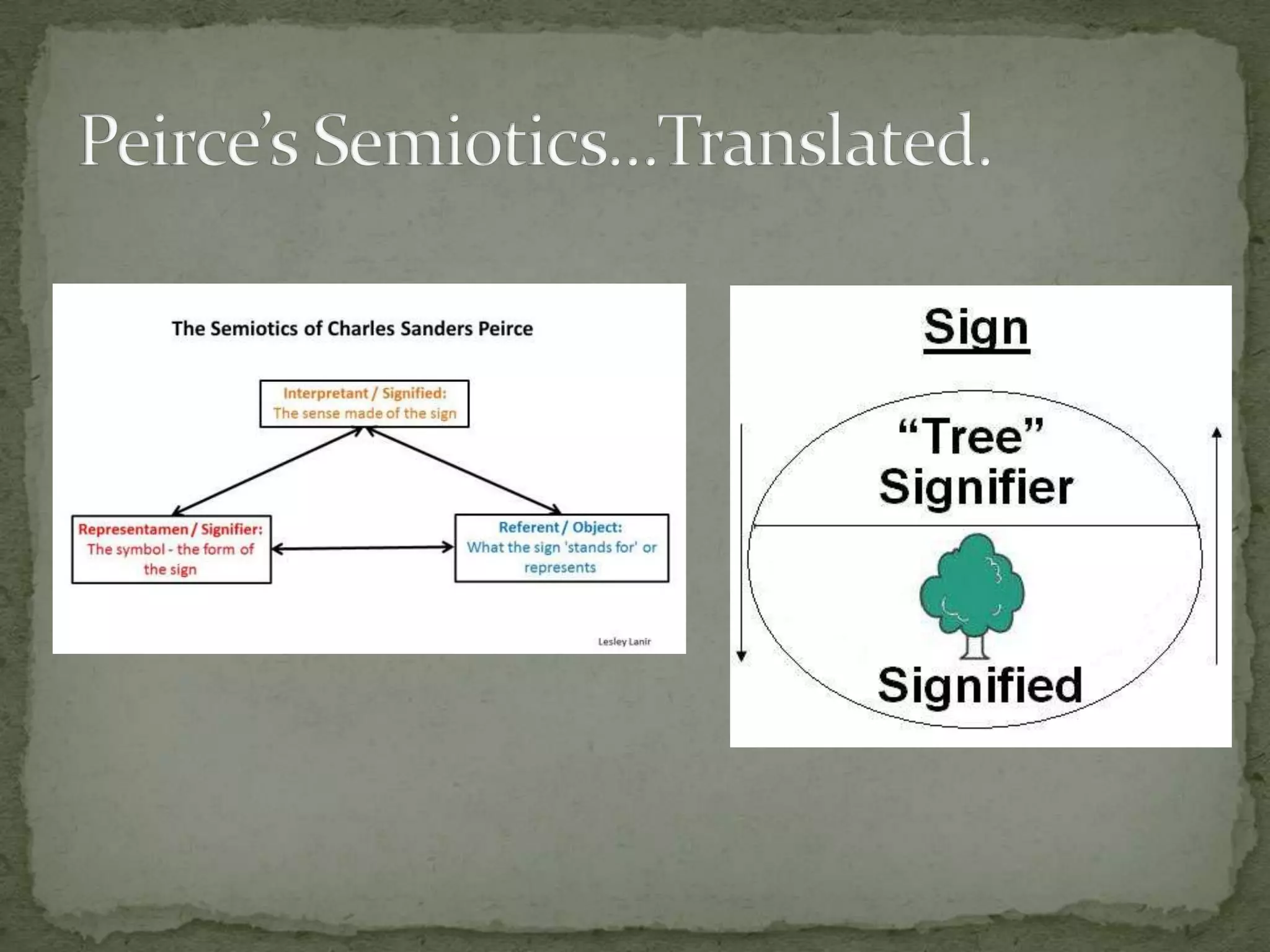
 Closely related to Semantics is Semiotics.
 "It is important to understand what I mean by semiosis. All

dynamical action, or action of brute force, physical or
psychical, either takes place between two subjects (whether
they react equally upon each other, or one is agent and the
other patient, entirely or partially) or at any rate is a
resultant of such actions between pairs. But by "semiosis" I
mean, on the contrary, an action, or influence, which is, or
involves, a cooperation of three subjects, such as a sign, its
object, and its interpretant, this tri-relative influence not
being in any way resolvable into actions between pairs."
 – Charles Sanders Peirce ('Pragmatism', EP 2:411, 1907)
 http://youtu.be/rEgxTKUP_WI
 This video is a nice introduction to some of the ideas of

semantics and semiotics. (Also…do you recognize
anybody in the video from this week’s reading?)
 Formal Semantics
 The logical aspects of meaning

 Lexical Semantics
 Studies of word meanings and word relations

 Conceptual Semantics
 The cognitive structure of meaning
 The Denotational Theory
 Wittgenstein referencing idea from Augustine:
 “The individual words in language name objects. Sentences are
combinations of such names…. Every word has a meaning. This
meaning is correlated with the word. It is the object for which the
word stands.”
 The Denotational Theory & ‘The Linguistic Turn’
 By the mid nineteenth century language was the focus. How do we
understand belief and representation of the world?
 ‘[Language] is the medium of conceptualization.’ – Wilfrid Sellars
 John Stuart Mill and British Empiricism

 Sense Impressions

Language
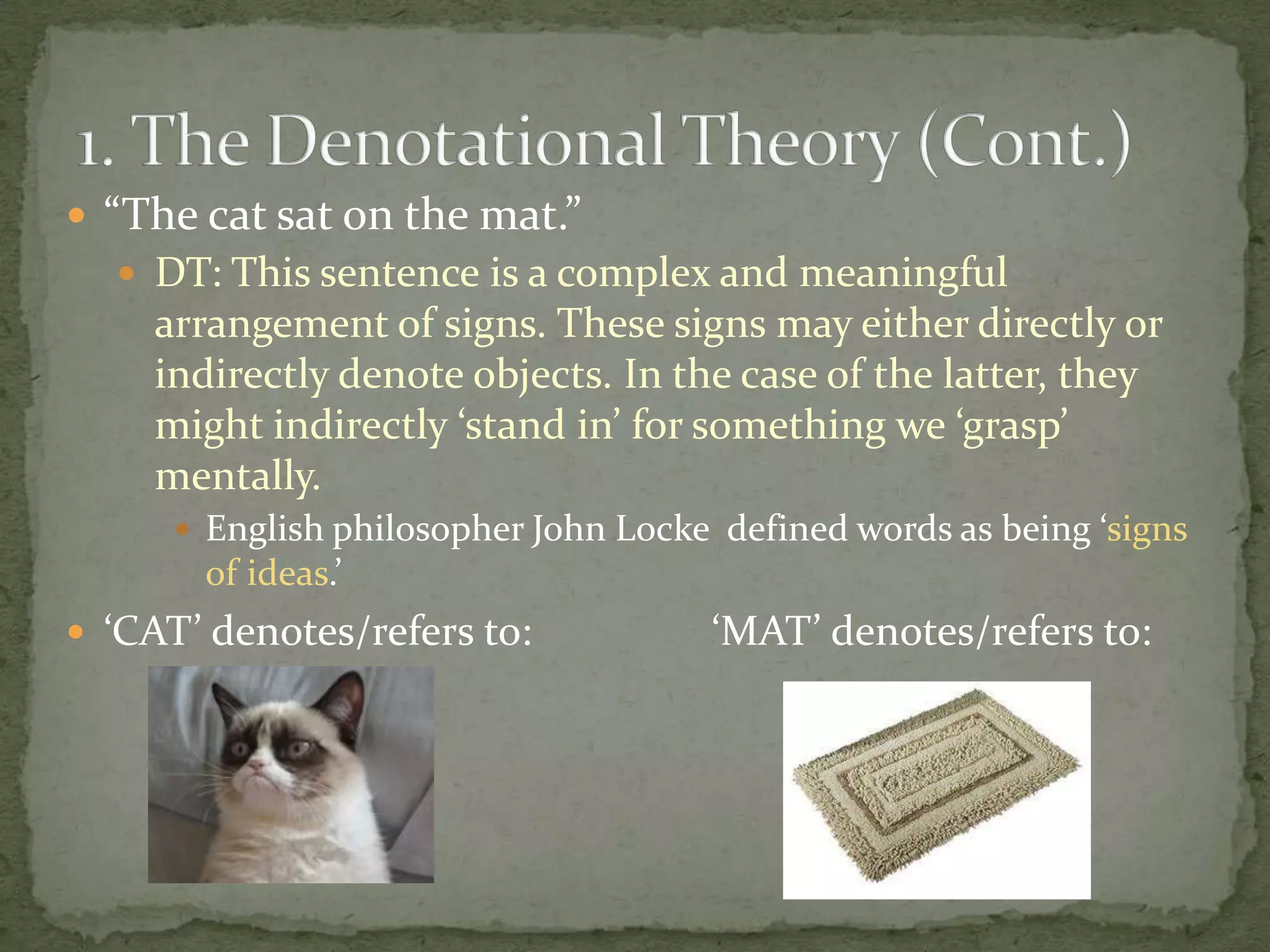
 “The cat sat on the mat.”
 DT: This sentence is a complex and meaningful

arrangement of signs. These signs may either directly or
indirectly denote objects. In the case of the latter, they
might indirectly ‘stand in’ for something we ‘grasp’
mentally.
 English philosopher John Locke defined words as being ‘signs

of ideas.’
 ‘CAT’ denotes/refers to:

‘MAT’ denotes/refers to:
 Two Problems:
 First
 ‘Phlogiston was thought to be the cause of combustion.’
 Phlogiston does not exist…so why do we still understand the

sentence? No such thing exists to be denoted!

 Second:
 ‘Atlantis does not exist.’
 If Atlantis does not exist, then this sentence has no reference so it should

be meaningless. Could we say ‘Atlantis’ is a concept and not an actual city?
 If Atlantis is a concept and not a city then the sentence ‘Atlantis

does not exist’ is false!

 Conclusion: Ordinary language is complex stuff!
 Gottleb Frege’s “Sense and Reference”
 The problem with Identity Statements and Meaning.
 Words denote things in the word, right? Well, what about the
meaning of sentences?
 ‘Brutus killed Caesar. ‘ vs. ‘Caesar killed Brutus.’
 The words denote the same things but the structure of the sentence
changes the meaning of the entire sentence!

 Morning Star = Evening Star
 “Now it is plausible to connect with a sign not only the
designated object, which may be called the reference of the
sign, but also the sense of the sign, in which is contained the
manner and context of presentation.”
 Bertrand Russell’s ‘On Denoting’
 Consider the sentence: ‘The present King of France is

bald.’
 How is this sentence meaningful when there is no present

King of France with a follicle deficiency?
 Solution? Analyzing sentences for logical constituents.
 ‘The author of Waverly was Scotch.’
 (i.) ‘x wrote Waverly’ is not always false.
 (ii.) ‘if x and y wrote Waverly, x and y are identical’ is always true.
 (iii.) ‘if x wrote Waverly, x was Scotch’ is always true.
 http://youtu.be/ILlvG78ZldQ

 The Tractatus Logico-Philosophicus
 With this slim 70 page book, Wittgenstein declared all

of the problems of philosophy (such as the ones just
discussed) to be solved. For Wittgenstein, the problems
of philosophy stemmed from a lack of clarity in
language.
 Wittgenstein’s beliefs regarding language changed radically

before the time of Philosophical Investigations. He later
rejected the assumptions of this earlier work!
 A possibly apocryphal story tells of Wittgenstein

riding on a train with Antonio Gramsci. Wittgenstein
was explaining his theories to him regarding
propositions. He insisted that a proposition must have
a logical form.
In response, Gramsci made a rude gesture and
asked, ‘What’s the form of that?’
Wittgenstein’s theory had a huge problem.
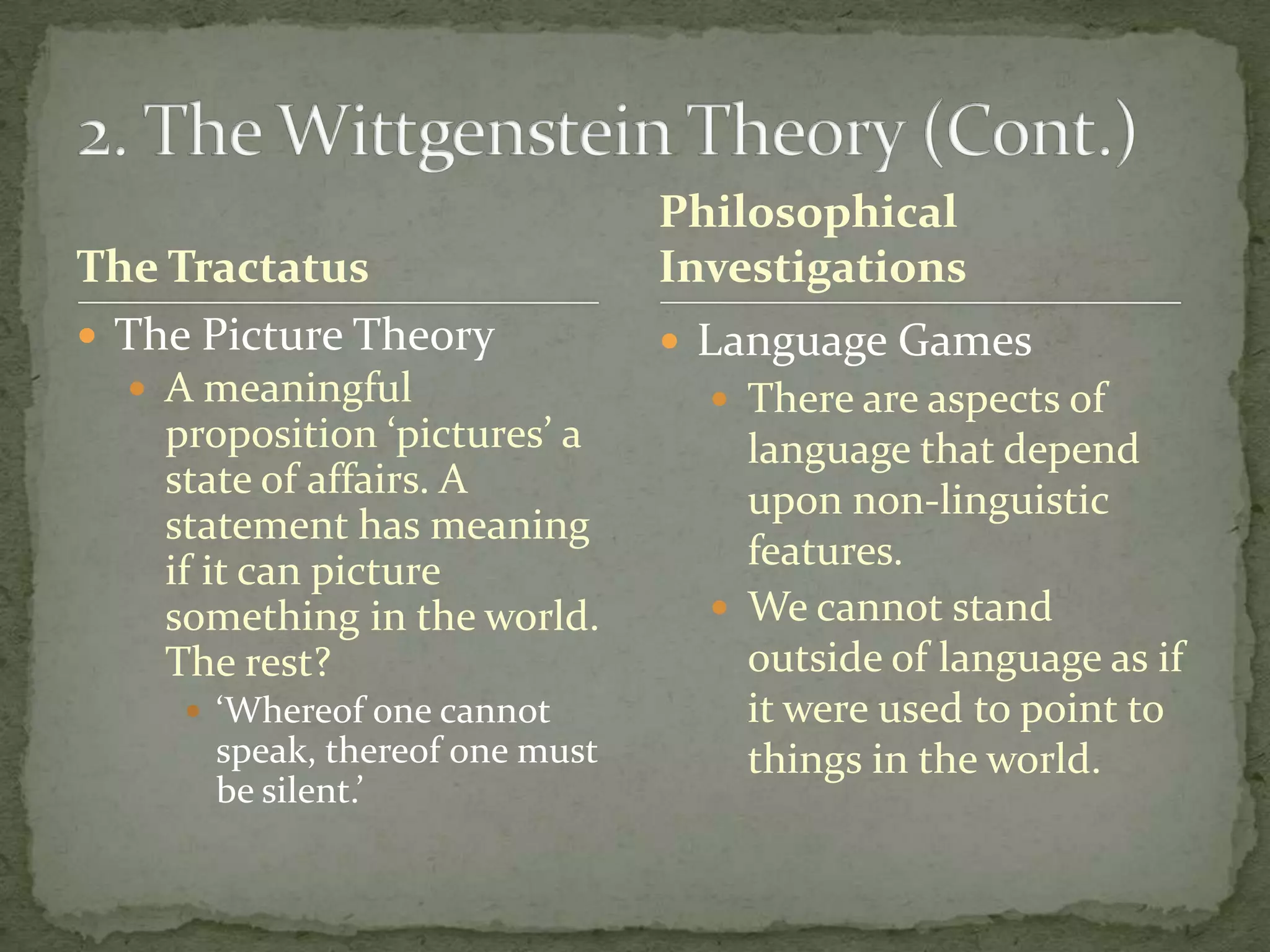
The Tractatus
 The Picture Theory
 A meaningful

proposition ‘pictures’ a
state of affairs. A
statement has meaning
if it can picture
something in the world.
The rest?
 ‘Whereof one cannot

speak, thereof one must
be silent.’

Philosophical
Investigations
 Language Games
 There are aspects of

language that depend
upon non-linguistic
features.
 We cannot stand
outside of language as if
it were used to point to
things in the world.
 "For a large class of cases--though not for all--in which

we employ the word "meaning" it can be defined thus:
the meaning of a word is its use in the language."
 Language Games
 A note on what is meant by the word ‘games.’

Wittgenstein originally used a German word that more
closely translates to ‘chess’ as opposed to a trivial
pursuit. Why is this important? Because in the original
context ‘games’ referred to strategic interactions
between people.
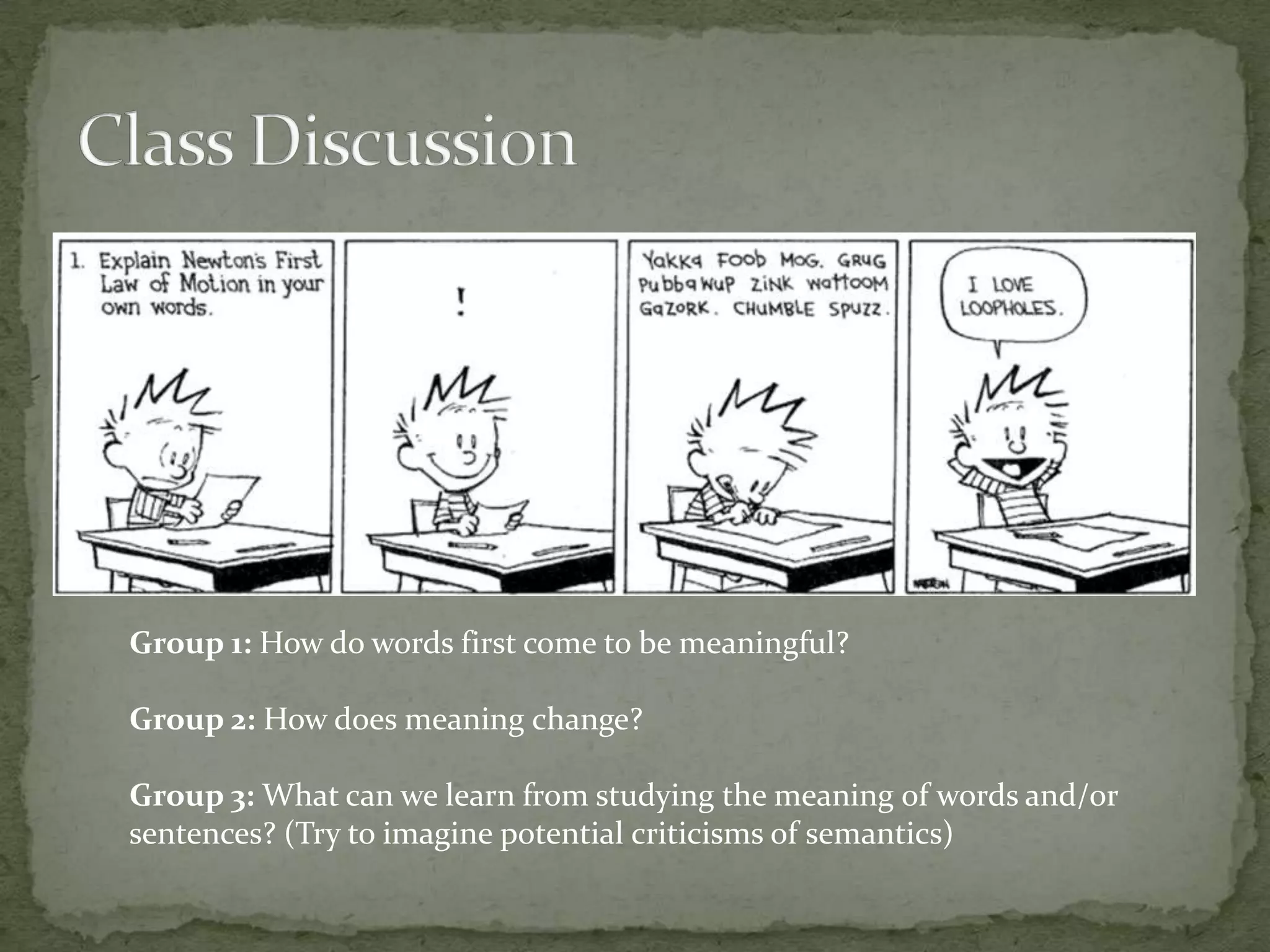
 On the next slide we have an image of someone

presenting a argument related to semantics. In your
groups, discuss this image and how it relates to your
topic. Try to tie back into this week’s reading.
(Bonus…could we tie this into last week’s discussion as
well?)
 Group 1: How do words first come to be meaningful?
 Group 2: How does meaning change?
 Group 3: What can we learn from studying the meaning

of words and/or sentences? (Try to imagine potential
criticisms of semantics)
Group 1: How do words first come to be meaningful?
Group 2: How does meaning change?
Group 3: What can we learn from studying the meaning of words and/or
sentences? (Try to imagine potential criticisms of semantics)

Semiotics, Semantics, and The Linguistic Turn in Philosophy

  • 1.
  • 2.
     A. Whatis Semantics?  Formal definition  Semiotics (a related study)  Types of Semantic Study  B. Theories of Meaning  The Denotational Theory  The Wittgenstein Theory  The Mentalist Theory*
  • 3.
     “Semantics isthe study of the meaning of linguistic expressions...Meaning in natural languages is mainly studied by linguists. In fact, semantics is one of the main branches of contemporary linguistics...There are strong connections to philosophy. Earlier in this century, much work in semantics was done by philosophers, and some important work is still done by philosophers.” (Richard Thomason, University of Michigan)  Semantics is important to not only linguistics but also computer science. Why would this be important?  Closely related to Semantics is Semiotics.
  • 4.
     "It isimportant to understand what I mean by semiosis. All dynamical action, or action of brute force, physical or psychical, either takes place between two subjects (whether they react equally upon each other, or one is agent and the other patient, entirely or partially) or at any rate is a resultant of such actions between pairs. But by "semiosis" I mean, on the contrary, an action, or influence, which is, or involves, a cooperation of three subjects, such as a sign, its object, and its interpretant, this tri-relative influence not being in any way resolvable into actions between pairs."  – Charles Sanders Peirce ('Pragmatism', EP 2:411, 1907)
  • 6.
     http://youtu.be/rEgxTKUP_WI  Thisvideo is a nice introduction to some of the ideas of semantics and semiotics. (Also…do you recognize anybody in the video from this week’s reading?)
  • 7.
     Formal Semantics The logical aspects of meaning  Lexical Semantics  Studies of word meanings and word relations  Conceptual Semantics  The cognitive structure of meaning
  • 8.
     The DenotationalTheory  Wittgenstein referencing idea from Augustine:  “The individual words in language name objects. Sentences are combinations of such names…. Every word has a meaning. This meaning is correlated with the word. It is the object for which the word stands.”  The Denotational Theory & ‘The Linguistic Turn’  By the mid nineteenth century language was the focus. How do we understand belief and representation of the world?  ‘[Language] is the medium of conceptualization.’ – Wilfrid Sellars  John Stuart Mill and British Empiricism  Sense Impressions Language
  • 9.
     “The catsat on the mat.”  DT: This sentence is a complex and meaningful arrangement of signs. These signs may either directly or indirectly denote objects. In the case of the latter, they might indirectly ‘stand in’ for something we ‘grasp’ mentally.  English philosopher John Locke defined words as being ‘signs of ideas.’  ‘CAT’ denotes/refers to: ‘MAT’ denotes/refers to:
  • 10.
     Two Problems: First  ‘Phlogiston was thought to be the cause of combustion.’  Phlogiston does not exist…so why do we still understand the sentence? No such thing exists to be denoted!  Second:  ‘Atlantis does not exist.’  If Atlantis does not exist, then this sentence has no reference so it should be meaningless. Could we say ‘Atlantis’ is a concept and not an actual city?  If Atlantis is a concept and not a city then the sentence ‘Atlantis does not exist’ is false!  Conclusion: Ordinary language is complex stuff!
  • 11.
     Gottleb Frege’s“Sense and Reference”  The problem with Identity Statements and Meaning.  Words denote things in the word, right? Well, what about the meaning of sentences?  ‘Brutus killed Caesar. ‘ vs. ‘Caesar killed Brutus.’  The words denote the same things but the structure of the sentence changes the meaning of the entire sentence!  Morning Star = Evening Star  “Now it is plausible to connect with a sign not only the designated object, which may be called the reference of the sign, but also the sense of the sign, in which is contained the manner and context of presentation.”
  • 12.
     Bertrand Russell’s‘On Denoting’  Consider the sentence: ‘The present King of France is bald.’  How is this sentence meaningful when there is no present King of France with a follicle deficiency?  Solution? Analyzing sentences for logical constituents.  ‘The author of Waverly was Scotch.’  (i.) ‘x wrote Waverly’ is not always false.  (ii.) ‘if x and y wrote Waverly, x and y are identical’ is always true.  (iii.) ‘if x wrote Waverly, x was Scotch’ is always true.
  • 13.
     http://youtu.be/ILlvG78ZldQ  TheTractatus Logico-Philosophicus  With this slim 70 page book, Wittgenstein declared all of the problems of philosophy (such as the ones just discussed) to be solved. For Wittgenstein, the problems of philosophy stemmed from a lack of clarity in language.  Wittgenstein’s beliefs regarding language changed radically before the time of Philosophical Investigations. He later rejected the assumptions of this earlier work!
  • 14.
     A possiblyapocryphal story tells of Wittgenstein riding on a train with Antonio Gramsci. Wittgenstein was explaining his theories to him regarding propositions. He insisted that a proposition must have a logical form. In response, Gramsci made a rude gesture and asked, ‘What’s the form of that?’ Wittgenstein’s theory had a huge problem.
  • 15.
    The Tractatus  ThePicture Theory  A meaningful proposition ‘pictures’ a state of affairs. A statement has meaning if it can picture something in the world. The rest?  ‘Whereof one cannot speak, thereof one must be silent.’ Philosophical Investigations  Language Games  There are aspects of language that depend upon non-linguistic features.  We cannot stand outside of language as if it were used to point to things in the world.
  • 16.
     "For alarge class of cases--though not for all--in which we employ the word "meaning" it can be defined thus: the meaning of a word is its use in the language."
  • 17.
     Language Games A note on what is meant by the word ‘games.’ Wittgenstein originally used a German word that more closely translates to ‘chess’ as opposed to a trivial pursuit. Why is this important? Because in the original context ‘games’ referred to strategic interactions between people.
  • 18.
     On thenext slide we have an image of someone presenting a argument related to semantics. In your groups, discuss this image and how it relates to your topic. Try to tie back into this week’s reading. (Bonus…could we tie this into last week’s discussion as well?)  Group 1: How do words first come to be meaningful?  Group 2: How does meaning change?  Group 3: What can we learn from studying the meaning of words and/or sentences? (Try to imagine potential criticisms of semantics)
  • 19.
    Group 1: Howdo words first come to be meaningful? Group 2: How does meaning change? Group 3: What can we learn from studying the meaning of words and/or sentences? (Try to imagine potential criticisms of semantics)

Editor's Notes

  • #2 Simply put, semantics is the branch of linguistics concerned with meaning.
  • #8 Some examples of semantic study