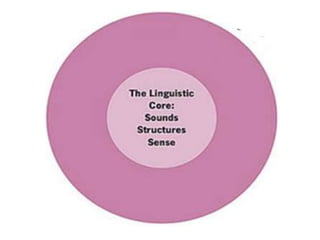
Let us now try to
place semantics
within linguistics and
see what that implies.
semantics is a
component or level of
linguistics of the same
kind as phonetics or
grammar..
•How do
linguists view
semantics
within
linguistics?
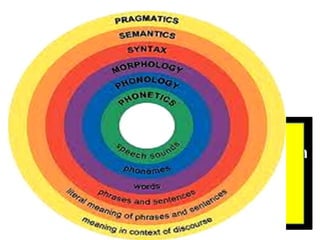
Nearly all linguists have, explicitly or
implicitly, accepted a linguistic model in
which semantics is at one 'end' and
phonetics at the other, with grammar
somewhere in the middle
(though not necessarily that
there are just these three
levels).
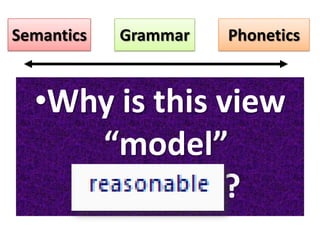
•Why is this view
“model”
plausible?
Semantics Grammar Phonetics
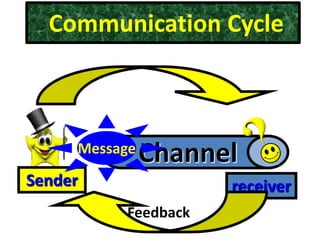
Channel
Communication Cycle
receiverSender
Message
Feedback
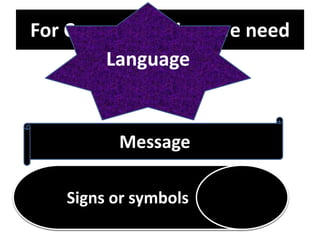
For Communication, we needA
Communication
System
Something to communicate
Something to
communicate
with
Language
Message
Signs or symbols
The Swiss linguist
Ferdinand de Saussure
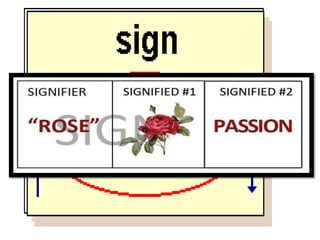
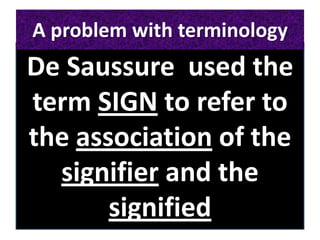
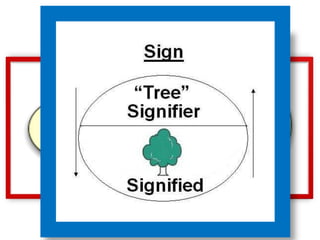
De Saussure used the
term SIGN to refer to
the association of the
signifier and the
signified
A problem with terminology
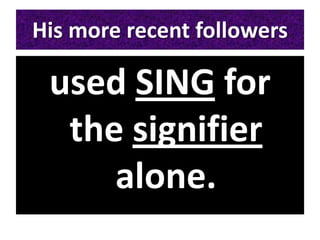
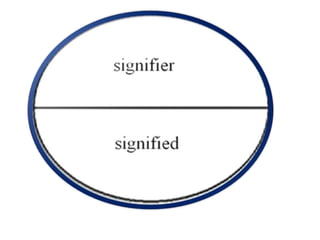
His more recent followers
used SING for
the signifier
alone.
•There are so many
communication
systems.
•They are much simpler
then language.
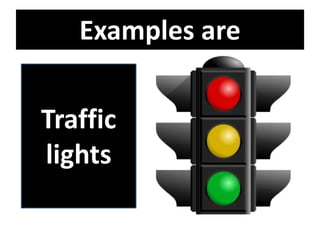
Examples are
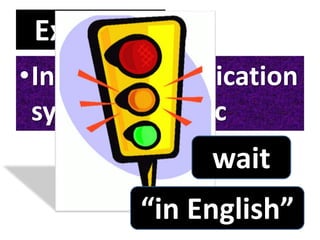
Traffic
lights
animals communicate
Gibbons
have a set of calls to
indicate
•the discovery of food,
•danger,
•friendly interest,
•desire for company,
•establishing position
have a set of calls to
indicate
•the discovery of food,
•danger,
•friendly interest,
•desire for company,
•establish position
Language as a system
of communication
differs from other
communication
systems.
First, language does not always have
a 'message’
• language is not simply a
matter of providing factual
information.
(Inter-personal relations)
(Social relashionships)
Secondly
•Complexity of “signifiers;
and the “signified” in
language.
• Complexity of the relation
between them.
Thirdly
• difficulty
(impossibility), of
specifying precisely
what the message is.
Example
•In the communication
system of traffic
wait
“in English”
The message can be
independently
identified in terms
of language
For language
Meaning (the 'message')
cannot be identified
independently of
language.
What is the meaning of
Could you please
pass the salt?
Language can only
be described in
terms of
language.
Language can only
be described in
terms of language.
Is semantics “scientific”?
(1)A scientific study
should be “empirical”.
(2) Linguistics is defended
as:
the 'scientific' study of
language.
one essential requirement
of a scientific study is that
statements made within it
must, in principle at
least, be verifiable by
observation.
This can easily be applied to
“phonetics”
we can observe
what is
happening.
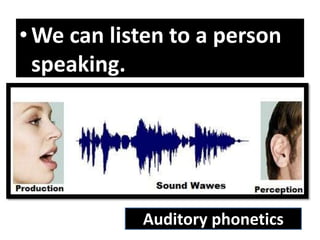
•We can listen to a person
speaking.
Auditory phonetics
English vowels : 1. / i: /
/ i:/
1. / i: / e.g. see
spelling:
ees------ee
vee------e
veeirec------ei
ayqu------ay
eas------ea
ldief------ie
Close, front ,spread narrow lips and long
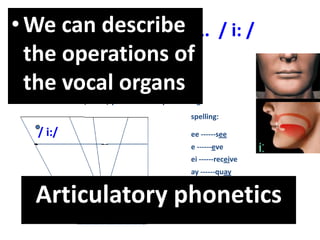
•We can describe
the operations of
the vocal organs
Articulatory phonetics
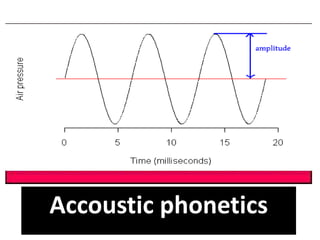
We can measure
precisely the physical
characteristics of the
sounds that are
emitted.
Accoustic phonetics
there
is, unfortunately, no
similar, simple, way
of dealing with
semantics.
BUT
Furthermore,
if linguistics is
scientific, it must be
concerned not with
specific instances, but
with generalisations.
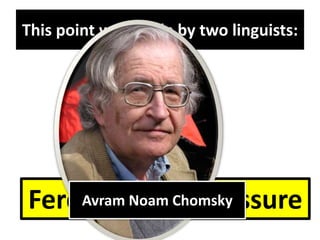
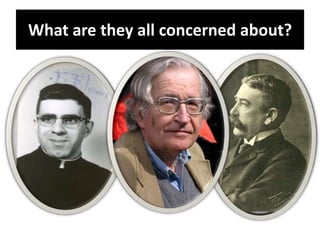
This point was made by two linguists:
Ferdinand de SaussureAvram Noam Chomsky
• Made the distinction between
Ferdinand de Saussure
• Made the distinction between:
Noam Chomsky
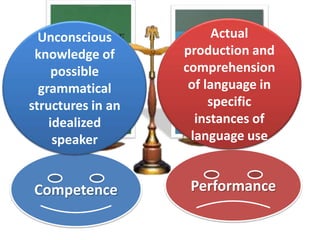
PerformanceCompetence
Unconscious
knowledge of
possible
grammatical
structures in an
idealized
speaker
Actual
production and
comprehension
of language in
specific
instances of
language use
What are they all concerned about?
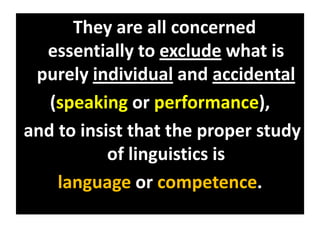
They are all concerned
essentially to exclude what is
purely individual and accidental
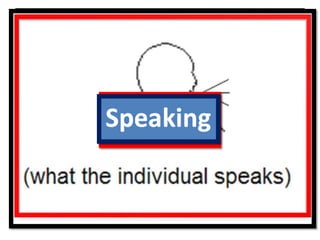
(speaking or performance),
and to insist that the proper study
of linguistics is
language or competence.
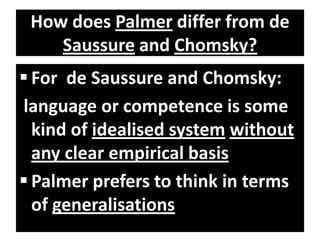
How does Palmer differ from de
Saussure and Chomsky?
 For de Saussure and Chomsky:
language or competence is some
kind of idealised system without
any clear empirical basis
 Palmer prefers to think in terms
of generalisations
What does this mean?
Let’s take the
example of
“phonetics” again.
The phonetician is not
primarily concerned with
• the particular sounds
•that are made at a particular
time
• by a particular person.
What does a phonetician do?
S/He studies the pronunciation of
words.
To do so, s/he
(1) will listen to a number of
individual utterances of the word,
and
(2) will make a generalised
statement on the basis of these.
What happens at each time
a person speaks is not
usually of interest in itself;
it is rather part of the
evidence for the
generalisations.
How does this
relate to
“semantics”
The same must be
true of semantics.
Recall Lewis Carroll
once again
(Through the Looking-
Glass):
Humpty Dumpty said in a
rather scornful tone,
'When I use a word, it
means what I choose it to
mean - neither more nor
less'.
Semantics is not normally
concerned with the
meaning any individual
wishes to place on his
words.
An individual's meaning is
not part of the general
study of semantics.
However, it is interesting or
important for some
purposes to see how and
why an individual diverges
from the normal pattern.
For example:
(1) Literature
(2) Psychiatric stdies.
(3) Etc
An important note
What is the difference
between:
(1) a sentence
and
(2) an utterance?
This is my bag.
Is this a sentence or
an utterance?
The distinction is as follows
An utterance is an event
in time:
Produced by someone.
At some particular time.
A sentence is
(1) An abstract entity that
has no existence in
time, but
(2) It is part of the linguistic
system of a language.
The distinction is related to
Competence
Performance
and
Competence
Sentences belong to
Utterance belong to
Performance
So; what is semantics concerned with?
Semantics is not
concerned with the
meaning of utterances.
It is concerned with the
meaning of sentences
What does this imply?
•Semantics cannot be
studied without assuming
a great deal about
grammar and other
aspects of the structure of
language.

(2) semantics and linguistics