Meaning of Language:
     Semantic
    Lovely Mae Prieto
       Ye Jin Kim
Terms
•   Semantics                    •   Enduring
•   Pragmatics                   •   Element
•   Ambiguity                    •   Entity
•   Entailment                   •   Feature
•   Contradictory                •   Agent
•   Compositionality             •   Theme
•   Anomaly                      •   Denote
•   Metaphor                     •   Instrument
•   Idioms                       •   Experiencer
•   Pragmatics                   •   Designate
•   Speech acts                  •   perception
•   Conversational implication
•   Deixis
Characteristics of semantics
• Semantics
  - study of the meaning of linguistic expressions
  - aims to account for what is linguistically encoded
  - linguistic meaning: made up from the sum of the meanings
  of its parts
  - meaning of sentence: words + syntactic makeup
  - focus on literal meaning (non-literal meaning for pragmatics)
• Meaning of a sentence : 2 truth values: true and false
  - negation: truth valued is switched.
• Ambiguous: more than one meaning
  - words: lexically ambiguous
  - phrases: lexically ambiguous and/or structurally ambiguous
• Entailment
  - “I dance gracefully.” entails “I dance.”
• Contradictory
  - entails the negation of the other sentence.
Principle of compositionality
• “expression is composed of the meanings of its parts
  and how they are combined structurally.”
• Semantic rule : determine the meaning of a phrase or
  sentence based on its composition.
  - Rule one: meaning of NP (an individual) is a member
  of the meaning of VP (a set of individuals), then the S
  is true, otherwise it is false.
  Ex. “I dance”
  - Rule two: meaning of ( V NP) is the set of individual
                          VP

  X such that X is the first member of any pair in the
  meaning of V whose second member is the meaning
  of NP.
  Ex. “Jack kissed James”
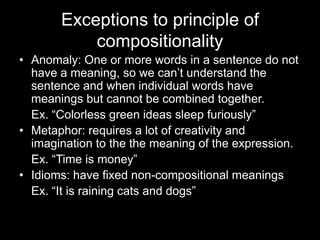
Exceptions to principle of
           compositionality
• Anomaly: One or more words in a sentence do not
  have a meaning, so we can‟t understand the
  sentence and when individual words have
  meanings but cannot be combined together.
  Ex. “Colorless green ideas sleep furiously”
• Metaphor: requires a lot of creativity and
  imagination to the the meaning of the expression.
  Ex. “Time is money”
• Idioms: have fixed non-compositional meanings
  Ex. “It is raining cats and dogs”
Lexical semantics
Subfield of semantics that studies word
 meanings in a sentence and their
 relationships with each other

Example:
    “I saw my mother just now.”
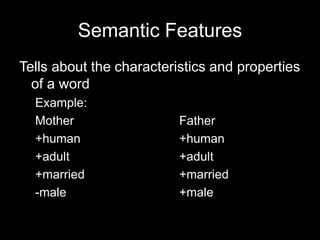
Semantic Features
Tells about the characteristics and properties
  of a word
  Example:
  Mother                  Father
  +human                  +human
  +adult                  +adult
  +married                +married
  -male                   +male
Semantic Roles (thematic roles)
The noun phrases such as people and thing
 in the sentence at describes the role
 entities and that involves action

 Agent and Theme
 Instrument and Experiencer
 Location, Source and Goal
Lexical Relations
• Synonymy
• Antonymy
    – Gradable Pairs
    – Complimentary Pairs
•   Hyponymy
•   Polysemy
•   Metonymy
•   Homonyms
•   Homophones
•   Homographs
•   Heteronyms
Theories of meanings

• Reference
• Sense
• Coreferential
Pragmatics
• Understanding of language in context
• Aspect of meaning which cannot be found in the plain
  sense of words or structure.

• Speech Acts: many utterances are equivalent to
  actions
  - Locutionary acts: speech acts that have taken place
  - Illocutionary acts: real actions which are performed
  by utterance
  - Perlocutionary acts: effects of the utterance on the
  listener
• Conversational implication: how the hearers manage
  to work out the complete message when speaker
  mean more that they say
  Ex. “Have you got any cash on you?”
Pragmatics-cont.
•   Deixis: concerns the way in which languages encode and thus also
    concerns ways in which the interpretation of utterance depends on the
    analysis of that context of utterance
    „verbal pointing‟
    - Deictic expressions
      . Personal or possessive pronouns (I, you, mine, yours)
      . Demonstrative pronouns (this, that)
      . Spatial or temporal adverbs (here, there, now)
      . Other pro-forms (so, do)
      . Personal or possessive adjectives (my, your)
      . Demonstrative adjective (my, your)
      . Article (the)
    - primary deixis (deixis): used to point to a situation outside a text
    (situational deixis) or to the speaker‟s and hearer‟s (shared) knowledge
    of the world (knowledge deixis).
    - secondary deixis (endophoric deixis): refer either backwards or
    forwards to other elements in a text
      . Anaphoric deixis: backward pointing (such, said, similar, same)
      . Cataphoric deixis: forward pointing (the
    following, certain, some, this, these, several)
Reference
1.   Saeed, J. I. (2009). Semantics third edition. West Sussex, UK: Blackwell
     Publishing Ltd.
2.   Yule, G. (2010). The study of Language fourth edition. New York, USA:
     Cambridge University Press.
3.   Fromkin, V., Rodman, R. & Hyams, N. (2010). Introduction to Linguistic
     Philippine Edition. Pasig city, Philippines: Cenage learning Asia Pte. Ltd.
     (Philippines branch).
4.   Thomason, R. H. (1996, December). What is semantics?. Retrieved
     November 30, 2011 from the World Wide Web:
     http://www.eecs.umich.edu/~rthomaso/documents/general/what-is-
     semantics.html.
5.   Clark, B. Sentence Meaning. Retrieved November 30, 2011 from the
     World Wide Web: http://www.llas.ac.uk/resources/gpg/139.
6.   Bach, K. Ambiguity. Retrieved November 30, 2011 from the World Wide
     Web: http://userwuw.sfsu.edu/~kbach/ambiguity.html.
7.   Moore, A. (1999, March). Pragmatics and speech acts. Retrieved
     December 1, 2011 from the World Wide Web:
     http://www.teachit.co.uk/armoore/lang/pragmatics.htm#top.
8.   O‟Grady, W., Dobrovolsky, M. & Katamba, F. (1997). Contemporary
     Linguistics an Introduction. Hong Kong: Longman Asia Limited.

Semantics: The Meaning of Language

  • 1.
    Meaning of Language: Semantic Lovely Mae Prieto Ye Jin Kim
  • 2.
    Terms • Semantics • Enduring • Pragmatics • Element • Ambiguity • Entity • Entailment • Feature • Contradictory • Agent • Compositionality • Theme • Anomaly • Denote • Metaphor • Instrument • Idioms • Experiencer • Pragmatics • Designate • Speech acts • perception • Conversational implication • Deixis
  • 3.
    Characteristics of semantics •Semantics - study of the meaning of linguistic expressions - aims to account for what is linguistically encoded - linguistic meaning: made up from the sum of the meanings of its parts - meaning of sentence: words + syntactic makeup - focus on literal meaning (non-literal meaning for pragmatics) • Meaning of a sentence : 2 truth values: true and false - negation: truth valued is switched. • Ambiguous: more than one meaning - words: lexically ambiguous - phrases: lexically ambiguous and/or structurally ambiguous • Entailment - “I dance gracefully.” entails “I dance.” • Contradictory - entails the negation of the other sentence.
  • 4.
    Principle of compositionality •“expression is composed of the meanings of its parts and how they are combined structurally.” • Semantic rule : determine the meaning of a phrase or sentence based on its composition. - Rule one: meaning of NP (an individual) is a member of the meaning of VP (a set of individuals), then the S is true, otherwise it is false. Ex. “I dance” - Rule two: meaning of ( V NP) is the set of individual VP X such that X is the first member of any pair in the meaning of V whose second member is the meaning of NP. Ex. “Jack kissed James”
  • 5.
    Exceptions to principleof compositionality • Anomaly: One or more words in a sentence do not have a meaning, so we can‟t understand the sentence and when individual words have meanings but cannot be combined together. Ex. “Colorless green ideas sleep furiously” • Metaphor: requires a lot of creativity and imagination to the the meaning of the expression. Ex. “Time is money” • Idioms: have fixed non-compositional meanings Ex. “It is raining cats and dogs”
  • 6.
    Lexical semantics Subfield ofsemantics that studies word meanings in a sentence and their relationships with each other Example: “I saw my mother just now.”
  • 7.
    Semantic Features Tells aboutthe characteristics and properties of a word Example: Mother Father +human +human +adult +adult +married +married -male +male
  • 8.
    Semantic Roles (thematicroles) The noun phrases such as people and thing in the sentence at describes the role entities and that involves action  Agent and Theme  Instrument and Experiencer  Location, Source and Goal
  • 9.
    Lexical Relations • Synonymy •Antonymy – Gradable Pairs – Complimentary Pairs • Hyponymy • Polysemy • Metonymy • Homonyms • Homophones • Homographs • Heteronyms
  • 10.
    Theories of meanings •Reference • Sense • Coreferential
  • 11.
    Pragmatics • Understanding oflanguage in context • Aspect of meaning which cannot be found in the plain sense of words or structure. • Speech Acts: many utterances are equivalent to actions - Locutionary acts: speech acts that have taken place - Illocutionary acts: real actions which are performed by utterance - Perlocutionary acts: effects of the utterance on the listener • Conversational implication: how the hearers manage to work out the complete message when speaker mean more that they say Ex. “Have you got any cash on you?”
  • 12.
    Pragmatics-cont. • Deixis: concerns the way in which languages encode and thus also concerns ways in which the interpretation of utterance depends on the analysis of that context of utterance „verbal pointing‟ - Deictic expressions . Personal or possessive pronouns (I, you, mine, yours) . Demonstrative pronouns (this, that) . Spatial or temporal adverbs (here, there, now) . Other pro-forms (so, do) . Personal or possessive adjectives (my, your) . Demonstrative adjective (my, your) . Article (the) - primary deixis (deixis): used to point to a situation outside a text (situational deixis) or to the speaker‟s and hearer‟s (shared) knowledge of the world (knowledge deixis). - secondary deixis (endophoric deixis): refer either backwards or forwards to other elements in a text . Anaphoric deixis: backward pointing (such, said, similar, same) . Cataphoric deixis: forward pointing (the following, certain, some, this, these, several)
  • 13.
    Reference 1. Saeed, J. I. (2009). Semantics third edition. West Sussex, UK: Blackwell Publishing Ltd. 2. Yule, G. (2010). The study of Language fourth edition. New York, USA: Cambridge University Press. 3. Fromkin, V., Rodman, R. & Hyams, N. (2010). Introduction to Linguistic Philippine Edition. Pasig city, Philippines: Cenage learning Asia Pte. Ltd. (Philippines branch). 4. Thomason, R. H. (1996, December). What is semantics?. Retrieved November 30, 2011 from the World Wide Web: http://www.eecs.umich.edu/~rthomaso/documents/general/what-is- semantics.html. 5. Clark, B. Sentence Meaning. Retrieved November 30, 2011 from the World Wide Web: http://www.llas.ac.uk/resources/gpg/139. 6. Bach, K. Ambiguity. Retrieved November 30, 2011 from the World Wide Web: http://userwuw.sfsu.edu/~kbach/ambiguity.html. 7. Moore, A. (1999, March). Pragmatics and speech acts. Retrieved December 1, 2011 from the World Wide Web: http://www.teachit.co.uk/armoore/lang/pragmatics.htm#top. 8. O‟Grady, W., Dobrovolsky, M. & Katamba, F. (1997). Contemporary Linguistics an Introduction. Hong Kong: Longman Asia Limited.