
Dictionary Meaning
A. Ait Taleb, Y. Taia, Z. Jamaati
Semantics and Pragmatics Course
Prof. Chouaibi
Outline
. Introduction.
1. The definition and the history of dictionary.
2. Meaning and the dictionary.
A-A typical dictionary
B- Semantics & lexicography.
3. Approaches to definition
4. Types of dictionaries
5. Properties of dictionaries
6. Sense relations affecting word meaning.
7. Knowledge of meaning (dictionary) Vs . Factual Knowledge
(encyclopedia).
8. . Problems of distinction b/w Dictionary and encyclopedia
9. Clues to differentiate b/w a dictionary and encyclopedia
• Among the kinds of questions semanticists ask
are the following:
• What are meanings ?
 definitions?
 Ideas in our heads?
 Sets of objects in the world?
• Can all meanings be precisely defined?
People may feel that the dictionary definition of a word
is the best representation of a word's meaning, but the
reality is that dictionaries model usage.
This presentation considers the role of DICTIONARY
definition in the description of meaning.
:
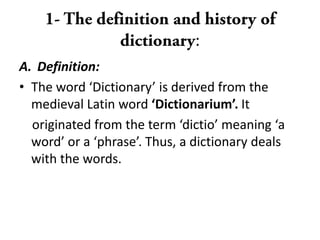
A. Definition:
• The word ‘Dictionary’ is derived from the
medieval Latin word ‘Dictionarium’. It
originated from the term ‘dictio’ meaning ‘a
word’ or a ‘phrase’. Thus, a dictionary deals
with the words.
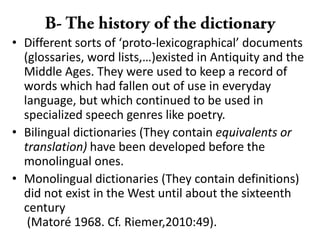
• Different sorts of ‘proto-lexicographical’ documents
(glossaries, word lists,…)existed in Antiquity and the
Middle Ages. They were used to keep a record of
words which had fallen out of use in everyday
language, but which continued to be used in
specialized speech genres like poetry.
• Bilingual dictionaries (They contain equivalents or
translation) have been developed before the
monolingual ones.
• Monolingual dictionaries (They contain definitions)
did not exist in the West until about the sixteenth
century
(Matoré 1968. Cf. Riemer,2010:49).
:
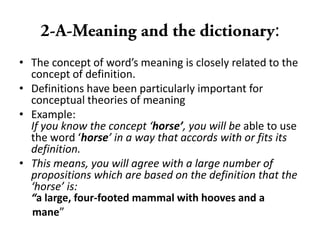
• The concept of word’s meaning is closely related to the
concept of definition.
• Definitions have been particularly important for
conceptual theories of meaning
• Example:
If you know the concept ‘horse’, you will be able to use
the word ‘horse’ in a way that accords with or fits its
definition.
• This means, you will agree with a large number of
propositions which are based on the definition that the
‘horse’ is:
“a large, four-footed mammal with hooves and a
mane”
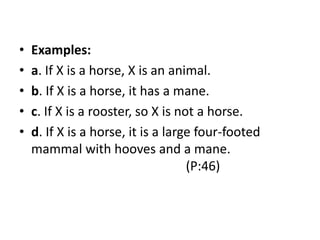
• Examples:
• a. If X is a horse, X is an animal.
• b. If X is a horse, it has a mane.
• c. If X is a rooster, so X is not a horse.
• d. If X is a horse, it is a large four-footed
mammal with hooves and a mane.
(P:46)
• As a result, an understanding of definition is
necessary for any attempt to develop a
conceptual theory of word meaning.
• Moreover, when people think of a word’s
meaning, they tend to think of something like
its definition in a dictionary.
:
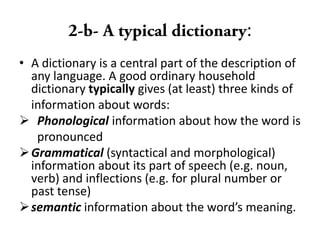
• A dictionary is a central part of the description of
any language. A good ordinary household
dictionary typically gives (at least) three kinds of
information about words:
 Phonological information about how the word is
pronounced
Grammatical (syntactical and morphological)
information about its part of speech (e.g. noun,
verb) and inflections (e.g. for plural number or
past tense)
semantic information about the word’s meaning.
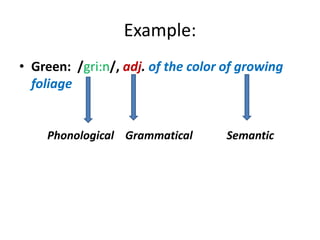
Example:
• Green: /gri:n/, adj. of the color of growing
foliage
Phonological Grammatical Semantic
• Lexicography/ dictionary writing is ‘a craft, a way
of doing something useful. It is not a theoretical
exercise to increase the sum of human knowledge
but practical work to put together a book that
people can understand.’
Landau (1984: 121 Cf. Reimer,2010:46)
• By contrast, linguistic semantics , in addition to its
concern with the meanings of words, is a
theoretical exercise.
• The primary goal of linguistic semantics is the
specification of the stored meaning
representation associated with each lexeme in
the mental lexicon.
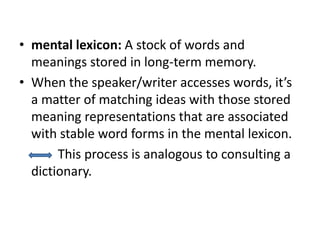
• mental lexicon: A stock of words and
meanings stored in long-term memory.
• When the speaker/writer accesses words, it’s
a matter of matching ideas with those stored
meaning representations that are associated
with stable word forms in the mental lexicon.
This process is analogous to consulting a
dictionary.
• Therefore, the dictionary constructed by a
semanticist is supposed to represent
important aspects of the mental knowledge
about meaning that any typical native
speaker of the language would have.
• Ordinary dictionaries usually fail to cater for
all the aspects of this mental knowledge.
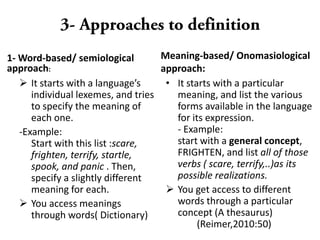
1- Word-based/ semiological
approach:
 It starts with a language’s
individual lexemes, and tries
to specify the meaning of
each one.
-Example:
Start with this list :scare,
frighten, terrify, startle,
spook, and panic . Then,
specify a slightly different
meaning for each.
 You access meanings
through words( Dictionary)
Meaning-based/ Onomasiological
approach:
• It starts with a particular
meaning, and list the various
forms available in the language
for its expression.
- Example:
start with a general concept,
FRIGHTEN, and list all of those
verbs ( scare, terrify,..)as its
possible realizations.
 You get access to different
words through a particular
concept (A thesaurus)
(Reimer,2010:50)
Semasiological and onomasiological analysis
are in no way exclusive:
• the semasiological approach emphasizes
differences between lexemes, the
onomasiological one similarities.
• Both are necessary to a full description of the
processes underlying communication.
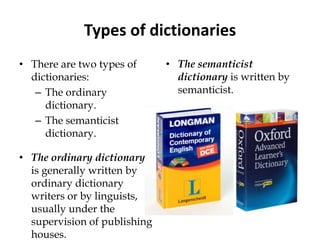
Types of dictionaries
• There are two types of
dictionaries:
– The ordinary
dictionary.
– The semanticist
dictionary.
• The ordinary dictionary
is generally written by
ordinary dictionary
writers or by linguists,
usually under the
supervision of publishing
houses.
• The semanticist
dictionary is written by
semanticist.
Types of dictionaries
• Both writers share the same goals when writing
dictionaries; that is to be as comprehensive as possible in
defining words.
• Difference is styles and approaches to reach their goals
Task
Properties of dictionaries
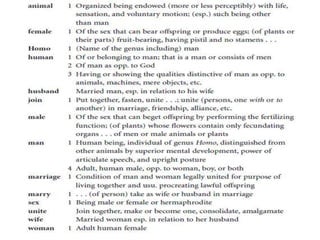
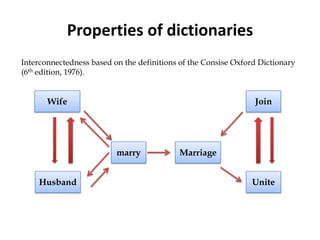
Interconnectedness based on the definitions of the Consise Oxford Dictionary
(6th edition, 1976).
marry
Wife Join
Husband Unite
Marriage
Properties of dictionaries
• Interconnectedness:
• In all dictionaries, definitions are in most of the time
interconnected. It is a feature that is desirable and can’t
be avoidable.
• It is more relied on by semanticists as they aim to
represent comprehensively the knowledge a native
speaker has about all sense relations between predicates.
• Semanticists are interested more in word sense relations;
(hyponymy, antonymy, polysemy, etc.)
Properties of dictionaries
• Circularity:
• Semanticist leave some terms undefined or ambiguous
compared to ordinary dictionary writers, who try to
exhaust definition of a term as much as possible.
Semantic primes
Properties of dictionaries
• Semantic Primes (Def.):
‘metalanguage which incorporates elements of the object
language can also be said to ‘defer full payment’. Only a
metalanguage which is completely independent of the object
language is in a position to offer a complete, non-circular
explanation in which every definiendum receives its own
semantic analysis independently of the analysis of the others.
Without such a metalanguage, there will always be a residue of
unexplained terms which escape definition.’
Properties of dictionaries
• They are actually words that cannot be understood with
simple words and they are difficult to define without
resorting to other ambiguous terms.
• The equivalent of Semantic primes in ordinary dictionaries
are the use of technique or abstruse terms in definition, or in
some cases define the words in another unfamiliar language
to
• e.g.:
Male: Of the sex that can beget offspring by
performing the fertilizing functions; (of plants)
whose flowers contain only fecundating organs of
men or male animals or plants.
Properties of dictionaries
• The framework of logic:
• Another important property that semanticists use in
dictionaries to describe the meaning.
• Note that those technical terms are not used by ordinary
dictionaries to mislead in understanding of a term, but
rather to describe the meaning.
• Both semanticists and ordinary dictionary writers aim to
describe the sense relation between predicates as they
understand them, in their own everyday life. (synonymy,
antonymy, etc.)
Properties of dictionaries
• Precision:
• The main and essential property of any dictionary is
Precision.
• Good ordinary dictionaries achieve high standard of
precision. However, in many cases they fail to define
some words with enough exactness.
Properties of dictionaries
• The distinction between homonymy and polysemy
increase the precision of a dictionary. However it is
difficult as in most of the time is arbitrary.
• The use of vague terms, such as ‘etc.’, ‘more or less’,
‘especially’, ‘usually’ affect the preciseness of a
dictionary.
• It is generally argued that the use of vague words in an
unavoidable as simply meanings cannot deduced with
absolute preciseness. It is a valid argument.
Sense relations that affect word meanings
• Incompatibility: "mutual and binary exclusiveness within the
same superordinate category" (e.g. male Vs. female)
• Symmetry: Interchangeability and belong of x to why and vice
versa
• Hyponymy: "inclusion of meaning" (cat is a hyponym of animal)
• Are generally assumed clear by ordinary dictionaries.
However Semanticist dictionaries focus more on finding all
sense relation between words.
• The aim after all is to present language as it is known by
native speakers.
Sense relations that affect word meanings
• Answer the following questions about sense relations between words
and sentences as you understand them:
• 1. Is Male compatible with female? Yes / No
• 2. Does John is married to Mary entail Mary is married to John?
Yes / No
• 3. Does the bench is joined to the table entail the table is joined to
the bench? Yes / No
• 4. Is man a hyponym of Animal? Yes / No
Knowledge of meaning
knowledge of a word’s meaning (dictionary
knowledge), which would be conceived of as
something fairly concise, perhaps like a
dictionary definition. knowledge of meaning is
knowledge of the essential meaning of a word
that all speakers must possess, and which
dictionaries must accurately represent in order
to allow the meaning to be acquired for the first
time.
factual (‘Encyclopedic’) knowledge
a book, often in many volumes, containing
articles on various topics, often arranged
in alphabetical order, dealing either with
the whole range of human knowledge or
with one particular subject a medical
encyclopedia
Example
A teacher:
or schoolteacher is a person who provides education for pupils (children) and
students (adults). The role of teacher is often formal and ongoing, carried
out at a school or other place of formal education. In many countries, a
person who wishes to become a teacher must first obtain specified
professional qualifications or credentials from a university or college.
These professional qualifications may include the study of pedagogy, the
science of teaching. Teachers, like other professionals, may have to
continue their education after they qualify, a process known as continuing
professional development. Teachers may use a lesson plan to facilitate
student learning, providing a course of study which is called
the curriculum.
A teacher's role may vary among cultures. Teachers may provide instruction
in literacy and numeracy, craftsmanship or vocational training, the
arts, religion, civics, community roles, or life skills.
A teacher who facilitates education for an individual may also be described as
a personal tutor, or, largely historically, a governess.
In some countries, formal education can take place through home
schooling. Informal learning may be assisted by a teacher occupying a
transient or ongoing role, such as a family member, or by anyone with
knowledge or skills in the wider community setting.
Problems with the distinction
between Dictionary and encyclopedia
Although they both cover different things, the
things they do cover are listed alphabetically
explained in detail, (generally) cross referenced
with other entries.
As any comparison of dictionaries will
reveal, it is very hard to determine where
information stops being part of a word’s
dictionary meaning and becomes part of
the encyclopedic knowledge we have of
its denotation.
. Which of the following pieces of
information, for example, should be
considered dictionary information about
the meaning of the word cow, and which
as facts about cows which form part of the
encyclopaedic knowledge we have about
them?
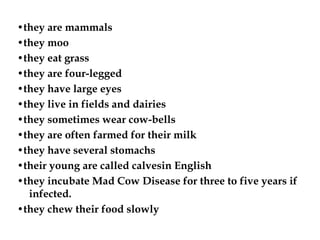
Example
•they are mammals
•they moo
•they eat grass
•they are four-legged
•they have large eyes
•they live in fields and dairies
•they sometimes wear cow-bells
•they are often farmed for their milk
•they have several stomachs
•their young are called calvesin English
•they incubate Mad Cow Disease for three to five years if
infected.
•they chew their food slowly
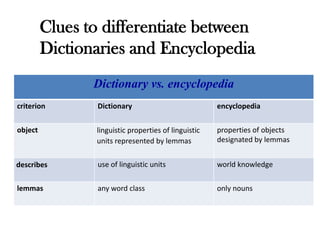
Dictionary vs. encyclopedia
criterion Dictionary encyclopedia
object linguistic properties of linguistic
units represented by lemmas
properties of objects
designated by lemmas
describes use of linguistic units world knowledge
lemmas any word class only nouns
Clues to differentiate between
Dictionaries and Encyclopedia
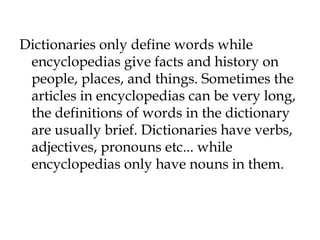
Dictionaries only define words while
encyclopedias give facts and history on
people, places, and things. Sometimes the
articles in encyclopedias can be very long,
the definitions of words in the dictionary
are usually brief. Dictionaries have verbs,
adjectives, pronouns etc... while
encyclopedias only have nouns in them.
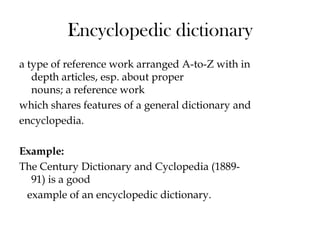
Encyclopedic dictionary
a type of reference work arranged A-to-Z with in
depth articles, esp. about proper
nouns; a reference work
which shares features of a general dictionary and
encyclopedia.
Example:
The Century Dictionary and Cyclopedia (1889-
91) is a good
example of an encyclopedic dictionary.
References
• Hurford, J.R and Heasly, B and Smith, M.B. (2007).
Semantics A Coursebook. UK: Cambridge University Press.
• Riemer, N. (2010). Introducing Semantics. UK: Cambridge
University Press.
• Site retirieved on 14 May 2013:
http://www.ling.upenn.edu/courses/ling001/semantic
s.html
Word meaning

Word meaning

  • 1.
    Dictionary Meaning A. AitTaleb, Y. Taia, Z. Jamaati Semantics and Pragmatics Course Prof. Chouaibi
  • 2.
    Outline . Introduction. 1. Thedefinition and the history of dictionary. 2. Meaning and the dictionary. A-A typical dictionary B- Semantics & lexicography. 3. Approaches to definition 4. Types of dictionaries 5. Properties of dictionaries 6. Sense relations affecting word meaning. 7. Knowledge of meaning (dictionary) Vs . Factual Knowledge (encyclopedia). 8. . Problems of distinction b/w Dictionary and encyclopedia 9. Clues to differentiate b/w a dictionary and encyclopedia
  • 3.
    • Among thekinds of questions semanticists ask are the following: • What are meanings ?  definitions?  Ideas in our heads?  Sets of objects in the world? • Can all meanings be precisely defined? People may feel that the dictionary definition of a word is the best representation of a word's meaning, but the reality is that dictionaries model usage. This presentation considers the role of DICTIONARY definition in the description of meaning.
  • 4.
    : A. Definition: • Theword ‘Dictionary’ is derived from the medieval Latin word ‘Dictionarium’. It originated from the term ‘dictio’ meaning ‘a word’ or a ‘phrase’. Thus, a dictionary deals with the words.
  • 5.
    • Different sortsof ‘proto-lexicographical’ documents (glossaries, word lists,…)existed in Antiquity and the Middle Ages. They were used to keep a record of words which had fallen out of use in everyday language, but which continued to be used in specialized speech genres like poetry. • Bilingual dictionaries (They contain equivalents or translation) have been developed before the monolingual ones. • Monolingual dictionaries (They contain definitions) did not exist in the West until about the sixteenth century (Matoré 1968. Cf. Riemer,2010:49).
  • 6.
    : • The conceptof word’s meaning is closely related to the concept of definition. • Definitions have been particularly important for conceptual theories of meaning • Example: If you know the concept ‘horse’, you will be able to use the word ‘horse’ in a way that accords with or fits its definition. • This means, you will agree with a large number of propositions which are based on the definition that the ‘horse’ is: “a large, four-footed mammal with hooves and a mane”
  • 7.
    • Examples: • a.If X is a horse, X is an animal. • b. If X is a horse, it has a mane. • c. If X is a rooster, so X is not a horse. • d. If X is a horse, it is a large four-footed mammal with hooves and a mane. (P:46)
  • 8.
    • As aresult, an understanding of definition is necessary for any attempt to develop a conceptual theory of word meaning. • Moreover, when people think of a word’s meaning, they tend to think of something like its definition in a dictionary.
  • 9.
    : • A dictionaryis a central part of the description of any language. A good ordinary household dictionary typically gives (at least) three kinds of information about words:  Phonological information about how the word is pronounced Grammatical (syntactical and morphological) information about its part of speech (e.g. noun, verb) and inflections (e.g. for plural number or past tense) semantic information about the word’s meaning.
  • 10.
    Example: • Green: /gri:n/,adj. of the color of growing foliage Phonological Grammatical Semantic
  • 11.
    • Lexicography/ dictionarywriting is ‘a craft, a way of doing something useful. It is not a theoretical exercise to increase the sum of human knowledge but practical work to put together a book that people can understand.’ Landau (1984: 121 Cf. Reimer,2010:46) • By contrast, linguistic semantics , in addition to its concern with the meanings of words, is a theoretical exercise. • The primary goal of linguistic semantics is the specification of the stored meaning representation associated with each lexeme in the mental lexicon.
  • 12.
    • mental lexicon:A stock of words and meanings stored in long-term memory. • When the speaker/writer accesses words, it’s a matter of matching ideas with those stored meaning representations that are associated with stable word forms in the mental lexicon. This process is analogous to consulting a dictionary.
  • 13.
    • Therefore, thedictionary constructed by a semanticist is supposed to represent important aspects of the mental knowledge about meaning that any typical native speaker of the language would have. • Ordinary dictionaries usually fail to cater for all the aspects of this mental knowledge.
  • 14.
    1- Word-based/ semiological approach: It starts with a language’s individual lexemes, and tries to specify the meaning of each one. -Example: Start with this list :scare, frighten, terrify, startle, spook, and panic . Then, specify a slightly different meaning for each.  You access meanings through words( Dictionary) Meaning-based/ Onomasiological approach: • It starts with a particular meaning, and list the various forms available in the language for its expression. - Example: start with a general concept, FRIGHTEN, and list all of those verbs ( scare, terrify,..)as its possible realizations.  You get access to different words through a particular concept (A thesaurus) (Reimer,2010:50)
  • 15.
    Semasiological and onomasiologicalanalysis are in no way exclusive: • the semasiological approach emphasizes differences between lexemes, the onomasiological one similarities. • Both are necessary to a full description of the processes underlying communication.
  • 16.
    Types of dictionaries •There are two types of dictionaries: – The ordinary dictionary. – The semanticist dictionary. • The ordinary dictionary is generally written by ordinary dictionary writers or by linguists, usually under the supervision of publishing houses. • The semanticist dictionary is written by semanticist.
  • 17.
    Types of dictionaries •Both writers share the same goals when writing dictionaries; that is to be as comprehensive as possible in defining words. • Difference is styles and approaches to reach their goals
  • 18.
  • 19.
    Properties of dictionaries Interconnectednessbased on the definitions of the Consise Oxford Dictionary (6th edition, 1976). marry Wife Join Husband Unite Marriage
  • 20.
    Properties of dictionaries •Interconnectedness: • In all dictionaries, definitions are in most of the time interconnected. It is a feature that is desirable and can’t be avoidable. • It is more relied on by semanticists as they aim to represent comprehensively the knowledge a native speaker has about all sense relations between predicates. • Semanticists are interested more in word sense relations; (hyponymy, antonymy, polysemy, etc.)
  • 21.
    Properties of dictionaries •Circularity: • Semanticist leave some terms undefined or ambiguous compared to ordinary dictionary writers, who try to exhaust definition of a term as much as possible. Semantic primes
  • 22.
    Properties of dictionaries •Semantic Primes (Def.): ‘metalanguage which incorporates elements of the object language can also be said to ‘defer full payment’. Only a metalanguage which is completely independent of the object language is in a position to offer a complete, non-circular explanation in which every definiendum receives its own semantic analysis independently of the analysis of the others. Without such a metalanguage, there will always be a residue of unexplained terms which escape definition.’
  • 23.
    Properties of dictionaries •They are actually words that cannot be understood with simple words and they are difficult to define without resorting to other ambiguous terms. • The equivalent of Semantic primes in ordinary dictionaries are the use of technique or abstruse terms in definition, or in some cases define the words in another unfamiliar language to • e.g.: Male: Of the sex that can beget offspring by performing the fertilizing functions; (of plants) whose flowers contain only fecundating organs of men or male animals or plants.
  • 24.
    Properties of dictionaries •The framework of logic: • Another important property that semanticists use in dictionaries to describe the meaning. • Note that those technical terms are not used by ordinary dictionaries to mislead in understanding of a term, but rather to describe the meaning. • Both semanticists and ordinary dictionary writers aim to describe the sense relation between predicates as they understand them, in their own everyday life. (synonymy, antonymy, etc.)
  • 25.
    Properties of dictionaries •Precision: • The main and essential property of any dictionary is Precision. • Good ordinary dictionaries achieve high standard of precision. However, in many cases they fail to define some words with enough exactness.
  • 26.
    Properties of dictionaries •The distinction between homonymy and polysemy increase the precision of a dictionary. However it is difficult as in most of the time is arbitrary. • The use of vague terms, such as ‘etc.’, ‘more or less’, ‘especially’, ‘usually’ affect the preciseness of a dictionary. • It is generally argued that the use of vague words in an unavoidable as simply meanings cannot deduced with absolute preciseness. It is a valid argument.
  • 27.
    Sense relations thataffect word meanings • Incompatibility: "mutual and binary exclusiveness within the same superordinate category" (e.g. male Vs. female) • Symmetry: Interchangeability and belong of x to why and vice versa • Hyponymy: "inclusion of meaning" (cat is a hyponym of animal) • Are generally assumed clear by ordinary dictionaries. However Semanticist dictionaries focus more on finding all sense relation between words. • The aim after all is to present language as it is known by native speakers.
  • 28.
    Sense relations thataffect word meanings • Answer the following questions about sense relations between words and sentences as you understand them: • 1. Is Male compatible with female? Yes / No • 2. Does John is married to Mary entail Mary is married to John? Yes / No • 3. Does the bench is joined to the table entail the table is joined to the bench? Yes / No • 4. Is man a hyponym of Animal? Yes / No
  • 29.
    Knowledge of meaning knowledgeof a word’s meaning (dictionary knowledge), which would be conceived of as something fairly concise, perhaps like a dictionary definition. knowledge of meaning is knowledge of the essential meaning of a word that all speakers must possess, and which dictionaries must accurately represent in order to allow the meaning to be acquired for the first time.
  • 30.
    factual (‘Encyclopedic’) knowledge abook, often in many volumes, containing articles on various topics, often arranged in alphabetical order, dealing either with the whole range of human knowledge or with one particular subject a medical encyclopedia
  • 31.
    Example A teacher: or schoolteacheris a person who provides education for pupils (children) and students (adults). The role of teacher is often formal and ongoing, carried out at a school or other place of formal education. In many countries, a person who wishes to become a teacher must first obtain specified professional qualifications or credentials from a university or college. These professional qualifications may include the study of pedagogy, the science of teaching. Teachers, like other professionals, may have to continue their education after they qualify, a process known as continuing professional development. Teachers may use a lesson plan to facilitate student learning, providing a course of study which is called the curriculum. A teacher's role may vary among cultures. Teachers may provide instruction in literacy and numeracy, craftsmanship or vocational training, the arts, religion, civics, community roles, or life skills. A teacher who facilitates education for an individual may also be described as a personal tutor, or, largely historically, a governess. In some countries, formal education can take place through home schooling. Informal learning may be assisted by a teacher occupying a transient or ongoing role, such as a family member, or by anyone with knowledge or skills in the wider community setting.
  • 32.
    Problems with thedistinction between Dictionary and encyclopedia Although they both cover different things, the things they do cover are listed alphabetically explained in detail, (generally) cross referenced with other entries.
  • 33.
    As any comparisonof dictionaries will reveal, it is very hard to determine where information stops being part of a word’s dictionary meaning and becomes part of the encyclopedic knowledge we have of its denotation.
  • 34.
    . Which ofthe following pieces of information, for example, should be considered dictionary information about the meaning of the word cow, and which as facts about cows which form part of the encyclopaedic knowledge we have about them? Example
  • 35.
    •they are mammals •theymoo •they eat grass •they are four-legged •they have large eyes •they live in fields and dairies •they sometimes wear cow-bells •they are often farmed for their milk •they have several stomachs •their young are called calvesin English •they incubate Mad Cow Disease for three to five years if infected. •they chew their food slowly
  • 36.
    Dictionary vs. encyclopedia criterionDictionary encyclopedia object linguistic properties of linguistic units represented by lemmas properties of objects designated by lemmas describes use of linguistic units world knowledge lemmas any word class only nouns Clues to differentiate between Dictionaries and Encyclopedia
  • 37.
    Dictionaries only definewords while encyclopedias give facts and history on people, places, and things. Sometimes the articles in encyclopedias can be very long, the definitions of words in the dictionary are usually brief. Dictionaries have verbs, adjectives, pronouns etc... while encyclopedias only have nouns in them.
  • 38.
    Encyclopedic dictionary a typeof reference work arranged A-to-Z with in depth articles, esp. about proper nouns; a reference work which shares features of a general dictionary and encyclopedia. Example: The Century Dictionary and Cyclopedia (1889- 91) is a good example of an encyclopedic dictionary.
  • 39.
    References • Hurford, J.Rand Heasly, B and Smith, M.B. (2007). Semantics A Coursebook. UK: Cambridge University Press. • Riemer, N. (2010). Introducing Semantics. UK: Cambridge University Press. • Site retirieved on 14 May 2013: http://www.ling.upenn.edu/courses/ling001/semantic s.html