Semantics
and
Pragmatics
Padang
February 23, 2022
Honesty Trila, S.Pd.I., M.Pd
Agenda
01 Introduction
02 MOU
03 RPKPS
04 Marks
05 Topic
2/26/2024 2
01
Introduction
Honesty Trila
Email: honesty.trila@gmail.com
S1: IAIN Imam Bonjol Padang (TBI’05)
S2: Universitas Negeri Padang
Experience:
Been teaching English at IAIN (UIN) Imam Bonjol
Padang, since 2011
Currently: Asst. Prof. Dr. Martin Kustati, M.Pd
2/26/2024 3
02
MOU
See RPKPS of Semantics and Pragmatics
A satisfied learners
2/26/2024 5
03
Marks
Ana
CFO
Larissa
CFO
Roman
CTO
Federico
COO
Alejandra
CPO
2/26/2024 6
04
What’s next…topic..
Syntax,
Semantics, and
Pragmatics
Language (Linguistics)
• Sounds; Phonology
• Form; Morphology, Syntax
• Meaning; Semantics and Pragmatics
• Semantics; The study of meaning in Language
• Pragmatics; The study of what people mean by
the language the use
2/26/2024 8
2/26/2024 9
In spite of big limitations, the
study of semantics has made an
important contribution to our
understanding of how languages
work.
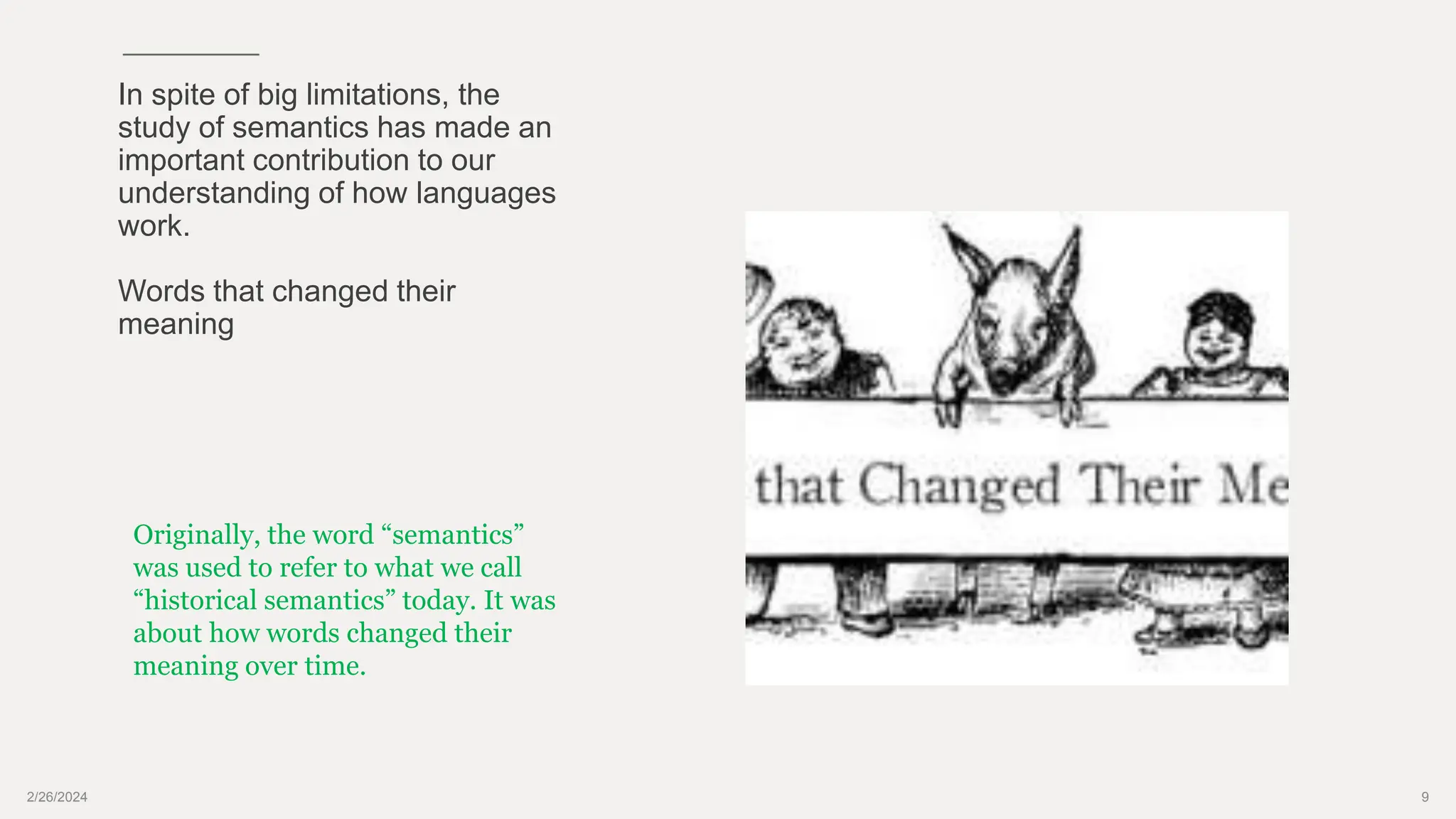
Words that changed their
meaning
Originally, the word “semantics”
was used to refer to what we call
“historical semantics” today. It was
about how words changed their
meaning over time.
2/26/2024 10
The word semantics did not
really catch on until the 1920s
when Richards and Ogden
published their famous
book, The Meaning of Meaning.
Today, Semantics is one of the
central areas of study in
Linguistics. After all, the whole
purpose of language is to
communicate meaning.
Today, we assume that
communication is the key
to language learning. Do
you agree with that?
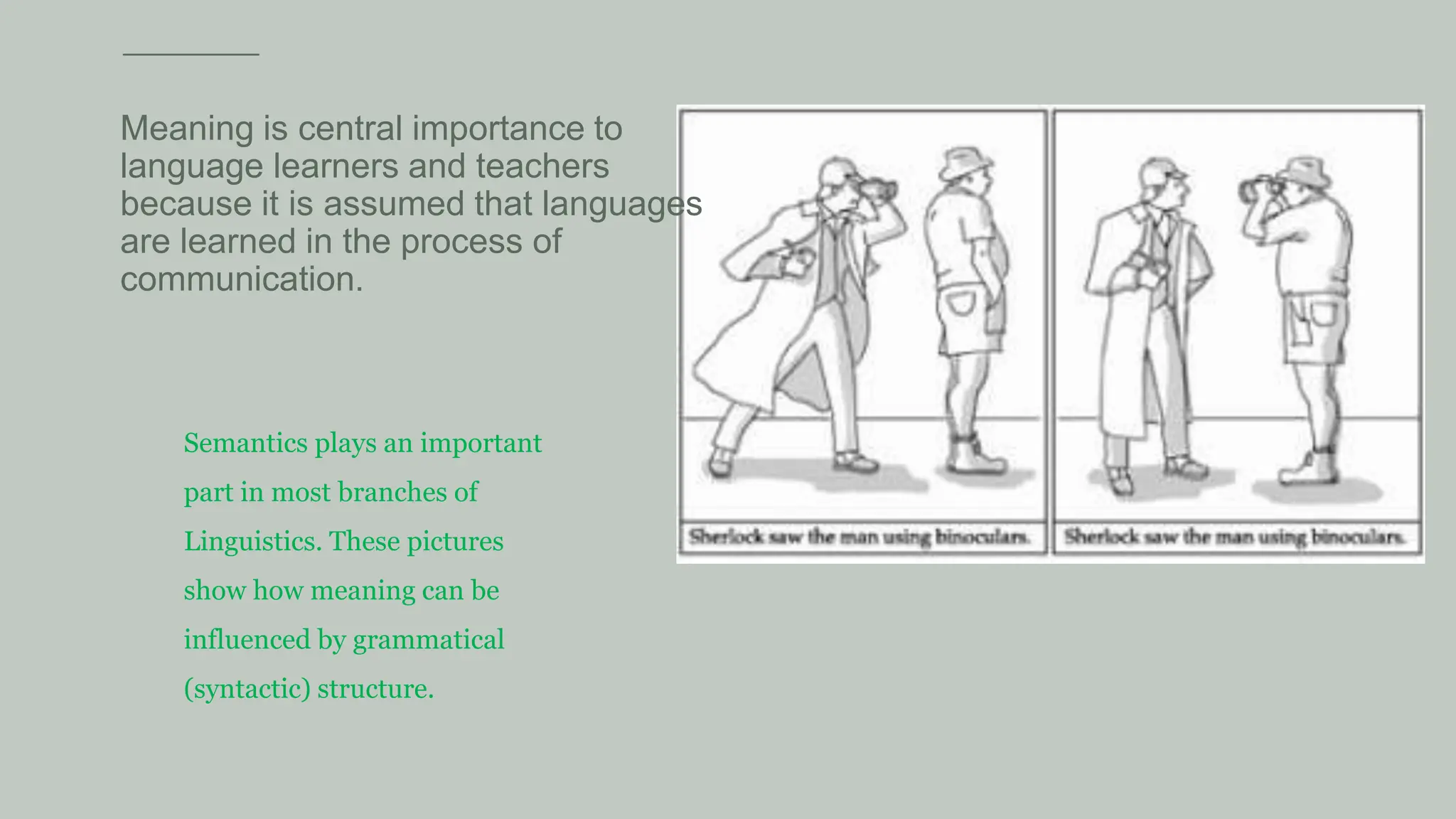
Semantics plays an important
part in most branches of
Linguistics. These pictures
show how meaning can be
influenced by grammatical
(syntactic) structure.
Meaning is central importance to
language learners and teachers
because it is assumed that languages
are learned in the process of
communication.
What is meaning?
• (in Linguistics) what a language expresses about the
world we live in or any possible or imaginary world
• English uses the verb “to mean” to refer to a
relationship involving at least one of three different
types of thing:
2/26/2024 13
Example…
2/26/2024 14
When I said ‘ Dublin has lots
of attractions’ I meant Dublin,
Ireland, not Dublin, Virginia.
In Sidney, ‘the bridge’ means
the Harbour Bridge.
‘Stout’ means ‘short and fat’
2/26/2024 15
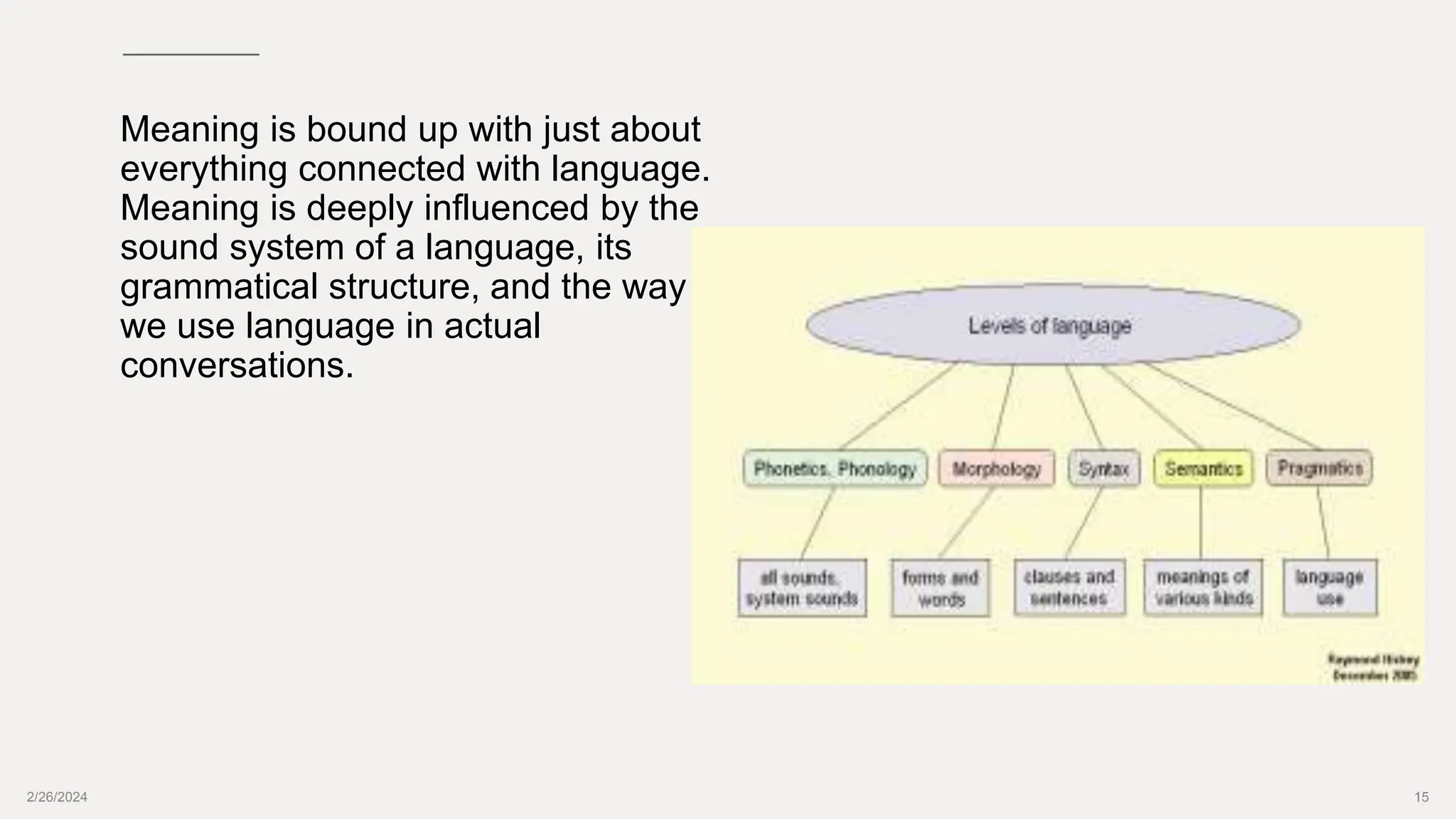
Meaning is bound up with just about
everything connected with language.
Meaning is deeply influenced by the
sound system of a language, its
grammatical structure, and the way
we use language in actual
conversations.
2/26/2024 16
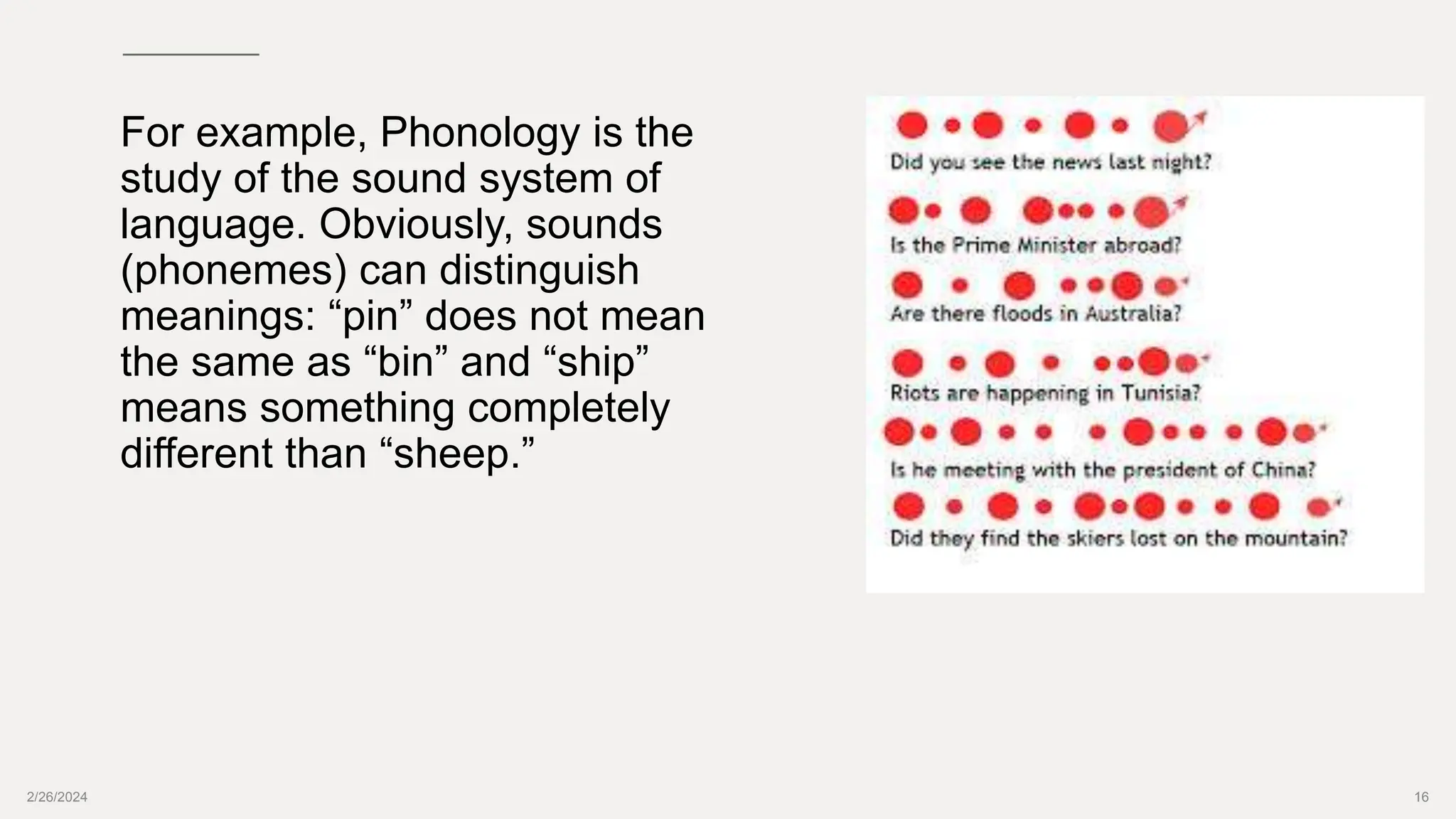
For example, Phonology is the
study of the sound system of
language. Obviously, sounds
(phonemes) can distinguish
meanings: “pin” does not mean
the same as “bin” and “ship”
means something completely
different than “sheep.”
2/26/2024 17
Add…
2/26/2024
18
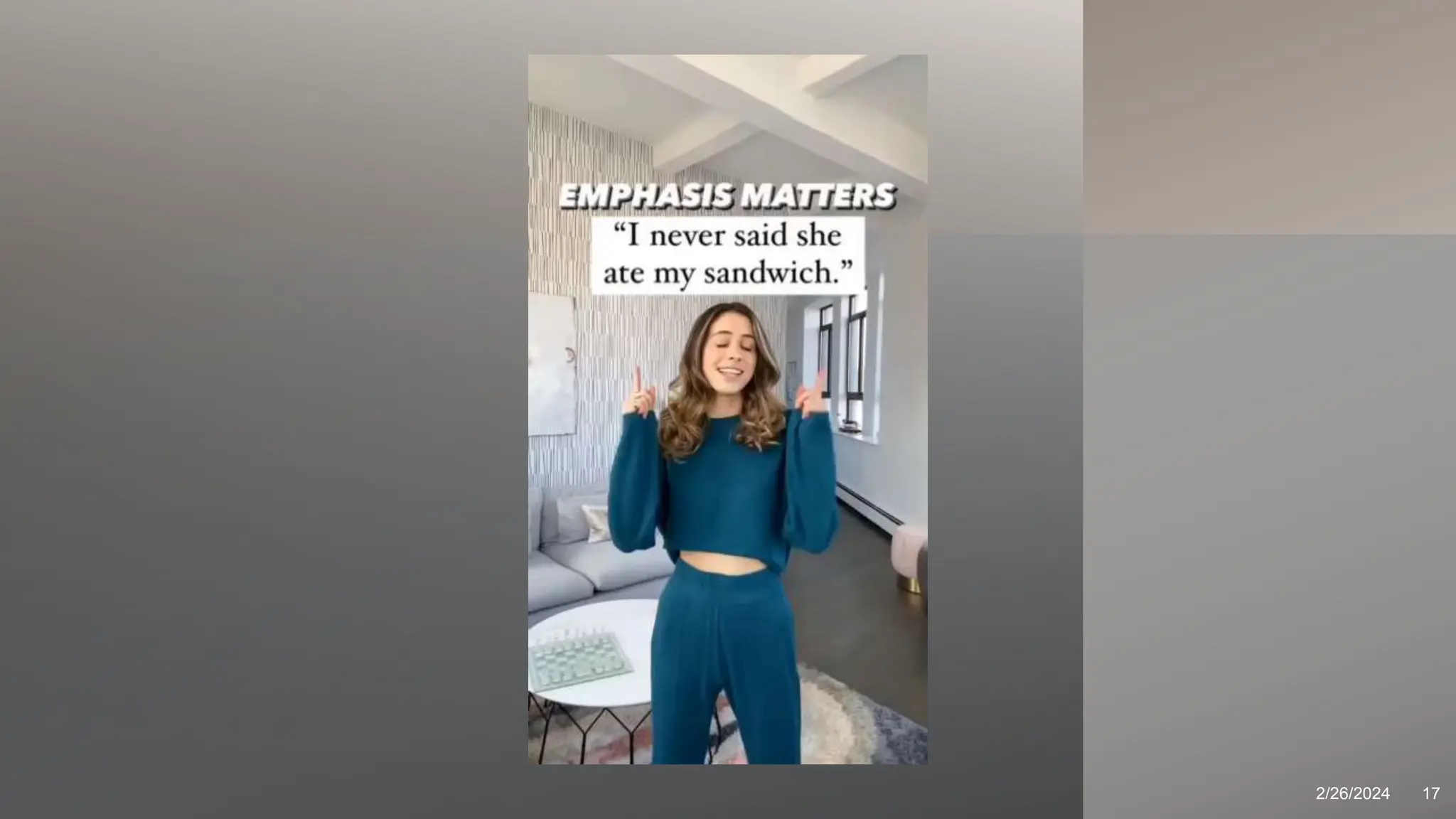
• Also, stress can change the meaning of words and sentences in big
ways: the word “contrast” has a different meaning depending on
whether you stress the first of the second syllable and a simple
sentence like “I didn’t eat the apple” has a different interpretation if
certain words are strongly stressed. Furthermore, tone can indicate a
question sentence rather than a declarative sentence.
2/26/2024 19
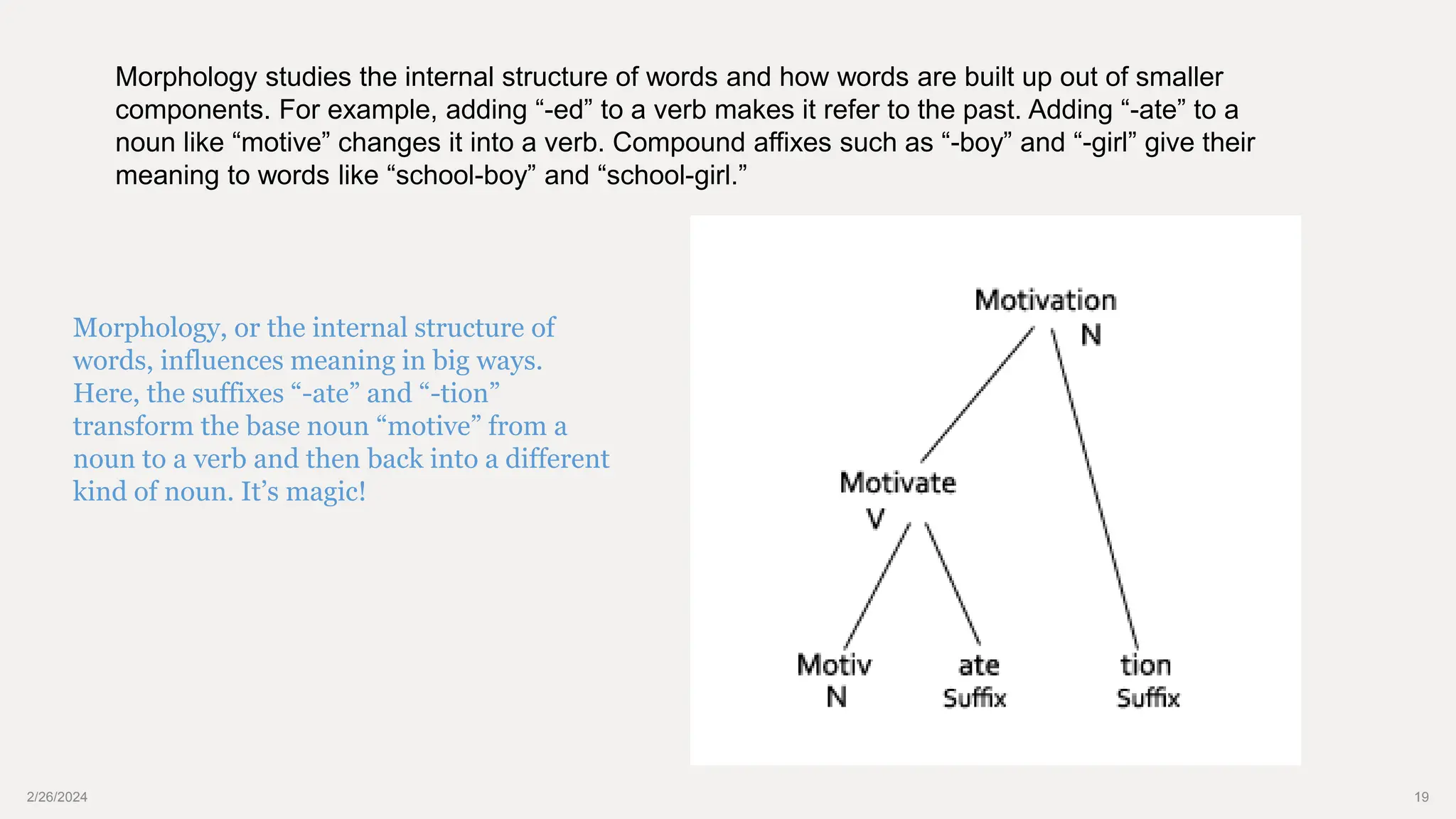
Morphology, or the internal structure of
words, influences meaning in big ways.
Here, the suffixes “-ate” and “-tion”
transform the base noun “motive” from a
noun to a verb and then back into a different
kind of noun. It’s magic!
Morphology studies the internal structure of words and how words are built up out of smaller
components. For example, adding “-ed” to a verb makes it refer to the past. Adding “-ate” to a
noun like “motive” changes it into a verb. Compound affixes such as “-boy” and “-girl” give their
meaning to words like “school-boy” and “school-girl.”
2/26/2024 20
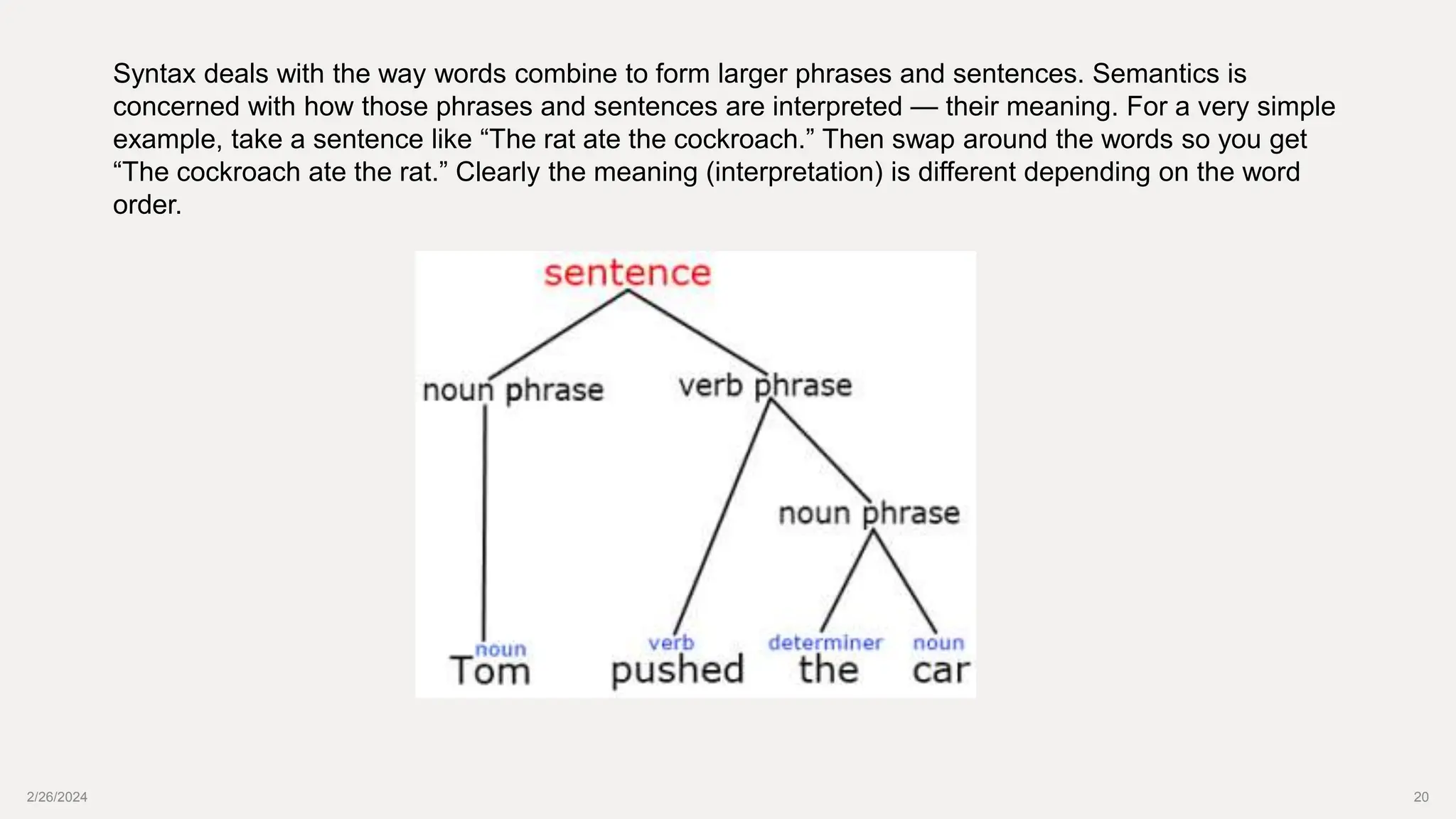
Syntax deals with the way words combine to form larger phrases and sentences. Semantics is
concerned with how those phrases and sentences are interpreted — their meaning. For a very simple
example, take a sentence like “The rat ate the cockroach.” Then swap around the words so you get
“The cockroach ate the rat.” Clearly the meaning (interpretation) is different depending on the word
order.
2/26/2024 21
Pragmatics, like Semantics, is also concerned with the transmission of meaning through
language. However, Pragmatics investigates the meanings that expressions have in particular
situations (contexts). For example, a sentence like “It’s hot in here” carries the meaning that the
temperature is high. However, in context, it could easily be taken as a request to open the window
or turn the heater off. In other words, “It’s hot in here” implies something else, not just that the
temperature is high.
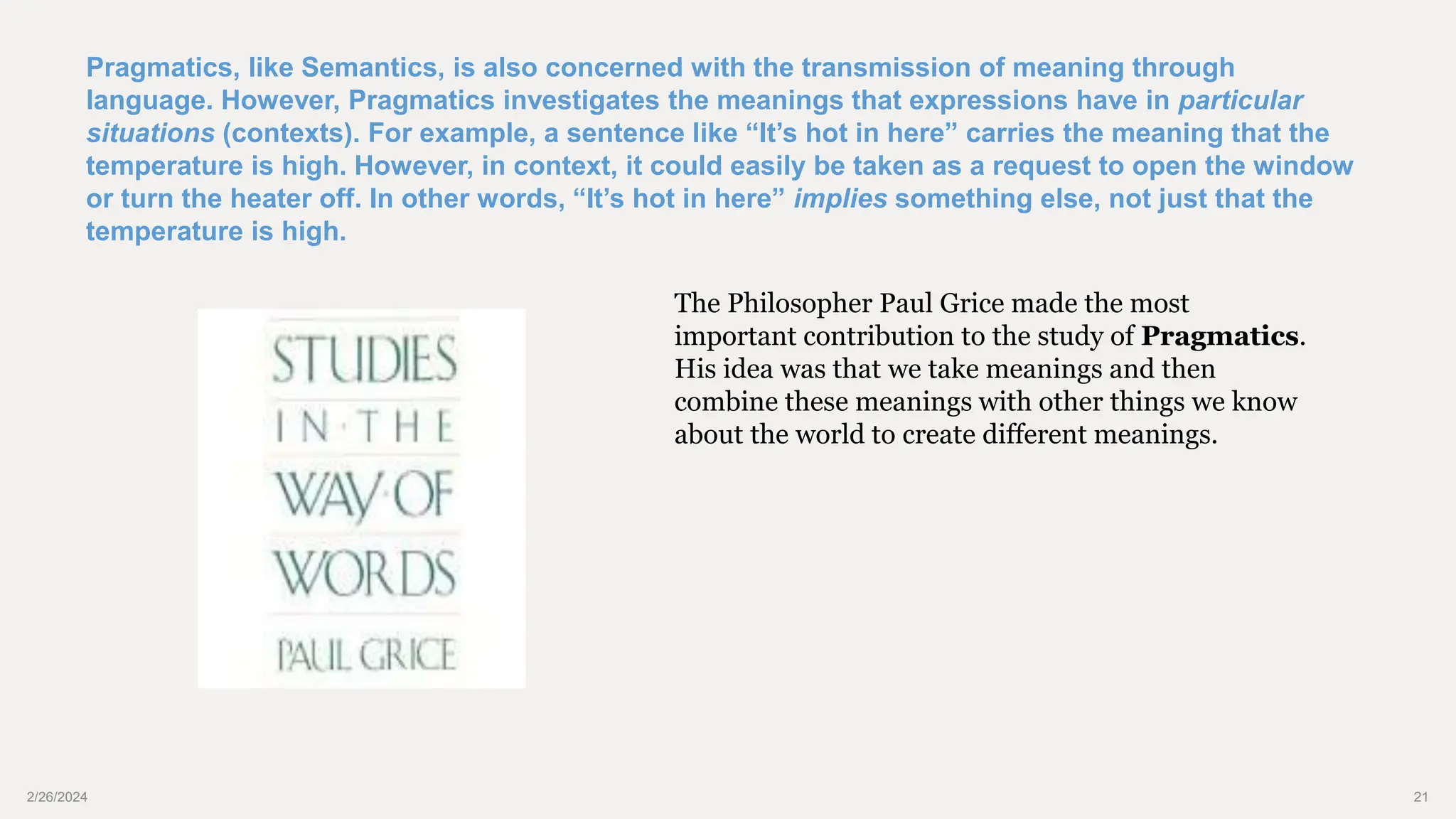
The Philosopher Paul Grice made the most
important contribution to the study of Pragmatics.
His idea was that we take meanings and then
combine these meanings with other things we know
about the world to create different meanings.
2/26/2024 22
• Stressing different
words in a sentence
can also make a
difference to how we
interpret things in
context.
Obviously, the way we stress words is an
important factor in different contexts. Go back to
the sentence “I didn’t eat the apple” and stress
different words again. Then think how the context
might change your interpretation of the sentence
depending on which words you stress.
What is
Semantics?
2/26/2024 23
The study of meaning is called
Semantics
Semantics comes from the ancient
Greek wordsemanticos, an adjective
meaning ‘relating to sign’, 0ne of the
original uses of sign is as a medical
term for symptoms that underlying
disease.
2/26/2024 24
Dictionary definition
Mental Images
Meaning and Preferences
Meaning and Truth
Meaning and Language Use
2/26/2024 25
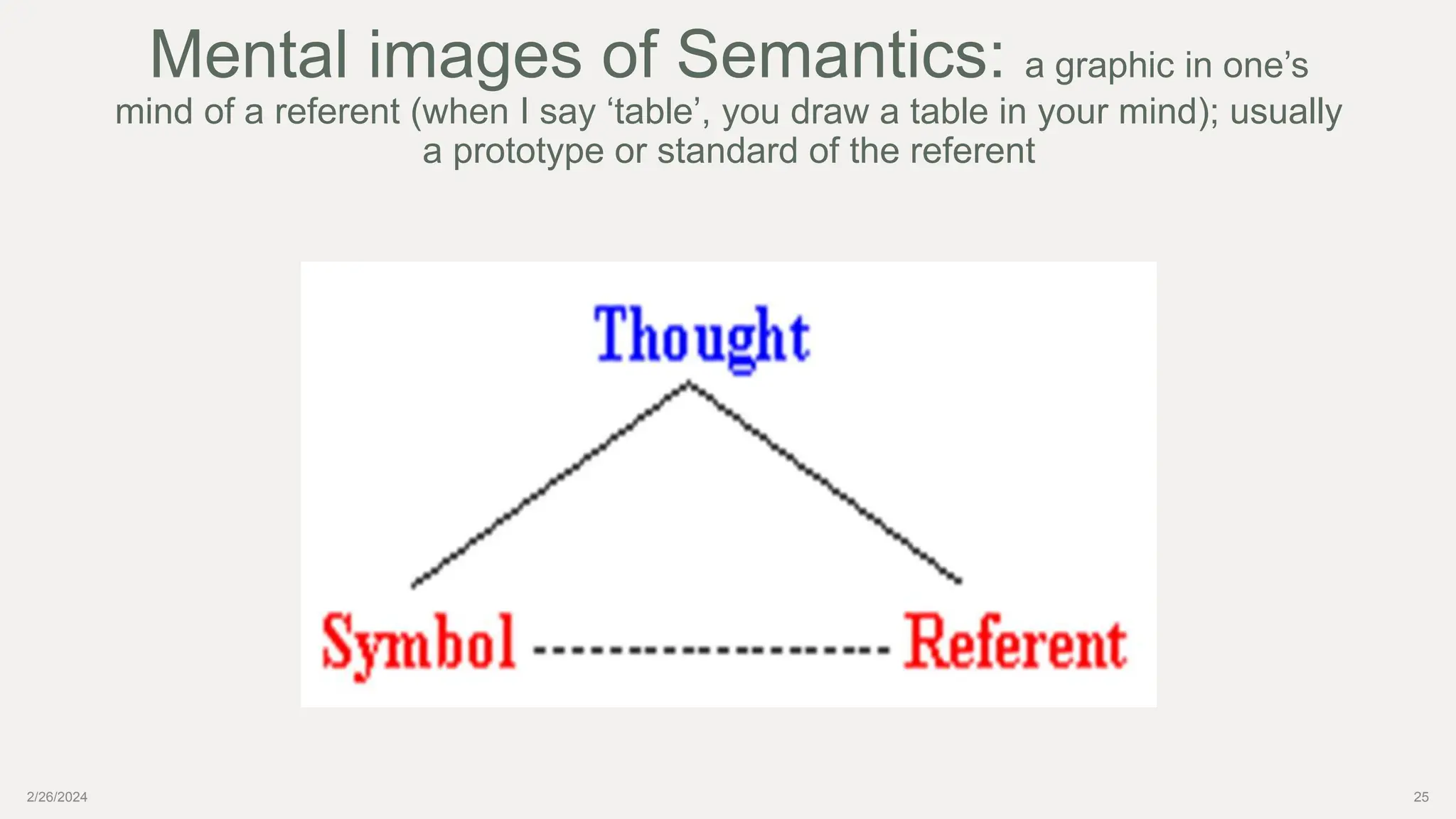
Mental images of Semantics: a graphic in one’s
mind of a referent (when I say ‘table’, you draw a table in your mind); usually
a prototype or standard of the referent
Meaning and
Preferences
2/26/2024
• semantic preference generally remains relatively
closely tied to the phenomenon of collocation. As
we have seen, it describes a phenomenon
whereby a particular item x collocates frequently,
not with another item y, but with a series of items
which belong to a semantic set. (Partington, 2004,
p.150)
• Ex: red: about color
• Large: has quantity and size
26
Meaning
and
Language
use
2/26/2024 27
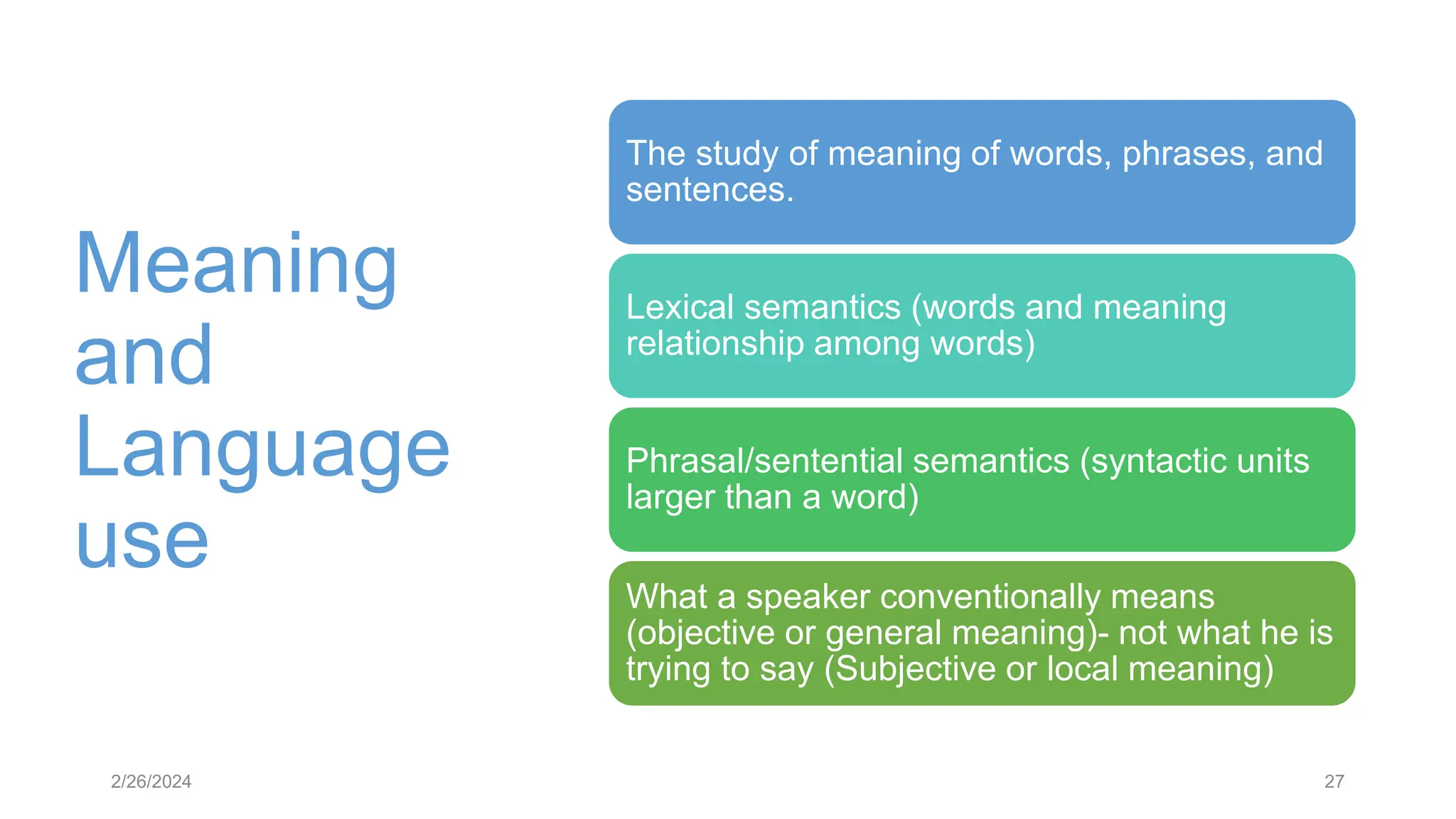
The study of meaning of words, phrases, and
sentences.
Lexical semantics (words and meaning
relationship among words)
Phrasal/sentential semantics (syntactic units
larger than a word)
What a speaker conventionally means
(objective or general meaning)- not what he is
trying to say (Subjective or local meaning)
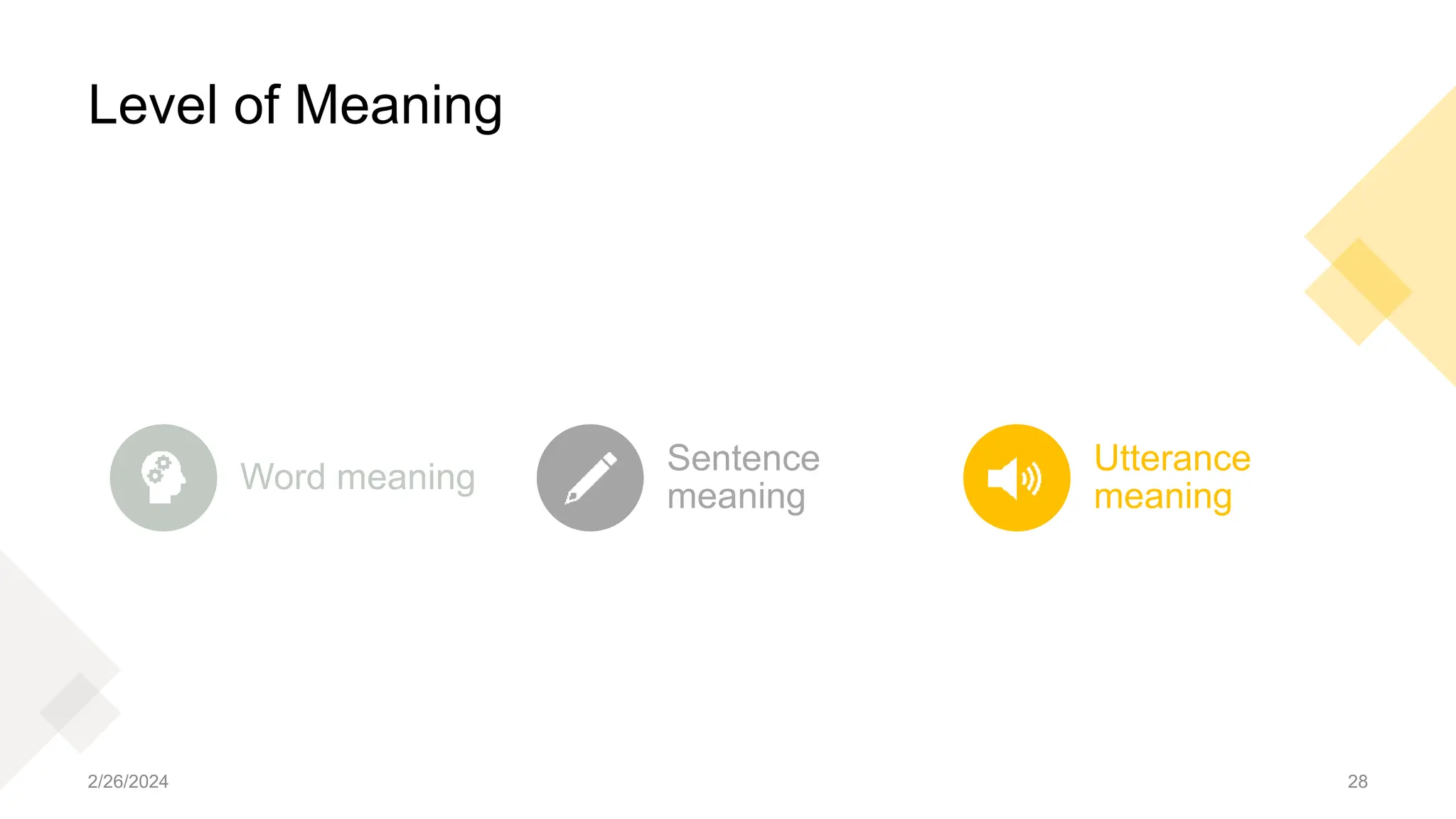
Level of Meaning
2/26/2024 28
Word meaning
Sentence
meaning
Utterance
meaning
Let see the
difference
2/26/2024 29
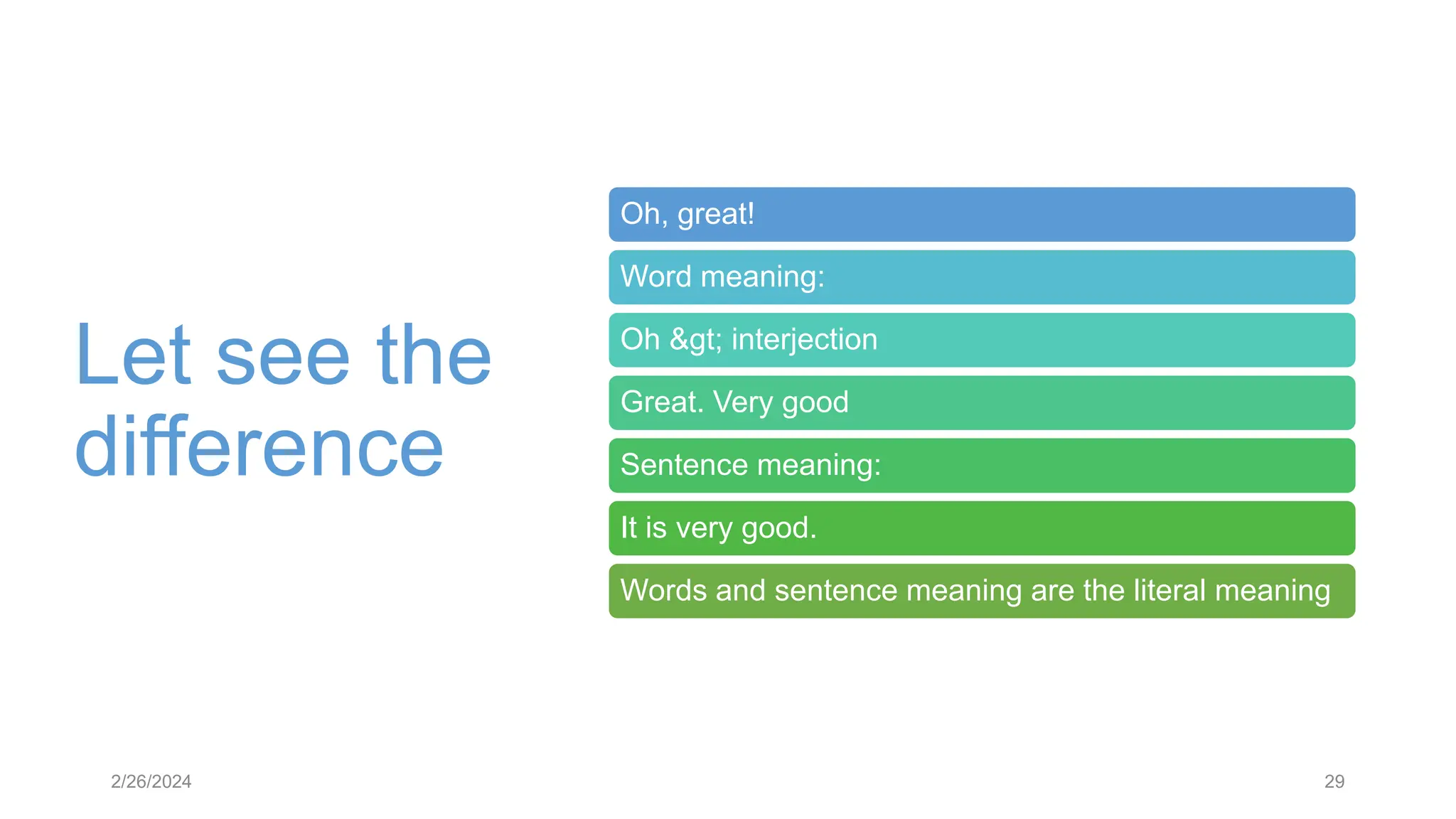
Oh, great!
Word meaning:
Oh > interjection
Great. Very good
Sentence meaning:
It is very good.
Words and sentence meaning are the literal meaning
Now let’s
see
sentence
meaning
VS
utterance
meaning
2/26/2024 30
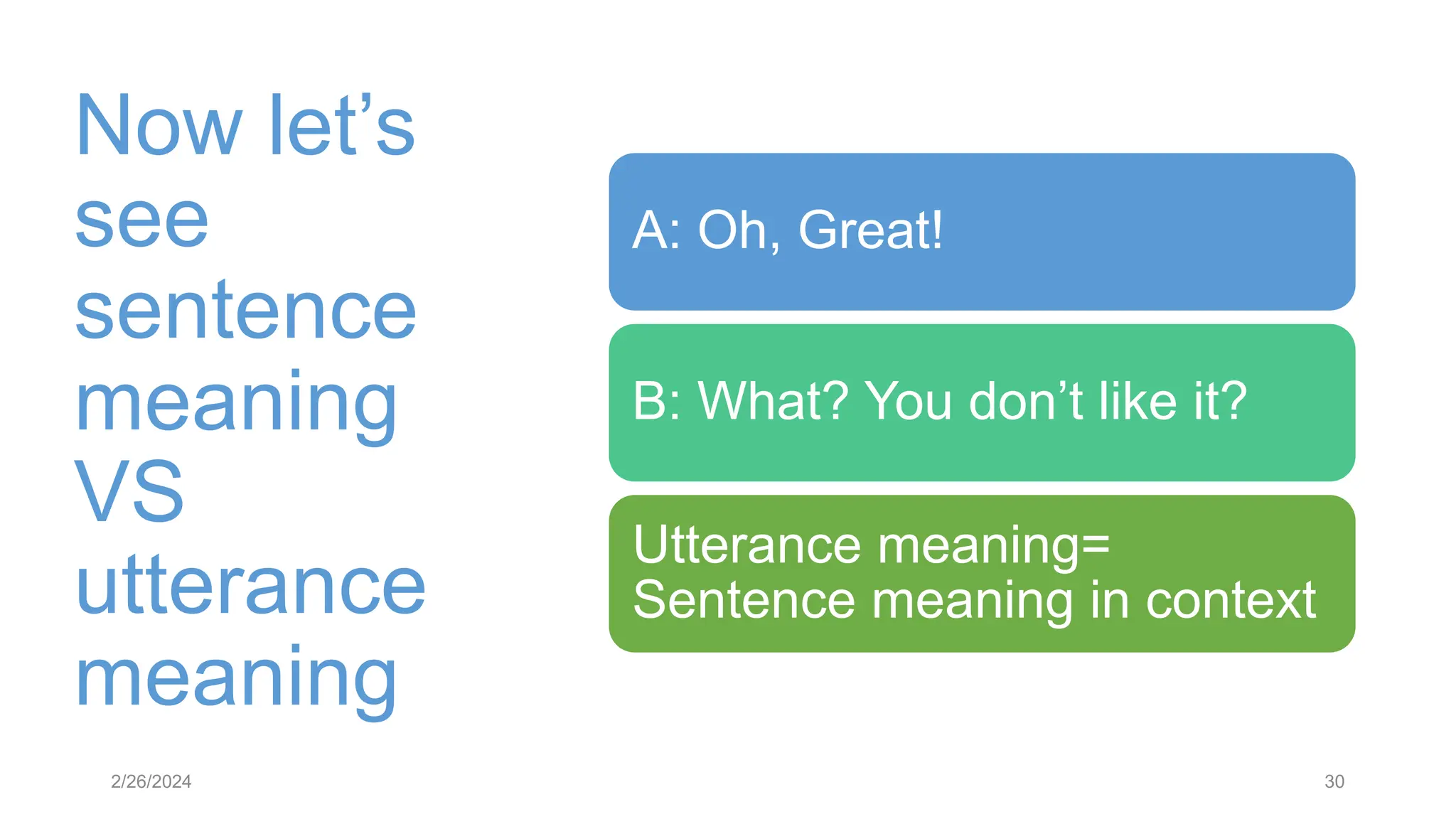
A: Oh, Great!
B: What? You don’t like it?
Utterance meaning=
Sentence meaning in context
Local
Example
2/26/2024 31
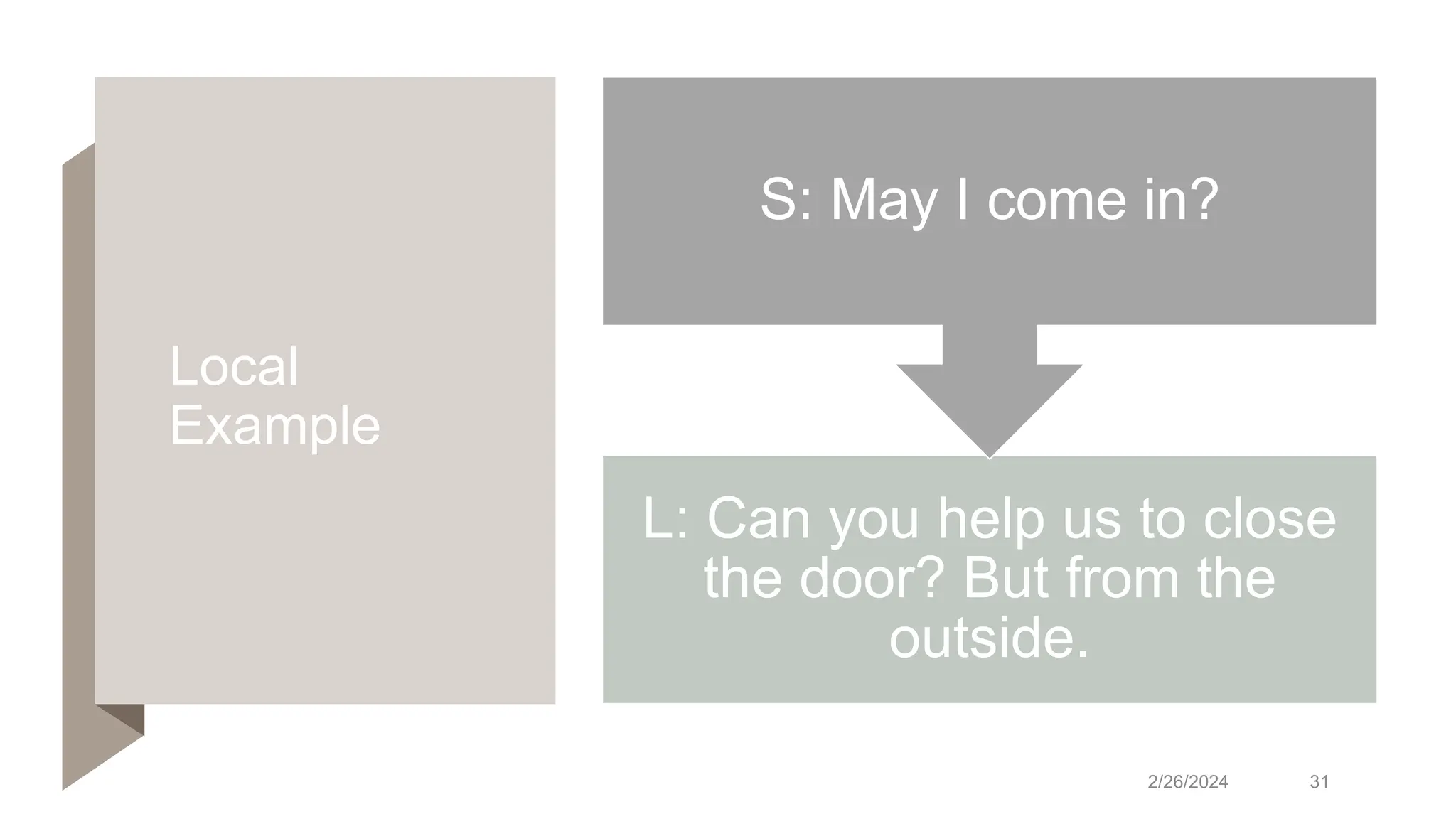
L: Can you help us to close
the door? But from the
outside.
S: May I come in?
Are Sentence
meaning and
Utterance
meaning
always
different?
2/26/2024 32
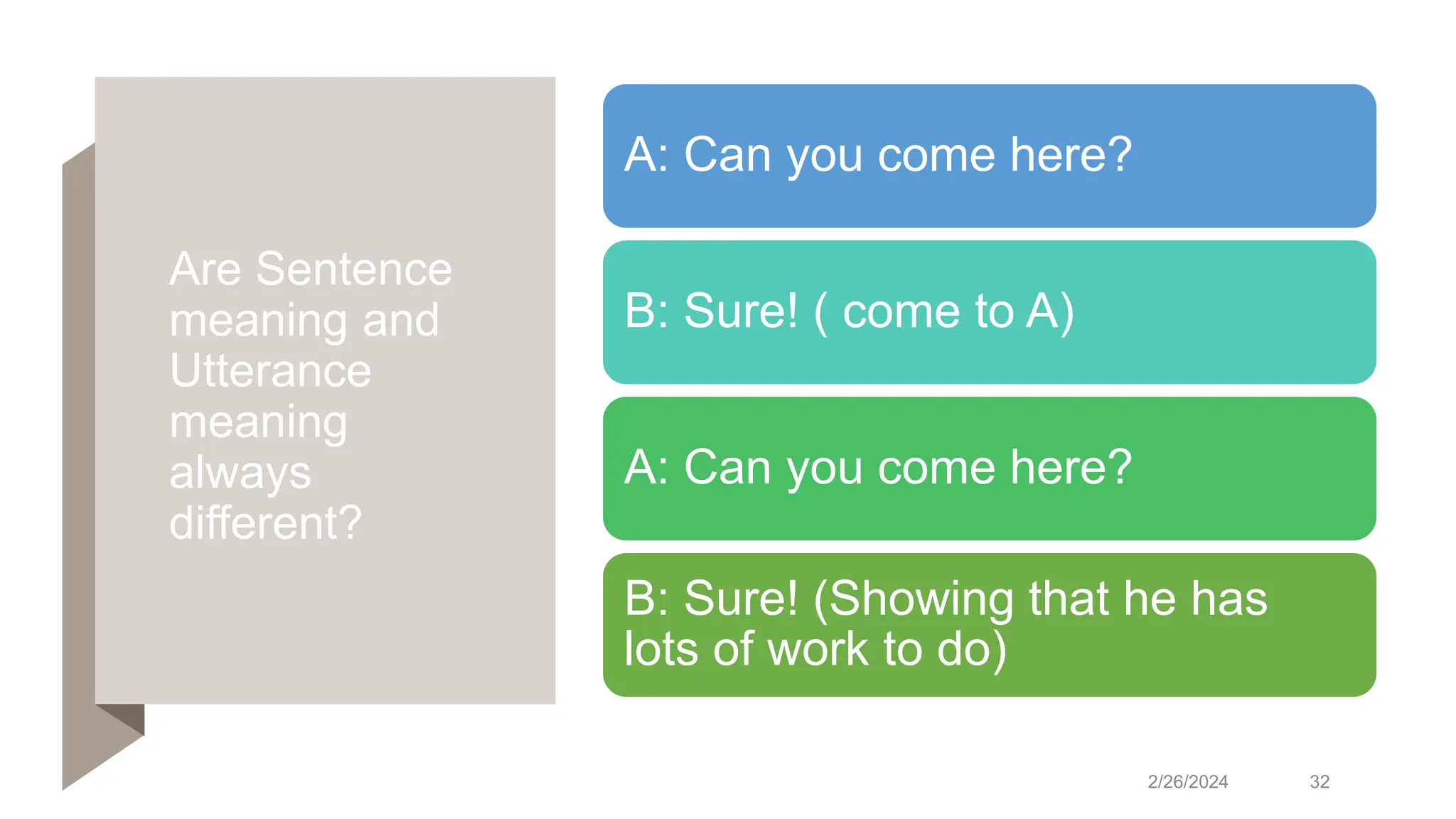
A: Can you come here?
B: Sure! ( come to A)
A: Can you come here?
B: Sure! (Showing that he has
lots of work to do)
2/26/2024 33
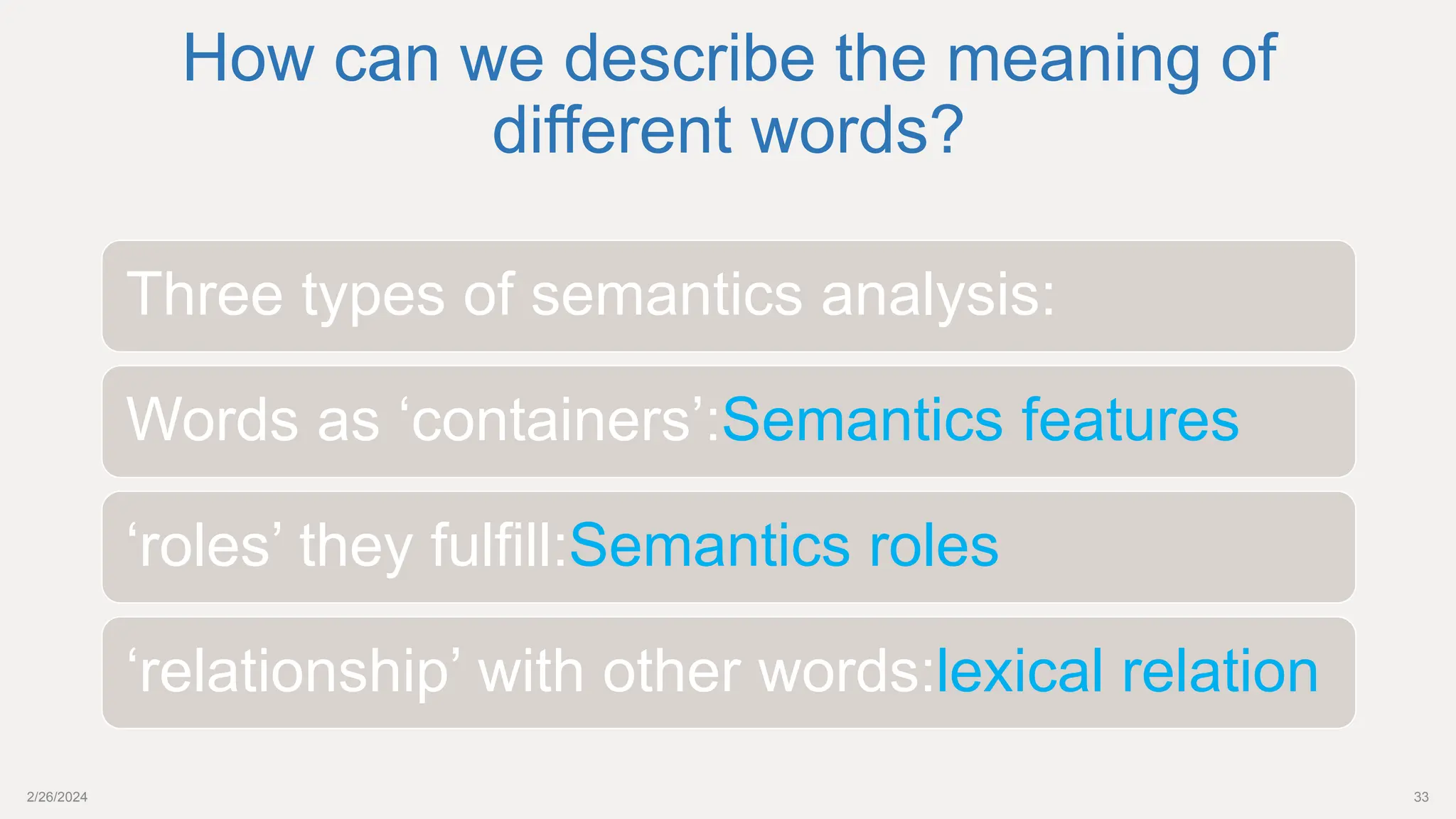
Three types of semantics analysis:
Words as ‘containers’:Semantics features
‘roles’ they fulfill:Semantics roles
‘relationship’ with other words:lexical relation
How can we describe the meaning of
different words?
Semantic
Features
2/26/2024 34
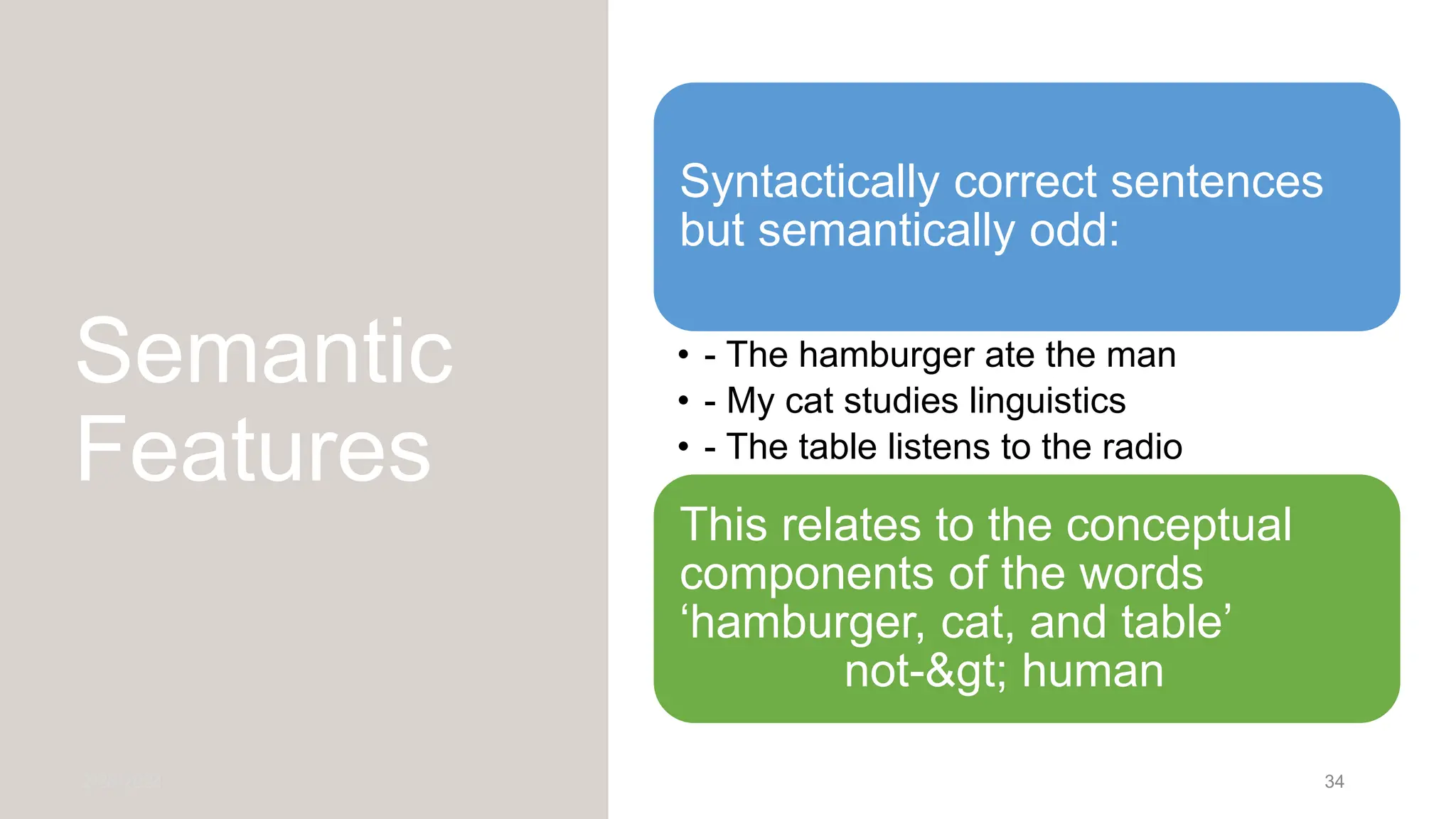
Syntactically correct sentences
but semantically odd:
• - The hamburger ate the man
• - My cat studies linguistics
• - The table listens to the radio
This relates to the conceptual
components of the words
‘hamburger, cat, and table’
not-> human
Semantic Features
2/26/2024 35
Semantic properties: The components of meaning
of a word.
A notational device for expressing the presence or
absence of semantic properties by pluses (+) and
minuses (-).
Example of componential analysis:
• babyis [+ young], [+ human], [– abstract].
2/26/2024 36
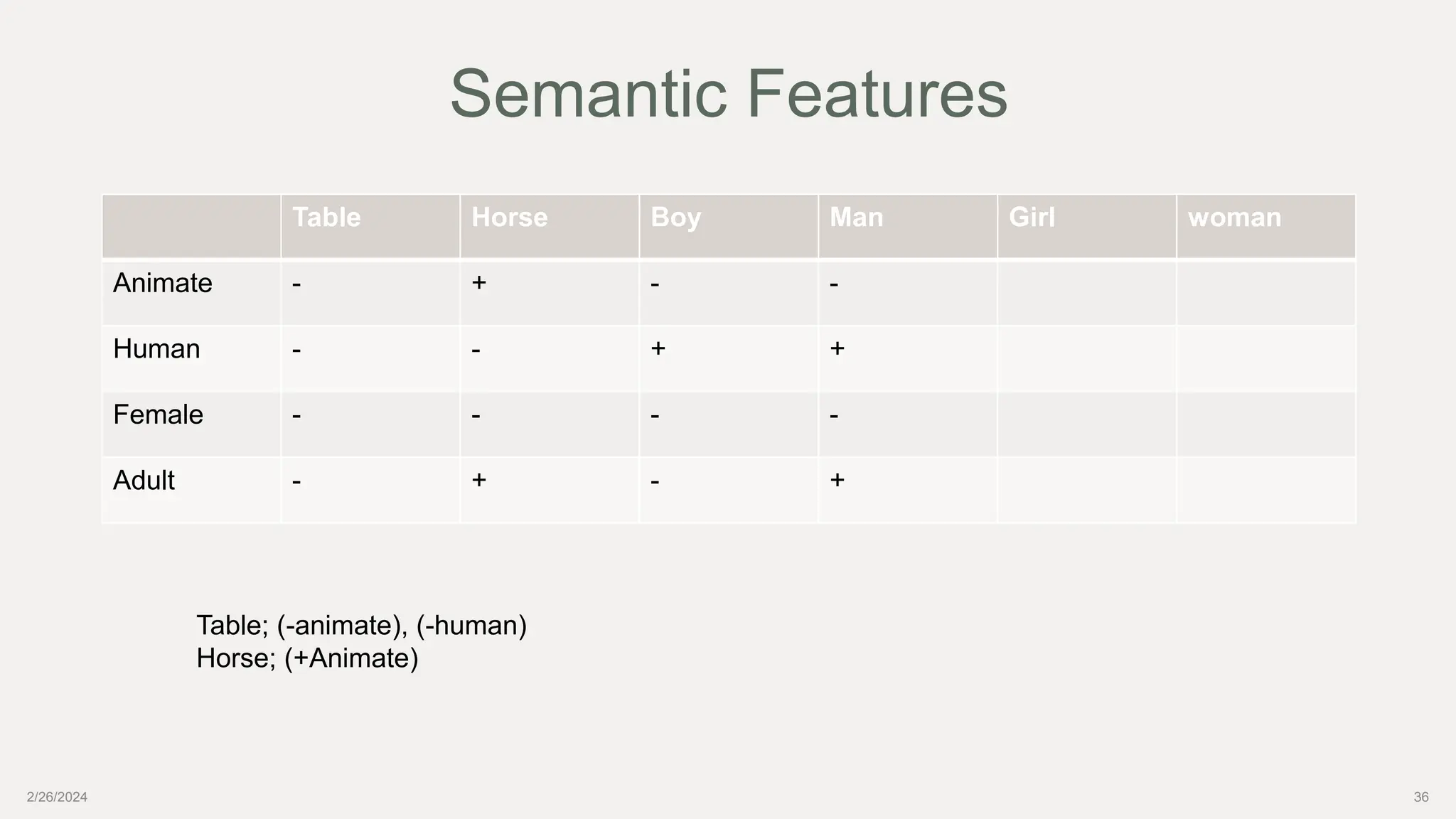
Table Horse Boy Man Girl woman
Animate - + - -
Human - - + +
Female - - - -
Adult - + - +
Semantic Features
Table; (-animate), (-human)
Horse; (+Animate)
Identify the features
(1)
2/26/2024 37
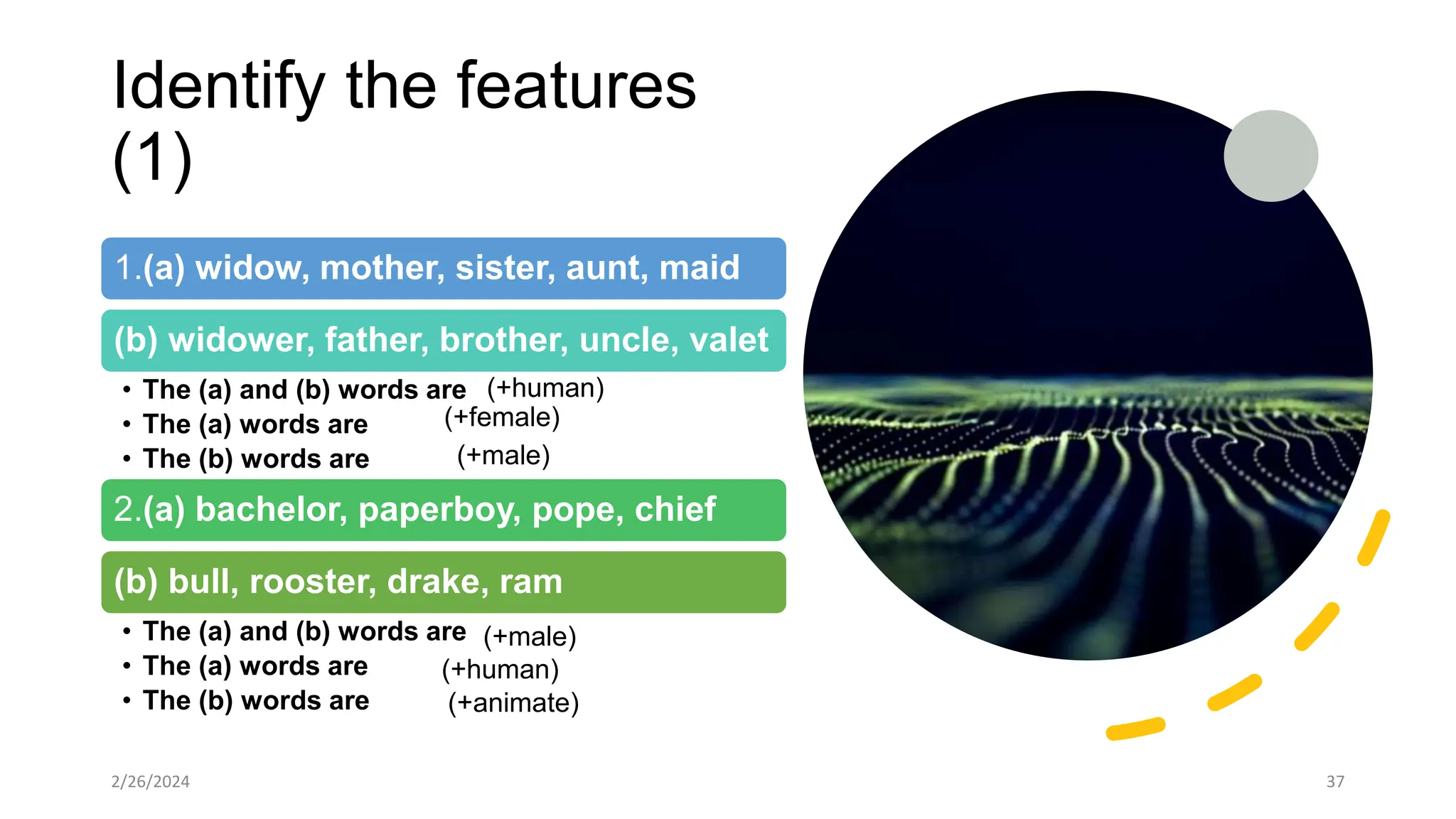
1.(a) widow, mother, sister, aunt, maid
(b) widower, father, brother, uncle, valet
• The (a) and (b) words are
• The (a) words are
• The (b) words are
2.(a) bachelor, paperboy, pope, chief
(b) bull, rooster, drake, ram
• The (a) and (b) words are
• The (a) words are
• The (b) words are (+animate)
(+human)
(+male)
(+male)
(+female)
(+human)
Identify
the
features
(2)
2/26/2024 38
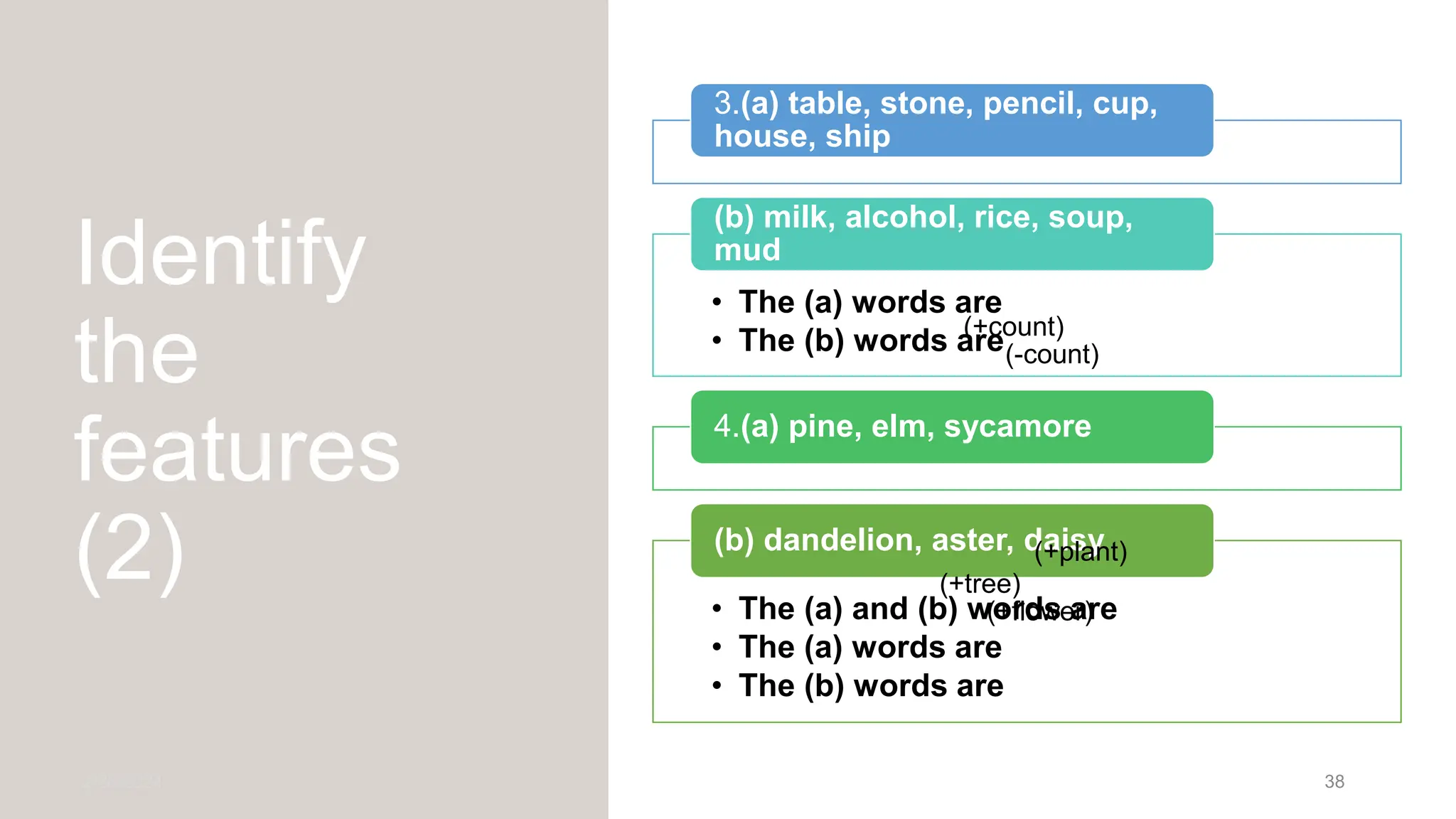
3.(a) table, stone, pencil, cup,
house, ship
• The (a) words are
• The (b) words are
(b) milk, alcohol, rice, soup,
mud
4.(a) pine, elm, sycamore
• The (a) and (b) words are
• The (a) words are
• The (b) words are
(b) dandelion, aster, daisy
(+flower)
(+tree)
(+plant)
(-count)
(+count)
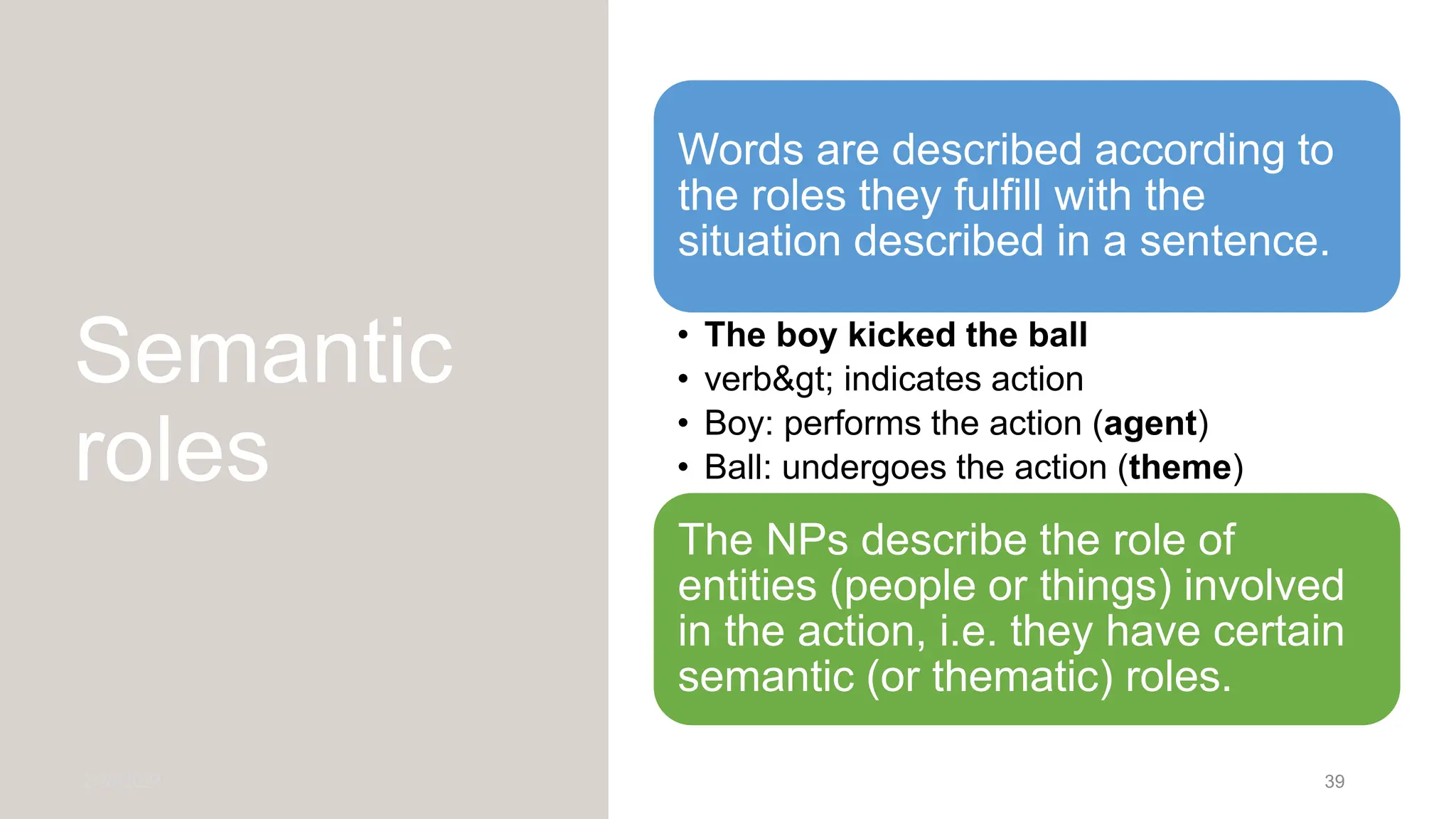
Semantic
roles
2/26/2024 39
Words are described according to
the roles they fulfill with the
situation described in a sentence.
• The boy kicked the ball
• verb> indicates action
• Boy: performs the action (agent)
• Ball: undergoes the action (theme)
The NPs describe the role of
entities (people or things) involved
in the action, i.e. they have certain
semantic (or thematic) roles.
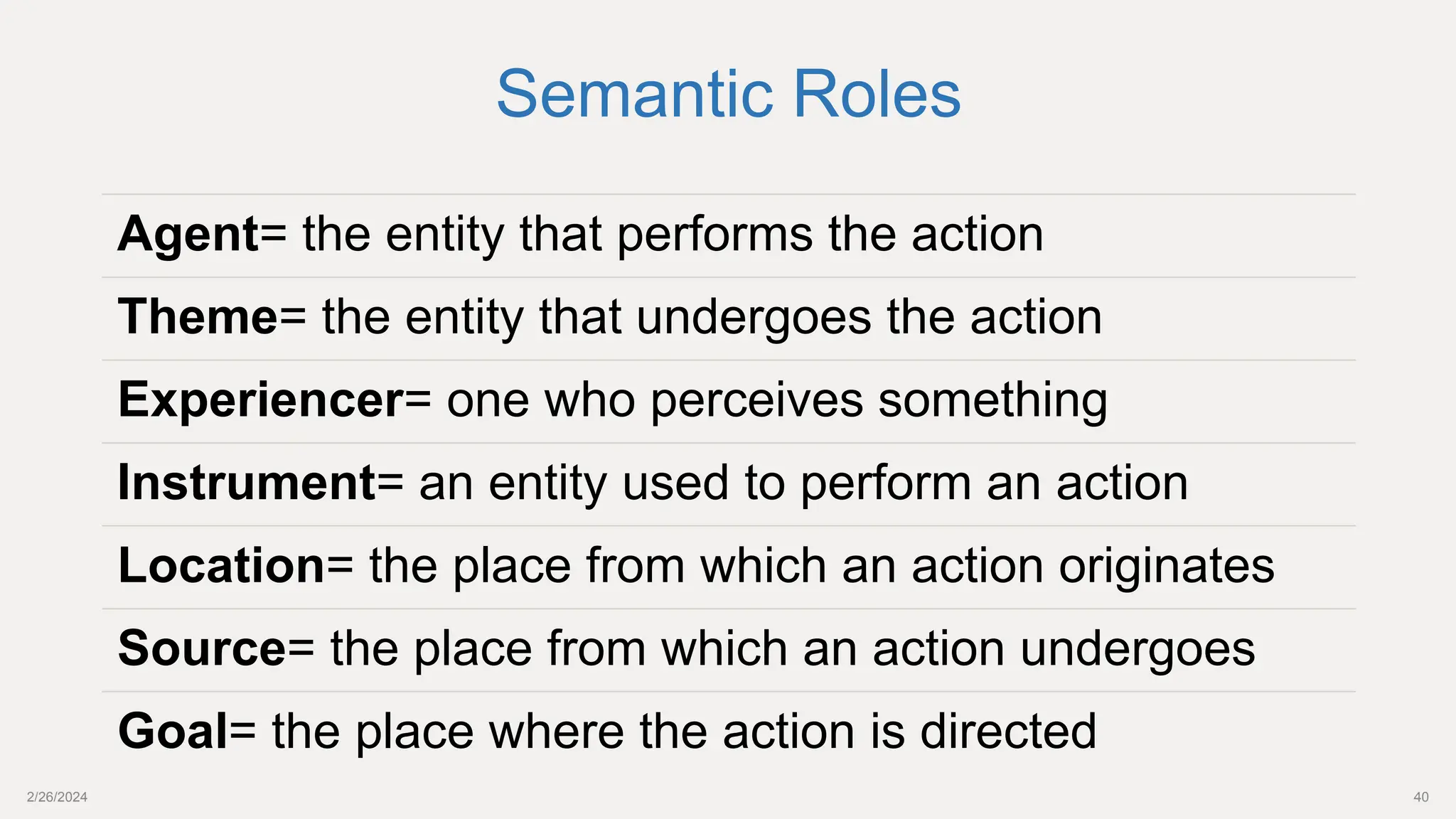
2/26/2024 40
Agent= the entity that performs the action
Theme= the entity that undergoes the action
Experiencer= one who perceives something
Instrument= an entity used to perform an action
Location= the place from which an action originates
Source= the place from which an action undergoes
Goal= the place where the action is directed
Semantic Roles
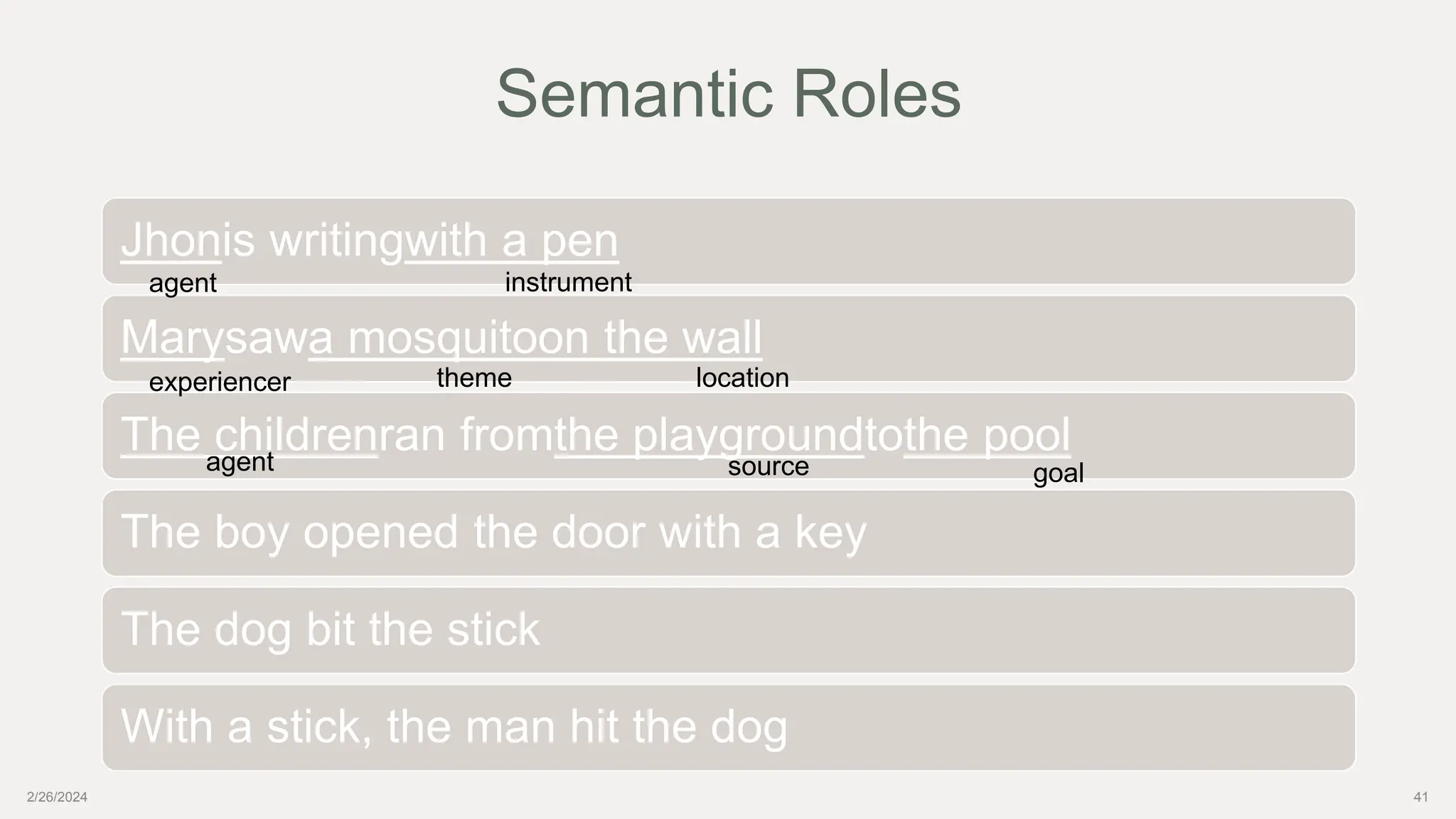
2/26/2024 41
Jhonis writingwith a pen
Marysawa mosquitoon the wall
The childrenran fromthe playgroundtothe pool
The boy opened the door with a key
The dog bit the stick
With a stick, the man hit the dog
Semantic Roles
instrument
agent
theme
experiencer
goal
location
agent source
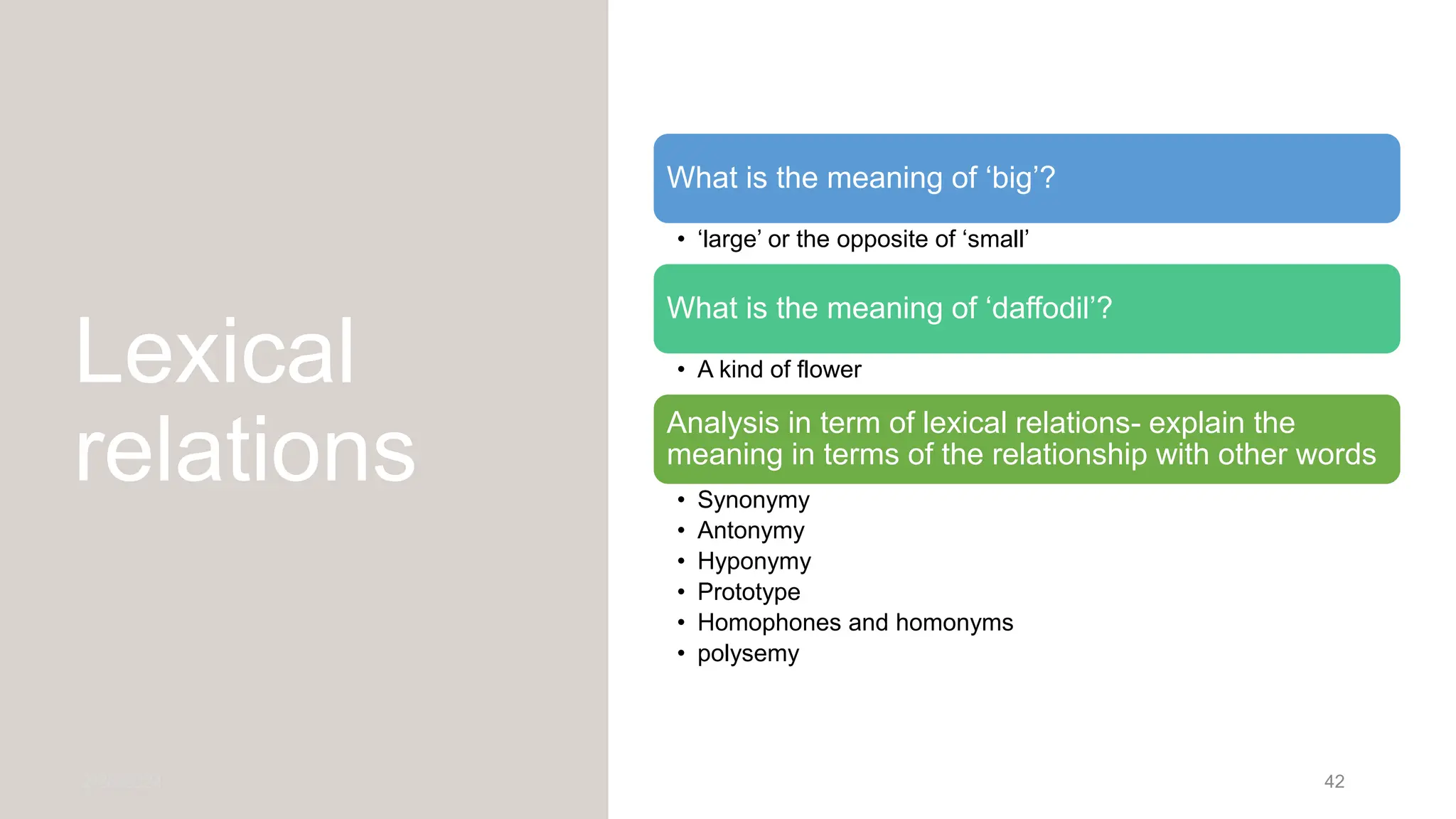
Lexical
relations
2/26/2024 42
What is the meaning of ‘big’?
• ‘large’ or the opposite of ‘small’
What is the meaning of ‘daffodil’?
• A kind of flower
Analysis in term of lexical relations- explain the
meaning in terms of the relationship with other words
• Synonymy
• Antonymy
• Hyponymy
• Prototype
• Homophones and homonyms
• polysemy
Summary
2/26/2024 43
05
Closing
Thank You
honesty.trila@gmail.com
2/26/2024 44

PPT pragmatics and semantics bahasa inggris.pptx

  • 1.
  • 2.
    Agenda 01 Introduction 02 MOU 03RPKPS 04 Marks 05 Topic 2/26/2024 2
  • 3.
    01 Introduction Honesty Trila Email: honesty.trila@gmail.com S1:IAIN Imam Bonjol Padang (TBI’05) S2: Universitas Negeri Padang Experience: Been teaching English at IAIN (UIN) Imam Bonjol Padang, since 2011 Currently: Asst. Prof. Dr. Martin Kustati, M.Pd 2/26/2024 3
  • 4.
  • 5.
    See RPKPS ofSemantics and Pragmatics A satisfied learners 2/26/2024 5
  • 6.
  • 7.
  • 8.
    Syntax, Semantics, and Pragmatics Language (Linguistics) •Sounds; Phonology • Form; Morphology, Syntax • Meaning; Semantics and Pragmatics • Semantics; The study of meaning in Language • Pragmatics; The study of what people mean by the language the use 2/26/2024 8
  • 9.
    2/26/2024 9 In spiteof big limitations, the study of semantics has made an important contribution to our understanding of how languages work. Words that changed their meaning Originally, the word “semantics” was used to refer to what we call “historical semantics” today. It was about how words changed their meaning over time.
  • 10.
    2/26/2024 10 The wordsemantics did not really catch on until the 1920s when Richards and Ogden published their famous book, The Meaning of Meaning. Today, Semantics is one of the central areas of study in Linguistics. After all, the whole purpose of language is to communicate meaning.
  • 11.
    Today, we assumethat communication is the key to language learning. Do you agree with that?
  • 12.
    Semantics plays animportant part in most branches of Linguistics. These pictures show how meaning can be influenced by grammatical (syntactic) structure. Meaning is central importance to language learners and teachers because it is assumed that languages are learned in the process of communication.
  • 13.
    What is meaning? •(in Linguistics) what a language expresses about the world we live in or any possible or imaginary world • English uses the verb “to mean” to refer to a relationship involving at least one of three different types of thing: 2/26/2024 13
  • 14.
    Example… 2/26/2024 14 When Isaid ‘ Dublin has lots of attractions’ I meant Dublin, Ireland, not Dublin, Virginia. In Sidney, ‘the bridge’ means the Harbour Bridge. ‘Stout’ means ‘short and fat’
  • 15.
    2/26/2024 15 Meaning isbound up with just about everything connected with language. Meaning is deeply influenced by the sound system of a language, its grammatical structure, and the way we use language in actual conversations.
  • 16.
    2/26/2024 16 For example,Phonology is the study of the sound system of language. Obviously, sounds (phonemes) can distinguish meanings: “pin” does not mean the same as “bin” and “ship” means something completely different than “sheep.”
  • 17.
  • 18.
    Add… 2/26/2024 18 • Also, stresscan change the meaning of words and sentences in big ways: the word “contrast” has a different meaning depending on whether you stress the first of the second syllable and a simple sentence like “I didn’t eat the apple” has a different interpretation if certain words are strongly stressed. Furthermore, tone can indicate a question sentence rather than a declarative sentence.
  • 19.
    2/26/2024 19 Morphology, orthe internal structure of words, influences meaning in big ways. Here, the suffixes “-ate” and “-tion” transform the base noun “motive” from a noun to a verb and then back into a different kind of noun. It’s magic! Morphology studies the internal structure of words and how words are built up out of smaller components. For example, adding “-ed” to a verb makes it refer to the past. Adding “-ate” to a noun like “motive” changes it into a verb. Compound affixes such as “-boy” and “-girl” give their meaning to words like “school-boy” and “school-girl.”
  • 20.
    2/26/2024 20 Syntax dealswith the way words combine to form larger phrases and sentences. Semantics is concerned with how those phrases and sentences are interpreted — their meaning. For a very simple example, take a sentence like “The rat ate the cockroach.” Then swap around the words so you get “The cockroach ate the rat.” Clearly the meaning (interpretation) is different depending on the word order.
  • 21.
    2/26/2024 21 Pragmatics, likeSemantics, is also concerned with the transmission of meaning through language. However, Pragmatics investigates the meanings that expressions have in particular situations (contexts). For example, a sentence like “It’s hot in here” carries the meaning that the temperature is high. However, in context, it could easily be taken as a request to open the window or turn the heater off. In other words, “It’s hot in here” implies something else, not just that the temperature is high. The Philosopher Paul Grice made the most important contribution to the study of Pragmatics. His idea was that we take meanings and then combine these meanings with other things we know about the world to create different meanings.
  • 22.
    2/26/2024 22 • Stressingdifferent words in a sentence can also make a difference to how we interpret things in context. Obviously, the way we stress words is an important factor in different contexts. Go back to the sentence “I didn’t eat the apple” and stress different words again. Then think how the context might change your interpretation of the sentence depending on which words you stress.
  • 23.
    What is Semantics? 2/26/2024 23 Thestudy of meaning is called Semantics Semantics comes from the ancient Greek wordsemanticos, an adjective meaning ‘relating to sign’, 0ne of the original uses of sign is as a medical term for symptoms that underlying disease.
  • 24.
    2/26/2024 24 Dictionary definition MentalImages Meaning and Preferences Meaning and Truth Meaning and Language Use
  • 25.
    2/26/2024 25 Mental imagesof Semantics: a graphic in one’s mind of a referent (when I say ‘table’, you draw a table in your mind); usually a prototype or standard of the referent
  • 26.
    Meaning and Preferences 2/26/2024 • semanticpreference generally remains relatively closely tied to the phenomenon of collocation. As we have seen, it describes a phenomenon whereby a particular item x collocates frequently, not with another item y, but with a series of items which belong to a semantic set. (Partington, 2004, p.150) • Ex: red: about color • Large: has quantity and size 26
  • 27.
    Meaning and Language use 2/26/2024 27 The studyof meaning of words, phrases, and sentences. Lexical semantics (words and meaning relationship among words) Phrasal/sentential semantics (syntactic units larger than a word) What a speaker conventionally means (objective or general meaning)- not what he is trying to say (Subjective or local meaning)
  • 28.
    Level of Meaning 2/26/202428 Word meaning Sentence meaning Utterance meaning
  • 29.
    Let see the difference 2/26/202429 Oh, great! Word meaning: Oh > interjection Great. Very good Sentence meaning: It is very good. Words and sentence meaning are the literal meaning
  • 30.
    Now let’s see sentence meaning VS utterance meaning 2/26/2024 30 A:Oh, Great! B: What? You don’t like it? Utterance meaning= Sentence meaning in context
  • 31.
    Local Example 2/26/2024 31 L: Canyou help us to close the door? But from the outside. S: May I come in?
  • 32.
    Are Sentence meaning and Utterance meaning always different? 2/26/202432 A: Can you come here? B: Sure! ( come to A) A: Can you come here? B: Sure! (Showing that he has lots of work to do)
  • 33.
    2/26/2024 33 Three typesof semantics analysis: Words as ‘containers’:Semantics features ‘roles’ they fulfill:Semantics roles ‘relationship’ with other words:lexical relation How can we describe the meaning of different words?
  • 34.
    Semantic Features 2/26/2024 34 Syntactically correctsentences but semantically odd: • - The hamburger ate the man • - My cat studies linguistics • - The table listens to the radio This relates to the conceptual components of the words ‘hamburger, cat, and table’ not-> human
  • 35.
    Semantic Features 2/26/2024 35 Semanticproperties: The components of meaning of a word. A notational device for expressing the presence or absence of semantic properties by pluses (+) and minuses (-). Example of componential analysis: • babyis [+ young], [+ human], [– abstract].
  • 36.
    2/26/2024 36 Table HorseBoy Man Girl woman Animate - + - - Human - - + + Female - - - - Adult - + - + Semantic Features Table; (-animate), (-human) Horse; (+Animate)
  • 37.
    Identify the features (1) 2/26/202437 1.(a) widow, mother, sister, aunt, maid (b) widower, father, brother, uncle, valet • The (a) and (b) words are • The (a) words are • The (b) words are 2.(a) bachelor, paperboy, pope, chief (b) bull, rooster, drake, ram • The (a) and (b) words are • The (a) words are • The (b) words are (+animate) (+human) (+male) (+male) (+female) (+human)
  • 38.
    Identify the features (2) 2/26/2024 38 3.(a) table,stone, pencil, cup, house, ship • The (a) words are • The (b) words are (b) milk, alcohol, rice, soup, mud 4.(a) pine, elm, sycamore • The (a) and (b) words are • The (a) words are • The (b) words are (b) dandelion, aster, daisy (+flower) (+tree) (+plant) (-count) (+count)
  • 39.
    Semantic roles 2/26/2024 39 Words aredescribed according to the roles they fulfill with the situation described in a sentence. • The boy kicked the ball • verb> indicates action • Boy: performs the action (agent) • Ball: undergoes the action (theme) The NPs describe the role of entities (people or things) involved in the action, i.e. they have certain semantic (or thematic) roles.
  • 40.
    2/26/2024 40 Agent= theentity that performs the action Theme= the entity that undergoes the action Experiencer= one who perceives something Instrument= an entity used to perform an action Location= the place from which an action originates Source= the place from which an action undergoes Goal= the place where the action is directed Semantic Roles
  • 41.
    2/26/2024 41 Jhonis writingwitha pen Marysawa mosquitoon the wall The childrenran fromthe playgroundtothe pool The boy opened the door with a key The dog bit the stick With a stick, the man hit the dog Semantic Roles instrument agent theme experiencer goal location agent source
  • 42.
    Lexical relations 2/26/2024 42 What isthe meaning of ‘big’? • ‘large’ or the opposite of ‘small’ What is the meaning of ‘daffodil’? • A kind of flower Analysis in term of lexical relations- explain the meaning in terms of the relationship with other words • Synonymy • Antonymy • Hyponymy • Prototype • Homophones and homonyms • polysemy
  • 43.
  • 44.

Editor's Notes