An Introduction to
English Semantics
and Pragmatics
Patrick Griffiths, 2006.
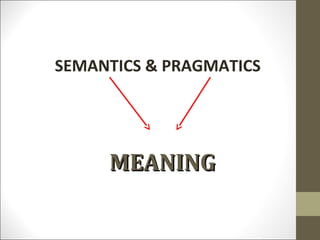
SEMANTICS & PRAGMATICS

MEANING
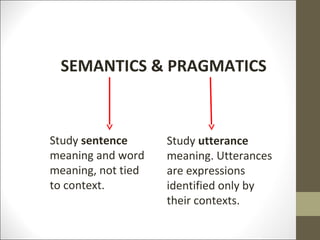
SEMANTICS & PRAGMATICS

Study sentence
meaning and word
meaning, not tied
to context.

Study utterance
meaning. Utterances
are expressions
identified only by
their contexts.
Three stages of
interpretation:
1st stage: Literal meaning (Semantic) its meaning is
based on the semantic information that you know
from your knowledge of English. The meaning can be
recognized without wondering who might say or
write the words, where or when. No consideration of
context is involved.

“That was the last bus”
Three stages of
interpretation:
2nd stage: Explicature (Pragmatic) Goes beyond the
literal meaning. It’s a basic interpretation of an
utterance, using contextual information and world
knowledge to work out what is being referred to and
which way to understand ambiguous expressions.

“That was the last bus”
Three stages of
interpretation:
3rd stage: Implicature (Pragmatic) it goes
further and looks for what is hinted at by an
utterance in its particular context. What the
speaker mean.

“That was the last bus”
FIGURATIVE LANGUAGE
• Figurative language is often employed whenever
we are unable to find the words which, used in
their literal and conventional sense, will
adequately express our meaning.
• The use of figurative language requires to
abstract meaning beyond “physical” words. It’s
about being capable of inferring information
beyond syntax or semantics.
FIGURATIVE LANGUAGE
• If the not grammatically expressed information is
not unveiled, the real meaning is not
accomplished and the figurative effect is lost.
• The use of figurative language shows us how
Pragmatics complements semantics.
Irony: A purely pragmatic
phenomenon

Verbal irony: communicates an opposite meaning;
when a speaker says something that seems to be
the opposite of what he/she means.
When we open the window in the morning an see
rain and a grey sky we say “What a beautiful day”.
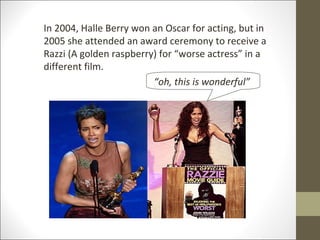
In 2004, Halle Berry won an Oscar for acting, but in
2005 she attended an award ceremony to receive a
Razzi (A golden raspberry) for “worse actress” in a
different film.
“oh, this is wonderful”
Irony: A purely pragmatic
phenomenon

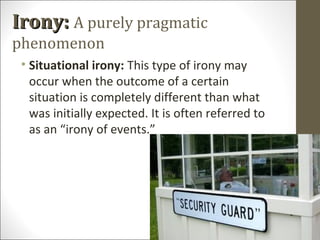
• Situational irony: This type of irony may
occur when the outcome of a certain
situation is completely different than what
was initially expected. It is often referred to
as an “irony of events.”
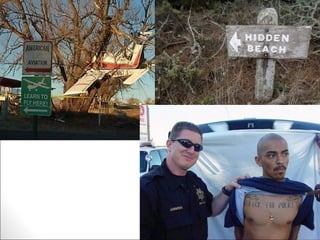
Examples of situational irony:
• A person who claims to be a vegan and avoids meat
but will eat a slice of pepperoni pizza because they are
hungry. It may not make sense, but it is an illustration
of irony.
• A man who is a traffic cop gets his license suspended
for unpaid parking tickets.
• An ambulance driver goes to a nightime bike accident
scene and runs over the accident victim because the
victim has crawled to the centre of the road with their
bike.
Sarcasm:
Another popular form of irony where the user intends to wittily
attack or make a derogatory statement about something or
someone. Often, sarcasm is confused with irony instead of being
a recognized form of irony.
•A beautiful actress walked by a table of talent agents as one
said “there goes a good time that was had by all”. The talent
agent said the phrase referring to the young actress’
extracurricular activities with fellow talent agents. It was a
derogatory statement, yet created with it.
•In "The Canterbury Tales" Chaucer criticizes the clergy who had
become corrupt, by referring to the Friar as a "wanton and
merry" person who takes bribes and seduces women.
Sarcasm can often be funny, and witty yet simultaneously it can
be hurtful and humiliating.
Responses to irony:
• React to what is said.
• React to what is implied.
• Laugh
• Not react
Presuppositions
Are those beliefs, preconceptions and information, that are
taken for granted by the speaker/writer and are expected to
be used for interpreting the message.
Presuppositions do not have to be true: communication may
depend on mutual awareness of fiction, ideologies,
prejudices, national stereotypes that are false of many
individuals.
For anything that humans talk or write about, there are
always presuppositions to be retrieved from memory.
Presuppositions are involved in formulating utterances and
interpreting them.
Presuppositions are a crucial part of advertising as they
can cause the reader to consider the existence of
objects, propositions, and culturally defined behavioural
properties. For example:

"Have you had your daily vitamins?"
Presupposes that you take or need "daily vitamins",
thereby creating and perpetuating the idea that the
behaviour of taking vitamins daily is part of our culture.
Metonymy
A person or object being referred to using as the vehicle a
word whose literal denotation is somehow pertinently
related.
Metonym vehicles must be distinctive properties of the
people or objects referred to. The vehicle must also be
relevant in the context of utterance.

The term for a figuratively-used word (or phrase) is
vehicle. The vehicle carries the figurative meaning
Example 1: Countries have capital cities and the name of the
capital can be used as a metonymic vehicle to talk about the
country, as in: “Moscow and Kiev certainly don’t agree on
everything”.
Example 2:
In a head-on collision, both father and son are critically
wounded. They are rushed into hospital where the chief
surgeon performs an emergency operation on the son. But it
is too late and the boy dies on the table. When an assistant
asks the surgeon, "Could you have a look at the other
victim?", the surgeon replies "I could not bear it. I have
already lost my son".
Does the chief surgeon's reply make sense?
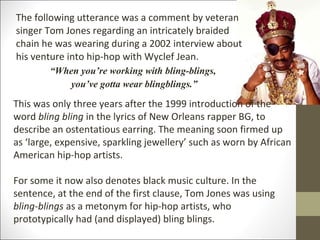
The following utterance was a comment by veteran
singer Tom Jones regarding an intricately braided
chain he was wearing during a 2002 interview about
his venture into hip-hop with Wyclef Jean.
“When you’re working with bling-blings,
you’ve gotta wear blingblings.”

This was only three years after the 1999 introduction of the
word bling bling in the lyrics of New Orleans rapper BG, to
describe an ostentatious earring. The meaning soon firmed up
as ‘large, expensive, sparkling jewellery’ such as worn by African
American hip-hop artists.
For some it now also denotes black music culture. In the
sentence, at the end of the first clause, Tom Jones was using
bling-blings as a metonym for hip-hop artists, who
prototypically had (and displayed) bling blings.
Metaphor
Metaphors tend to provoke thoughts and feelings to a
greater extend than more literal descriptions do.
Is a figure of speech containing an implied comparison, in
which a word or phrase ordinarily and primarily used of one
thing is applied to another.
A metaphor is distinct from, but related to a simile, which is
also a comparison. The primary difference is that a simile
uses the word like or as to compare two things, while a
metaphor simply suggests that the dissimilar things are the
same.
One of the most prominent examples of a metaphor in English
literature is the All the world’s a stage monologue from As you
like it:
All the world’s a stage,
And all the men and women merely players;
They have their exits and their entrances.
(William Shakespeare, As you like it)
This quote is a metaphor because the world is not literally a
stage. By figuratively asserting that the world is a stage,
Shakespeare uses the points of comparison between the world
and a stage to convey an understanding about the mechanics
of the world and the lives of the people within it.
“He is a vast (metaphorically speaking) databank of
information.”
This was from BBC presenter Sarah Montague, writing about
James Naughtie, a moderately bulky person.
She was signalled that vast should not be taken literally as a
comment on his physical size, but treated as a modifier within
the vehicle phrase.
Readers were to do their interpretation by contemplating how
the main features of a vast databank of information could help
one form an impression of the nature of her colleague: that she
rated him as extremely knowledgeable, efficient at supplying
facts, etcetera.
Metaphores vs. similes
Similes are very close to metaphors, but make a comparison
instead of actually suggesting that two things are essentially
the same. Some authors agree on that we can explain how
metaphors work by saying that they are just similes with the
like erased.
For example, the quote by Qan Zhang that "Success is like a
pie, there are different layers" compares success to a pie.
It was proposed that there should be a superficial distinction
between these two figures. Stern states that “Similes should
be analysed on the model as metaphors”.
This sentence has the form of a simile, but it can be taken
either figuratively or literally:
a.She’s like my mother (Figurative or literal)
b.She is a mother to me (Figurative, a standard metaphor)
c.She’s similar to my mother (Literal)
Summary
• The chapter has given a sketch of figurative interpretation in
terms of two stages of pragmatics – explicature and
implicature.
• Semantically, words and sentences have literal meanings. A
literal interpretation of an utterance in context is an
explicature that involves only literal meanings.
• Figurative interpretation is explicature in which one or more
literal meanings are replaced, for example by an antonym in
some types of irony.
• Wilson and Sperber’s more sophisticated account of irony was
one illustration of how presuppositions (beliefs presumed to
be shared) are the source for figurative alternatives to literal
meanings.
Summary
• Stern’s (2000) theory of metaphor was informally
recounted, according to which vehicle expressions (ones
that carry figurative meanings) are used rather in the
manner of a deictic demonstrative (like the word that) to
“point” out presuppositions for use in interpretation.
• Figurative interpretation is somewhat open-ended
because different people come with different
presuppositions and differ over what they regard as
relevant in a given context.
• Similes were argued to be metaphors too.

4 figurative language

  • 1.
    An Introduction to EnglishSemantics and Pragmatics Patrick Griffiths, 2006.
  • 2.
  • 3.
    SEMANTICS & PRAGMATICS Studysentence meaning and word meaning, not tied to context. Study utterance meaning. Utterances are expressions identified only by their contexts.
  • 4.
    Three stages of interpretation: 1ststage: Literal meaning (Semantic) its meaning is based on the semantic information that you know from your knowledge of English. The meaning can be recognized without wondering who might say or write the words, where or when. No consideration of context is involved. “That was the last bus”
  • 5.
    Three stages of interpretation: 2ndstage: Explicature (Pragmatic) Goes beyond the literal meaning. It’s a basic interpretation of an utterance, using contextual information and world knowledge to work out what is being referred to and which way to understand ambiguous expressions. “That was the last bus”
  • 6.
    Three stages of interpretation: 3rdstage: Implicature (Pragmatic) it goes further and looks for what is hinted at by an utterance in its particular context. What the speaker mean. “That was the last bus”
  • 7.
    FIGURATIVE LANGUAGE • Figurativelanguage is often employed whenever we are unable to find the words which, used in their literal and conventional sense, will adequately express our meaning. • The use of figurative language requires to abstract meaning beyond “physical” words. It’s about being capable of inferring information beyond syntax or semantics.
  • 8.
    FIGURATIVE LANGUAGE • Ifthe not grammatically expressed information is not unveiled, the real meaning is not accomplished and the figurative effect is lost. • The use of figurative language shows us how Pragmatics complements semantics.
  • 9.
    Irony: A purelypragmatic phenomenon Verbal irony: communicates an opposite meaning; when a speaker says something that seems to be the opposite of what he/she means. When we open the window in the morning an see rain and a grey sky we say “What a beautiful day”.
  • 10.
    In 2004, HalleBerry won an Oscar for acting, but in 2005 she attended an award ceremony to receive a Razzi (A golden raspberry) for “worse actress” in a different film. “oh, this is wonderful”
  • 11.
    Irony: A purelypragmatic phenomenon • Situational irony: This type of irony may occur when the outcome of a certain situation is completely different than what was initially expected. It is often referred to as an “irony of events.”
  • 12.
    Examples of situationalirony: • A person who claims to be a vegan and avoids meat but will eat a slice of pepperoni pizza because they are hungry. It may not make sense, but it is an illustration of irony. • A man who is a traffic cop gets his license suspended for unpaid parking tickets. • An ambulance driver goes to a nightime bike accident scene and runs over the accident victim because the victim has crawled to the centre of the road with their bike.
  • 14.
    Sarcasm: Another popular formof irony where the user intends to wittily attack or make a derogatory statement about something or someone. Often, sarcasm is confused with irony instead of being a recognized form of irony. •A beautiful actress walked by a table of talent agents as one said “there goes a good time that was had by all”. The talent agent said the phrase referring to the young actress’ extracurricular activities with fellow talent agents. It was a derogatory statement, yet created with it. •In "The Canterbury Tales" Chaucer criticizes the clergy who had become corrupt, by referring to the Friar as a "wanton and merry" person who takes bribes and seduces women. Sarcasm can often be funny, and witty yet simultaneously it can be hurtful and humiliating.
  • 15.
    Responses to irony: •React to what is said. • React to what is implied. • Laugh • Not react
  • 16.
    Presuppositions Are those beliefs,preconceptions and information, that are taken for granted by the speaker/writer and are expected to be used for interpreting the message. Presuppositions do not have to be true: communication may depend on mutual awareness of fiction, ideologies, prejudices, national stereotypes that are false of many individuals. For anything that humans talk or write about, there are always presuppositions to be retrieved from memory. Presuppositions are involved in formulating utterances and interpreting them.
  • 17.
    Presuppositions are acrucial part of advertising as they can cause the reader to consider the existence of objects, propositions, and culturally defined behavioural properties. For example: "Have you had your daily vitamins?" Presupposes that you take or need "daily vitamins", thereby creating and perpetuating the idea that the behaviour of taking vitamins daily is part of our culture.
  • 18.
    Metonymy A person orobject being referred to using as the vehicle a word whose literal denotation is somehow pertinently related. Metonym vehicles must be distinctive properties of the people or objects referred to. The vehicle must also be relevant in the context of utterance. The term for a figuratively-used word (or phrase) is vehicle. The vehicle carries the figurative meaning
  • 19.
    Example 1: Countrieshave capital cities and the name of the capital can be used as a metonymic vehicle to talk about the country, as in: “Moscow and Kiev certainly don’t agree on everything”. Example 2: In a head-on collision, both father and son are critically wounded. They are rushed into hospital where the chief surgeon performs an emergency operation on the son. But it is too late and the boy dies on the table. When an assistant asks the surgeon, "Could you have a look at the other victim?", the surgeon replies "I could not bear it. I have already lost my son". Does the chief surgeon's reply make sense?
  • 20.
    The following utterancewas a comment by veteran singer Tom Jones regarding an intricately braided chain he was wearing during a 2002 interview about his venture into hip-hop with Wyclef Jean. “When you’re working with bling-blings, you’ve gotta wear blingblings.” This was only three years after the 1999 introduction of the word bling bling in the lyrics of New Orleans rapper BG, to describe an ostentatious earring. The meaning soon firmed up as ‘large, expensive, sparkling jewellery’ such as worn by African American hip-hop artists. For some it now also denotes black music culture. In the sentence, at the end of the first clause, Tom Jones was using bling-blings as a metonym for hip-hop artists, who prototypically had (and displayed) bling blings.
  • 21.
    Metaphor Metaphors tend toprovoke thoughts and feelings to a greater extend than more literal descriptions do. Is a figure of speech containing an implied comparison, in which a word or phrase ordinarily and primarily used of one thing is applied to another. A metaphor is distinct from, but related to a simile, which is also a comparison. The primary difference is that a simile uses the word like or as to compare two things, while a metaphor simply suggests that the dissimilar things are the same.
  • 22.
    One of themost prominent examples of a metaphor in English literature is the All the world’s a stage monologue from As you like it: All the world’s a stage, And all the men and women merely players; They have their exits and their entrances. (William Shakespeare, As you like it) This quote is a metaphor because the world is not literally a stage. By figuratively asserting that the world is a stage, Shakespeare uses the points of comparison between the world and a stage to convey an understanding about the mechanics of the world and the lives of the people within it.
  • 23.
    “He is avast (metaphorically speaking) databank of information.” This was from BBC presenter Sarah Montague, writing about James Naughtie, a moderately bulky person. She was signalled that vast should not be taken literally as a comment on his physical size, but treated as a modifier within the vehicle phrase. Readers were to do their interpretation by contemplating how the main features of a vast databank of information could help one form an impression of the nature of her colleague: that she rated him as extremely knowledgeable, efficient at supplying facts, etcetera.
  • 24.
    Metaphores vs. similes Similesare very close to metaphors, but make a comparison instead of actually suggesting that two things are essentially the same. Some authors agree on that we can explain how metaphors work by saying that they are just similes with the like erased. For example, the quote by Qan Zhang that "Success is like a pie, there are different layers" compares success to a pie. It was proposed that there should be a superficial distinction between these two figures. Stern states that “Similes should be analysed on the model as metaphors”.
  • 25.
    This sentence hasthe form of a simile, but it can be taken either figuratively or literally: a.She’s like my mother (Figurative or literal) b.She is a mother to me (Figurative, a standard metaphor) c.She’s similar to my mother (Literal)
  • 26.
    Summary • The chapterhas given a sketch of figurative interpretation in terms of two stages of pragmatics – explicature and implicature. • Semantically, words and sentences have literal meanings. A literal interpretation of an utterance in context is an explicature that involves only literal meanings. • Figurative interpretation is explicature in which one or more literal meanings are replaced, for example by an antonym in some types of irony. • Wilson and Sperber’s more sophisticated account of irony was one illustration of how presuppositions (beliefs presumed to be shared) are the source for figurative alternatives to literal meanings.
  • 27.
    Summary • Stern’s (2000)theory of metaphor was informally recounted, according to which vehicle expressions (ones that carry figurative meanings) are used rather in the manner of a deictic demonstrative (like the word that) to “point” out presuppositions for use in interpretation. • Figurative interpretation is somewhat open-ended because different people come with different presuppositions and differ over what they regard as relevant in a given context. • Similes were argued to be metaphors too.