Downloaded 18 times




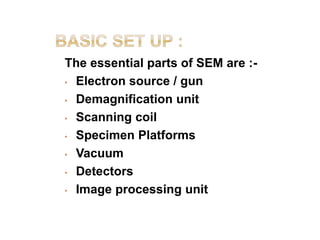
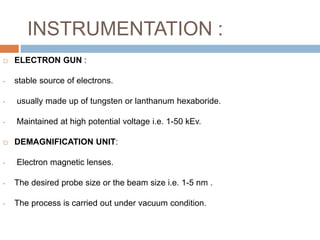


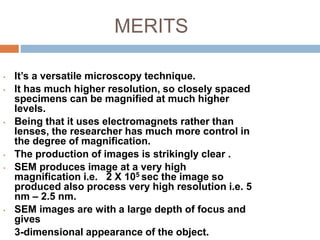
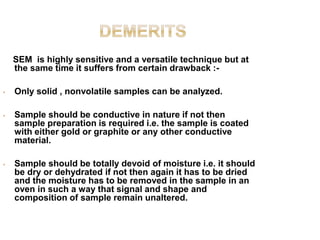


This document provides an introduction to scanning electron microscopy (SEM). It discusses the basic principles and components of SEM, including how it works by scanning a sample's surface with a fine electron beam. This interaction produces signals containing information about the sample's topography, composition, and other properties. SEM allows for high magnification imaging at resolutions as small as 5 nm. It has various applications in forensic science such as analysis of gunshot residue, paint layers, tool marks, soils, fibers, and biological evidence.


