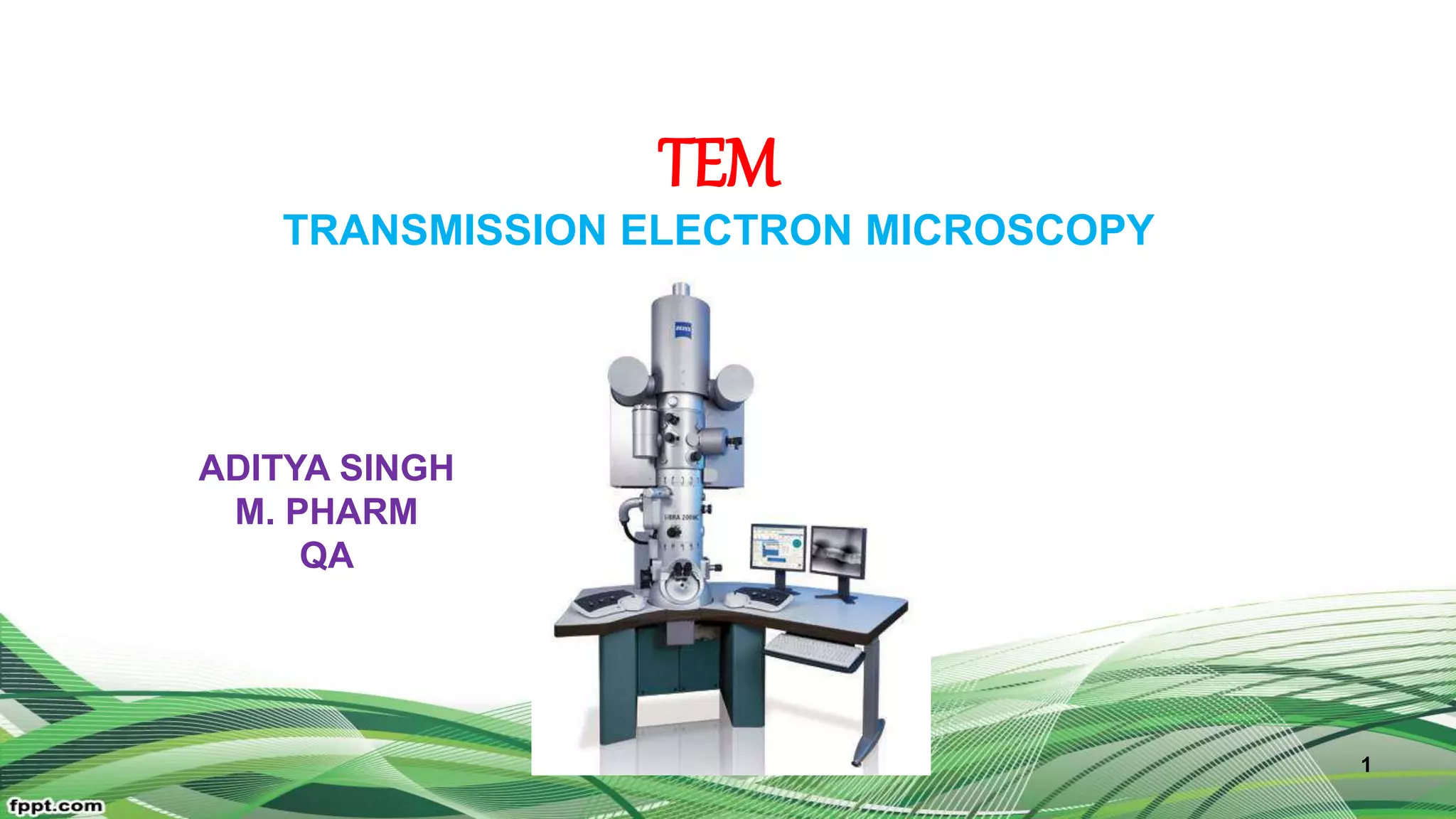

TEM
TRANSMISSION ELECTRON MICROSCOPY
ADITYA SINGH
M. PHARM
QA
1
PRINCIPLE OF TEM
 TEM works like a slide projector.
 A projector shines a beam of light which transmits
through the slide. The patterns painted on the slide
only allow certain parts of the light beam to pass
through. Thus the transmitted beam replicates the
patterns on the slide, forming an enlarged image of
the slide when falling on the screen.
2
 TEMs work the same way except that they shine a beam of
electrons (like the light in a slide projector) through the
specimen (like the slide). However, in TEM, the
transmission of electron beam is highly dependent on the
properties of material being examined. Such properties
include density, composition, etc. For example, porous
material will allow more electrons to pass through while
dense material will allow less. As a result, a specimen with
a non-uniform density can be examined by this technique.
Whatever part is transmitted is projected onto a phosphor
screen for the user to see.
3
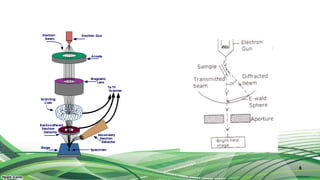
 WORKING OF TEM
 Stream of electrons are produced by the electron gun and is made
to fall over the specimen using the magnetic condensing lens.
 Based on the angle of incidence the beam is partially transmitted
and partially diffracted. Both these beams are recombined at the
E-Wald sphere to form the image. The combined image is called
the phase contrast image.
 In order to increase the intensity and the contrast of the image, an
amplitude contrast has to be obtained. This can be achieved only
by using the transmitting beam and thus the diffracted beam can
be eliminated.
4
 Now in order to eliminate the diffracted beam, the resultant beam is
passed through the magnetic objective lens and the aperture. The
aperture is adjusted in such a way that the diffracted image is
eliminated. Thus, the final image obtained due to transmitted beam
alone is passed through the projector lens for further magnification.
 The magnified image is recorded in fluorescent screen or CCD. This
high contrast image is called Bright Field Image
5
6
Application of tem
 A Transmission Electron Microscope is ideal for a number of different
fields such as life sciences, nanotechnology, medical, biological and
material research, forensic analysis, gemology and metallurgy as well
as industry and education.
 TEMs provide topographical, morphological, compositional and
crystalline information.
 The images allow researchers to view samples on a molecular level,
making it possible to analyze structure and texture.
7
 This information is useful in the study of crystals and metals, but
also has industrial applications.
 TEMs can be used in semiconductor analysis and production and
the manufacturing of computer and silicon chips.
 Technology companies use TEMs to identify flaws, fractures and
damages to micro-sized objects; this data can help fix problems
and/or help to make a more durable, efficient product
8
Thankyou
9
10
 REFERENCES
 "The Nobel Prize in Physics 1986, Perspectives – Life
through a Lens". nobelprize.org.
 Hague, M. A. & Saif, M. T. A. (2001). "In-situ tensile
testing of nano-scale specimens in SEM and
TEM". Experimental Mechanics. 42: 123.
 www.britanica.com

Transmission Electron microscopy

  • 1.
  • 2.
    PRINCIPLE OF TEM TEM works like a slide projector.  A projector shines a beam of light which transmits through the slide. The patterns painted on the slide only allow certain parts of the light beam to pass through. Thus the transmitted beam replicates the patterns on the slide, forming an enlarged image of the slide when falling on the screen. 2
  • 3.
     TEMs workthe same way except that they shine a beam of electrons (like the light in a slide projector) through the specimen (like the slide). However, in TEM, the transmission of electron beam is highly dependent on the properties of material being examined. Such properties include density, composition, etc. For example, porous material will allow more electrons to pass through while dense material will allow less. As a result, a specimen with a non-uniform density can be examined by this technique. Whatever part is transmitted is projected onto a phosphor screen for the user to see. 3
  • 4.
     WORKING OFTEM  Stream of electrons are produced by the electron gun and is made to fall over the specimen using the magnetic condensing lens.  Based on the angle of incidence the beam is partially transmitted and partially diffracted. Both these beams are recombined at the E-Wald sphere to form the image. The combined image is called the phase contrast image.  In order to increase the intensity and the contrast of the image, an amplitude contrast has to be obtained. This can be achieved only by using the transmitting beam and thus the diffracted beam can be eliminated. 4
  • 5.
     Now inorder to eliminate the diffracted beam, the resultant beam is passed through the magnetic objective lens and the aperture. The aperture is adjusted in such a way that the diffracted image is eliminated. Thus, the final image obtained due to transmitted beam alone is passed through the projector lens for further magnification.  The magnified image is recorded in fluorescent screen or CCD. This high contrast image is called Bright Field Image 5
  • 6.
  • 7.
    Application of tem A Transmission Electron Microscope is ideal for a number of different fields such as life sciences, nanotechnology, medical, biological and material research, forensic analysis, gemology and metallurgy as well as industry and education.  TEMs provide topographical, morphological, compositional and crystalline information.  The images allow researchers to view samples on a molecular level, making it possible to analyze structure and texture. 7
  • 8.
     This informationis useful in the study of crystals and metals, but also has industrial applications.  TEMs can be used in semiconductor analysis and production and the manufacturing of computer and silicon chips.  Technology companies use TEMs to identify flaws, fractures and damages to micro-sized objects; this data can help fix problems and/or help to make a more durable, efficient product 8
  • 9.
  • 10.
    10  REFERENCES  "TheNobel Prize in Physics 1986, Perspectives – Life through a Lens". nobelprize.org.  Hague, M. A. & Saif, M. T. A. (2001). "In-situ tensile testing of nano-scale specimens in SEM and TEM". Experimental Mechanics. 42: 123.  www.britanica.com