Presented by:
TEJASVI BHATIA
In this process amino acids become joined together by
peptide bond to form polypeptides.
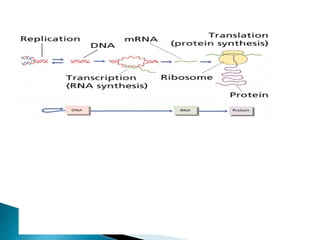
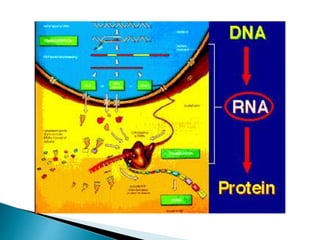
Translation is a process by which the genetic code contained
within an mRNA molecule is decoded to produce the specific
sequence of amino acids in a polypeptide chain.
It occurs in the cytoplasm following transcription and, like
transcription, has three stages: initiation, elongation and
termination.
The key components required for translation are
mRNA, ribosomes, tRNA and aminoacyl-tRNA synthetases.
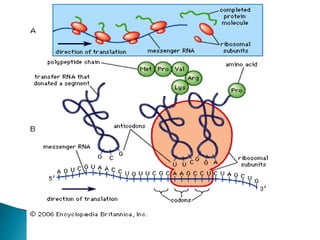
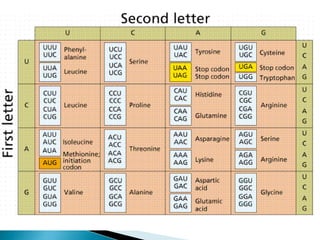
During translation mRNA nucleotide bases are read as three
base codons, each of which codes for a particular amino acid.
The genetic code is described as degenerate because a single
amino acid may be coded for by more than one codon. There are
also specific codons that signal the start and the end of
translation.
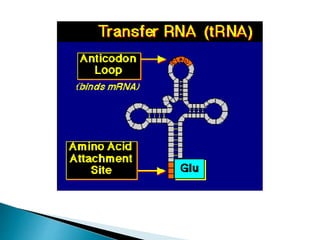
Each tRNA molecule possesses an anticodon on the opposite
end that is complementary to the mRNA codon. tRNA molecules
are therefore responsible for bringing amino acids to the
ribosome in the correct order ready for polypeptide assembly.
Aminoacyl-tRNA synthetases are enzymes that link amino
acids to their corresponding tRNA molecules. The resulting
complex is charged and is referred to as an aminoacyl-tRNA.
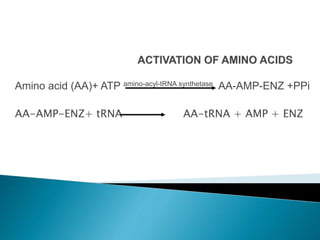
Amino acid (AA)+ ATP amino-acyl-tRNA synthetase AA-AMP-ENZ +PPi
AA-AMP-ENZ+ tRNA AA-tRNA + AMP + ENZ
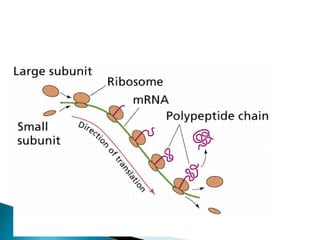
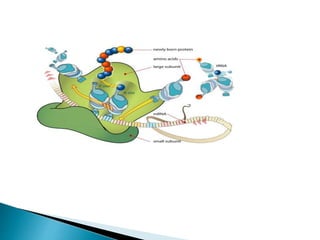
 The ribosome has two subunits- a large subunit and a
small subunit.
 The mRNA binds to the small subunit and the translation
begins.
 There are two sites on large subunit-the P-site and A-
site.
 The small subunit attaches to the large subunit in such a
way that the initiation codon (AUG) comes on the P-site.
 The initiator t RNA (methionyl t RNA) binds to the P-site.
At the 5’ cap of mRNA the small 40s subunit of the ribosome
(with methionyl-tRNA) binds.
For translation to start the start codon 5’AUG must be
recognised.
This is a codon specific to the amino acid methionine
(anticodon on tRNA=5’CAU).
The large 60s subunit of the ribosome then binds for
elongation to occur.
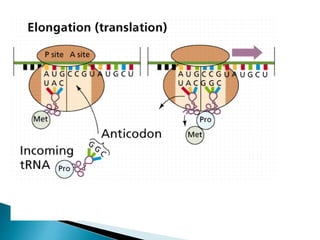
The ribosome has two tRNA binding sites; the P site which holds the
peptide chain and the A site which accepts the tRNA.
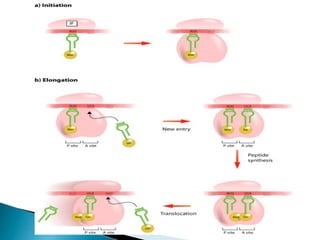
 A second tRNA charged with another amino acid binds
to the A-site.
 A peptide (CO-NH) bond is formed between the carboxyl
group of first amino acid and amino group of second
amino acid.
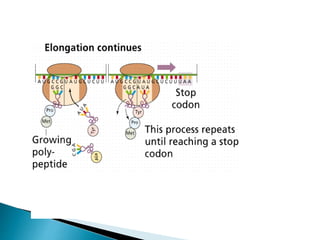
 The ribosome moves from codon to codon along the
mRNA in the 5’  3’ direction.
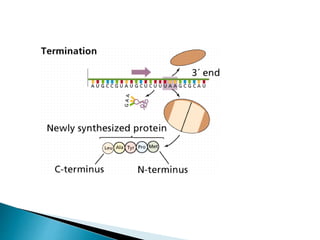
 When one of the termination codons comes at
the A-site, it does not code for any amino acid
and there is no tRNA molecule for it.
 As a result the polypeptide synthesis stops.
 The nascent polypeptide chain is released from
the ribosome.
Translation (1)
Translation (1)
Translation (1)
Translation (1)
Translation (1)
Translation (1)
Translation (1)

Translation (1)

  • 1.
  • 2.
    In this processamino acids become joined together by peptide bond to form polypeptides. Translation is a process by which the genetic code contained within an mRNA molecule is decoded to produce the specific sequence of amino acids in a polypeptide chain. It occurs in the cytoplasm following transcription and, like transcription, has three stages: initiation, elongation and termination.
  • 4.
    The key componentsrequired for translation are mRNA, ribosomes, tRNA and aminoacyl-tRNA synthetases. During translation mRNA nucleotide bases are read as three base codons, each of which codes for a particular amino acid. The genetic code is described as degenerate because a single amino acid may be coded for by more than one codon. There are also specific codons that signal the start and the end of translation. Each tRNA molecule possesses an anticodon on the opposite end that is complementary to the mRNA codon. tRNA molecules are therefore responsible for bringing amino acids to the ribosome in the correct order ready for polypeptide assembly. Aminoacyl-tRNA synthetases are enzymes that link amino acids to their corresponding tRNA molecules. The resulting complex is charged and is referred to as an aminoacyl-tRNA.
  • 5.
    Amino acid (AA)+ATP amino-acyl-tRNA synthetase AA-AMP-ENZ +PPi AA-AMP-ENZ+ tRNA AA-tRNA + AMP + ENZ
  • 6.
     The ribosomehas two subunits- a large subunit and a small subunit.  The mRNA binds to the small subunit and the translation begins.  There are two sites on large subunit-the P-site and A- site.  The small subunit attaches to the large subunit in such a way that the initiation codon (AUG) comes on the P-site.  The initiator t RNA (methionyl t RNA) binds to the P-site.
  • 7.
    At the 5’cap of mRNA the small 40s subunit of the ribosome (with methionyl-tRNA) binds. For translation to start the start codon 5’AUG must be recognised. This is a codon specific to the amino acid methionine (anticodon on tRNA=5’CAU). The large 60s subunit of the ribosome then binds for elongation to occur. The ribosome has two tRNA binding sites; the P site which holds the peptide chain and the A site which accepts the tRNA.
  • 9.
     A secondtRNA charged with another amino acid binds to the A-site.  A peptide (CO-NH) bond is formed between the carboxyl group of first amino acid and amino group of second amino acid.  The ribosome moves from codon to codon along the mRNA in the 5’  3’ direction.
  • 12.
     When oneof the termination codons comes at the A-site, it does not code for any amino acid and there is no tRNA molecule for it.  As a result the polypeptide synthesis stops.  The nascent polypeptide chain is released from the ribosome.