Atomic Force Microscopy
-
Basics and Applications
Summer School June 2006
„Complex Materials: Cooperative Projects of the
Natural, Engineering and Biosciences“
Astrid Kronenberger
School of Engineering and Science
Outline
• Scanning Probe Microscopy
• Atomic Force Microscopy
– General set-up & operation modes
– Sample preparation
• Applications in life science
– Imaging mode
– Force-distance mode
• Conclusion
Scanning Probe Microscopy
(SPM)
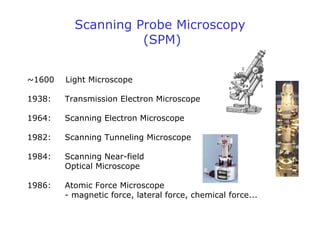
~1600 Light Microscope
1938: Transmission Electron Microscope
1964: Scanning Electron Microscope
1982: Scanning Tunneling Microscope
1984: Scanning Near-field
Optical Microscope
1986: Atomic Force Microscope
- magnetic force, lateral force, chemical force...
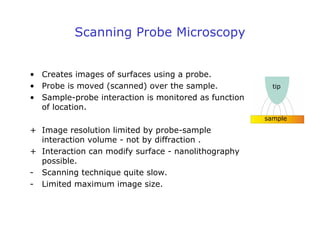
Scanning Probe Microscopy
• Creates images of surfaces using a probe.
• Probe is moved (scanned) over the sample.
• Sample-probe interaction is monitored as function
of location.
+ Image resolution limited by probe-sample
interaction volume - not by diffraction .
+ Interaction can modify surface - nanolithography
possible.
- Scanning technique quite slow.
- Limited maximum image size.
sample
tip
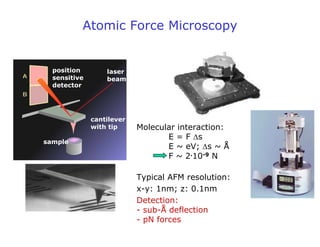
Atomic Force Microscopy
laser
beam
position
sensitive
detector
sample
cantilever
with tip Molecular interaction:
E = F Δs
E ~ eV; Δs ~ Å
F ~ 2.
10-9 N
Typical AFM resolution:
x-y: 1nm; z: 0.1nm
Detection:
- sub-Å deflection
- pN forces
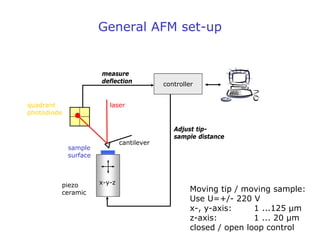
General AFM set-up
controller
piezo
ceramic
sample
surface
laser
cantilever
quadrant
photodiode
Moving tip / moving sample:
Use U=+/- 220 V
x-, y-axis: 1 ...125 µm
z-axis: 1 ... 20 µm
closed / open loop control
x-y-z
measure
deflection
Adjust tip-
sample distance
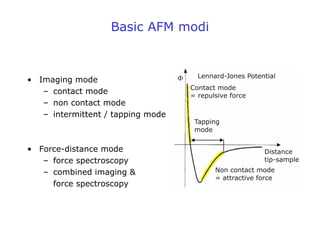
Basic AFM modi
• Imaging mode
– contact mode
– non contact mode
– intermittent / tapping mode
• Force-distance mode
– force spectroscopy
– combined imaging &
force spectroscopy
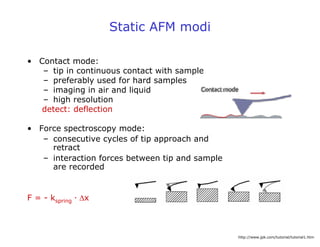
• Contact mode:
– tip in continuous contact with sample
– preferably used for hard samples
– imaging in air and liquid
– high resolution
detect: deflection
• Force spectroscopy mode:
– consecutive cycles of tip approach and
retract
– interaction forces between tip and sample
are recorded
F = - kspring
. Δx
Static AFM modi
http://www.jpk.com/tutorial/tutorial1.htm
Dynamic AFM modi
• Intermittent/tapping mode:
– oscillating cantilever, tip touching surface
gently and frequently
– often used for biological samples
– imaging in air and liquid
– good resolution
• Non contact mode:
– oscillating cantilever, tip not in contact with
sample
– used for soft samples
– imaging in vacuum
– distance range 50Å - 150Å
detect: amplitude
phase
deflection
http://www.jpk.com/tutorial/tutorial1.htm
effm
k
ω =
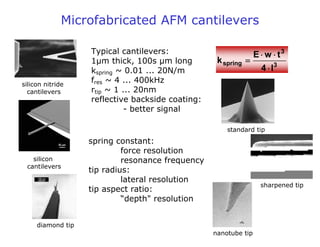
Microfabricated AFM cantilevers
standard tip
diamond tip
nanotube tip
sharpened tip
silicon nitride
cantilevers
silicon
cantilevers
spring constant:
force resolution
resonance frequency
tip radius:
lateral resolution
tip aspect ratio:
“depth" resolution
Typical cantilevers:
1µm thick, 100s µm long
kspring ~ 0.01 ... 20N/m
fres ~ 4 ... 400kHz
rtip ~ 1 ... 20nm
reflective backside coating:
- better signal
3
3
spring
l4
twE
k
⋅
⋅⋅
=
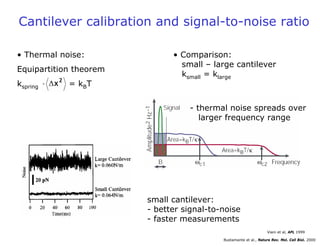
• Thermal noise:
Equipartition theorem
kspring = kBT
Cantilever calibration and signal-to-noise ratio
Bustamante et al., Nature Rev. Mol. Cell Biol. 2000
• Comparison:
small – large cantilever
ksmall = klarge
- thermal noise spreads over
larger frequency range
Viani et al, APL 1999
small cantilever:
- better signal-to-noise
- faster measurements
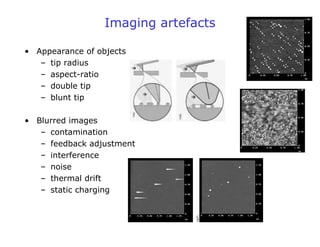
Imaging artefacts
• Appearance of objects
– tip radius
– aspect-ratio
– double tip
– blunt tip
• Blurred images
– contamination
– feedback adjustment
– interference
– noise
– thermal drift
– static charging
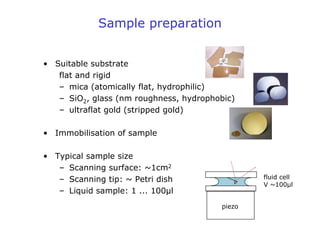
Sample preparation
• Suitable substrate
flat and rigid
– mica (atomically flat, hydrophilic)
– SiO2, glass (nm roughness, hydrophobic)
– ultraflat gold (stripped gold)
• Immobilisation of sample
• Typical sample size
– Scanning surface: ~1cm2
– Scanning tip: ~ Petri dish
– Liquid sample: 1 ... 100µl
piezo
fluid cell
V ~100µl
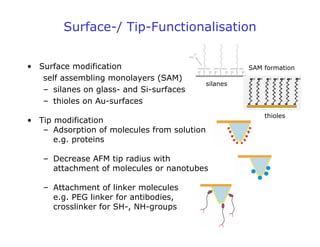
• Surface modification
self assembling monolayers (SAM)
– silanes on glass- and Si-surfaces
– thioles on Au-surfaces
• Tip modification
– Adsorption of molecules from solution
e.g. proteins
– Decrease AFM tip radius with
attachment of molecules or nanotubes
– Attachment of linker molecules
e.g. PEG linker for antibodies,
crosslinker for SH-, NH-groups
Surface-/ Tip-Functionalisation
H H H H H H H
SAM formation
silanes
thioles
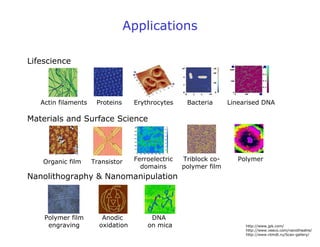
Applications
Lifescience
Materials and Surface Science
Nanolithography & Nanomanipulation
Polymer film
engraving
DNA
on mica
ProteinsActin filaments Linearised DNABacteriaErythrocytes
PolymerOrganic film Transistor Ferroelectric
domains
Triblock co-
polymer film
Anodic
oxidation http://www.jpk.com/
http://www.veeco.com/nanotheatre/
http://www.ntmdt.ru/Scan-gallery/
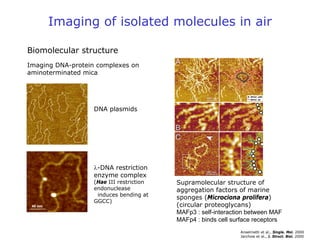
Imaging of isolated molecules in air
Biomolecular structure
Supramolecular structure of
aggregation factors of marine
sponges (Microciona prolifera)
(circular proteoglycans)
MAFp3 : self-interaction between MAF
MAFp4 : binds cell surface receptors
Imaging DNA-protein complexes on
aminoterminated mica
λ-DNA restriction
enzyme complex
(Hae III restriction
endonuclease
induces bending at
GGCC)
DNA plasmids
Anselmetti et al., Single. Mol. 2000
Jarchow et al., J. Struct. Biol. 2000
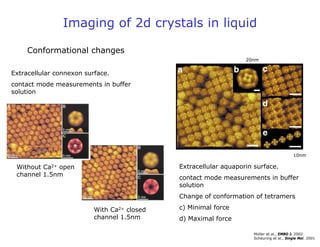
Imaging of 2d crystals in liquid
Conformational changes
10nm
20nm
Extracellular connexon surface.
contact mode measurements in buffer
solution
Müller et al., EMBO J. 2002
Scheuring et al., Single Mol. 2001
Extracellular aquaporin surface.
contact mode measurements in buffer
solution
Change of conformation of tetramers
c) Minimal force
d) Maximal force
Without Ca2+ open
channel 1.5nm
With Ca2+ closed
channel 1.5nm
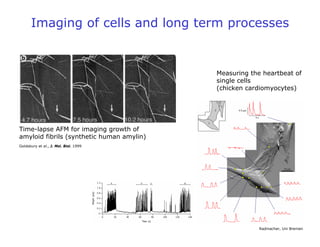
Imaging of cells and long term processes
Goldsbury et al., J. Mol. Biol. 1999
Time-lapse AFM for imaging growth of
amyloid fibrils (synthetic human amylin)
Measuring the heartbeat of
single cells
(chicken cardiomyocytes)
Radmacher, Uni Bremen
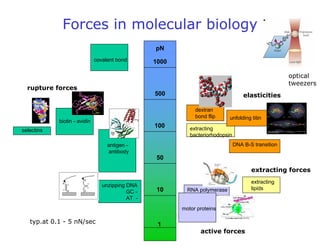
Forces in molecular biology
motor proteins
RNA polymerase
active forces
extracting
lipids
DNA B-S transition
unfolding titin
dextran
bond flip
extracting
bacteriorhodopsin
elasticities
extracting forces
typ.at 0.1 - 5 nN/sec
10
50
1
100
500
1000
pN
selectins
biotin - avidin
covalent bond
antigen -
antibody
rupture forces
unzipping DNA
GC -
AT -
optical
tweezers
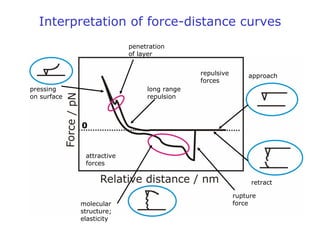
Interpretation of force-distance curves
long range
repulsion
approach
retract
penetration
of layer
pressing
on surface
repulsive
forces
molecular
structure;
elasticity
attractive
forces
rupture
force
0
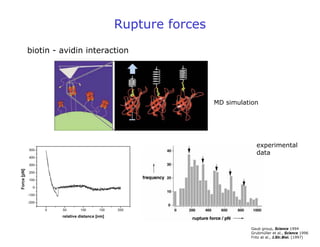
Rupture forces
Gaub group, Science 1994
Grubmüller et al., Science 1996
Fritz at al., J.Str.Biol. (1997)
biotin - avidin interaction
MD simulation
experimental
data
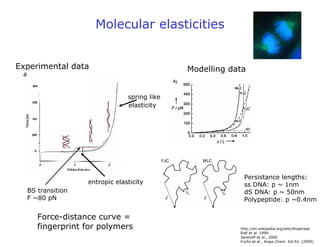
Molecular elasticities
Experimental data
ss DNA
entropic elasticity
spring like
Modelling data
http://en.wikipedia.org/wiki/Anaphase
Rief et al. 1999
Janshoff et al., 2000
Fuchs et al., Angw.Chem. Int.Ed. (2000)
elasticity
Persistance lengths:
ss DNA: p ~ 1nm
dS DNA: p ~ 50nm
Polypeptide: p ~0.4nm
BS transition
F ~80 pN
Force-distance curve =
fingerprint for polymers
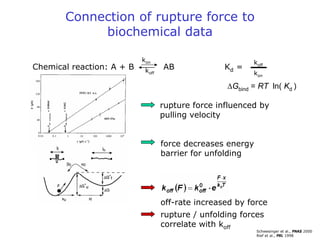
Chemical reaction: A + B AB Kd =
ΔGbind = RT ln( Kd )
Connection of rupture force to
biochemical data
Schwesinger et al., PNAS 2000
Rief et al., PRL 1998
off-rate increased by force
kon
koff
koff
kon
rupture force influenced by
pulling velocity
force decreases energy
barrier for unfolding
rupture / unfolding forces
correlate with koff
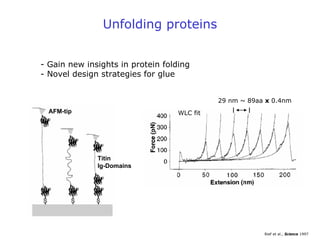
Unfolding proteins
AFM-tip
Titin
Ig-Domains
29 nm ~ 89aa x 0.4nm
WLC fit
- Gain new insights in protein folding
- Novel design strategies for glue
Rief et al., Science 1997
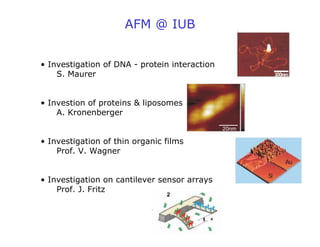
AFM @ IUB
• Investigation of DNA - protein interaction
S. Maurer
• Investion of proteins & liposomes
A. Kronenberger
• Investigation of thin organic films
Prof. V. Wagner
• Investigation on cantilever sensor arrays
Prof. J. Fritz
20nm
Conclusion
AFM is a versatile tool to investigate
- topography of surfaces
- properties of surfaces
- properties of single molecules
- forces within molecules
But: always consider experimental
conditions and artefacts on measurements!
Thanks!

Atomic force microscopy(afm)

  • 1.
    Atomic Force Microscopy - Basicsand Applications Summer School June 2006 „Complex Materials: Cooperative Projects of the Natural, Engineering and Biosciences“ Astrid Kronenberger School of Engineering and Science
  • 2.
    Outline • Scanning ProbeMicroscopy • Atomic Force Microscopy – General set-up & operation modes – Sample preparation • Applications in life science – Imaging mode – Force-distance mode • Conclusion
  • 3.
    Scanning Probe Microscopy (SPM) ~1600Light Microscope 1938: Transmission Electron Microscope 1964: Scanning Electron Microscope 1982: Scanning Tunneling Microscope 1984: Scanning Near-field Optical Microscope 1986: Atomic Force Microscope - magnetic force, lateral force, chemical force...
  • 4.
    Scanning Probe Microscopy •Creates images of surfaces using a probe. • Probe is moved (scanned) over the sample. • Sample-probe interaction is monitored as function of location. + Image resolution limited by probe-sample interaction volume - not by diffraction . + Interaction can modify surface - nanolithography possible. - Scanning technique quite slow. - Limited maximum image size. sample tip
  • 5.
    Atomic Force Microscopy laser beam position sensitive detector sample cantilever withtip Molecular interaction: E = F Δs E ~ eV; Δs ~ Å F ~ 2. 10-9 N Typical AFM resolution: x-y: 1nm; z: 0.1nm Detection: - sub-Å deflection - pN forces
  • 6.
    General AFM set-up controller piezo ceramic sample surface laser cantilever quadrant photodiode Movingtip / moving sample: Use U=+/- 220 V x-, y-axis: 1 ...125 µm z-axis: 1 ... 20 µm closed / open loop control x-y-z measure deflection Adjust tip- sample distance
  • 7.
    Basic AFM modi •Imaging mode – contact mode – non contact mode – intermittent / tapping mode • Force-distance mode – force spectroscopy – combined imaging & force spectroscopy
  • 8.
    • Contact mode: –tip in continuous contact with sample – preferably used for hard samples – imaging in air and liquid – high resolution detect: deflection • Force spectroscopy mode: – consecutive cycles of tip approach and retract – interaction forces between tip and sample are recorded F = - kspring . Δx Static AFM modi http://www.jpk.com/tutorial/tutorial1.htm
  • 9.
    Dynamic AFM modi •Intermittent/tapping mode: – oscillating cantilever, tip touching surface gently and frequently – often used for biological samples – imaging in air and liquid – good resolution • Non contact mode: – oscillating cantilever, tip not in contact with sample – used for soft samples – imaging in vacuum – distance range 50Å - 150Å detect: amplitude phase deflection http://www.jpk.com/tutorial/tutorial1.htm effm k ω =
  • 10.
    Microfabricated AFM cantilevers standardtip diamond tip nanotube tip sharpened tip silicon nitride cantilevers silicon cantilevers spring constant: force resolution resonance frequency tip radius: lateral resolution tip aspect ratio: “depth" resolution Typical cantilevers: 1µm thick, 100s µm long kspring ~ 0.01 ... 20N/m fres ~ 4 ... 400kHz rtip ~ 1 ... 20nm reflective backside coating: - better signal 3 3 spring l4 twE k ⋅ ⋅⋅ =
  • 11.
    • Thermal noise: Equipartitiontheorem kspring = kBT Cantilever calibration and signal-to-noise ratio Bustamante et al., Nature Rev. Mol. Cell Biol. 2000 • Comparison: small – large cantilever ksmall = klarge - thermal noise spreads over larger frequency range Viani et al, APL 1999 small cantilever: - better signal-to-noise - faster measurements
  • 12.
    Imaging artefacts • Appearanceof objects – tip radius – aspect-ratio – double tip – blunt tip • Blurred images – contamination – feedback adjustment – interference – noise – thermal drift – static charging
  • 13.
    Sample preparation • Suitablesubstrate flat and rigid – mica (atomically flat, hydrophilic) – SiO2, glass (nm roughness, hydrophobic) – ultraflat gold (stripped gold) • Immobilisation of sample • Typical sample size – Scanning surface: ~1cm2 – Scanning tip: ~ Petri dish – Liquid sample: 1 ... 100µl piezo fluid cell V ~100µl
  • 14.
    • Surface modification selfassembling monolayers (SAM) – silanes on glass- and Si-surfaces – thioles on Au-surfaces • Tip modification – Adsorption of molecules from solution e.g. proteins – Decrease AFM tip radius with attachment of molecules or nanotubes – Attachment of linker molecules e.g. PEG linker for antibodies, crosslinker for SH-, NH-groups Surface-/ Tip-Functionalisation H H H H H H H SAM formation silanes thioles
  • 15.
    Applications Lifescience Materials and SurfaceScience Nanolithography & Nanomanipulation Polymer film engraving DNA on mica ProteinsActin filaments Linearised DNABacteriaErythrocytes PolymerOrganic film Transistor Ferroelectric domains Triblock co- polymer film Anodic oxidation http://www.jpk.com/ http://www.veeco.com/nanotheatre/ http://www.ntmdt.ru/Scan-gallery/
  • 16.
    Imaging of isolatedmolecules in air Biomolecular structure Supramolecular structure of aggregation factors of marine sponges (Microciona prolifera) (circular proteoglycans) MAFp3 : self-interaction between MAF MAFp4 : binds cell surface receptors Imaging DNA-protein complexes on aminoterminated mica λ-DNA restriction enzyme complex (Hae III restriction endonuclease induces bending at GGCC) DNA plasmids Anselmetti et al., Single. Mol. 2000 Jarchow et al., J. Struct. Biol. 2000
  • 17.
    Imaging of 2dcrystals in liquid Conformational changes 10nm 20nm Extracellular connexon surface. contact mode measurements in buffer solution Müller et al., EMBO J. 2002 Scheuring et al., Single Mol. 2001 Extracellular aquaporin surface. contact mode measurements in buffer solution Change of conformation of tetramers c) Minimal force d) Maximal force Without Ca2+ open channel 1.5nm With Ca2+ closed channel 1.5nm
  • 18.
    Imaging of cellsand long term processes Goldsbury et al., J. Mol. Biol. 1999 Time-lapse AFM for imaging growth of amyloid fibrils (synthetic human amylin) Measuring the heartbeat of single cells (chicken cardiomyocytes) Radmacher, Uni Bremen
  • 19.
    Forces in molecularbiology motor proteins RNA polymerase active forces extracting lipids DNA B-S transition unfolding titin dextran bond flip extracting bacteriorhodopsin elasticities extracting forces typ.at 0.1 - 5 nN/sec 10 50 1 100 500 1000 pN selectins biotin - avidin covalent bond antigen - antibody rupture forces unzipping DNA GC - AT - optical tweezers
  • 20.
    Interpretation of force-distancecurves long range repulsion approach retract penetration of layer pressing on surface repulsive forces molecular structure; elasticity attractive forces rupture force 0
  • 21.
    Rupture forces Gaub group,Science 1994 Grubmüller et al., Science 1996 Fritz at al., J.Str.Biol. (1997) biotin - avidin interaction MD simulation experimental data
  • 22.
    Molecular elasticities Experimental data ssDNA entropic elasticity spring like Modelling data http://en.wikipedia.org/wiki/Anaphase Rief et al. 1999 Janshoff et al., 2000 Fuchs et al., Angw.Chem. Int.Ed. (2000) elasticity Persistance lengths: ss DNA: p ~ 1nm dS DNA: p ~ 50nm Polypeptide: p ~0.4nm BS transition F ~80 pN Force-distance curve = fingerprint for polymers
  • 23.
    Chemical reaction: A+ B AB Kd = ΔGbind = RT ln( Kd ) Connection of rupture force to biochemical data Schwesinger et al., PNAS 2000 Rief et al., PRL 1998 off-rate increased by force kon koff koff kon rupture force influenced by pulling velocity force decreases energy barrier for unfolding rupture / unfolding forces correlate with koff
  • 24.
    Unfolding proteins AFM-tip Titin Ig-Domains 29 nm~ 89aa x 0.4nm WLC fit - Gain new insights in protein folding - Novel design strategies for glue Rief et al., Science 1997
  • 25.
    AFM @ IUB •Investigation of DNA - protein interaction S. Maurer • Investion of proteins & liposomes A. Kronenberger • Investigation of thin organic films Prof. V. Wagner • Investigation on cantilever sensor arrays Prof. J. Fritz 20nm
  • 26.
    Conclusion AFM is aversatile tool to investigate - topography of surfaces - properties of surfaces - properties of single molecules - forces within molecules But: always consider experimental conditions and artefacts on measurements!
  • 27.