AMMUNITION
BY:
TEJASVI
BHATIA
CONTENTS
 Definition
 Rifle cartridge
• Cartridge case
• Primer
• Propellant
• Projectile
• Lubricants
 REFERENCES
DEFINITION
An assembly of a case, the propellant , the projectile and the initiation
mixture contained in a container known as shell or cartridge.
According to Indian Arms Act, 1959, Ammunition means:
“Ammunition for any firearm” and includes:-
 Rockets, bombs, grenades, shells and other missiles.
 Articles designed for torpedo services & submarine mining.
 Other articles designed to contain explosive or fissionable material or
noxious liquid or other such thing whether capable of using with firearm or
not.
 Such ingredients as the central government may by notification in the
official gazette specify in this behalf.
Rifle ammunition
Parts of rifle cartridge are:
Cartridge case
Primer
Propellant
Projectile
Lubricant
CARTRIDGE CASE
 It is a housing for the primer, the projectile and the powder etc of a
round or cartridge
 Brass has been found a particularly good material for shells.
 Its function is to expand and seal the chamber against rearward
escape of gases when the cartridge is fired.
 Head Stamp: is a series of letters, numbers, symbols or trade
names and is present on the base of cartridge case.
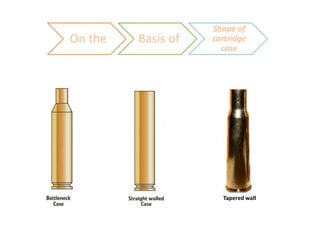
On the Basis of
Base of
cartridge
case
Tapered wall
On the Basis of
Shape of
cartridge
case
Center fire Rim- fire Pin fire
On the Basis of
Mode of
ignition
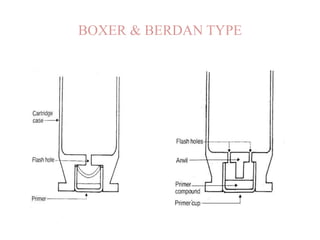
PRIMERS
A mixture of initiating ingredients packed in a metallic cup
that sets the propellant on fire.
It consists of:
 An initiator, a sensitive explosive
 Fuel
 Oxidizer and,
 Stabilizer
This composition is placed in a percussion cap which are of
two types:
 Boxer type
 Berdan type
BOXER & BERDAN TYPE
PROPELLANTS
The explosive material used in cartridges which on burning produce gases
that propel the projectiles out of the barrel of the firearm.
 BLACK POWDER (gun powder): is a mixture of potassium nitrate,
charcoal & sulfur.
 Until the end of 19th century, all cartridges were loaded with black powder.
 SMOKELESS POWDER: first synthesized by VIEILLE in 1884.The basic
ingredients are nitrocellulose & nitroglycerin.
 When nitrocellulose & nitroglycerine are used in
combination, these are called as double base powders.
 SEMI-SMOKELESS POWDER: is a mixture of black powder and
nitrocellulose.
Powders
Bulk Powders
Dense Powders
Progressive Powders
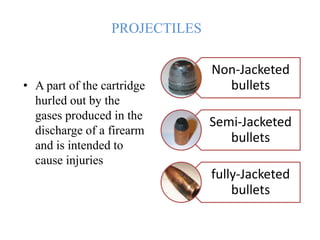
PROJECTILES
• A part of the cartridge
hurled out by the
gases produced in the
discharge of a firearm
and is intended to
cause injuries
Non-Jacketed
bullets
Semi-Jacketed
bullets
fully-Jacketed
bullets
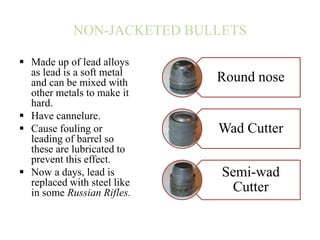
NON-JACKETED BULLETS
 Made up of lead alloys
as lead is a soft metal
and can be mixed with
other metals to make it
hard.
 Have cannelure.
 Cause fouling or
leading of barrel so
these are lubricated to
prevent this effect.
 Now a days, lead is
replaced with steel like
in some Russian Rifles.
Round nose
Wad Cutter
Semi-wad
Cutter
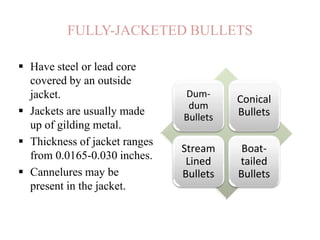
FULLY-JACKETED BULLETS
 Have steel or lead core
covered by an outside
jacket.
 Jackets are usually made
up of gilding metal.
 Thickness of jacket ranges
from 0.0165-0.030 inches.
 Cannelures may be
present in the jacket.
Dum-
dum
Bullets
Conical
Bullets
Stream
Lined
Bullets
Boat-
tailed
Bullets
SEMI- JACKETED BULLETS
Have metal jacket open
at the tip of the bullet to
expose the lead core and is
usually closed at the base
Tip of the bullet may be
round or pointed or a semi-
wadcutter configuration
Depending on the bullet
design varying degree of
lead is exposed
LUBRICANTS
• Bullets are lubricated to reduce friction and
prevent oxidation of the cases or projectiles.
• Lubrication is achieved either by external or
internal lubrication.
• Jacketed bullets do not have any lubricant.
References
• Sharma B.R. (1990)’Firearms in criminal
investigation and trials”, universal law publications,
pp 58-78
• Di Miao (1987):”Gunshot wounds”, CRC
publications, NewYork. pp 11- 22
• Johari M. (1980):”Monogram on forensic ballistics”,
Govt. of India publishers, New Delhi. pp 9-14
• http://www.firearmsid.com
Rifled ammunition

Rifled ammunition

  • 1.
  • 2.
    CONTENTS  Definition  Riflecartridge • Cartridge case • Primer • Propellant • Projectile • Lubricants  REFERENCES
  • 3.
    DEFINITION An assembly ofa case, the propellant , the projectile and the initiation mixture contained in a container known as shell or cartridge. According to Indian Arms Act, 1959, Ammunition means: “Ammunition for any firearm” and includes:-  Rockets, bombs, grenades, shells and other missiles.  Articles designed for torpedo services & submarine mining.  Other articles designed to contain explosive or fissionable material or noxious liquid or other such thing whether capable of using with firearm or not.  Such ingredients as the central government may by notification in the official gazette specify in this behalf.
  • 4.
    Rifle ammunition Parts ofrifle cartridge are: Cartridge case Primer Propellant Projectile Lubricant
  • 5.
    CARTRIDGE CASE  Itis a housing for the primer, the projectile and the powder etc of a round or cartridge  Brass has been found a particularly good material for shells.  Its function is to expand and seal the chamber against rearward escape of gases when the cartridge is fired.  Head Stamp: is a series of letters, numbers, symbols or trade names and is present on the base of cartridge case.
  • 6.
    On the Basisof Base of cartridge case
  • 7.
    Tapered wall On theBasis of Shape of cartridge case
  • 8.
    Center fire Rim-fire Pin fire On the Basis of Mode of ignition
  • 9.
    PRIMERS A mixture ofinitiating ingredients packed in a metallic cup that sets the propellant on fire. It consists of:  An initiator, a sensitive explosive  Fuel  Oxidizer and,  Stabilizer This composition is placed in a percussion cap which are of two types:  Boxer type  Berdan type
  • 10.
  • 11.
    PROPELLANTS The explosive materialused in cartridges which on burning produce gases that propel the projectiles out of the barrel of the firearm.  BLACK POWDER (gun powder): is a mixture of potassium nitrate, charcoal & sulfur.  Until the end of 19th century, all cartridges were loaded with black powder.  SMOKELESS POWDER: first synthesized by VIEILLE in 1884.The basic ingredients are nitrocellulose & nitroglycerin.  When nitrocellulose & nitroglycerine are used in combination, these are called as double base powders.  SEMI-SMOKELESS POWDER: is a mixture of black powder and nitrocellulose.
  • 12.
  • 13.
    PROJECTILES • A partof the cartridge hurled out by the gases produced in the discharge of a firearm and is intended to cause injuries Non-Jacketed bullets Semi-Jacketed bullets fully-Jacketed bullets
  • 14.
    NON-JACKETED BULLETS  Madeup of lead alloys as lead is a soft metal and can be mixed with other metals to make it hard.  Have cannelure.  Cause fouling or leading of barrel so these are lubricated to prevent this effect.  Now a days, lead is replaced with steel like in some Russian Rifles. Round nose Wad Cutter Semi-wad Cutter
  • 15.
    FULLY-JACKETED BULLETS  Havesteel or lead core covered by an outside jacket.  Jackets are usually made up of gilding metal.  Thickness of jacket ranges from 0.0165-0.030 inches.  Cannelures may be present in the jacket. Dum- dum Bullets Conical Bullets Stream Lined Bullets Boat- tailed Bullets
  • 16.
    SEMI- JACKETED BULLETS Havemetal jacket open at the tip of the bullet to expose the lead core and is usually closed at the base Tip of the bullet may be round or pointed or a semi- wadcutter configuration Depending on the bullet design varying degree of lead is exposed
  • 17.
    LUBRICANTS • Bullets arelubricated to reduce friction and prevent oxidation of the cases or projectiles. • Lubrication is achieved either by external or internal lubrication. • Jacketed bullets do not have any lubricant.
  • 18.
    References • Sharma B.R.(1990)’Firearms in criminal investigation and trials”, universal law publications, pp 58-78 • Di Miao (1987):”Gunshot wounds”, CRC publications, NewYork. pp 11- 22 • Johari M. (1980):”Monogram on forensic ballistics”, Govt. of India publishers, New Delhi. pp 9-14 • http://www.firearmsid.com