FORENSIC PHYSICS
TEJASVI BHATIA
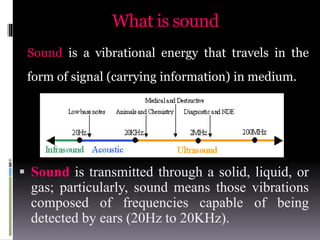
What is sound
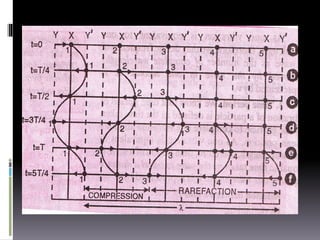
 Sound is transmitted through a solid, liquid, or
gas; particularly, sound means those vibrations
composed of frequencies capable of being
detected by ears (20Hz to 20KHz).
Sound is a vibrational energy that travels in the
form of signal (carrying information) in medium.
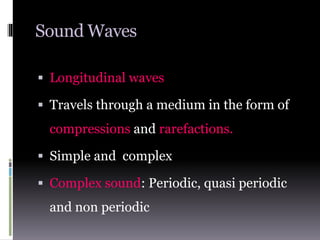
Sound Waves
 Longitudinal waves
 Travels through a medium in the form of
compressions and rarefactions.
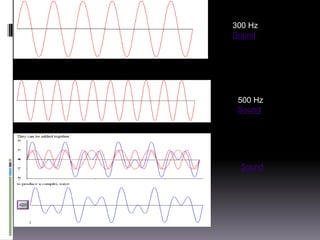
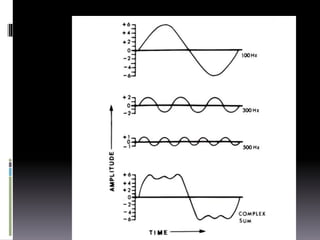
 Simple and complex
 Complex sound: Periodic, quasi periodic
and non periodic
300 Hz
Sound
500 Hz
Sound
Sound
Sound v/s Speech
 All Speech is a sound but all Sound is not a speech
 Speech is a sound which is the form of
communication among human being.
 Speech is a sound wave of air originated from the
complex actions of human body.
 Speech is a complex waveform. It contains
different frequencies.
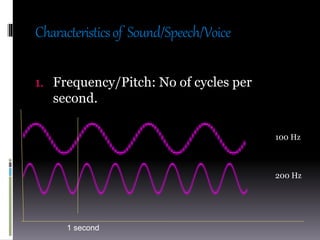
Characteristicsof Sound/Speech/Voice
1. Frequency/Pitch: No of cycles per
second.
100 Hz
200 Hz
1 second
 Audible frequency range: 20 Hz to 20 KHz
 Frequencies important to speech signals are in the
range of 100- 8000 Hz.
 Frequency related to the pitch directly.
 When frequency of vibration increased pitch increased
and vice versa.
 Frequency is measurable but Pitch is a psychological
phenomenon.
 Pitch is basically Fundamental Frequency of a person.
 Male fundamental frequency/Pitch range : 80-
150 Hz
 Female fundamental frequency/Pitch
range:150-250 Hz
 Child fundamental frequency/Pitch range:
greater than 250 Hz
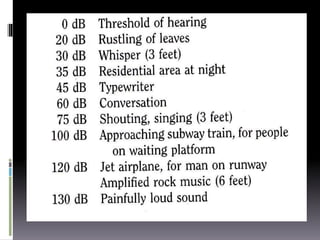
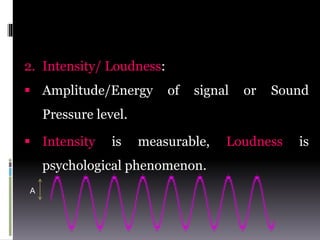
2. Intensity/ Loudness:
 Amplitude/Energy of signal or Sound
Pressure level.
 Intensity is measurable, Loudness is
psychological phenomenon.
A
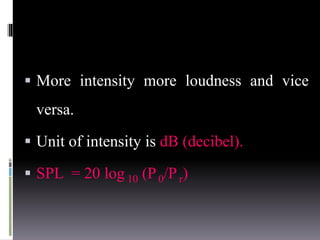
 More intensity more loudness and vice
versa.
 Unit of intensity is dB (decibel).
 SPL = 20 log 10 (P0/Pr)
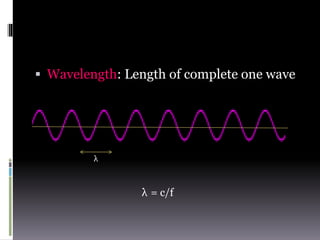
 Wavelength: Length of complete one wave
λ
= c/fλ
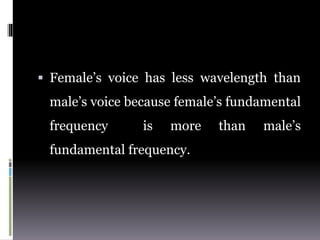
 Female’s voice has less wavelength than
male’s voice because female’s fundamental
frequency is more than male’s
fundamental frequency.
 Intonation: Variation in pitch pattern.
 Voice Quality/ Timbre: like Breathy Voice
 Diction: Clarity of speech
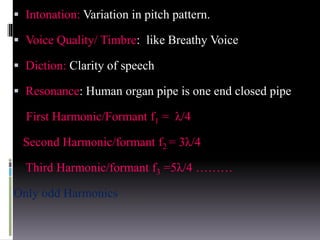
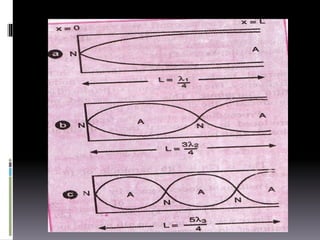
 Resonance: Human organ pipe is one end closed pipe
First Harmonic/Formant f1 = λ/4
Second Harmonic/formant f2 = 3λ/4
Third Harmonic/formant f3 =5λ/4 ………
Only odd Harmonics
VOICE IDENTIFICATION
Voice Identification is one of the important
emerging areas in forensic science
The recent development in the area of
information and communication technology has
made infinite advantage of connecting people
over exceptionally large distance at the fraction
of second - The brighter side of the coin.
But the darker side of the coin flashes the
use of communication technology in
several criminal offences such making
hoax calls to the police, ambulance or fire
brigade, making threatening or harassing
telephone calls, blackmail or extortion
demands or match fixing etc.
 Developed in the early years of 1940’s by
Green, Potter and Kopp at the Bell
Laboratories for the purpose of helping
military during world war II
 After criminal offence, no evidence
was left except the recorded
voice/voices of the suspect/suspects
then we definitely need for
Voice/Speaker Identification.
Voice Identification
 The task of determining an unknown
speaker’s identity. (Voice identification
determines which registered speaker
provides a given utterance from
amongst a set of known speakers.)
 Person’s speech/voice characteristics
MethodsofVoice/speakeridentification
 Aural examination of voice
 Spectrographic - visual examination
of voice spectrogram
 Automatic method of voice
identification

Lecture speech

  • 1.
  • 2.
    What is sound Sound is transmitted through a solid, liquid, or gas; particularly, sound means those vibrations composed of frequencies capable of being detected by ears (20Hz to 20KHz). Sound is a vibrational energy that travels in the form of signal (carrying information) in medium.
  • 3.
    Sound Waves  Longitudinalwaves  Travels through a medium in the form of compressions and rarefactions.  Simple and complex  Complex sound: Periodic, quasi periodic and non periodic
  • 5.
  • 8.
    Sound v/s Speech All Speech is a sound but all Sound is not a speech  Speech is a sound which is the form of communication among human being.  Speech is a sound wave of air originated from the complex actions of human body.  Speech is a complex waveform. It contains different frequencies.
  • 9.
    Characteristicsof Sound/Speech/Voice 1. Frequency/Pitch:No of cycles per second. 100 Hz 200 Hz 1 second
  • 10.
     Audible frequencyrange: 20 Hz to 20 KHz  Frequencies important to speech signals are in the range of 100- 8000 Hz.  Frequency related to the pitch directly.  When frequency of vibration increased pitch increased and vice versa.  Frequency is measurable but Pitch is a psychological phenomenon.  Pitch is basically Fundamental Frequency of a person.
  • 11.
     Male fundamentalfrequency/Pitch range : 80- 150 Hz  Female fundamental frequency/Pitch range:150-250 Hz  Child fundamental frequency/Pitch range: greater than 250 Hz
  • 12.
    2. Intensity/ Loudness: Amplitude/Energy of signal or Sound Pressure level.  Intensity is measurable, Loudness is psychological phenomenon. A
  • 13.
     More intensitymore loudness and vice versa.  Unit of intensity is dB (decibel).  SPL = 20 log 10 (P0/Pr)
  • 14.
     Wavelength: Lengthof complete one wave λ = c/fλ
  • 15.
     Female’s voicehas less wavelength than male’s voice because female’s fundamental frequency is more than male’s fundamental frequency.
  • 16.
     Intonation: Variationin pitch pattern.  Voice Quality/ Timbre: like Breathy Voice  Diction: Clarity of speech  Resonance: Human organ pipe is one end closed pipe First Harmonic/Formant f1 = λ/4 Second Harmonic/formant f2 = 3λ/4 Third Harmonic/formant f3 =5λ/4 ……… Only odd Harmonics
  • 18.
  • 19.
    Voice Identification isone of the important emerging areas in forensic science The recent development in the area of information and communication technology has made infinite advantage of connecting people over exceptionally large distance at the fraction of second - The brighter side of the coin.
  • 20.
    But the darkerside of the coin flashes the use of communication technology in several criminal offences such making hoax calls to the police, ambulance or fire brigade, making threatening or harassing telephone calls, blackmail or extortion demands or match fixing etc.
  • 21.
     Developed inthe early years of 1940’s by Green, Potter and Kopp at the Bell Laboratories for the purpose of helping military during world war II
  • 22.
     After criminaloffence, no evidence was left except the recorded voice/voices of the suspect/suspects then we definitely need for Voice/Speaker Identification.
  • 23.
    Voice Identification  Thetask of determining an unknown speaker’s identity. (Voice identification determines which registered speaker provides a given utterance from amongst a set of known speakers.)  Person’s speech/voice characteristics
  • 24.
    MethodsofVoice/speakeridentification  Aural examinationof voice  Spectrographic - visual examination of voice spectrogram  Automatic method of voice identification