TEJASVI BHATIA
The study of:
 the composition (make-up) of
matter
 the changes that matter undergoes
 Anything that:
◦has mass
and
◦occupies space (volume).
 Mass: a measure of the amount of
matter that an object contains. (SI
unit kilogram, kg)
 Weight: The force with which the
earth pulls on an object. (SI unit
Newton, N)
 Inorganic
 Organic
 Analytical
 Physical
 Biochemistry
 The study of chemicals that do
not contain carbon.
 The study of chemicals that
contain carbon.
 Origin: study of chemicals in
living organisms.
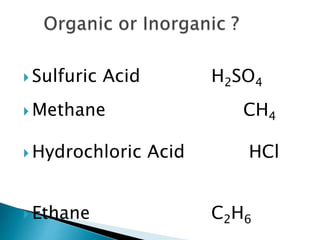
 Sulfuric Acid H2SO4
 Methane CH4
 Hydrochloric Acid HCl
 Ethane C2H6
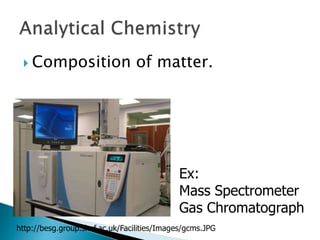
 Composition of matter.
http://besg.group.shef.ac.uk/Facilities/Images/gcms.JPG
Ex:
Mass Spectrometer
Gas Chromatograph
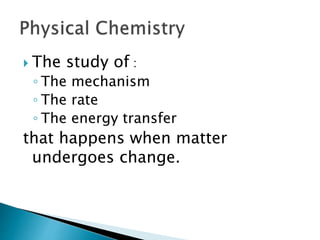
 The study of :
◦ The mechanism
◦ The rate
◦ The energy transfer
that happens when matter
undergoes change.
 Study of processes that take place
in organisms.
 What?
 Why?
 How?
 When?
 Science  Pure
◦ Does not necessarily have an
application.
 Technology  Applied
◦ Has practical applications in society.
◦ Engineering.
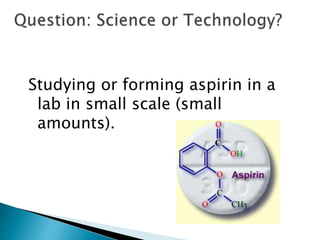
Studying or forming aspirin in a
lab in small scale (small
amounts).
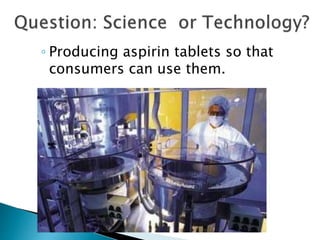
◦ Producing aspirin tablets so that
consumers can use them.
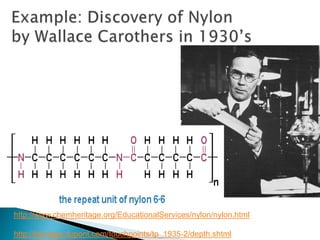
http://www.chemheritage.org/EducationalServices/nylon/nylon.html
http://heritage.dupont.com/touchpoints/tp_1935-2/depth.shtml
 Micro –(small)
◦ Microscopic- objects can be seen
with a microscope.
 Macro-(from afar)
◦ Macroscopic- objects are seen
without a microscope.
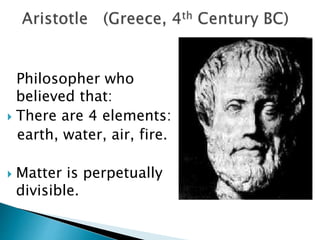
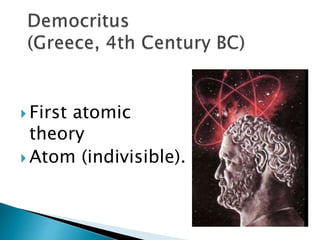
Philosopher who
believed that:
 There are 4 elements:
earth, water, air, fire.
 Matter is perpetually
divisible.
 First atomic
theory
 Atom (indivisible).
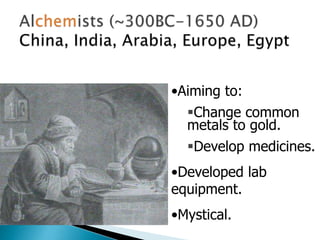
•Aiming to:
Change common
metals to gold.
Develop medicines.
•Developed lab
equipment.
•Mystical.
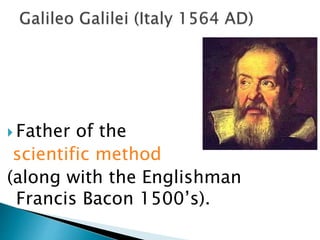
 Father of the
scientific method
(along with the Englishman
Francis Bacon 1500’s).
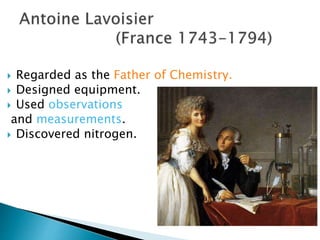
 Regarded as the Father of Chemistry.
 Designed equipment.
 Used observations
and measurements.
 Discovered nitrogen.
 Discovered the Law of Conservation of
Mass:
◦ In a chemical reaction mass is conserved.
 Explained burning as reaction with oxygen.
 Old theory: release of “phlogiston”.
Antoine Lavoisier (cont’d)
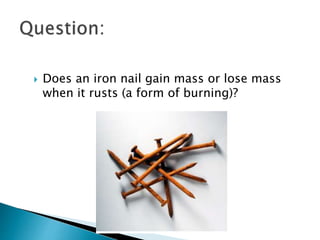
 Does an iron nail gain mass or lose mass
when it rusts (a form of burning)?
 Atomic theory
 Avogadro’s Number 6.02x10²³
 One mole of any substance contains
6.02x10²³ particles.
 First Periodic Table of
elements.
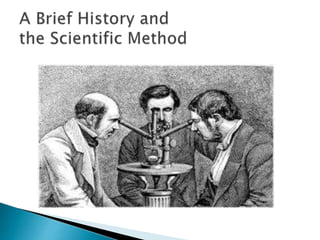
 Steps followed during
scientific investigations.
 Observation- recognition of a problem.
 Hypothesis- a proposed explanation of an
observation
◦ an educated guess
◦ must be testable.
 Experiment- a procedure used to test a
hypothesis (measurement, data collection,
manipulated and responding variables)
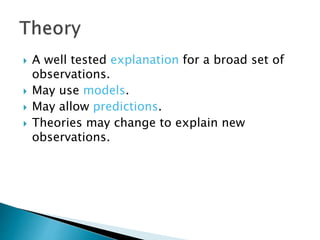
 Theory
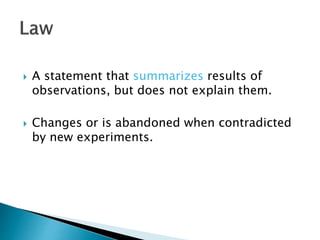
 Law
 A well tested explanation for a broad set of
observations.
 May use models.
 May allow predictions.
 Theories may change to explain new
observations.
 A statement that summarizes results of
observations, but does not explain them.
 Changes or is abandoned when contradicted
by new experiments.
 The order of the steps can vary and additional
steps may be added.
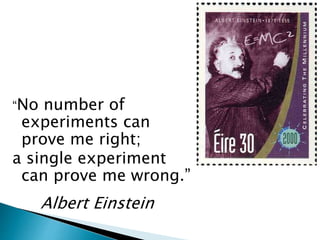
“No number of
experiments can
prove me right;
a single experiment
can prove me wrong.”
Albert Einstein

Intro to chem