Grammar Book

  Brooke Miller
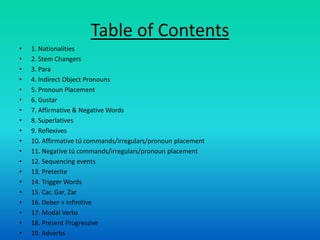
Table of Contents
•   1. Nationalities
•   2. Stem Changers
•   3. Para
•   4. Indirect Object Pronouns
•   5. Pronoun Placement
•   6. Gustar
•   7. Affirmative & Negative Words
•   8. Superlatives
•   9. Reflexives
•   10. Affirmative tú commands/irregulars/pronoun placement
•   11. Negative tú commands/irregulars/pronoun placement
•   12. Sequencing events
•   13. Preterite
•   14. Trigger Words
•   15. Car, Gar, Zar
•   16. Deber + Infinitive
•   17. Modal Verbs
•   18. Present Progressive
•   19. Adverbs
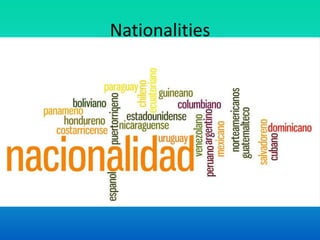
Nationalities
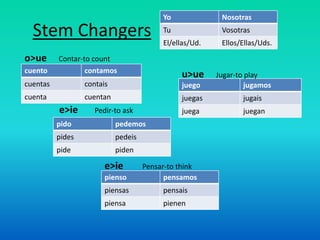
Yo              Nosotras

  Stem Changers                           Tu
                                          El/ellas/Ud.
                                                          Vosotras
                                                          Ellos/Ellas/Uds.
o>ue      Contar-to count
cuento            contamos
                                               u>ue      Jugar-to play
cuentas           contais                      juego              jugamos
cuenta            cuentan                      juegas           jugais
          e>ie       Pedir-to ask              juega            juegan
          pido              pedemos
          pides             pedeis
          pide              piden

                        e>ie         Pensar-to think
                        pienso             pensamos
                        piensas           pensais
                        piensa            pienen
Para

*You use para to indicate the recipient of items.

(for, in order to)


           El regalo para tu mama. -purpose
           Vamos al restaurante para comer. –implied purpose
           Tengo dinero para [compra] algo.
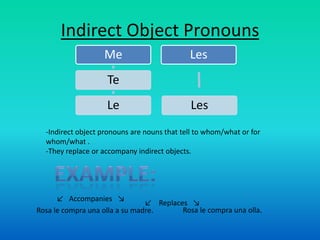
Indirect Object Pronouns
                   Me                        Les
                    Te
                    Le                       Les
  -Indirect object pronouns are nouns that tell to whom/what or for
  whom/what .
  -They replace or accompany indirect objects.


      ↙ Accompanies ↘
                                ↙ Replaces ↘
Rosa le compra una olla a su madre.      Rosa le compra una olla.
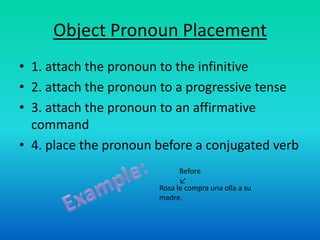
Object Pronoun Placement
• 1. attach the pronoun to the infinitive
• 2. attach the pronoun to a progressive tense
• 3. attach the pronoun to an affirmative
  command
• 4. place the pronoun before a conjugated verb
                             Before
                             ↙
                       Rosa le compra una olla a su
                       madre.
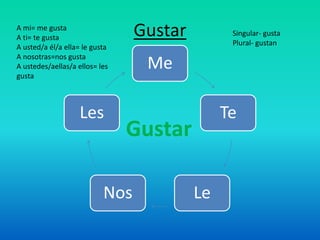
A mi= me gusta
A ti= te gusta                   Gustar         Singular- gusta
                                                Plural- gustan
A usted/a él/a ella= le gusta
A nosotras=nos gusta
A ustedes/aellas/a ellos= les     Me
gusta


                    Les                        Te
                                Gustar

                           Nos            Le
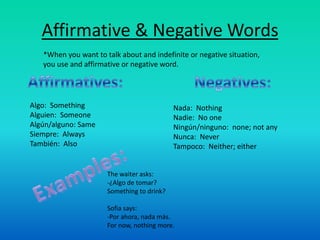
Affirmative & Negative Words
   *When you want to talk about and indefinite or negative situation,
   you use and affirmative or negative word.


Algo: Something                             Nada: Nothing
Alguien: Someone                            Nadie: No one
Algún/alguno: Same                          Ningún/ninguno: none; not any
Siempre: Always                             Nunca: Never
También: Also                               Tampoco: Neither; either


                      The waiter asks:
                      -¿Algo de tomar?
                      Something to drink?

                      Sofia says:
                      -Por ahora, nada más.
                      For now, nothing more.
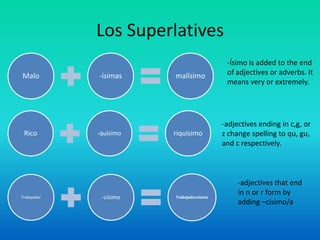
Los Superlatives
                                            -Ísimo is added to the end
Malo         -ísimas    malísimo            of adjectives or adverbs. It
                                            means very or extremely.


                                           -adjectives ending in c,g, or
 Rico        -quísimo   riquísimo          z change spelling to qu, gu,
                                           and c respectively.


                                                -adjectives that end
                                                in n or r form by
Trabajador    -císimo   Trabajadorcísimo
                                                adding –císimo/a
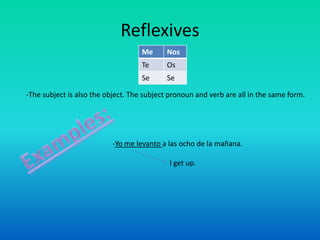
Reflexives
                                    Me     Nos
                                    Te     Os
                                    Se     Se

-The subject is also the object. The subject pronoun and verb are all in the same form.


                          -Yo me levanto a las ocho de la mañana.

                                            I get up.
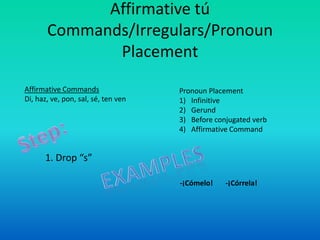
Affirmative tú
       Commands/Irregulars/Pronoun
              Placement
Affirmative Commands                 Pronoun Placement
Di, haz, ve, pon, sal, sé, ten ven   1) Infinitive
                                     2) Gerund
                                     3) Before conjugated verb
                                     4) Affirmative Command


      1. Drop “s”

                                     -¡Cómelo!    -¡Córrela!
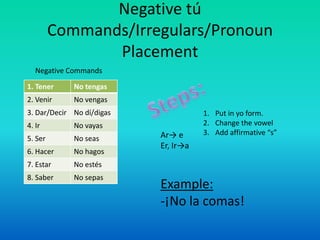
Negative tú
         Commands/Irregulars/Pronoun
                Placement
   Negative Commands

1. Tener     No tengas
2. Venir     No vengas
3. Dar/Decir No dí/digas              1. Put in yo form.
4. Ir        No vayas                 2. Change the vowel
                           Ar→ e      3. Add affirmative “s”
5. Ser       No seas
                           Er, Ir→a
6. Hacer     No hagos
7. Estar     No estés
8. Saber     No sepas
                           Example:
                           -¡No la comas!
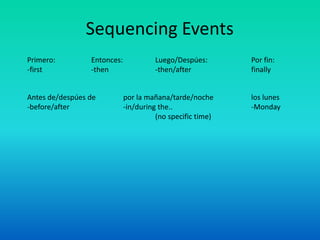
Sequencing Events
Primero:         Entonces:            Luego/Despúes:        Por fin:
-first           -then                -then/after           finally


Antes de/despúes de          por la mañana/tarde/noche      los lunes
-before/after                -in/during the..               -Monday
                                       (no specific time)
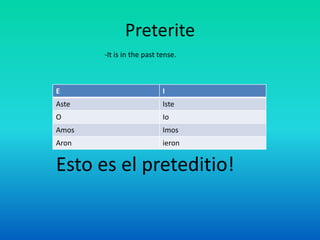
Preterite
       -It is in the past tense.


E                          I
Aste                       Iste
O                          Io
Amos                       Imos
Aron                       ieron


Esto es el preteditio!
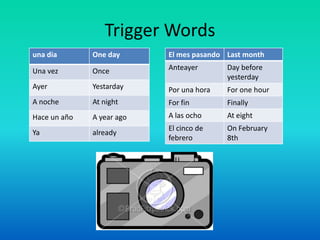
Trigger Words
una dia       One day      El mes pasando Last month

Una vez       Once         Anteayer       Day before
                                          yesterday
Ayer          Yestarday    Por una hora   For one hour
A noche       At night     For fin        Finally
Hace un año   A year ago   A las ocho     At eight
                           El cinco de    On February
Ya            already
                           febrero        8th
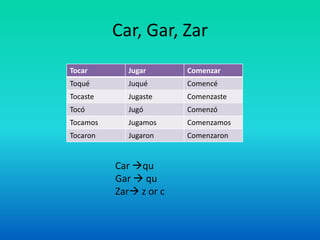
Car, Gar, Zar
Tocar       Jugar       Comenzar
Toqué       Juqué       Comencé
Tocaste     Jugaste     Comenzaste
Tocó        Jugó        Comenzó
Tocamos     Jugamos     Comenzamos
Tocaron     Jugaron     Comenzaron


          Car qu
          Gar  qu
          Zar z or c
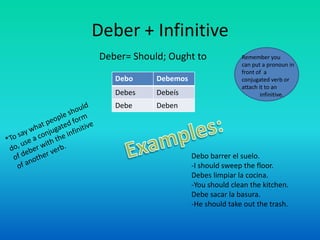
Deber + Infinitive
 Deber= Should; Ought to              Remember you
                                      can put a pronoun in
                                      front of a
    Debo     Debemos                  conjugated verb or
                                      attach it to an
    Debes    Debeís                           infinitive.
    Debe     Deben


                       Debo barrer el suelo.
                       -I should sweep the floor.
                       Debes limpiar la cocina.
                       -You should clean the kitchen.
                       Debe sacar la basura.
                       -He should take out the trash.
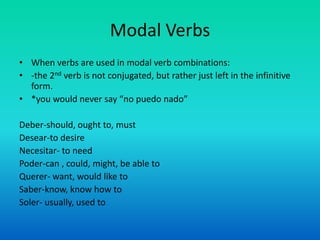
Modal Verbs
• When verbs are used in modal verb combinations:
• -the 2nd verb is not conjugated, but rather just left in the infinitive
  form.
• *you would never say “no puedo nado”

Deber-should, ought to, must
Desear-to desire
Necesitar- to need
Poder-can , could, might, be able to
Querer- want, would like to
Saber-know, know how to
Soler- usually, used to
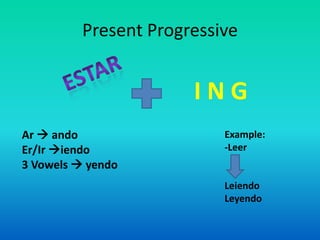
Present Progressive


                       ING
Ar  ando                  Example:
Er/Ir iendo               -Leer
3 Vowels  yendo
                           Leiendo
                           Leyendo
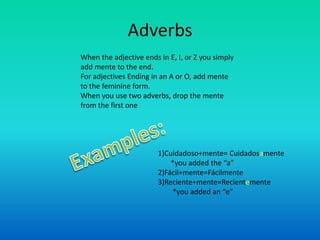
Adverbs
When the adjective ends in E, I, or Z you simply
add mente to the end.
For adjectives Ending in an A or O, add mente
to the feminine form.
When you use two adverbs, drop the mente
from the first one


                        1)Cuidadoso+mente= Cuidadosamente
                            *you added the “a”
                        2)Fácil+mente=Fácilmente
                        3)Reciente+mente=Recientemente
                            *you added an “e”

Grammar Book

  • 1.
    Grammar Book Brooke Miller
  • 2.
    Table of Contents • 1. Nationalities • 2. Stem Changers • 3. Para • 4. Indirect Object Pronouns • 5. Pronoun Placement • 6. Gustar • 7. Affirmative & Negative Words • 8. Superlatives • 9. Reflexives • 10. Affirmative tú commands/irregulars/pronoun placement • 11. Negative tú commands/irregulars/pronoun placement • 12. Sequencing events • 13. Preterite • 14. Trigger Words • 15. Car, Gar, Zar • 16. Deber + Infinitive • 17. Modal Verbs • 18. Present Progressive • 19. Adverbs
  • 3.
  • 4.
    Yo Nosotras Stem Changers Tu El/ellas/Ud. Vosotras Ellos/Ellas/Uds. o>ue Contar-to count cuento contamos u>ue Jugar-to play cuentas contais juego jugamos cuenta cuentan juegas jugais e>ie Pedir-to ask juega juegan pido pedemos pides pedeis pide piden e>ie Pensar-to think pienso pensamos piensas pensais piensa pienen
  • 5.
    Para *You use parato indicate the recipient of items. (for, in order to) El regalo para tu mama. -purpose Vamos al restaurante para comer. –implied purpose Tengo dinero para [compra] algo.
  • 6.
    Indirect Object Pronouns Me Les Te Le Les -Indirect object pronouns are nouns that tell to whom/what or for whom/what . -They replace or accompany indirect objects. ↙ Accompanies ↘ ↙ Replaces ↘ Rosa le compra una olla a su madre. Rosa le compra una olla.
  • 7.
    Object Pronoun Placement •1. attach the pronoun to the infinitive • 2. attach the pronoun to a progressive tense • 3. attach the pronoun to an affirmative command • 4. place the pronoun before a conjugated verb Before ↙ Rosa le compra una olla a su madre.
  • 8.
    A mi= megusta A ti= te gusta Gustar Singular- gusta Plural- gustan A usted/a él/a ella= le gusta A nosotras=nos gusta A ustedes/aellas/a ellos= les Me gusta Les Te Gustar Nos Le
  • 9.
    Affirmative & NegativeWords *When you want to talk about and indefinite or negative situation, you use and affirmative or negative word. Algo: Something Nada: Nothing Alguien: Someone Nadie: No one Algún/alguno: Same Ningún/ninguno: none; not any Siempre: Always Nunca: Never También: Also Tampoco: Neither; either The waiter asks: -¿Algo de tomar? Something to drink? Sofia says: -Por ahora, nada más. For now, nothing more.
  • 10.
    Los Superlatives -Ísimo is added to the end Malo -ísimas malísimo of adjectives or adverbs. It means very or extremely. -adjectives ending in c,g, or Rico -quísimo riquísimo z change spelling to qu, gu, and c respectively. -adjectives that end in n or r form by Trabajador -císimo Trabajadorcísimo adding –císimo/a
  • 11.
    Reflexives Me Nos Te Os Se Se -The subject is also the object. The subject pronoun and verb are all in the same form. -Yo me levanto a las ocho de la mañana. I get up.
  • 12.
    Affirmative tú Commands/Irregulars/Pronoun Placement Affirmative Commands Pronoun Placement Di, haz, ve, pon, sal, sé, ten ven 1) Infinitive 2) Gerund 3) Before conjugated verb 4) Affirmative Command 1. Drop “s” -¡Cómelo! -¡Córrela!
  • 13.
    Negative tú Commands/Irregulars/Pronoun Placement Negative Commands 1. Tener No tengas 2. Venir No vengas 3. Dar/Decir No dí/digas 1. Put in yo form. 4. Ir No vayas 2. Change the vowel Ar→ e 3. Add affirmative “s” 5. Ser No seas Er, Ir→a 6. Hacer No hagos 7. Estar No estés 8. Saber No sepas Example: -¡No la comas!
  • 14.
    Sequencing Events Primero: Entonces: Luego/Despúes: Por fin: -first -then -then/after finally Antes de/despúes de por la mañana/tarde/noche los lunes -before/after -in/during the.. -Monday (no specific time)
  • 15.
    Preterite -It is in the past tense. E I Aste Iste O Io Amos Imos Aron ieron Esto es el preteditio!
  • 16.
    Trigger Words una dia One day El mes pasando Last month Una vez Once Anteayer Day before yesterday Ayer Yestarday Por una hora For one hour A noche At night For fin Finally Hace un año A year ago A las ocho At eight El cinco de On February Ya already febrero 8th
  • 17.
    Car, Gar, Zar Tocar Jugar Comenzar Toqué Juqué Comencé Tocaste Jugaste Comenzaste Tocó Jugó Comenzó Tocamos Jugamos Comenzamos Tocaron Jugaron Comenzaron Car qu Gar  qu Zar z or c
  • 18.
    Deber + Infinitive Deber= Should; Ought to Remember you can put a pronoun in front of a Debo Debemos conjugated verb or attach it to an Debes Debeís infinitive. Debe Deben Debo barrer el suelo. -I should sweep the floor. Debes limpiar la cocina. -You should clean the kitchen. Debe sacar la basura. -He should take out the trash.
  • 19.
    Modal Verbs • Whenverbs are used in modal verb combinations: • -the 2nd verb is not conjugated, but rather just left in the infinitive form. • *you would never say “no puedo nado” Deber-should, ought to, must Desear-to desire Necesitar- to need Poder-can , could, might, be able to Querer- want, would like to Saber-know, know how to Soler- usually, used to
  • 20.
    Present Progressive ING Ar  ando Example: Er/Ir iendo -Leer 3 Vowels  yendo Leiendo Leyendo
  • 21.
    Adverbs When the adjectiveends in E, I, or Z you simply add mente to the end. For adjectives Ending in an A or O, add mente to the feminine form. When you use two adverbs, drop the mente from the first one 1)Cuidadoso+mente= Cuidadosamente *you added the “a” 2)Fácil+mente=Fácilmente 3)Reciente+mente=Recientemente *you added an “e”