BRIEF
PSYCHOTIC
DISORDER
P R E S E N T E D B Y
G U L R U K H R A N A
Today We will cover:
 BRIEF PSYCHOTIC DISORDER (DIAGNOSTIC
PROTOCOLS- DSM-V)
 ASSOCIATED FEATURES
 DEVELOPMENTAL COURSE
 RISK & PROGNOSTIC FACTORS
 FUNCTIONAL CONSEQUENCES
 DIFFERENTIAL
 CULTURE-RELATED
 PREVALENCE
B R I E F :
S H O R T D U R A T I O N ; N O T L A S T I N G F O R
L O N G .
P S Y C H O T I C :
A S E V E R E M E N T A L D I S O R D E R I N W H I C H
T H O U G H T A N D E M O T I O N S A R E S O
I M P A I R E D T H A T C O N T A C T I S L O S T W I T H
E X T E R N A L R E A L I T Y .
D I S O R D E R :
D I S R U P T T H E S Y S T E M A T I C F U N C T I O N I N G
BRIEF PSYCHOTIC DISORDER
DIAGNOSTIC CRITERIA
Presence of one (or more) of the following symptoms. At least
one of these must be (1), (2), or (3):
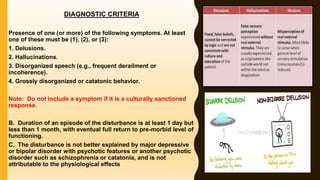
1. Delusions.
2. Hallucinations.
3. Disorganized speech (e.g., frequent derailment or
incoherence).
4. Grossly disorganized or catatonic behavior.
Note: Do not include a symptom if it is a culturally sanctioned
response.
B. Duration of an episode of the disturbance is at least 1 day but
less than 1 month, with eventual full return to pre-morbid level of
functioning.
C. The disturbance is not better explained by major depressive
or bipolar disorder with psychotic features or another psychotic
disorder such as schizophrenia or catatonia, and is not
attributable to the physiological effects
With marked stressor(s) (brief reactive
psychosis): If symptoms occur in
response to
• events that, singly or together, would be
markedly stressful to almost anyone in
similar circumstances in the individual’s
culture.
Without marked stressor(s): If symptoms
do not occur in response to events that,
singly or together, would be markedly
stressful to almost anyone in similar
circumstances in the individual’s culture.
• With postpartum onset: If onset is
during pregnancy or within 4 weeks
postpartum.
• With catatonia (refer to the criteria for
catatonia associated with another
mental disorder, pp. 119-120, for
definition)
• Coding note: Use additional code 293.89 (F06.1)
catatonia associated with brief psychotic disorder
to indicate the presence of the co-morbid
catatonia.
Specify current severity:
Severity is rated by a quantitative assessment of the
primary symptoms of
• psychosis, including delusions, hallucinations,
disorganized speech, abnormal psychomotor
behavior, and negative symptoms. Each of these
symptoms may be rated for its current severity
(most severe in the last 7 days) on a 5-point scale
ranging from 0 (not present) to 4 (present and
severe). (See Clinician-Rated Dimensions of
Psychosis Symptom Severity in the chapter
“Assessment Measures.”)
• Note: Diagnosis of brief psychotic disorder can be
made without using this severity specifier.
SPECIFY IF
ASSOCIATED / SUPPORTING FEATURES
Individuals with brief psychotic disorder typically experience emotional
turmoil or overwhelming confusion. They may have rapid shifts from one
intense affect to another.
Although the disturbance is brief, the level of impairment may be severe, and
supervision may be required to ensure that nutritional and hygienic needs are
met and that the individual is protected from the consequences of poor
judgment, cognitive impairment, or acting on the basis of delusions.
There appears to be an increased risk of suicidal behavior, particularly during
the acute episode.
R I S K A N D P R O G N O S T I C F A C T O R S
Temperamental
• Preexisting Personality Disorders and
Traits (E.G., Schizotypal Personality
Disorder; Borderline Personality Disorder;
or Traits in The Psychoticism Domain, Such
As Perceptual Dysregulation , And The
Negative Affectivity Domain, Such As
Suspiciousness) May Predispose The
Individual To The Development Of The
Disorder.
F U N C T I O N A L C O N S E Q U E N C E S
Despite high rates of relapse, for most
individuals, outcome is excellent in
terms of social functioning and
symptomatology.
DIFFERENTIAL
Depressive and bipolar disorders.
The diagnosis of brief psychotic disorder cannot be made if the psychotic symptoms
are better explained by a mood episode (i.e., the psychotic symptoms occur
exclusively during a full major depressive, manic, or mixed episode).
• Other psychotic disorders. If the psychotic symptoms persist for 1 month or longer,
the diagnosis is either schizophreniform disorder, delusional disorder, depressive
disorder with psychotic features, bipolar disorder with psychotic features, or other
specified or unspecified schizophrenia spectrum and other psychotic disorder,
depending on the other symptoms in the presentation. The differential diagnosis
between brief psychotic disorder and schizophreniform disorder is difficult when
the psychotic symptoms have remitted before 1 month in response to successful
treatment with medication.
• Careful attention should be given to the possibility that a recurrent disorder (e.g., bipolar disorder,
recurrent acute exacerbations of schizophrenia) may be responsible for any recurring psychotic
episodes.
DIFFERENTIAL
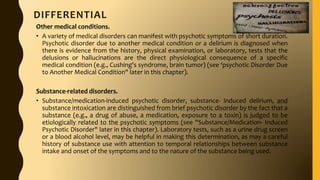
Other medical conditions.
• A variety of medical disorders can manifest with psychotic symptoms of short duration.
Psychotic disorder due to another medical condition or a delirium is diagnosed when
there is evidence from the history, physical examination, or laboratory, tests that the
delusions or hallucinations are the direct physiological consequence of a specific
medical condition (e.g., Cushing's syndrome, brain tumor) (see ‘psychotic Disorder Due
to Another Medical Condition" later in this chapter).
Substance-related disorders.
• Substance/medication-induced psychotic disorder, substance- induced delirium, and
substance intoxication are distinguished from brief psychotic disorder by the fact that a
substance (e.g., a drug of abuse, a medication, exposure to a toxin) is judged to be
etiologically related to the psychotic symptoms (see ''Substance/Medication- Induced
Psychotic Disorder" later in this chapter). Laboratory tests, such as a urine drug screen
or a blood alcohol level, may be helpful in making this determination, as may a careful
history of substance use with attention to temporal relationships between substance
intake and onset of the symptoms and to the nature of the substance being used.
DIFFERENTIAL
• Malingering and factitious disorders. An episode of factitious disorder, with
predominantly psychological signs and symptoms, may have the appearance of
brief psychotic disorder, but in such cases there is evidence that the symptoms are
intentionally produced.
• When malingering involves apparently psychotic symptoms, there is usually
evidence
• that the illness is being feigned for an understandable goal.
• Personality disorders. In certain individuals with personality disorders, psychosocial
stressors may precipitate brief periods of psychotic symptoms. These symptoms
are usually transient and do not warrant a separate diagnosis. If psychotic
symptoms persist for at least 1 day, an additional diagnosis of brief psychotic
disorder may be appropriate.
CULTURE-RELATED DIAGNOSTIC ISSUES
It is important to distinguish symptoms of brief psychotic
disorder from culturally sanctioned response patterns.
For example, in some religious ceremonies, an individual
may report hearing voices, but these do not generally
persist and are not perceived as abnormal by most
members of the individual's community. In addition,
cultural and religious background
PREVALENCE
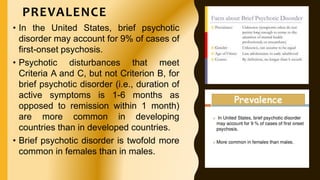
• In the United States, brief psychotic
disorder may account for 9% of cases of
first-onset psychosis.
• Psychotic disturbances that meet
Criteria A and C, but not Criterion B, for
brief psychotic disorder (i.e., duration of
active symptoms is 1-6 months as
opposed to remission within 1 month)
are more common in developing
countries than in developed countries.
• Brief psychotic disorder is twofold more
common in females than in males.
ANY QUESTIONS!!!!

Brief psychotic Disorder

  • 1.
    BRIEF PSYCHOTIC DISORDER P R ES E N T E D B Y G U L R U K H R A N A
  • 2.
    Today We willcover:  BRIEF PSYCHOTIC DISORDER (DIAGNOSTIC PROTOCOLS- DSM-V)  ASSOCIATED FEATURES  DEVELOPMENTAL COURSE  RISK & PROGNOSTIC FACTORS  FUNCTIONAL CONSEQUENCES  DIFFERENTIAL  CULTURE-RELATED  PREVALENCE
  • 3.
    B R IE F : S H O R T D U R A T I O N ; N O T L A S T I N G F O R L O N G . P S Y C H O T I C : A S E V E R E M E N T A L D I S O R D E R I N W H I C H T H O U G H T A N D E M O T I O N S A R E S O I M P A I R E D T H A T C O N T A C T I S L O S T W I T H E X T E R N A L R E A L I T Y . D I S O R D E R : D I S R U P T T H E S Y S T E M A T I C F U N C T I O N I N G BRIEF PSYCHOTIC DISORDER
  • 4.
    DIAGNOSTIC CRITERIA Presence ofone (or more) of the following symptoms. At least one of these must be (1), (2), or (3): 1. Delusions. 2. Hallucinations. 3. Disorganized speech (e.g., frequent derailment or incoherence). 4. Grossly disorganized or catatonic behavior. Note: Do not include a symptom if it is a culturally sanctioned response. B. Duration of an episode of the disturbance is at least 1 day but less than 1 month, with eventual full return to pre-morbid level of functioning. C. The disturbance is not better explained by major depressive or bipolar disorder with psychotic features or another psychotic disorder such as schizophrenia or catatonia, and is not attributable to the physiological effects
  • 5.
    With marked stressor(s)(brief reactive psychosis): If symptoms occur in response to • events that, singly or together, would be markedly stressful to almost anyone in similar circumstances in the individual’s culture. Without marked stressor(s): If symptoms do not occur in response to events that, singly or together, would be markedly stressful to almost anyone in similar circumstances in the individual’s culture. • With postpartum onset: If onset is during pregnancy or within 4 weeks postpartum. • With catatonia (refer to the criteria for catatonia associated with another mental disorder, pp. 119-120, for definition) • Coding note: Use additional code 293.89 (F06.1) catatonia associated with brief psychotic disorder to indicate the presence of the co-morbid catatonia. Specify current severity: Severity is rated by a quantitative assessment of the primary symptoms of • psychosis, including delusions, hallucinations, disorganized speech, abnormal psychomotor behavior, and negative symptoms. Each of these symptoms may be rated for its current severity (most severe in the last 7 days) on a 5-point scale ranging from 0 (not present) to 4 (present and severe). (See Clinician-Rated Dimensions of Psychosis Symptom Severity in the chapter “Assessment Measures.”) • Note: Diagnosis of brief psychotic disorder can be made without using this severity specifier. SPECIFY IF
  • 6.
    ASSOCIATED / SUPPORTINGFEATURES Individuals with brief psychotic disorder typically experience emotional turmoil or overwhelming confusion. They may have rapid shifts from one intense affect to another. Although the disturbance is brief, the level of impairment may be severe, and supervision may be required to ensure that nutritional and hygienic needs are met and that the individual is protected from the consequences of poor judgment, cognitive impairment, or acting on the basis of delusions. There appears to be an increased risk of suicidal behavior, particularly during the acute episode.
  • 7.
    R I SK A N D P R O G N O S T I C F A C T O R S Temperamental • Preexisting Personality Disorders and Traits (E.G., Schizotypal Personality Disorder; Borderline Personality Disorder; or Traits in The Psychoticism Domain, Such As Perceptual Dysregulation , And The Negative Affectivity Domain, Such As Suspiciousness) May Predispose The Individual To The Development Of The Disorder.
  • 8.
    F U NC T I O N A L C O N S E Q U E N C E S Despite high rates of relapse, for most individuals, outcome is excellent in terms of social functioning and symptomatology.
  • 9.
    DIFFERENTIAL Depressive and bipolardisorders. The diagnosis of brief psychotic disorder cannot be made if the psychotic symptoms are better explained by a mood episode (i.e., the psychotic symptoms occur exclusively during a full major depressive, manic, or mixed episode). • Other psychotic disorders. If the psychotic symptoms persist for 1 month or longer, the diagnosis is either schizophreniform disorder, delusional disorder, depressive disorder with psychotic features, bipolar disorder with psychotic features, or other specified or unspecified schizophrenia spectrum and other psychotic disorder, depending on the other symptoms in the presentation. The differential diagnosis between brief psychotic disorder and schizophreniform disorder is difficult when the psychotic symptoms have remitted before 1 month in response to successful treatment with medication. • Careful attention should be given to the possibility that a recurrent disorder (e.g., bipolar disorder, recurrent acute exacerbations of schizophrenia) may be responsible for any recurring psychotic episodes.
  • 10.
    DIFFERENTIAL Other medical conditions. •A variety of medical disorders can manifest with psychotic symptoms of short duration. Psychotic disorder due to another medical condition or a delirium is diagnosed when there is evidence from the history, physical examination, or laboratory, tests that the delusions or hallucinations are the direct physiological consequence of a specific medical condition (e.g., Cushing's syndrome, brain tumor) (see ‘psychotic Disorder Due to Another Medical Condition" later in this chapter). Substance-related disorders. • Substance/medication-induced psychotic disorder, substance- induced delirium, and substance intoxication are distinguished from brief psychotic disorder by the fact that a substance (e.g., a drug of abuse, a medication, exposure to a toxin) is judged to be etiologically related to the psychotic symptoms (see ''Substance/Medication- Induced Psychotic Disorder" later in this chapter). Laboratory tests, such as a urine drug screen or a blood alcohol level, may be helpful in making this determination, as may a careful history of substance use with attention to temporal relationships between substance intake and onset of the symptoms and to the nature of the substance being used.
  • 11.
    DIFFERENTIAL • Malingering andfactitious disorders. An episode of factitious disorder, with predominantly psychological signs and symptoms, may have the appearance of brief psychotic disorder, but in such cases there is evidence that the symptoms are intentionally produced. • When malingering involves apparently psychotic symptoms, there is usually evidence • that the illness is being feigned for an understandable goal. • Personality disorders. In certain individuals with personality disorders, psychosocial stressors may precipitate brief periods of psychotic symptoms. These symptoms are usually transient and do not warrant a separate diagnosis. If psychotic symptoms persist for at least 1 day, an additional diagnosis of brief psychotic disorder may be appropriate.
  • 12.
    CULTURE-RELATED DIAGNOSTIC ISSUES Itis important to distinguish symptoms of brief psychotic disorder from culturally sanctioned response patterns. For example, in some religious ceremonies, an individual may report hearing voices, but these do not generally persist and are not perceived as abnormal by most members of the individual's community. In addition, cultural and religious background
  • 13.
    PREVALENCE • In theUnited States, brief psychotic disorder may account for 9% of cases of first-onset psychosis. • Psychotic disturbances that meet Criteria A and C, but not Criterion B, for brief psychotic disorder (i.e., duration of active symptoms is 1-6 months as opposed to remission within 1 month) are more common in developing countries than in developed countries. • Brief psychotic disorder is twofold more common in females than in males.
  • 14.