Perspectives on Schizophrenia
• Schizophrenia is characterized by a broad
spectrum of disturbances in thinking
(delusions), perception (hallucinations),
speech, emotions, and behavior
• Diagnosis of schizophrenia requires that two
or more positive, negative and/or disorganized
symptoms be present for at least 1 month
• Affects 1% of population
• Complete recovery from schizophrenia is rare
Clinical Description and Symptoms
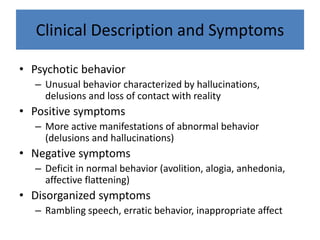
• Psychotic behavior
– Unusual behavior characterized by hallucinations,
delusions and loss of contact with reality
• Positive symptoms
– More active manifestations of abnormal behavior
(delusions and hallucinations)
• Negative symptoms
– Deficit in normal behavior (avolition, alogia, anhedonia,
affective flattening)
• Disorganized symptoms
– Rambling speech, erratic behavior, inappropriate affect
Symptoms, Diagnosis and Course
POSITIVE SYPTOMS
-they represent overt expression of unusual
perceptions, thoughts and behaviors.
- Delusions, Hallucinations
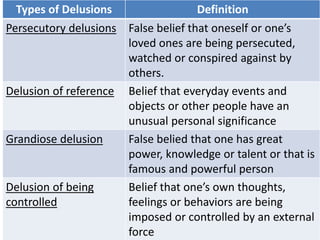
Types of Delusions Definition
Persecutory delusions False belief that oneself or one’s
loved ones are being persecuted,
watched or conspired against by
others.
Delusion of reference Belief that everyday events and
objects or other people have an
unusual personal significance
Grandiose delusion False belied that one has great
power, knowledge or talent or that is
famous and powerful person
Delusion of being
controlled
Belief that one’s own thoughts,
feelings or behaviors are being
imposed or controlled by an external
force
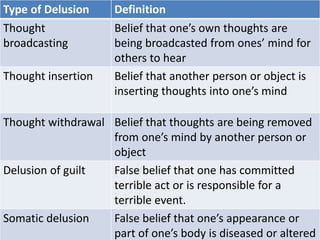
Type of Delusion Definition
Thought
broadcasting
Belief that one’s own thoughts are
being broadcasted from ones’ mind for
others to hear
Thought insertion Belief that another person or object is
inserting thoughts into one’s mind
Thought withdrawal Belief that thoughts are being removed
from one’s mind by another person or
object
Delusion of guilt False belief that one has committed
terrible act or is responsible for a
terrible event.
Somatic delusion False belief that one’s appearance or
part of one’s body is diseased or altered
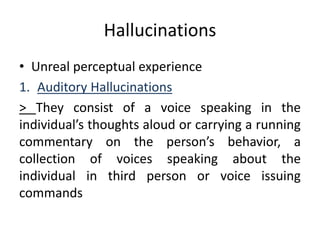
Hallucinations
Hallucinations
• Unreal perceptual experience
1. Auditory Hallucinations
> They consist of a voice speaking in the
individual’s thoughts aloud or carrying a running
commentary on the person’s behavior, a
collection of voices speaking about the
individual in third person or voice issuing
commands
2. Visual hallucinations
Often accompanied by auditory hallucinations
3. Tactile hallucinations
> Involve the perception that something is
happening to the outside of the person’s body
Negative Symptoms
• Avolition
–Apathy, inability to initiate and persist in
activities
• Alogia
–Absence of speech (poor communication
skills)
• Anhedonia
–Lack of pleasure
• Affective flattening
–Don’t show emotions when a reaction
would be expected
Disorganized symptoms
• Disorganized speech
–Lack of insight
–Jump from topic to topic, talk illogically, lack
of coherence
• Inappropriate affect and disorganized
behavior
–Laugh or cry at improper times
–Motor dysfunctions (agitation or
immobility)
Schizophrenia subtypes
-Paranoid type
• Delusions, hallucinations but cognitive skills and
affect are relatively intact, better prognosis
– Disorganized type
• Disrupted speech and behavior, delusions,
hallucinations, flat or silly affect, self-absorbed
– Catatonic type
• Motor disturbance predominate (echolalia,
echopraxia)
– Undifferentiated type
• Major symptoms of schizophrenia (no particular type)
– Residual type
• People who experienced at least one episode of
schizophrenia but no longer manifest major
symptoms
Psychosocial Factors
• Expressed emotion
• Stressful life events
• Low socioeconomic class
• Limited social network
Genetic factors:
(The evidence mounts…)
• Monozygotic twins (31%-78%) vs dizygotic
twins
• 4-9% risk in first degree relatives of
schizophrenics
• Adoption studies
• Linkage, molecular studies
Genetics of Schizophrenia:
The take-home message
• Vulnerability to schizophrenia is likely
inherited
• “Heritability” is probably 60-90%
• Schizophrenia probably involves dysfunction
of many genes
Anatomical abnormalities
• Enlargement of lateral
ventricles
• Smaller than normal total
brain volume
• Cortical atrophy
• Widening of third ventricle
• Smaller hippocampus
Schizoaffective disorder
Diagnostic Criteria for Schizoaffective disorder
A. An uninterrupted period of illness during which
there is a major mood episode (major depressive
or manic)
B. Delusions or hallucinations for 2 or more weeks
in the absence of a major mood episode
(depressive of manic during the lifetime duration
of the illness.
C. Symptoms that meet criteria for a major mood
episode are present for the majority of the total
duration active and residual portions of the illness
D. The disturbance is not attributable to the effects
of substance (e.g., drug abuse or medication) or
another medical condition.
Specify type:
Bipolar type: A manic episode is part of the
presentation. Major depressive episodes may
also occur.
Depressive type: If only major depressive
episodes are part the presentation
Specify if: with catatonia
Schizophreniform Disorder
A. Criteria A, D, and E of Schizophrenia are met
B. An episode of the disorder lasts at least 1
month but less than 6 months. When the
diagnosis must be made waiting for recovery,
it should be qualified as “provisional”
C. With good prognostic features: as evidence
by two or more of the following
1. Onset of prominent psychotic symptoms
within 4 weeks of the first noticeable change in
usual behavior or functioning.
2. Confusion or perplexity
3. Good premorbid social and occupational
functioning
4. Absence of blunted or flat affect
Brief psychotic disorder
A. Presence of one or more of the following
symptoms.
1. Delusions
2. Hallucinations
3. Disorganized speech
4. Grossly disorganized or catatonic behavior
B. Duration of an episode of the disturbance is at least
1 day but less than 1 month, with eventual fill return to
premorbid level of functioning
C. The disturbance is not better explained by major
depressive or bipolar disorder with psychotic features
or another psychotic disorder such as schizophrenia.

Schizophrenia

  • 2.
    Perspectives on Schizophrenia •Schizophrenia is characterized by a broad spectrum of disturbances in thinking (delusions), perception (hallucinations), speech, emotions, and behavior • Diagnosis of schizophrenia requires that two or more positive, negative and/or disorganized symptoms be present for at least 1 month • Affects 1% of population • Complete recovery from schizophrenia is rare
  • 3.
    Clinical Description andSymptoms • Psychotic behavior – Unusual behavior characterized by hallucinations, delusions and loss of contact with reality • Positive symptoms – More active manifestations of abnormal behavior (delusions and hallucinations) • Negative symptoms – Deficit in normal behavior (avolition, alogia, anhedonia, affective flattening) • Disorganized symptoms – Rambling speech, erratic behavior, inappropriate affect
  • 4.
    Symptoms, Diagnosis andCourse POSITIVE SYPTOMS -they represent overt expression of unusual perceptions, thoughts and behaviors. - Delusions, Hallucinations
  • 5.
    Types of DelusionsDefinition Persecutory delusions False belief that oneself or one’s loved ones are being persecuted, watched or conspired against by others. Delusion of reference Belief that everyday events and objects or other people have an unusual personal significance Grandiose delusion False belied that one has great power, knowledge or talent or that is famous and powerful person Delusion of being controlled Belief that one’s own thoughts, feelings or behaviors are being imposed or controlled by an external force
  • 6.
    Type of DelusionDefinition Thought broadcasting Belief that one’s own thoughts are being broadcasted from ones’ mind for others to hear Thought insertion Belief that another person or object is inserting thoughts into one’s mind Thought withdrawal Belief that thoughts are being removed from one’s mind by another person or object Delusion of guilt False belief that one has committed terrible act or is responsible for a terrible event. Somatic delusion False belief that one’s appearance or part of one’s body is diseased or altered
  • 7.
  • 8.
    Hallucinations • Unreal perceptualexperience 1. Auditory Hallucinations > They consist of a voice speaking in the individual’s thoughts aloud or carrying a running commentary on the person’s behavior, a collection of voices speaking about the individual in third person or voice issuing commands
  • 9.
    2. Visual hallucinations Oftenaccompanied by auditory hallucinations 3. Tactile hallucinations > Involve the perception that something is happening to the outside of the person’s body
  • 10.
    Negative Symptoms • Avolition –Apathy,inability to initiate and persist in activities • Alogia –Absence of speech (poor communication skills) • Anhedonia –Lack of pleasure • Affective flattening –Don’t show emotions when a reaction would be expected
  • 11.
    Disorganized symptoms • Disorganizedspeech –Lack of insight –Jump from topic to topic, talk illogically, lack of coherence • Inappropriate affect and disorganized behavior –Laugh or cry at improper times –Motor dysfunctions (agitation or immobility)
  • 13.
    Schizophrenia subtypes -Paranoid type •Delusions, hallucinations but cognitive skills and affect are relatively intact, better prognosis – Disorganized type • Disrupted speech and behavior, delusions, hallucinations, flat or silly affect, self-absorbed – Catatonic type • Motor disturbance predominate (echolalia, echopraxia) – Undifferentiated type • Major symptoms of schizophrenia (no particular type) – Residual type • People who experienced at least one episode of schizophrenia but no longer manifest major symptoms
  • 15.
    Psychosocial Factors • Expressedemotion • Stressful life events • Low socioeconomic class • Limited social network
  • 16.
    Genetic factors: (The evidencemounts…) • Monozygotic twins (31%-78%) vs dizygotic twins • 4-9% risk in first degree relatives of schizophrenics • Adoption studies • Linkage, molecular studies
  • 17.
    Genetics of Schizophrenia: Thetake-home message • Vulnerability to schizophrenia is likely inherited • “Heritability” is probably 60-90% • Schizophrenia probably involves dysfunction of many genes
  • 18.
    Anatomical abnormalities • Enlargementof lateral ventricles • Smaller than normal total brain volume • Cortical atrophy • Widening of third ventricle • Smaller hippocampus
  • 19.
  • 20.
    Diagnostic Criteria forSchizoaffective disorder A. An uninterrupted period of illness during which there is a major mood episode (major depressive or manic) B. Delusions or hallucinations for 2 or more weeks in the absence of a major mood episode (depressive of manic during the lifetime duration of the illness. C. Symptoms that meet criteria for a major mood episode are present for the majority of the total duration active and residual portions of the illness D. The disturbance is not attributable to the effects of substance (e.g., drug abuse or medication) or another medical condition.
  • 21.
    Specify type: Bipolar type:A manic episode is part of the presentation. Major depressive episodes may also occur. Depressive type: If only major depressive episodes are part the presentation Specify if: with catatonia
  • 22.
    Schizophreniform Disorder A. CriteriaA, D, and E of Schizophrenia are met B. An episode of the disorder lasts at least 1 month but less than 6 months. When the diagnosis must be made waiting for recovery, it should be qualified as “provisional” C. With good prognostic features: as evidence by two or more of the following
  • 23.
    1. Onset ofprominent psychotic symptoms within 4 weeks of the first noticeable change in usual behavior or functioning. 2. Confusion or perplexity 3. Good premorbid social and occupational functioning 4. Absence of blunted or flat affect
  • 24.
    Brief psychotic disorder A.Presence of one or more of the following symptoms. 1. Delusions 2. Hallucinations 3. Disorganized speech 4. Grossly disorganized or catatonic behavior B. Duration of an episode of the disturbance is at least 1 day but less than 1 month, with eventual fill return to premorbid level of functioning C. The disturbance is not better explained by major depressive or bipolar disorder with psychotic features or another psychotic disorder such as schizophrenia.