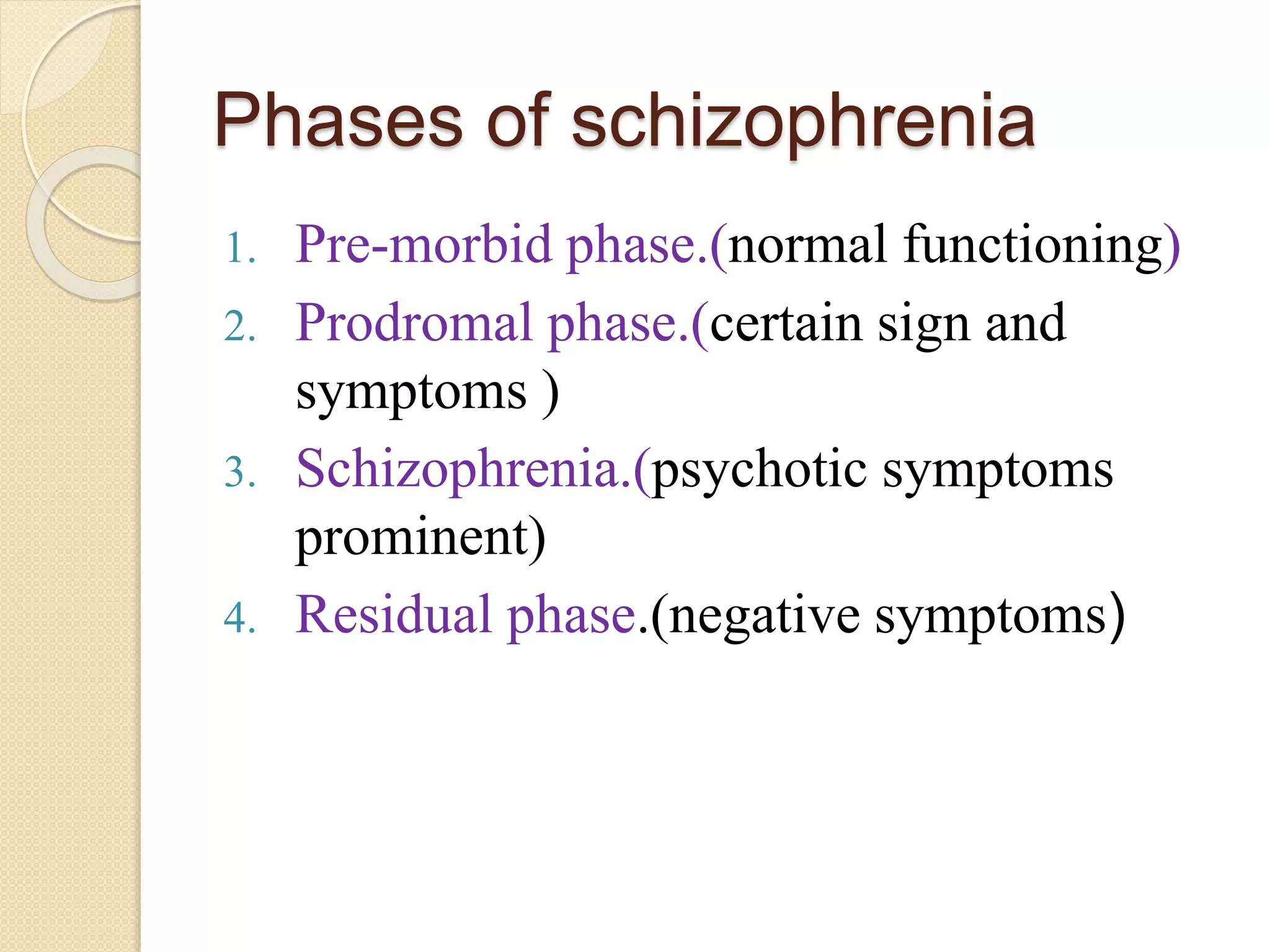
Schizophrenia is a type of psychosis characterized by disturbances in thinking, perception, affect, and behavior. It has been studied and defined by researchers like Kraepelin, Bleuler, and Schneider. Bleuler identified four fundamental symptoms - affective blunting, loosening of associations, autism, and ambivalence. Schizophrenia has several phases and is influenced by biological, psychological, and environmental factors. It is diagnosed based on the presence of symptoms from different groups for over one month. Treatment involves pharmacological therapy with antipsychotics, electroconvulsive therapy in rare cases, and psychosocial interventions like psychoeducation, psychotherapy, and rehabilitation.
Definition :-
“itis type of functional psychosis
characterized mainly by disturbance in
thinking and associated disturbances in
psychomotor activity, affect, perception,
and behaviour.
3.
History :-
EmilKraepelin: This illness develops relatively
early in life, and its course is likely deteriorating
and chronic; deterioration reminded dementia
(„Dementia praecox“), but was not followed by
any organic changes of the brain, detectable at
that time.
Eugen Bleuler: He renamed Kraepelin’s dementia
praecox as schizophrenia (1911); he recognized
the cognitive impairment in this illness, which he
named as a „splitting“ of mind.
Kurt Schneider: He emphasized the role of
psychotic symptoms, as hallucinations, delusions
and gave them the privilege of „the first rank
symptoms” even in the concept of the diagnosis of
schizophrenia.
4.
cont.
Bleuler maintained,that for the diagnosis of
schizophrenia are most important the following four
fundamental symptoms:
◦ affective blunting
◦ Loosing of association (fragmented thinking)
◦ Autism(Social withdrawal)
◦ ambivalence (conflicting attitude )
These groups of symptoms, are called „four A’ s” and
Bleuler thought, that they are „primary” for this
diagnosis.
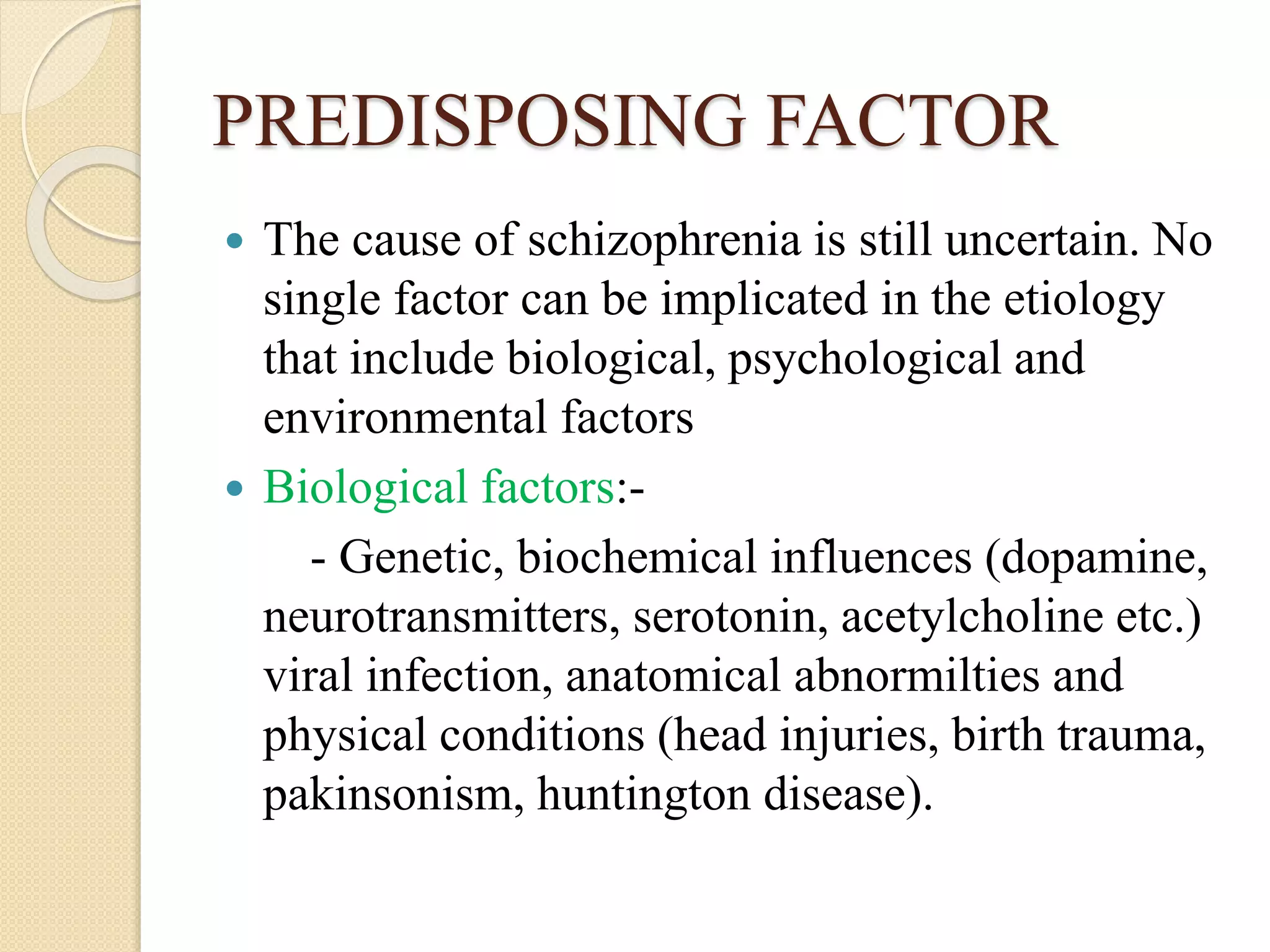
PREDISPOSING FACTOR
Thecause of schizophrenia is still uncertain. No
single factor can be implicated in the etiology
that include biological, psychological and
environmental factors
Biological factors:-
- Genetic, biochemical influences (dopamine,
neurotransmitters, serotonin, acetylcholine etc.)
viral infection, anatomical abnormilties and
physical conditions (head injuries, birth trauma,
pakinsonism, huntington disease).
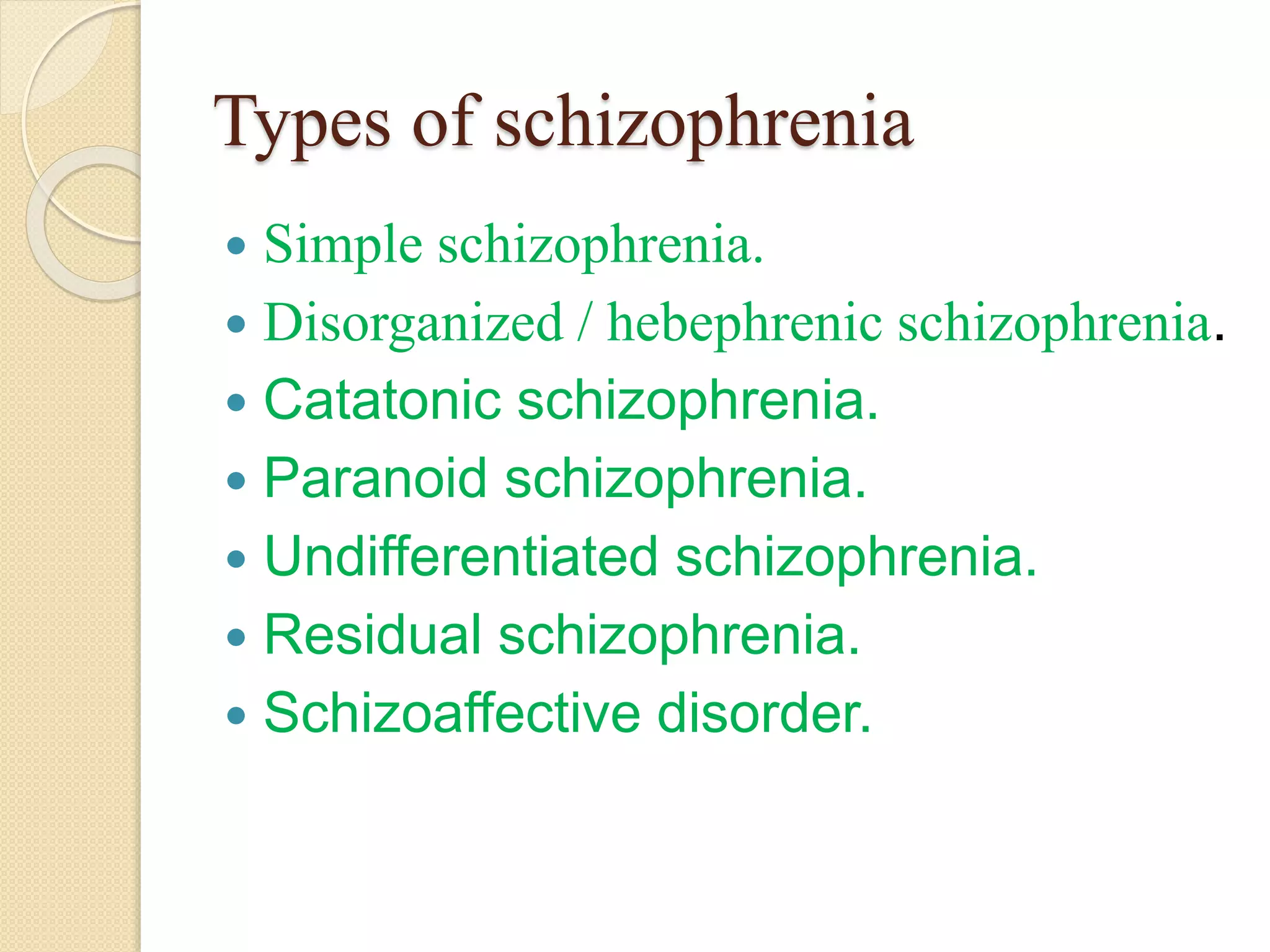
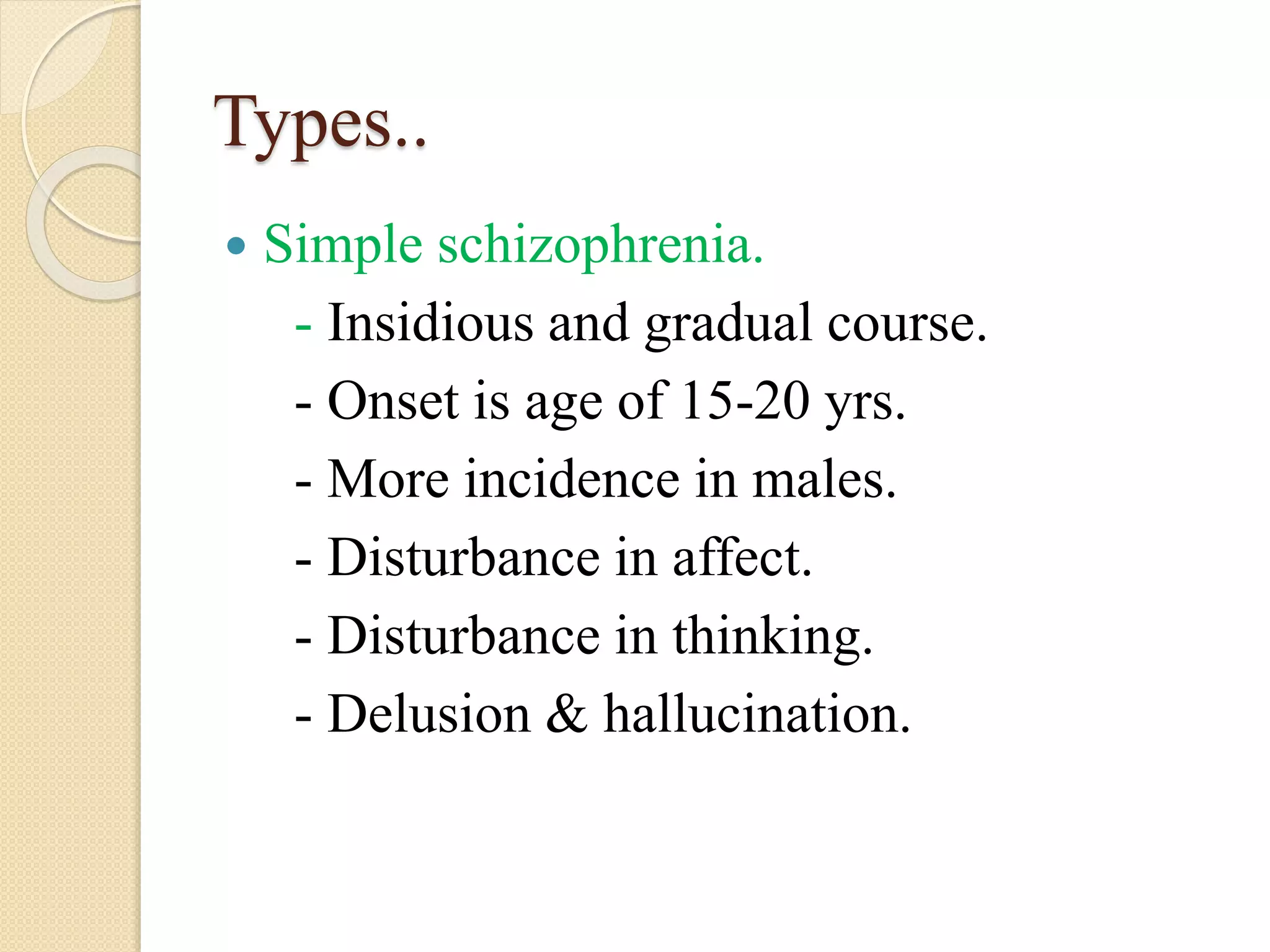
Types..
Simple schizophrenia.
-Insidious and gradual course.
- Onset is age of 15-20 yrs.
- More incidence in males.
- Disturbance in affect.
- Disturbance in thinking.
- Delusion & hallucination.
10.
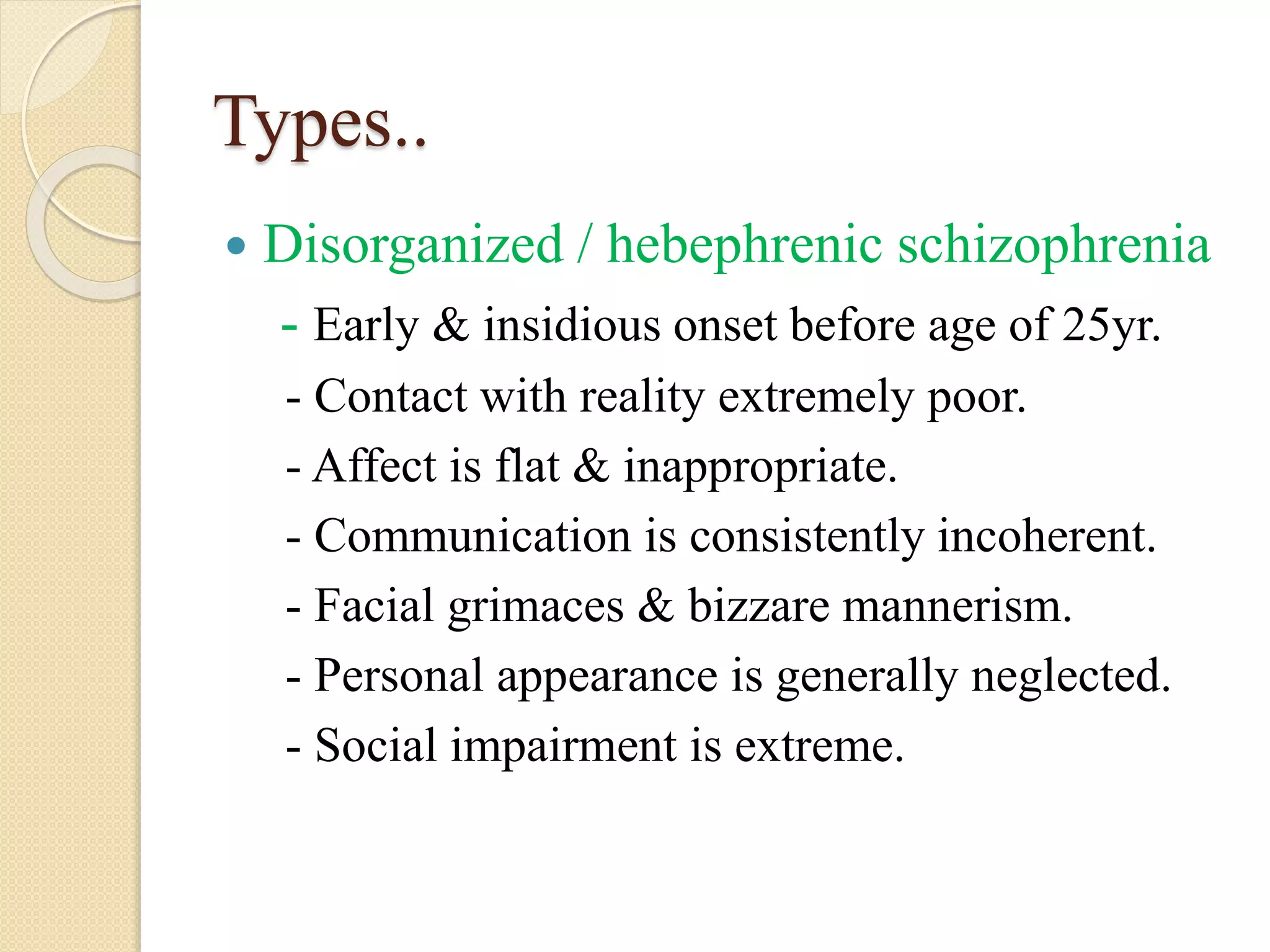
Types..
Disorganized /hebephrenic schizophrenia
- Early & insidious onset before age of 25yr.
- Contact with reality extremely poor.
- Affect is flat & inappropriate.
- Communication is consistently incoherent.
- Facial grimaces & bizzare mannerism.
- Personal appearance is generally neglected.
- Social impairment is extreme.
11.
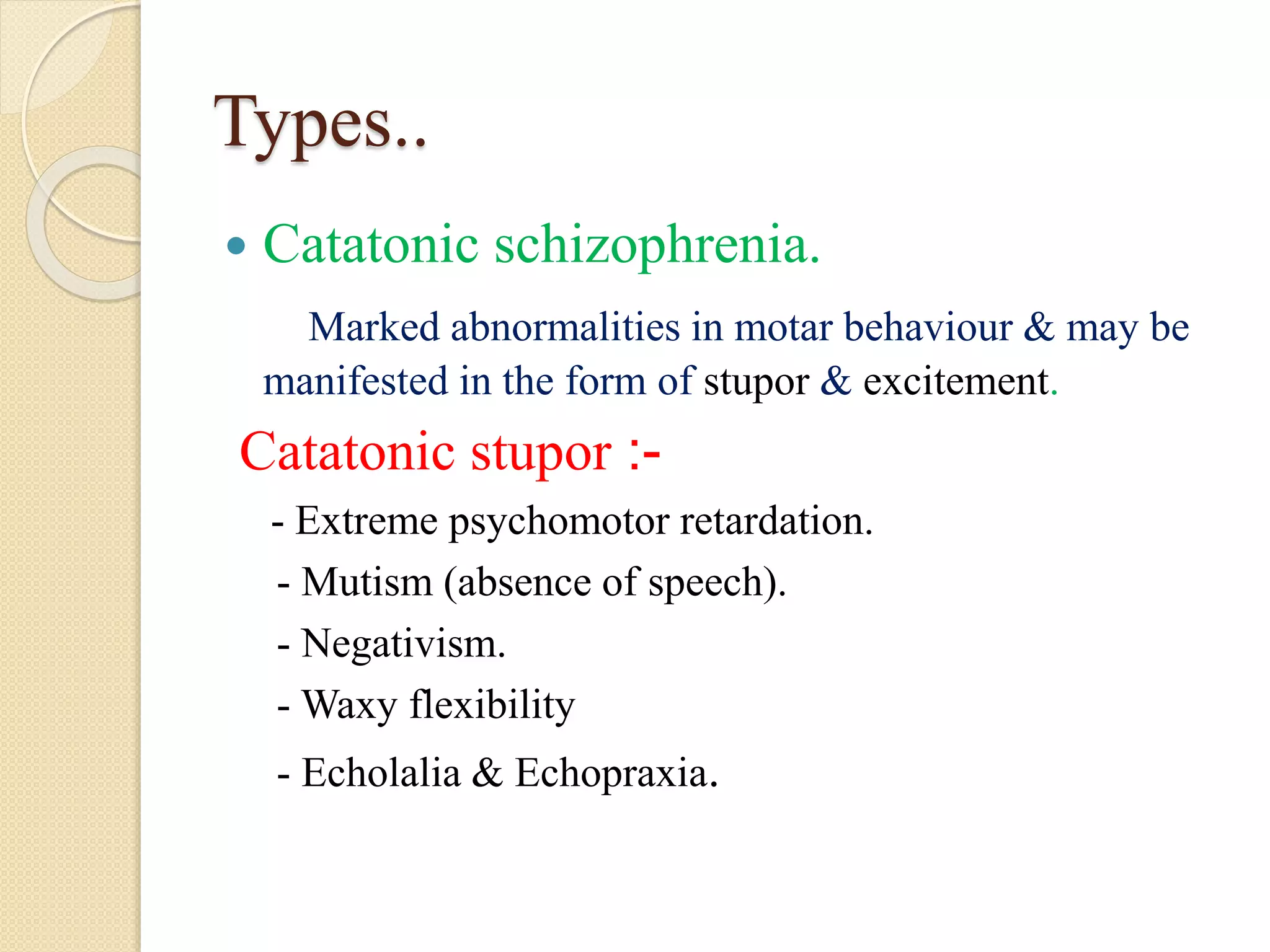
Types..
Catatonic schizophrenia.
Markedabnormalities in motar behaviour & may be
manifested in the form of stupor & excitement.
Catatonic stupor :-
- Extreme psychomotor retardation.
- Mutism (absence of speech).
- Negativism.
- Waxy flexibility
- Echolalia & Echopraxia.
12.
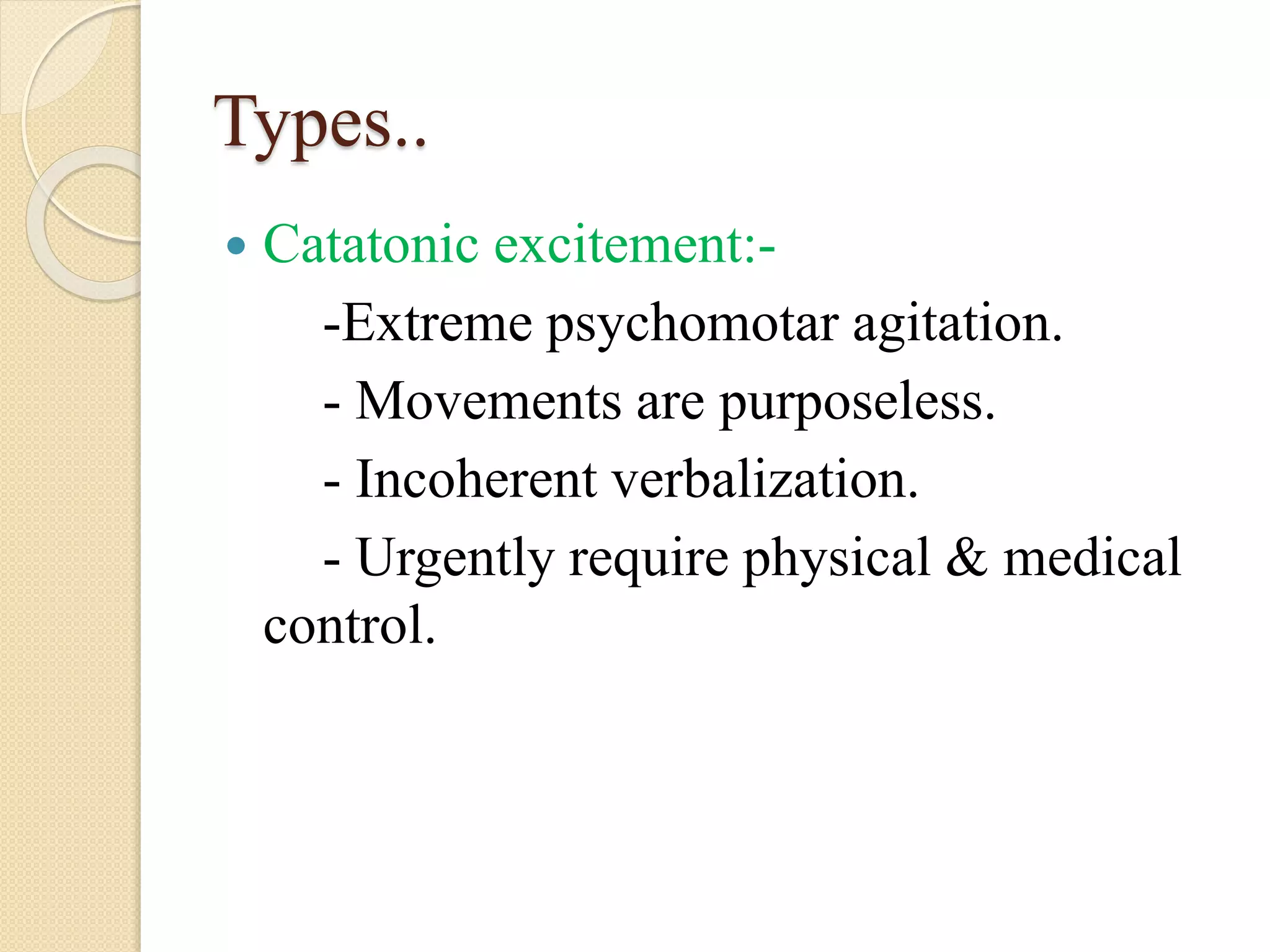
Types..
Catatonic excitement:-
-Extremepsychomotar agitation.
- Movements are purposeless.
- Incoherent verbalization.
- Urgently require physical & medical
control.
13.
Types..
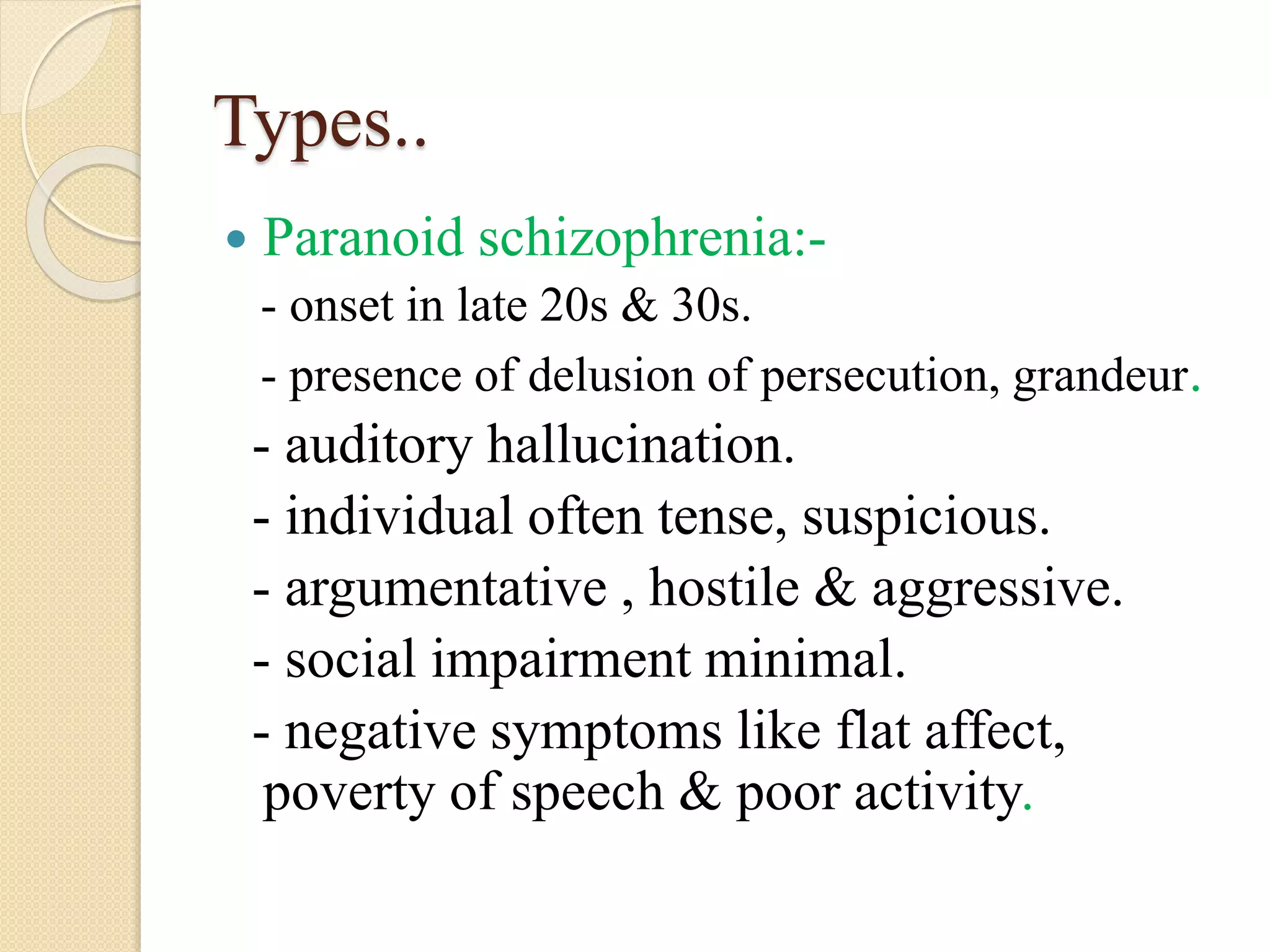
Paranoid schizophrenia:-
-onset in late 20s & 30s.
- presence of delusion of persecution, grandeur.
- auditory hallucination.
- individual often tense, suspicious.
- argumentative , hostile & aggressive.
- social impairment minimal.
- negative symptoms like flat affect,
poverty of speech & poor activity.
14.
Types..
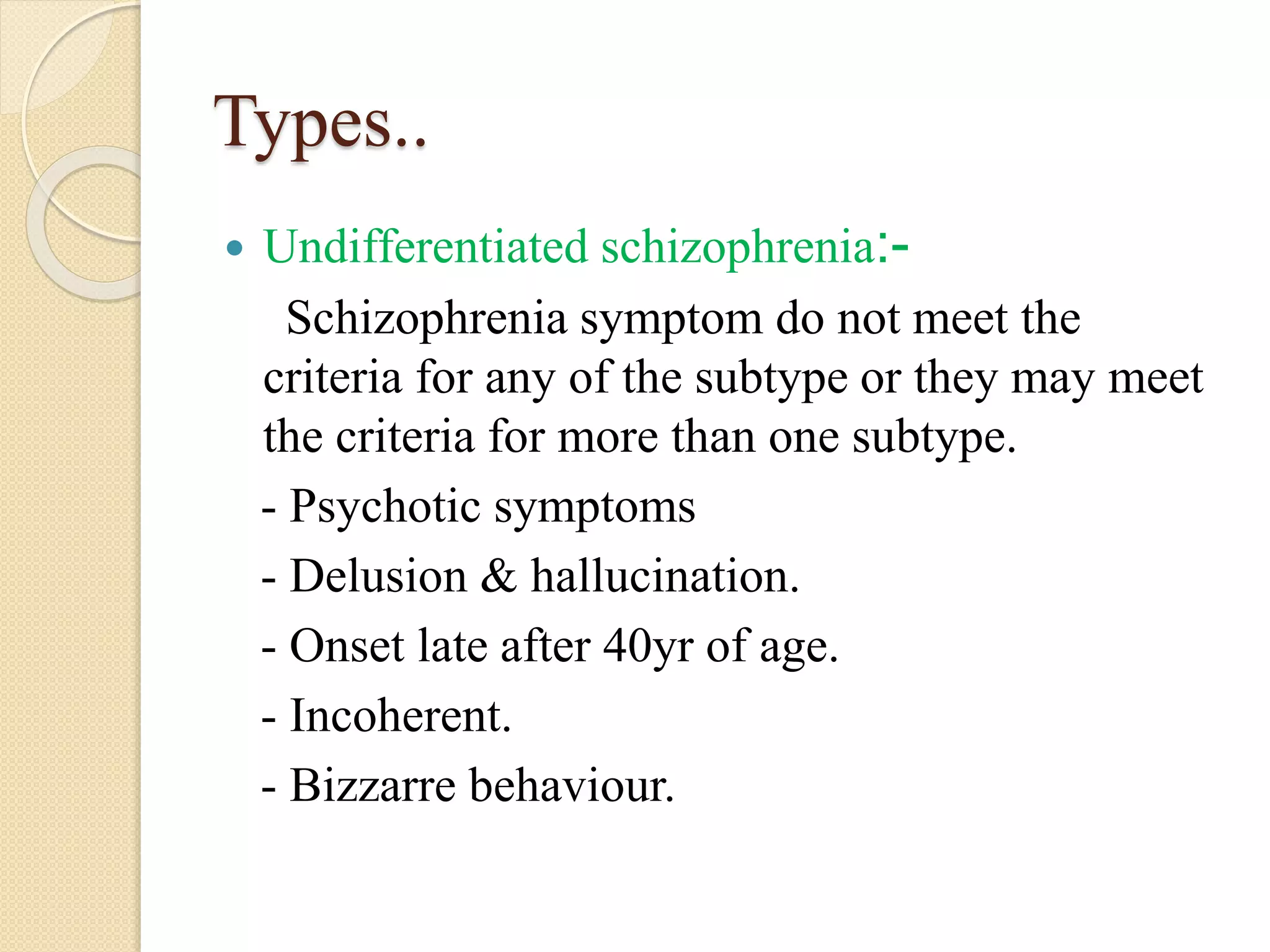
Undifferentiated schizophrenia:-
Schizophreniasymptom do not meet the
criteria for any of the subtype or they may meet
the criteria for more than one subtype.
- Psychotic symptoms
- Delusion & hallucination.
- Onset late after 40yr of age.
- Incoherent.
- Bizzarre behaviour.
15.
Types..
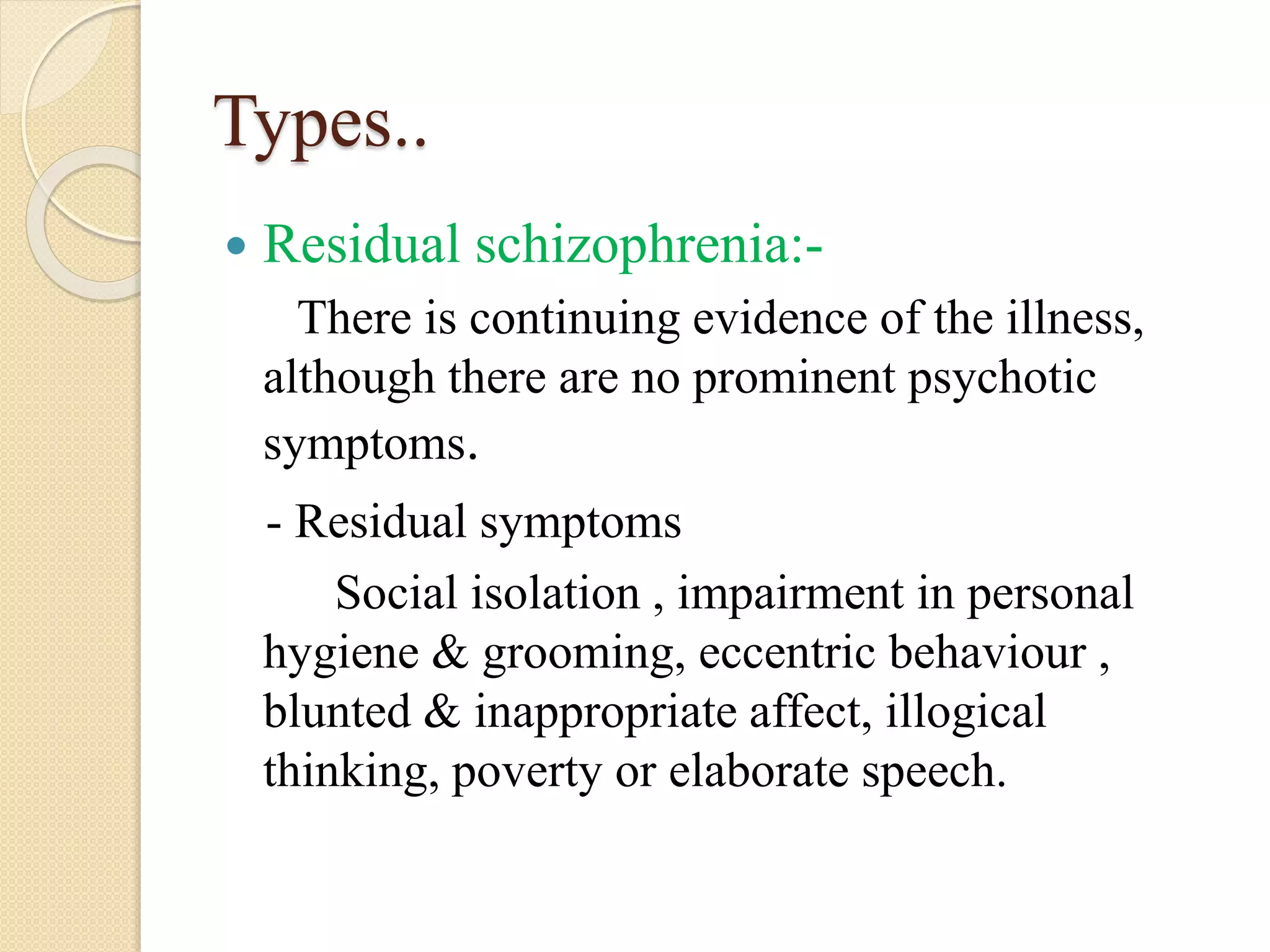
Residual schizophrenia:-
Thereis continuing evidence of the illness,
although there are no prominent psychotic
symptoms.
- Residual symptoms
Social isolation , impairment in personal
hygiene & grooming, eccentric behaviour ,
blunted & inappropriate affect, illogical
thinking, poverty or elaborate speech.
16.
Types..
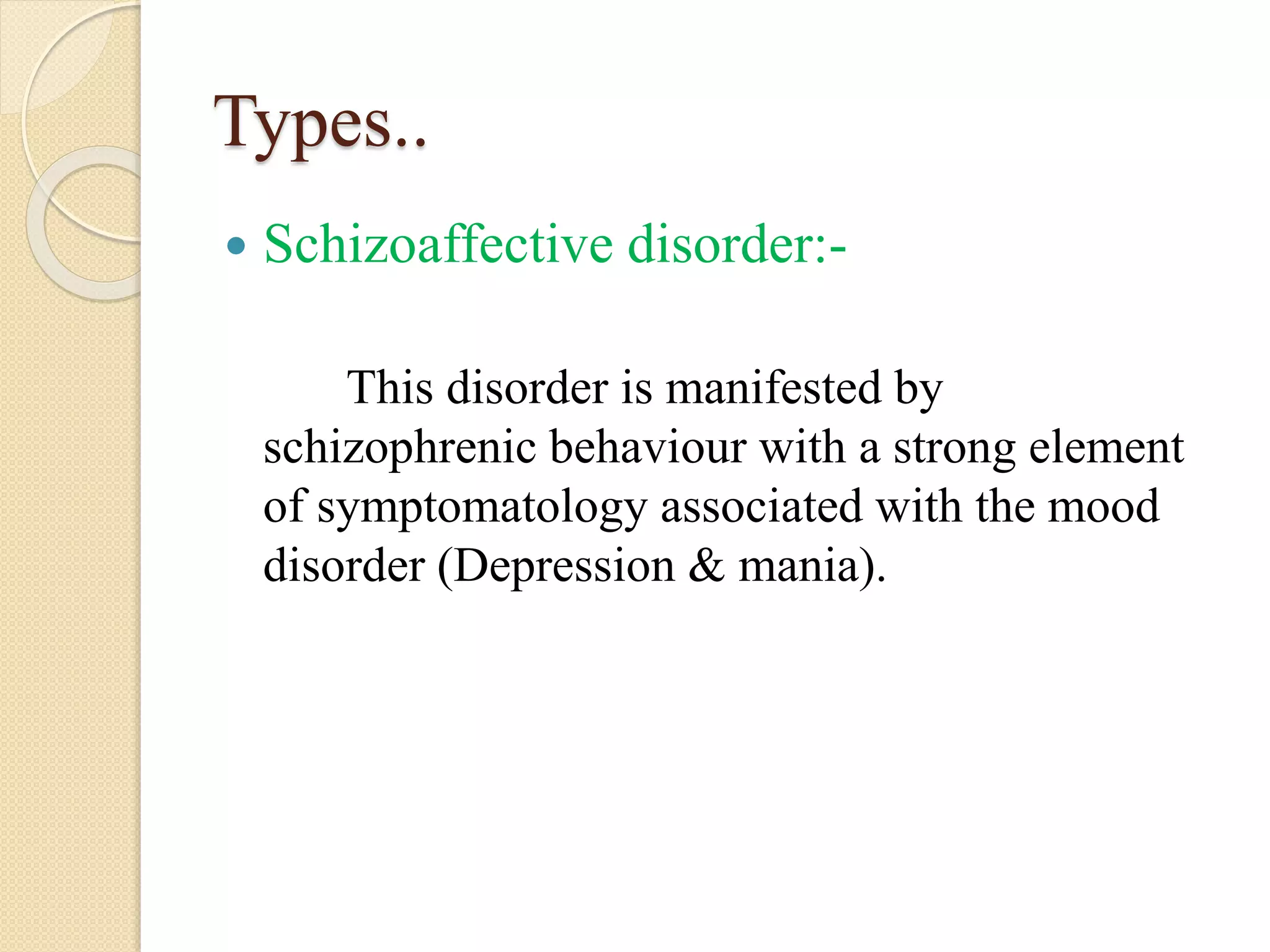
Schizoaffective disorder:-
Thisdisorder is manifested by
schizophrenic behaviour with a strong element
of symptomatology associated with the mood
disorder (Depression & mania).
17.
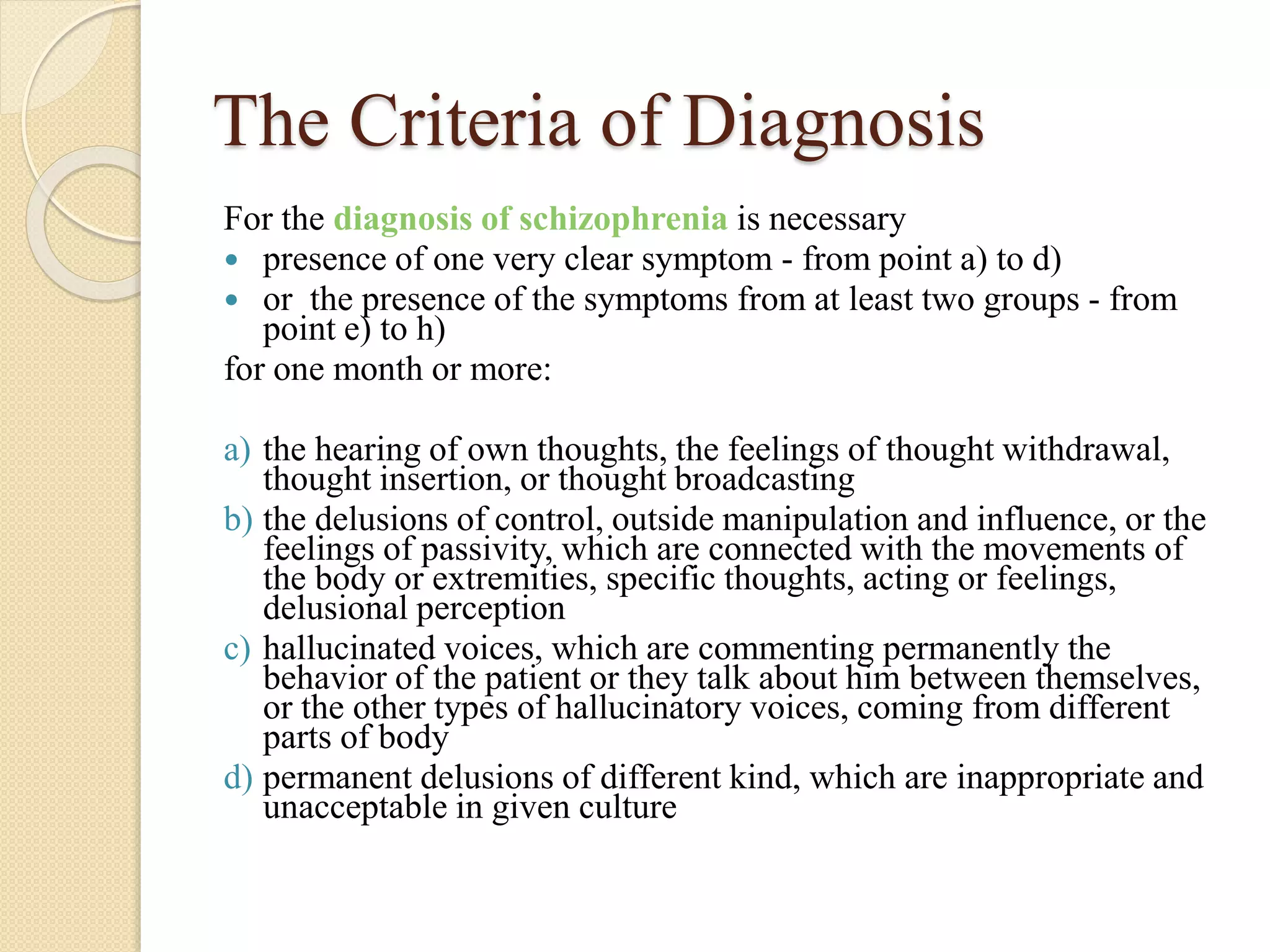
The Criteria ofDiagnosis
For the diagnosis of schizophrenia is necessary
presence of one very clear symptom - from point a) to d)
or the presence of the symptoms from at least two groups - from
point e) to h)
for one month or more:
a) the hearing of own thoughts, the feelings of thought withdrawal,
thought insertion, or thought broadcasting
b) the delusions of control, outside manipulation and influence, or the
feelings of passivity, which are connected with the movements of
the body or extremities, specific thoughts, acting or feelings,
delusional perception
c) hallucinated voices, which are commenting permanently the
behavior of the patient or they talk about him between themselves,
or the other types of hallucinatory voices, coming from different
parts of body
d) permanent delusions of different kind, which are inappropriate and
unacceptable in given culture
18.
The Criteria ofDiagnosis
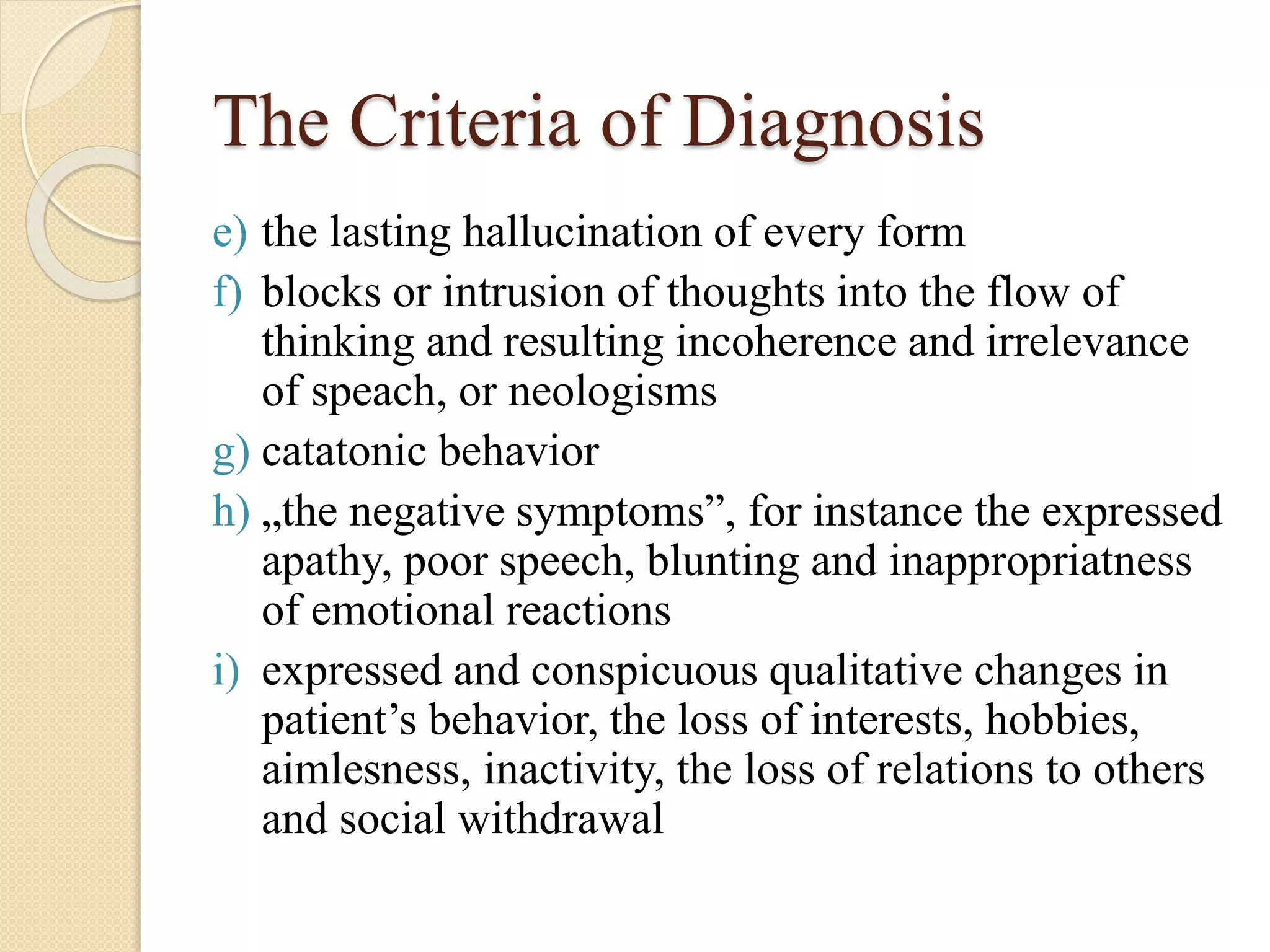
e) the lasting hallucination of every form
f) blocks or intrusion of thoughts into the flow of
thinking and resulting incoherence and irrelevance
of speach, or neologisms
g) catatonic behavior
h) „the negative symptoms”, for instance the expressed
apathy, poor speech, blunting and inappropriatness
of emotional reactions
i) expressed and conspicuous qualitative changes in
patient’s behavior, the loss of interests, hobbies,
aimlesness, inactivity, the loss of relations to others
and social withdrawal
19.
CLINICAL MANIFESTATION
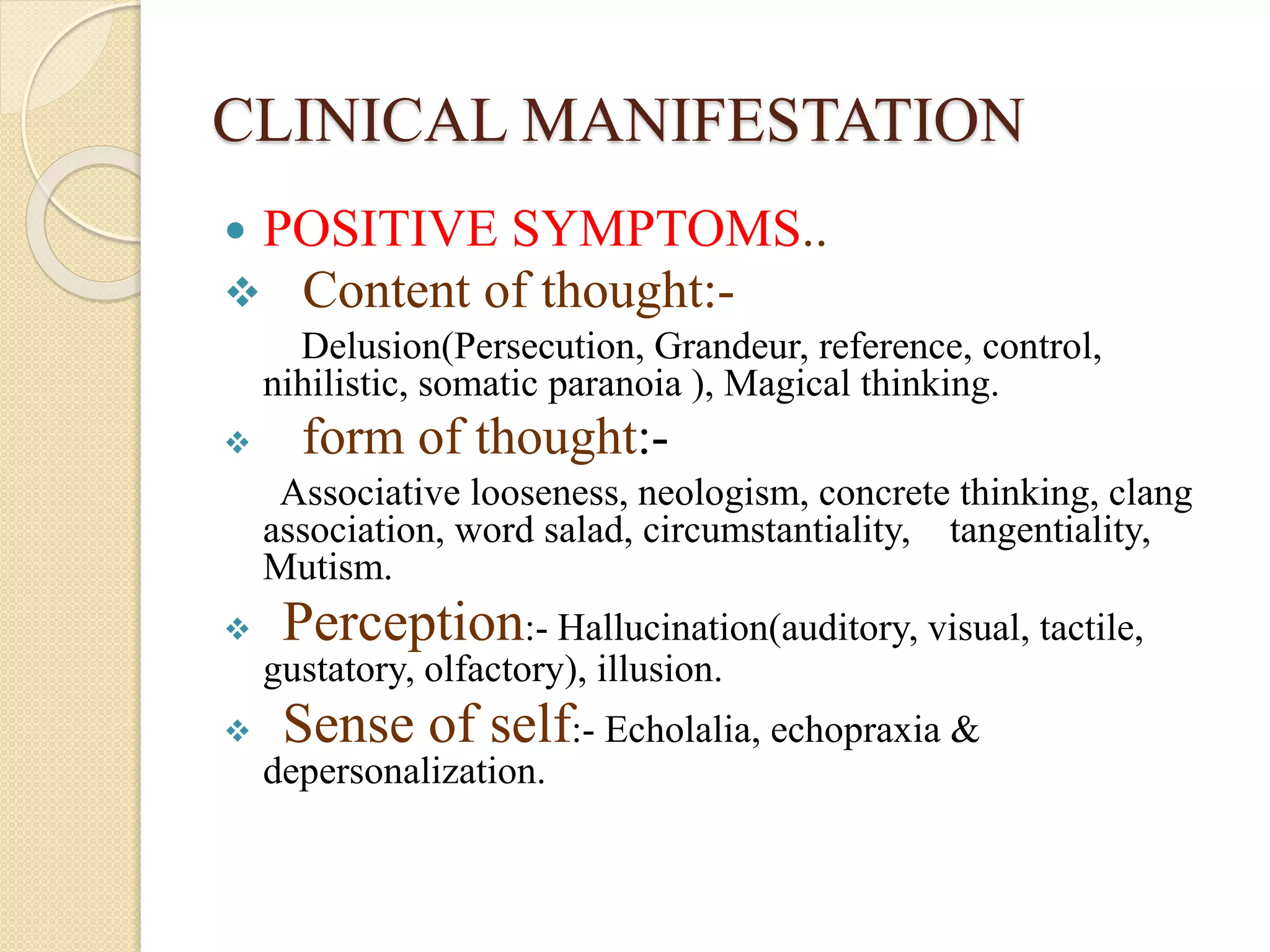
POSITIVESYMPTOMS..
Content of thought:-
Delusion(Persecution, Grandeur, reference, control,
nihilistic, somatic paranoia ), Magical thinking.
form of thought:-
Associative looseness, neologism, concrete thinking, clang
association, word salad, circumstantiality, tangentiality,
Mutism.
Perception:- Hallucination(auditory, visual, tactile,
gustatory, olfactory), illusion.
Sense of self:- Echolalia, echopraxia &
depersonalization.
20.
CLINICAL MANIFESTATION
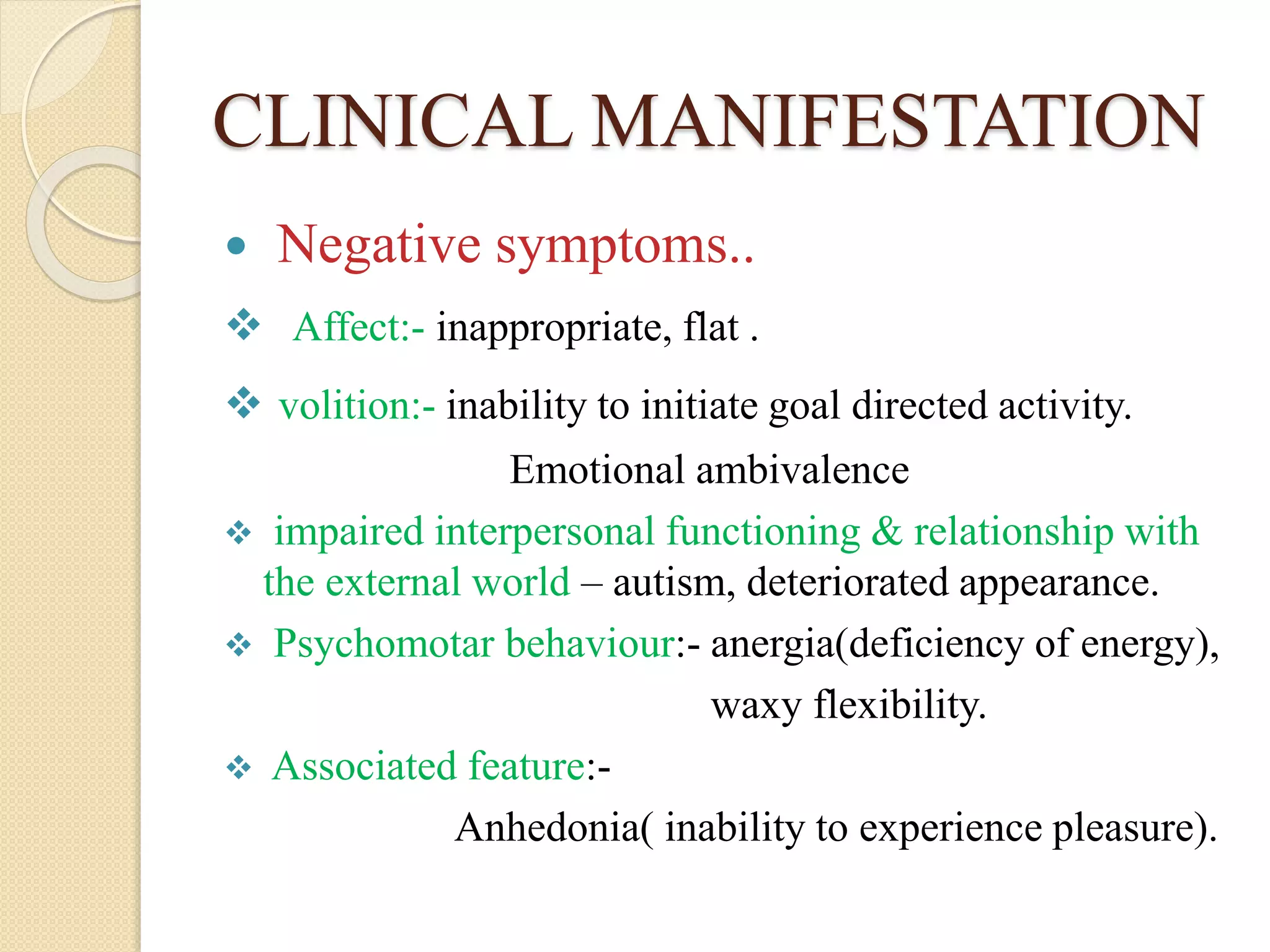
Negativesymptoms..
Affect:- inappropriate, flat .
volition:- inability to initiate goal directed activity.
Emotional ambivalence
impaired interpersonal functioning & relationship with
the external world – autism, deteriorated appearance.
Psychomotar behaviour:- anergia(deficiency of energy),
waxy flexibility.
Associated feature:-
Anhedonia( inability to experience pleasure).
21.
Management of Schizophrenia
Thetreatment of schizophrenia can be discussed
under the following headings.
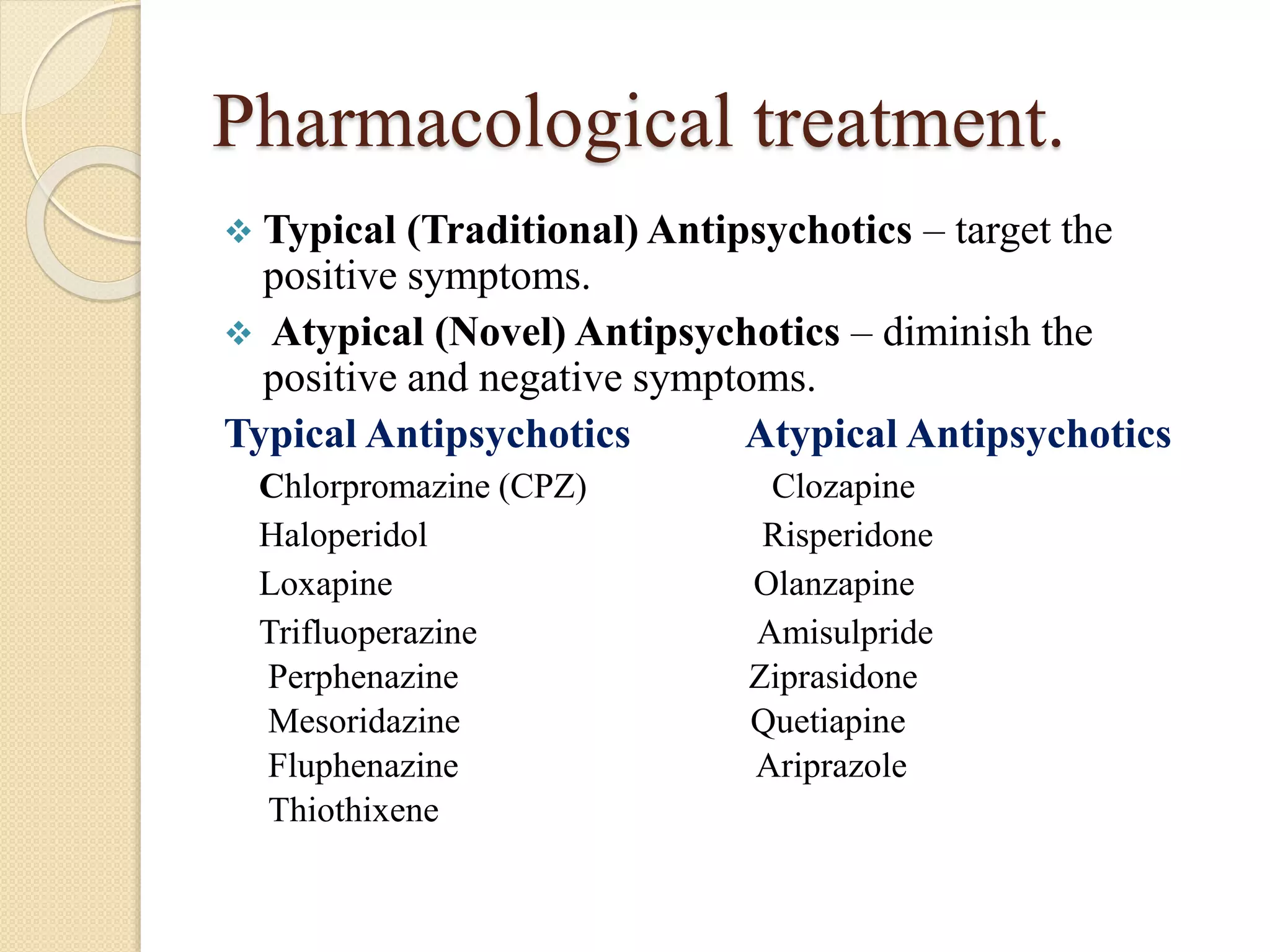
Pharmacological treatment.
Electro-convulsive therapy.
Psychosocial treatment & Rehabilitation.
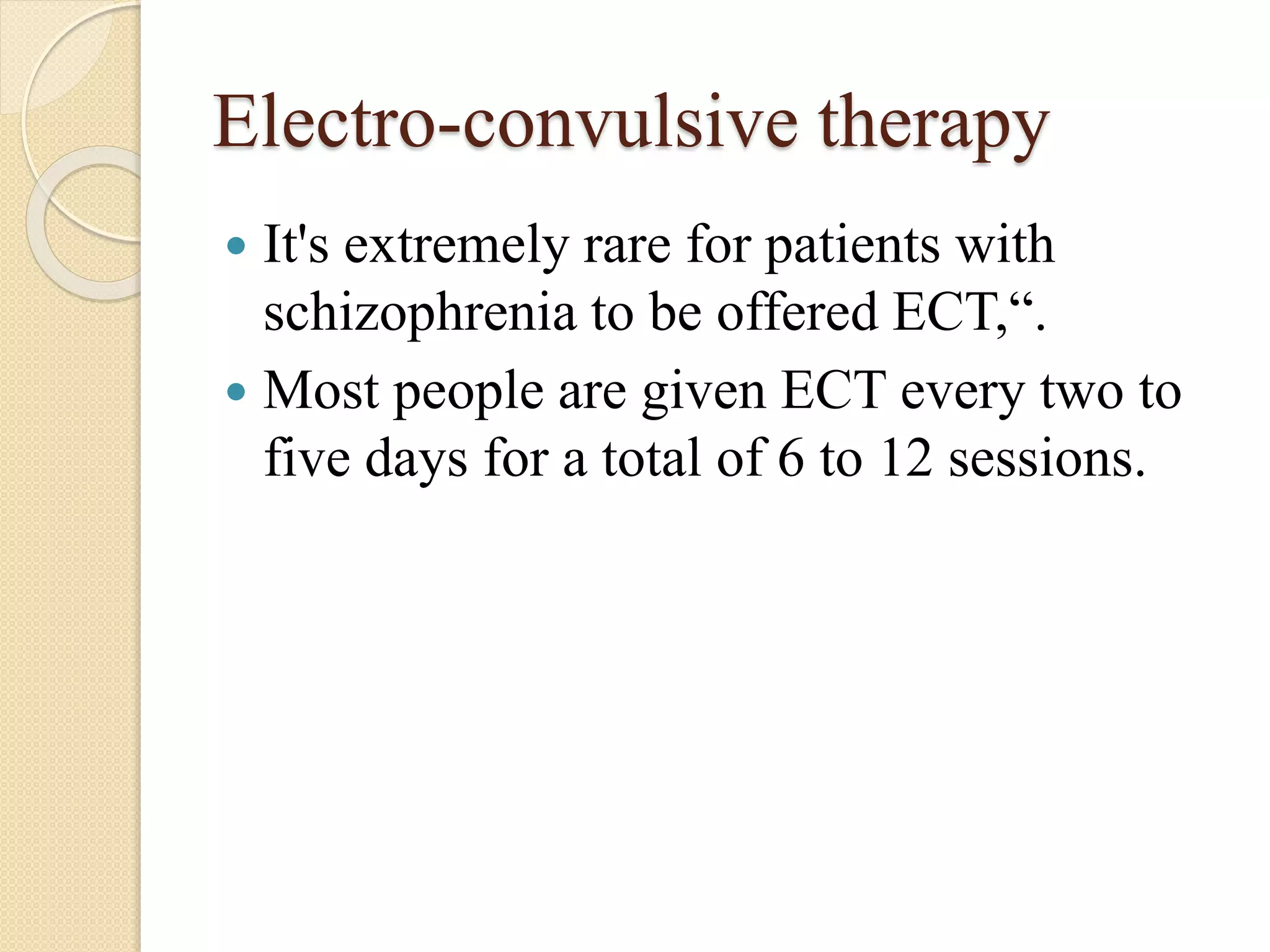
Electro-convulsive therapy
It'sextremely rare for patients with
schizophrenia to be offered ECT,“.
Most people are given ECT every two to
five days for a total of 6 to 12 sessions.
24.
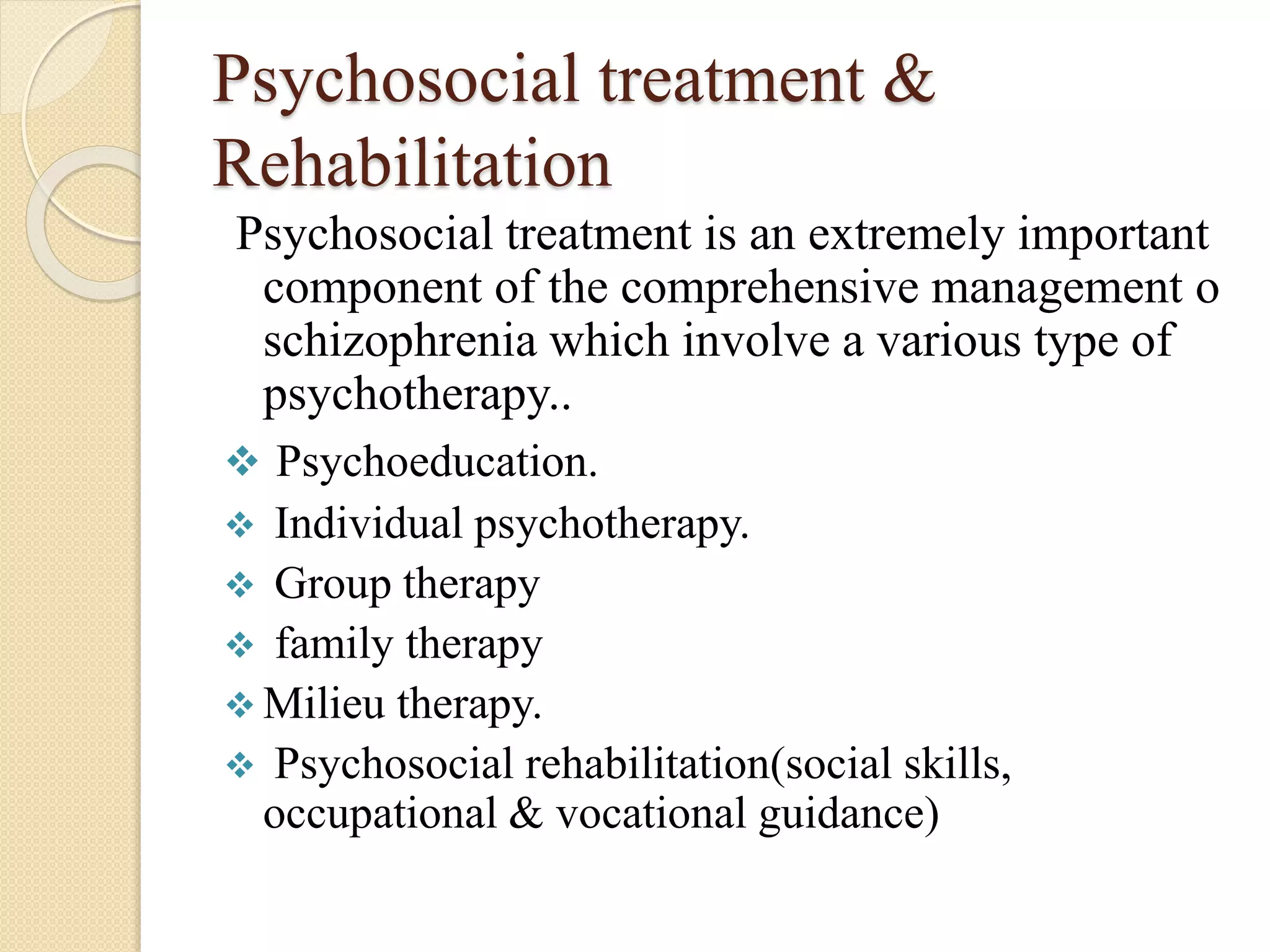
Psychosocial treatment &
Rehabilitation
Psychosocialtreatment is an extremely important
component of the comprehensive management o
schizophrenia which involve a various type of
psychotherapy..
Psychoeducation.
Individual psychotherapy.
Group therapy
family therapy
Milieu therapy.
Psychosocial rehabilitation(social skills,
occupational & vocational guidance)