SCHIZOPHRENIASCHIZOPHRENIA
And It’s DDxAnd It’s DDx
Mohammed Nabil Al Ali
Hassan Mohammed Al Awadh
ABDULLAH ALKHAWAJAH, Majid AL-DanDan
Ammar Mohammed Al Mulhem
Mutaz Hasan AL-Hashem, Khaled Saud AL-Zahrani
Mohammed Faisal Alkhazal
Hussain Abdrabalameer Albahrani
5th Year Medical Students5th Year Medical Students
At King Faisal UniversityAt King Faisal University
AlHassaAlHassa
Introduced byIntroduced by
OUTLINESOUTLINES ::
- Schizophrenia
- Schizophreniform Disorder
- Schizoaffective Disorder
- Delusional Disorder
- Brief Psychotic Disorder 
- Shared Psychotic Disorder 
- Postpartum psychosis
SchizophreniaSchizophrenia
To Know
SchizophreniaSchizophrenia
is
to know
PsychiatryPsychiatry
The schizophrenic disorders
are characterized in general
by fundamental and
characteristic distortions of
thinking and perception, and
affects that are inappropriate
or blunted. Clear
consciousness and
intellectual capacity are
usually maintained although
certain cognitive deficits may
evolve in the course of time.
SchizophreniaSchizophrenia ::
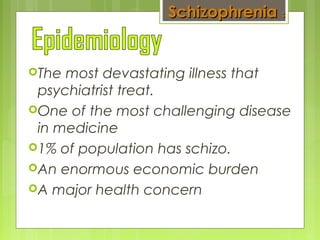
The most devastating illness that
psychiatrist treat.
One of the most challenging disease
in medicine
1% of population has schizo.
An enormous economic burden
A major health concern
SchizophreniaSchizophrenia ::
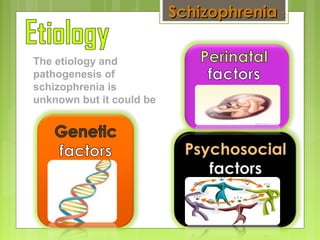
The etiology and
pathogenesis of
schizophrenia is
unknown but it could be
SchizophreniaSchizophrenia ::
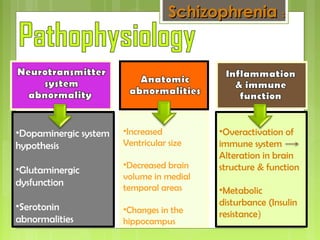
•Dopaminergic system
hypothesis
•Glutaminergic
dysfunction
•Serotonin
abnormalities
•Increased
Ventricular size
•Decreased brain
volume in medial
temporal areas
•Changes in the
hippocampus
•Overactivation of
immune system
Alteration in brain
structure & function
•Metabolic
disturbance (Insulin
resistance)
SchizophreniaSchizophrenia ::
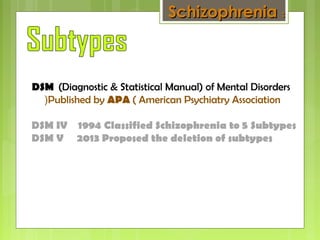
DSM (Diagnostic & Statistical Manual) of Mental Disorders
Published by APA ( American Psychiatry Association(
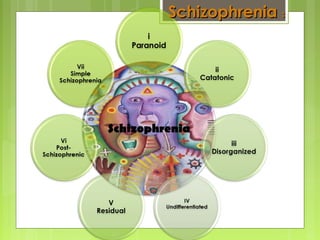
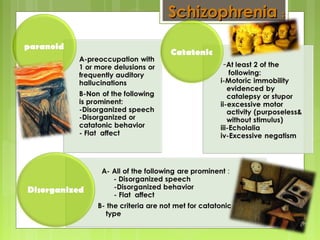
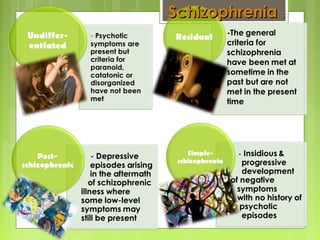
DSM IV 1994 Classified Schizophrenia to 5 Subtypes
DSM V 2013 Proposed the deletion of subtypes
SchizophreniaSchizophrenia ::
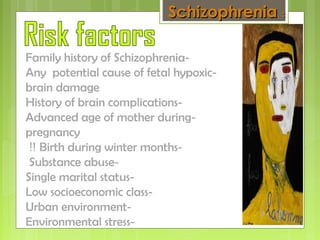
-Family history of Schizophrenia
-Any potential cause of fetal hypoxic
brain damage
-History of brain complications
-Advanced age of mother during
pregnancy
-Birth during winter months!!
-Substance abuse
-Single marital status
-Low socioeconomic class
-Urban environment
-Environmental stress
SchizophreniaSchizophrenia ::
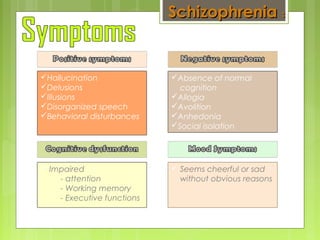
Hallucination
Delusions
Illusions
Disorganized speech
Behavioral disturbances
Absence of normal
cognition
Allogia
Avolition
Anhedonia
Social isolation
 Impaired
- attention
- Working memory
- Executive functions
 Seems cheerful or sad
without obvious reasons
SchizophreniaSchizophrenia ::
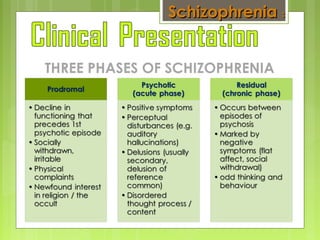
THREE PHASES OF SCHIZOPHRENIA
SchizophreniaSchizophrenia ::
F. Significantly Social
/occupational
dysfunction
G. Continuous signs of the
disturbance persists for
at least six months
H. Schizoaffective and
mood disorder exclusion
I. Substance/medical
condition exclusion
J. Relationship to
pervasive
developmental disorder
autism+ schiz.<D/H-1 m
A. Characteristic
symptoms. At least 2
of the following; each
for 1- month period:
a. delusions
b. hallucinations
c. disorganized speech
d. grossly disorganized
or catatonic behavior
e. negative symptoms,
i.e. avolition, flattening
of affect, alogia
(poverty of speech)
 The diagnosis of schizophrenia is based entirely on the clinical
presentation – history and examination.
SchizophreniaSchizophrenia ::
 Organic syndrome
 Drug or Alcohol
 Temporal lobe epilepsy
 Delirium
 Dementia
 Diffuse brain disease
 Psychotic mood disorder
 Personality disorder
 Schizoaffective disorder
SchizophreniaSchizophrenia ::
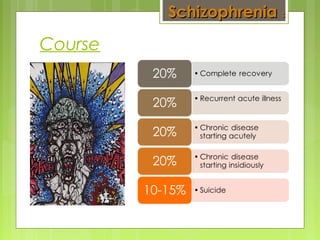
Course
SchizophreniaSchizophrenia ::
Prognosis
 Recover completely/long
term minimal symptoms-
30%(The percentage on
the rise)
 Recurrent illness -poorer
prognosis
 Young patient -high risk
of suicide
SchizophreniaSchizophrenia ::
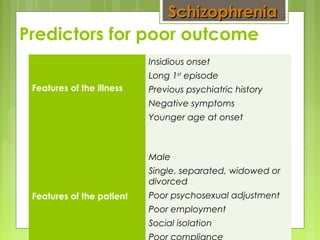
Predictors for poor outcome
Features of the illness
Insidious onset
Long 1st
episode
Previous psychiatric history
Negative symptoms
Younger age at onset
Features of the patient
Male
Single, separated, widowed or
divorced
Poor psychosexual adjustment
Poor employment
Social isolation
SchizophreniaSchizophrenia ::
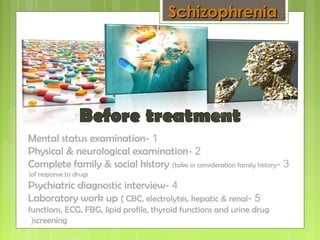
ManagementManagement
1-Mental status examination
2-Physical & neurological examination
3-Complete family & social history (take in consideration family history
of response to drugs(
4-Psychiatric diagnostic interview
5-Laboratory work up ( CBC, electrolytes, hepatic & renal
functions, ECG, FBG, lipid profile, thyroid functions and urine drug
screening(
SchizophreniaSchizophrenia ::
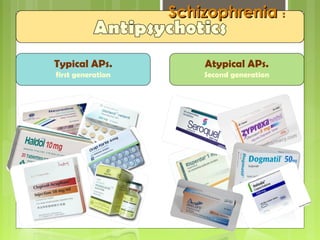
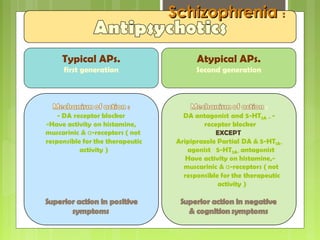
Atypical APs.
Second generation
Typical APs.
first generation
SchizophreniaSchizophrenia ::
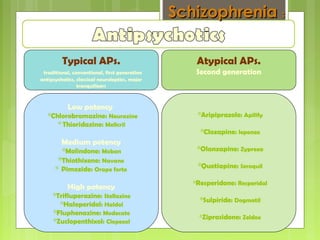
Atypical APs.
Second generation
Typical APs.
traditional, conventional, first generation
antipsychotics, classical neuroleptics, major
tranquilizers
Low potency
Chlorobromazine: Neurazine®
Thioridazine: Mellcril®
Medium potency
Molindone: Moban®
Thiothixene: Navane®
Pimozide: Orape forte®
High potency
Trifluperazine: Stellazine®
Haloperidol: Haldol®
Fluphenazine: Modecate®
Zuclopenthixol: Clopexol®
Aripiprazole: Apilify®
Clozapine: leponex®
Olanzapine: Zyprexa®
Quetiapine: Seroquil®
Resperidone: Resperidal®
Sulpiride: Dogmatil®
Ziprasidone: Zeldox®
SchizophreniaSchizophrenia ::
Atypical APs.
Second generation
Typical APs.
first generation
SchizophreniaSchizophrenia ::
Atypical APs.
Second generation
Typical APs.
first generation
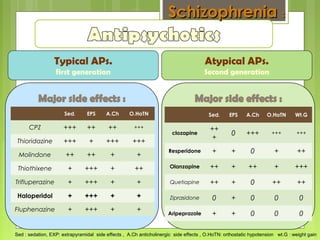
Sed. EPS A.Ch O.HoTN
CPZ +++ ++ ++ +++
Thioridazine +++ + +++ +++
Molindone ++ ++ + +
Thiothixene + +++ + ++
Trifluperazine + +++ + +
Haloperidol + +++ + +
Fluphenazine + +++ + +
Sed. EPS A.Ch O.HoTN Wt.G
clozapine
++
+
0 +++ +++ +++
Resperidone + + 0 + ++
Olanzapine ++ + ++ + +++
Quetiapine ++ + 0 ++ ++
Ziprasidone 0 + 0 0 0
Aripeprazole + + 0 0 0
Sed : sedation, EXP: extrapyramidal side effects , A.Ch anticholinergic side effects , O.HoTN: orthostatic hypotension wt.G : weight gain
SchizophreniaSchizophrenia ::
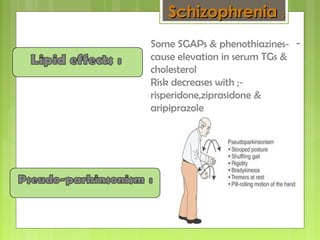
--Some SGAPs & phenothiazines
cause elevation in serum TGs &
cholesterol
-Risk decreases with ;
risperidone,ziprasidone &
aripiprazole
SchizophreniaSchizophrenia ::
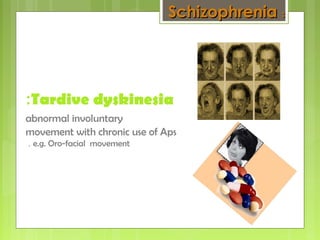
Tardive dyskinesia:
abnormal involuntary
movement with chronic use of Aps
e.g. Oro-facial movement.
SchizophreniaSchizophrenia ::
Schizophreniform
Disorder
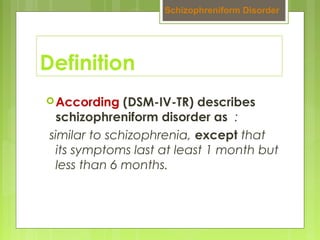
Definition
According (DSM-IV-TR) describes
schizophreniform disorder as :
similar to schizophrenia, except that
its symptoms last at least 1 month but
less than 6 months.
Schizophreniform Disorder
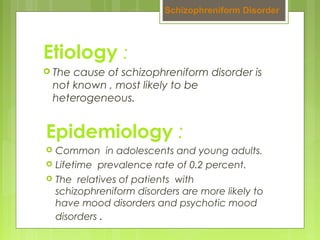
Etiology :
 The cause of schizophreniform disorder is
not known , most likely to be
heterogeneous.
Schizophreniform Disorder
Epidemiology :
 Common in adolescents and young adults.
 Lifetime prevalence rate of 0.2 percent.
 The relatives of patients with
schizophreniform disorders are more likely to
have mood disorders and psychotic mood
disorders .
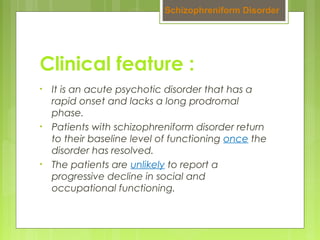
Clinical feature :
• It is an acute psychotic disorder that has a
rapid onset and lacks a long prodromal
phase.
• Patients with schizophreniform disorder return
to their baseline level of functioning once the
disorder has resolved.
• The patients are unlikely to report a
progressive decline in social and
occupational functioning.
Schizophreniform Disorder
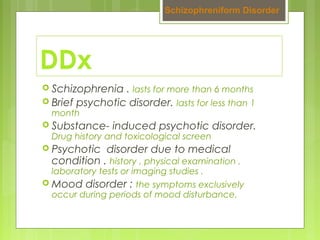
DDx
 Schizophrenia . lasts for more than 6 months
 Brief psychotic disorder. lasts for less than 1
month
 Substance- induced psychotic disorder.
Drug history and toxicological screen
 Psychotic disorder due to medical
condition . history , physical examination ,
laboratory tests or imaging studies .
 Mood disorder : the symptoms exclusively
occur during periods of mood disturbance.
Schizophreniform Disorder
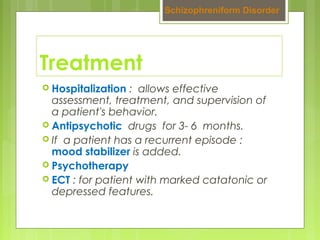
Treatment
 Hospitalization : allows effective
assessment, treatment, and supervision of
a patient's behavior.
 Antipsychotic drugs for 3- 6 months.
 If a patient has a recurrent episode :
mood stabilizer is added.
 Psychotherapy
 ECT : for patient with marked catatonic or
depressed features.
Schizophreniform Disorder
Schizoaffective
Disorder
Introduction
 Schizoaffective disorder is a serious mental
illness that affects about one in 100 people.
 It is serious mental illness that has features of
two different conditions:
1. schizophrenia
2. an affective (mood) disorder that may be
diagnosed as either
major depression or bipolar disorder.
Schizoaffective Disorder
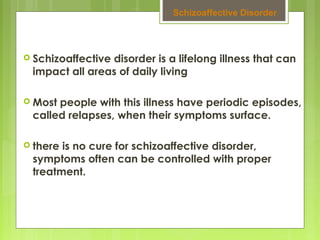
 Schizoaffective disorder is a lifelong illness that can
impact all areas of daily living
 Most people with this illness have periodic episodes,
called relapses, when their symptoms surface.
 there is no cure for schizoaffective disorder,
symptoms often can be controlled with proper
treatment.
Schizoaffective Disorder
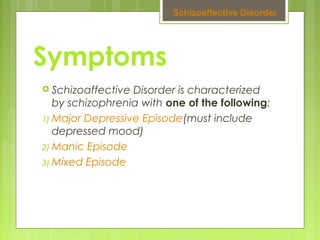
Symptoms
 Schizoaffective Disorder is characterized
by schizophrenia with one of the following:
1) Major Depressive Episode(must include
depressed mood)
2) Manic Episode
3) Mixed Episode
Schizoaffective Disorder
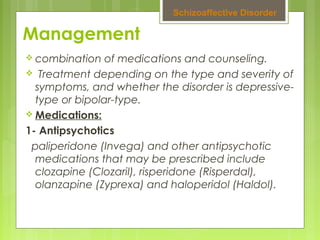
Management
 combination of medications and counseling.
 Treatment depending on the type and severity of
symptoms, and whether the disorder is depressive-
type or bipolar-type.
 Medications:
1- Antipsychotics
  paliperidone (Invega) and other antipsychotic
medications that may be prescribed include
clozapine (Clozaril), risperidone (Risperdal),
olanzapine (Zyprexa) and haloperidol (Haldol).
Schizoaffective Disorder
2-Mood-stabilizing medications.
Include lithium (Lithobid) and divalproex
(Depakote). Anticonvulsants such as
carbamazepine (Carbatrol, Tegretol, others)
and valproate (Depacon).
3-Antidepressants.
 Common medications include citalopram
(Celexa), fluoxetine (Prozac) and
escitalopram (Lexapro).
Schizoaffective Disorder
Psychotherapy
Psychotherapy and counseling. 
Family or group therapy. 
Treatment can be more effective when people
with schizoaffective disorder are able to discuss
their real-life problems with others.
Supportive group settings can also help decrease
social isolation and provide a reality check
during periods of psychosis.
Schizoaffective Disorder
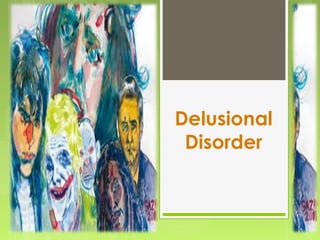
Delusional
Disorder
Definition
Delusional disorder is an illness
characterized by the presence of
nonbizarre delusions in the absence of
other mood or psychotic symptoms
Delusional Disorder
Epidemiology
- The prevalence of delusional disorder in the USA is estimated in
theDSM-IV-TR to be around 0.03% .
- considerably lower than the prevalence of schizophrenia (1%) ,
mood disorders (5%) .
- The mean age of onset is 40 years .
- Men are more likely than women to develop paranoid
delusions .
- women are more likely than men to develop delusions of
erotomania .
Delusional Disorder
Etiology
(a) Genetic :
Not a variant of schizophrenia or mood disorders. No
increase in first degree relatives.
(b) Neurological conditions :
- limbic system and the basal ganglia disorders .
- Patients tend to have complex delusions similar to
those in patients with delusional disorder .
(c) Psychodynamic Factors :
- socially isolated persons .
- - Abuse .
Delusional Disorder
Current Diagnosis Criteria
* DSM-IV-TR  
defines delusional disorder with the
following criteria:
A) Non bizarre delusions .
B) Criterion A for schizophrenia has never been met .
C)  functioning is not markedly impaired and
behavior is not obviously odd or bizarre.
D) If mood episodes have occurred concurrently with
delusions, their total duration has been brief relative
to the duration of the delusional periods.
E) The disturbance is not due to a drug of abuse,
medication or general medical condition.
Delusional Disorder
Clinical Features
- Mental State Examination usually normal except
presence of abnormal delusional beliefs.
- Mood and affect are consistent with delusional
content.
- Tactile and olfactory hallucinations may be present
if they are related to delusional theme.
- The thought content is notable for systematized, well-
organized, nonbizarre delusions that are possible to
occur.
Delusional Disorder
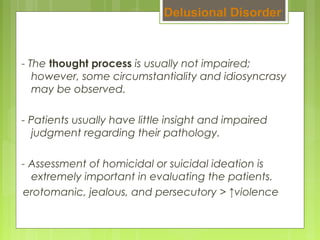
- The thought process is usually not impaired;
however, some circumstantiality and idiosyncrasy
may be observed.
- Patients usually have little insight and impaired
judgment regarding their pathology.
- Assessment of homicidal or suicidal ideation is
extremely important in evaluating the patients.
erotomanic, jealous, and persecutory > ↑violence
Delusional Disorder
Subtypes of delusional disorder
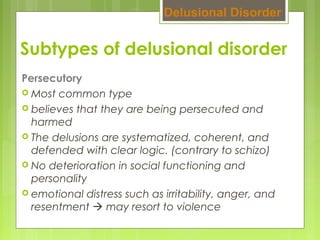
Persecutory
 Most common type
 believes that they are being persecuted and
harmed
 The delusions are systematized, coherent, and
defended with clear logic. (contrary to schizo)
 No deterioration in social functioning and
personality
 emotional distress such as irritability, anger, and
resentment  may resort to violence
Delusional Disorder
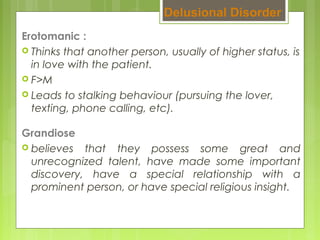
Erotomanic :
 Thinks that another person, usually of higher status, is
in love with the patient.
 F>M
 Leads to stalking behaviour (pursuing the lover,
texting, phone calling, etc).
Delusional Disorder
Grandiose
 believes that they possess some great and
unrecognized talent, have made some important
discovery, have a special relationship with a
prominent person, or have special religious insight.
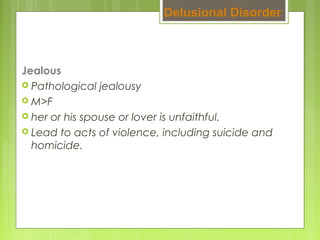
Jealous
 Pathological jealousy
 M>F
 her or his spouse or lover is unfaithful.
 Lead to acts of violence, including suicide and
homicide.
Delusional Disorder
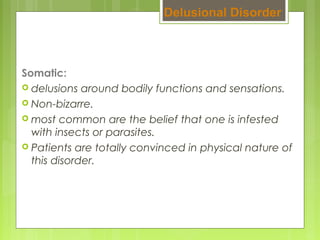
Somatic:
 delusions around bodily functions and sensations.
 Non-bizarre.
 most common are the belief that one is infested
with insects or parasites.
 Patients are totally convinced in physical nature of
this disorder.
Delusional Disorder
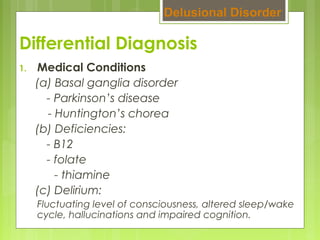
Differential Diagnosis
1. Medical Conditions
(a) Basal ganglia disorder
- Parkinson’s disease
- Huntington’s chorea
(b) Deficiencies:
- B12
- folate
- thiamine
(c) Delirium:
Fluctuating level of consciousness, altered sleep/wake
cycle, hallucinations and impaired cognition.
Delusional Disorder
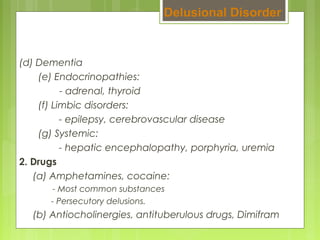
(d) Dementia
(e) Endocrinopathies:
- adrenal, thyroid
(f) Limbic disorders:
- epilepsy, cerebrovascular disease
(g) Systemic:
- hepatic encephalopathy, porphyria, uremia
2. Drugs
(a) Amphetamines, cocaine:
- Most common substances
- Persecutory delusions.
(b) Antiocholinergies, antituberulous drugs, Dimifram
Delusional Disorder
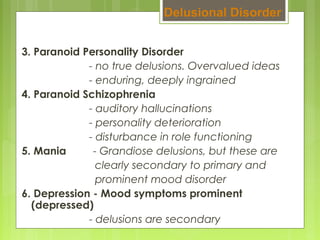
3. Paranoid Personality Disorder
- no true delusions. Overvalued ideas
- enduring, deeply ingrained
4. Paranoid Schizophrenia
- auditory hallucinations
- personality deterioration
- disturbance in role functioning
5. Mania - Grandiose delusions, but these are
clearly secondary to primary and
prominent mood disorder
6. Depression - Mood symptoms prominent
(depressed)
- delusions are secondary
Delusional Disorder
Management Plan:
* Investigations:
- To rule out substance abuse: drug screening .
- To rule out medical causes: CT, MRI.
- To choose a proper medication (prevent side
effects)
- Blood glucose level, lipid profile (anti-psychotics)
RFT, thyroid FT, LFT, ECG (Lithium & others)
Delusional Disorder
* Treatment
A) if suicidal or homicidal ideas present
(hospitalization ) or if refuse eating .
B) Medication:
- Antipsychotics- Pimozide .
- If there are somatic delusion & depressive symptoms
Antidepressants (SSRIs) may be used
C) Should also add supportive and educational
psychotherapy sessions to help the patient (to
improve insight & compliance).
Delusional Disorder
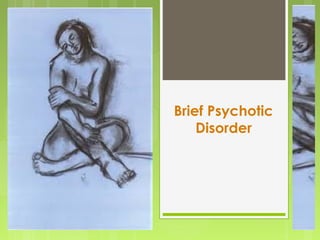
Brief Psychotic
Disorder
Acute psychotic condition that
involves the sudden onset of psychotic
symptoms, which lasts 1 day or more
but less than 1 month. Remission is full,
and the individual returns to the
premorbid level of functioning.
Definition
Brief Psychotic Disorder
The disorder occurs more often
among younger patients (20s
and 30s)
More commen in women.
Epidemiology
Brief Psychotic Disorder
 Presence of one (or more) of the following
symptoms:
 delusions
 hallucinations
 disorganized speech
 grossly disorganized or catatonic behavior
 Duration of an episode of the disturbance is
at least 1 day but less than 1 month, with
eventual full return to premorbid level of
functioning.
Diagnostic Criteria
Brief Psychotic Disorder
Associated symptoms may include the
following:
 Disorientation,
 Impaired attention,
 Emotional volatility,
 strange or bizarre behavior,
 Screaming,
 Impaired memory for recent events.
Brief Psychotic Disorder
 Schizophrenia,
 Schizophreniform Disorder,
 Brief Psychotic Disorder,
 Delusional Disorder,
 Mood disorder with psychotic features,
 Substance-induced psychotic disorder,
 Psychosis due to a medical condition.
Differential Diagnosis
Brief Psychotic Disorder
 Brief hospitalization,
 Antipsychotics (haloperidol or
ziprasadone),
 Benzodiazepines (short-term treatment ).
Prognosis:
 A good prognosis is usually associated
with sudden onset, short duration of
symptoms, and good premorbid
adjustment
Treatment
Brief Psychotic Disorder
 Shared Psychotic
Disorder 
Case
 A 28-year-old woman taking care of her
schizophrenic husband starts believing her
husband’s claim that he invented the telephone.
When she went abroad for a few months, her
beliefs disappeared.
 Also known as folie à deux, shared
psychotic disorder is diagnosed when a
patient develops the same delusional
symptoms as someone he or she is in a
close relationship with. Most people
suffering from shared psychotic disorder
are family members.
DSM-IV-TR Diagnostic Criteria for
Shared Psychotic Disorder
 A delusion develops in an individual in the context
of a close relationship with another person(s), who
has an already-established delusion.
 The delusion is similar in content to that of the
person who already has the established delusion.
 The disturbance is not better accounted for by
another psychotic disorder (e.g., schizophrenia) or
a mood disorder with psychotic features and is not
due to the direct physiological effects of a
substance (e.g., a drug of abuse, a medication)
or a general medical condition.
PROGNOSIS
 Twenty to 40% will recover upon removal
from the inducing person.
 Shared Psychotic Disorder 
TREATMENT
 The first step is to separate the patient from the
person who is the source of shared delusions
(usually a family member with an underlying
psychotic disorder).
 Psychotherapy should be undertaken.
 Antipsychotic medications should be used if
symptoms have not improved in 1 to 2 weeks
after separation
 Shared Psychotic Disorder 
Postpartum
psychosis
POST PARTUM PSYCHOSIS
 Postpartum psychosis (sometimes called puerperal
psychosis) is an example of psychotic that occurs
in women who have recently delivered a baby.
 The incidence of postpartum psychosis is about 1
to 2 per 1,000 childbirths.
 About 50 to 60 percent of affected women have
just had their first child.
 About 50 percent of the affected women have a
family history of mood disorders.
 Most available data suggest a close relation
between postpartum psychosis and mood
disorders, particularly bipolar disorder and major
depressive disorder.
Postpartum psychosis
Clinical features:
The symptoms of postpartum psychosis
can often begin within days of the
delivery, although the mean time to
onset is within 2 to 3 weeks and almost
always within 8 weeks of delivery.
Insomnia, restlessness and emotional
liability
Progress to confusion, delusions.
Thoughts of harming self or baby
characteristic
Postpartum psychosis
Treatment:
 Postpartum psychosis is a psychiatric
emergency.
 Antipsychotic medications and lithium often in
combination with an antidepressant, are the
treatments of choice.
 Psychotherapy is indicated after the period of
acute psychosis.
 Changes in environmental factors may also be
indicated.
Postpartum psychosis
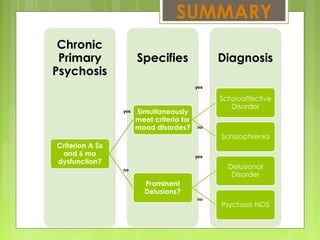
SUMMARY
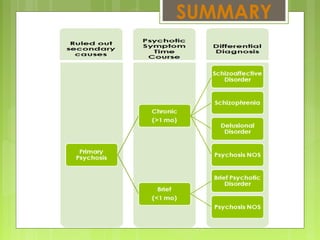
yes
no
no
no
yes
yes
SUMMARY
Any question ?
REFERENCES
Thank youThank you

Schizophrenia

  • 1.
    SCHIZOPHRENIASCHIZOPHRENIA And It’s DDxAndIt’s DDx Mohammed Nabil Al Ali Hassan Mohammed Al Awadh ABDULLAH ALKHAWAJAH, Majid AL-DanDan Ammar Mohammed Al Mulhem Mutaz Hasan AL-Hashem, Khaled Saud AL-Zahrani Mohammed Faisal Alkhazal Hussain Abdrabalameer Albahrani 5th Year Medical Students5th Year Medical Students At King Faisal UniversityAt King Faisal University AlHassaAlHassa Introduced byIntroduced by
  • 2.
    OUTLINESOUTLINES :: - Schizophrenia -Schizophreniform Disorder - Schizoaffective Disorder - Delusional Disorder - Brief Psychotic Disorder  - Shared Psychotic Disorder  - Postpartum psychosis
  • 3.
  • 4.
    The schizophrenic disorders arecharacterized in general by fundamental and characteristic distortions of thinking and perception, and affects that are inappropriate or blunted. Clear consciousness and intellectual capacity are usually maintained although certain cognitive deficits may evolve in the course of time. SchizophreniaSchizophrenia ::
  • 5.
    The most devastatingillness that psychiatrist treat. One of the most challenging disease in medicine 1% of population has schizo. An enormous economic burden A major health concern SchizophreniaSchizophrenia ::
  • 6.
  • 7.
    The etiology and pathogenesisof schizophrenia is unknown but it could be SchizophreniaSchizophrenia ::
  • 8.
    •Dopaminergic system hypothesis •Glutaminergic dysfunction •Serotonin abnormalities •Increased Ventricular size •Decreasedbrain volume in medial temporal areas •Changes in the hippocampus •Overactivation of immune system Alteration in brain structure & function •Metabolic disturbance (Insulin resistance) SchizophreniaSchizophrenia ::
  • 9.
    DSM (Diagnostic &Statistical Manual) of Mental Disorders Published by APA ( American Psychiatry Association( DSM IV 1994 Classified Schizophrenia to 5 Subtypes DSM V 2013 Proposed the deletion of subtypes SchizophreniaSchizophrenia ::
  • 10.
  • 11.
  • 12.
  • 13.
    -Family history ofSchizophrenia -Any potential cause of fetal hypoxic brain damage -History of brain complications -Advanced age of mother during pregnancy -Birth during winter months!! -Substance abuse -Single marital status -Low socioeconomic class -Urban environment -Environmental stress SchizophreniaSchizophrenia ::
  • 14.
    Hallucination Delusions Illusions Disorganized speech Behavioral disturbances Absenceof normal cognition Allogia Avolition Anhedonia Social isolation  Impaired - attention - Working memory - Executive functions  Seems cheerful or sad without obvious reasons SchizophreniaSchizophrenia ::
  • 15.
    THREE PHASES OFSCHIZOPHRENIA SchizophreniaSchizophrenia ::
  • 16.
  • 17.
    F. Significantly Social /occupational dysfunction G.Continuous signs of the disturbance persists for at least six months H. Schizoaffective and mood disorder exclusion I. Substance/medical condition exclusion J. Relationship to pervasive developmental disorder autism+ schiz.<D/H-1 m A. Characteristic symptoms. At least 2 of the following; each for 1- month period: a. delusions b. hallucinations c. disorganized speech d. grossly disorganized or catatonic behavior e. negative symptoms, i.e. avolition, flattening of affect, alogia (poverty of speech)  The diagnosis of schizophrenia is based entirely on the clinical presentation – history and examination. SchizophreniaSchizophrenia ::
  • 18.
     Organic syndrome Drug or Alcohol  Temporal lobe epilepsy  Delirium  Dementia  Diffuse brain disease  Psychotic mood disorder  Personality disorder  Schizoaffective disorder SchizophreniaSchizophrenia ::
  • 19.
  • 20.
    Prognosis  Recover completely/long termminimal symptoms- 30%(The percentage on the rise)  Recurrent illness -poorer prognosis  Young patient -high risk of suicide SchizophreniaSchizophrenia ::
  • 21.
    Predictors for pooroutcome Features of the illness Insidious onset Long 1st episode Previous psychiatric history Negative symptoms Younger age at onset Features of the patient Male Single, separated, widowed or divorced Poor psychosexual adjustment Poor employment Social isolation SchizophreniaSchizophrenia ::
  • 22.
  • 23.
    1-Mental status examination 2-Physical& neurological examination 3-Complete family & social history (take in consideration family history of response to drugs( 4-Psychiatric diagnostic interview 5-Laboratory work up ( CBC, electrolytes, hepatic & renal functions, ECG, FBG, lipid profile, thyroid functions and urine drug screening( SchizophreniaSchizophrenia ::
  • 24.
    Atypical APs. Second generation TypicalAPs. first generation SchizophreniaSchizophrenia ::
  • 25.
    Atypical APs. Second generation TypicalAPs. traditional, conventional, first generation antipsychotics, classical neuroleptics, major tranquilizers Low potency Chlorobromazine: Neurazine® Thioridazine: Mellcril® Medium potency Molindone: Moban® Thiothixene: Navane® Pimozide: Orape forte® High potency Trifluperazine: Stellazine® Haloperidol: Haldol® Fluphenazine: Modecate® Zuclopenthixol: Clopexol® Aripiprazole: Apilify® Clozapine: leponex® Olanzapine: Zyprexa® Quetiapine: Seroquil® Resperidone: Resperidal® Sulpiride: Dogmatil® Ziprasidone: Zeldox® SchizophreniaSchizophrenia ::
  • 26.
    Atypical APs. Second generation TypicalAPs. first generation SchizophreniaSchizophrenia ::
  • 27.
    Atypical APs. Second generation TypicalAPs. first generation Sed. EPS A.Ch O.HoTN CPZ +++ ++ ++ +++ Thioridazine +++ + +++ +++ Molindone ++ ++ + + Thiothixene + +++ + ++ Trifluperazine + +++ + + Haloperidol + +++ + + Fluphenazine + +++ + + Sed. EPS A.Ch O.HoTN Wt.G clozapine ++ + 0 +++ +++ +++ Resperidone + + 0 + ++ Olanzapine ++ + ++ + +++ Quetiapine ++ + 0 ++ ++ Ziprasidone 0 + 0 0 0 Aripeprazole + + 0 0 0 Sed : sedation, EXP: extrapyramidal side effects , A.Ch anticholinergic side effects , O.HoTN: orthostatic hypotension wt.G : weight gain SchizophreniaSchizophrenia ::
  • 28.
    --Some SGAPs &phenothiazines cause elevation in serum TGs & cholesterol -Risk decreases with ; risperidone,ziprasidone & aripiprazole SchizophreniaSchizophrenia ::
  • 29.
    Tardive dyskinesia: abnormal involuntary movementwith chronic use of Aps e.g. Oro-facial movement. SchizophreniaSchizophrenia ::
  • 30.
  • 31.
  • 32.
    Definition According (DSM-IV-TR) describes schizophreniformdisorder as : similar to schizophrenia, except that its symptoms last at least 1 month but less than 6 months. Schizophreniform Disorder
  • 33.
    Etiology :  Thecause of schizophreniform disorder is not known , most likely to be heterogeneous. Schizophreniform Disorder Epidemiology :  Common in adolescents and young adults.  Lifetime prevalence rate of 0.2 percent.  The relatives of patients with schizophreniform disorders are more likely to have mood disorders and psychotic mood disorders .
  • 34.
    Clinical feature : •It is an acute psychotic disorder that has a rapid onset and lacks a long prodromal phase. • Patients with schizophreniform disorder return to their baseline level of functioning once the disorder has resolved. • The patients are unlikely to report a progressive decline in social and occupational functioning. Schizophreniform Disorder
  • 35.
    DDx  Schizophrenia .lasts for more than 6 months  Brief psychotic disorder. lasts for less than 1 month  Substance- induced psychotic disorder. Drug history and toxicological screen  Psychotic disorder due to medical condition . history , physical examination , laboratory tests or imaging studies .  Mood disorder : the symptoms exclusively occur during periods of mood disturbance. Schizophreniform Disorder
  • 36.
    Treatment  Hospitalization :allows effective assessment, treatment, and supervision of a patient's behavior.  Antipsychotic drugs for 3- 6 months.  If a patient has a recurrent episode : mood stabilizer is added.  Psychotherapy  ECT : for patient with marked catatonic or depressed features. Schizophreniform Disorder
  • 37.
  • 38.
    Introduction  Schizoaffective disorderis a serious mental illness that affects about one in 100 people.  It is serious mental illness that has features of two different conditions: 1. schizophrenia 2. an affective (mood) disorder that may be diagnosed as either major depression or bipolar disorder. Schizoaffective Disorder
  • 39.
     Schizoaffective disorderis a lifelong illness that can impact all areas of daily living  Most people with this illness have periodic episodes, called relapses, when their symptoms surface.  there is no cure for schizoaffective disorder, symptoms often can be controlled with proper treatment. Schizoaffective Disorder
  • 40.
    Symptoms  Schizoaffective Disorderis characterized by schizophrenia with one of the following: 1) Major Depressive Episode(must include depressed mood) 2) Manic Episode 3) Mixed Episode Schizoaffective Disorder
  • 41.
    Management  combination ofmedications and counseling.  Treatment depending on the type and severity of symptoms, and whether the disorder is depressive- type or bipolar-type.  Medications: 1- Antipsychotics   paliperidone (Invega) and other antipsychotic medications that may be prescribed include clozapine (Clozaril), risperidone (Risperdal), olanzapine (Zyprexa) and haloperidol (Haldol). Schizoaffective Disorder
  • 42.
    2-Mood-stabilizing medications. Include lithium(Lithobid) and divalproex (Depakote). Anticonvulsants such as carbamazepine (Carbatrol, Tegretol, others) and valproate (Depacon). 3-Antidepressants.  Common medications include citalopram (Celexa), fluoxetine (Prozac) and escitalopram (Lexapro). Schizoaffective Disorder
  • 43.
    Psychotherapy Psychotherapy and counseling.  Familyor group therapy.  Treatment can be more effective when people with schizoaffective disorder are able to discuss their real-life problems with others. Supportive group settings can also help decrease social isolation and provide a reality check during periods of psychosis. Schizoaffective Disorder
  • 44.
  • 45.
    Definition Delusional disorder isan illness characterized by the presence of nonbizarre delusions in the absence of other mood or psychotic symptoms Delusional Disorder
  • 46.
    Epidemiology - The prevalenceof delusional disorder in the USA is estimated in theDSM-IV-TR to be around 0.03% . - considerably lower than the prevalence of schizophrenia (1%) , mood disorders (5%) . - The mean age of onset is 40 years . - Men are more likely than women to develop paranoid delusions . - women are more likely than men to develop delusions of erotomania . Delusional Disorder
  • 47.
    Etiology (a) Genetic : Nota variant of schizophrenia or mood disorders. No increase in first degree relatives. (b) Neurological conditions : - limbic system and the basal ganglia disorders . - Patients tend to have complex delusions similar to those in patients with delusional disorder . (c) Psychodynamic Factors : - socially isolated persons . - - Abuse . Delusional Disorder
  • 48.
    Current Diagnosis Criteria *DSM-IV-TR   defines delusional disorder with the following criteria: A) Non bizarre delusions . B) Criterion A for schizophrenia has never been met . C)  functioning is not markedly impaired and behavior is not obviously odd or bizarre. D) If mood episodes have occurred concurrently with delusions, their total duration has been brief relative to the duration of the delusional periods. E) The disturbance is not due to a drug of abuse, medication or general medical condition. Delusional Disorder
  • 49.
    Clinical Features - MentalState Examination usually normal except presence of abnormal delusional beliefs. - Mood and affect are consistent with delusional content. - Tactile and olfactory hallucinations may be present if they are related to delusional theme. - The thought content is notable for systematized, well- organized, nonbizarre delusions that are possible to occur. Delusional Disorder
  • 50.
    - The thoughtprocess is usually not impaired; however, some circumstantiality and idiosyncrasy may be observed. - Patients usually have little insight and impaired judgment regarding their pathology. - Assessment of homicidal or suicidal ideation is extremely important in evaluating the patients. erotomanic, jealous, and persecutory > ↑violence Delusional Disorder
  • 51.
    Subtypes of delusionaldisorder Persecutory  Most common type  believes that they are being persecuted and harmed  The delusions are systematized, coherent, and defended with clear logic. (contrary to schizo)  No deterioration in social functioning and personality  emotional distress such as irritability, anger, and resentment  may resort to violence Delusional Disorder
  • 52.
    Erotomanic :  Thinksthat another person, usually of higher status, is in love with the patient.  F>M  Leads to stalking behaviour (pursuing the lover, texting, phone calling, etc). Delusional Disorder Grandiose  believes that they possess some great and unrecognized talent, have made some important discovery, have a special relationship with a prominent person, or have special religious insight.
  • 53.
    Jealous  Pathological jealousy M>F  her or his spouse or lover is unfaithful.  Lead to acts of violence, including suicide and homicide. Delusional Disorder
  • 54.
    Somatic:  delusions aroundbodily functions and sensations.  Non-bizarre.  most common are the belief that one is infested with insects or parasites.  Patients are totally convinced in physical nature of this disorder. Delusional Disorder
  • 55.
    Differential Diagnosis 1. MedicalConditions (a) Basal ganglia disorder - Parkinson’s disease - Huntington’s chorea (b) Deficiencies: - B12 - folate - thiamine (c) Delirium: Fluctuating level of consciousness, altered sleep/wake cycle, hallucinations and impaired cognition. Delusional Disorder
  • 56.
    (d) Dementia (e) Endocrinopathies: -adrenal, thyroid (f) Limbic disorders: - epilepsy, cerebrovascular disease (g) Systemic: - hepatic encephalopathy, porphyria, uremia 2. Drugs (a) Amphetamines, cocaine: - Most common substances - Persecutory delusions. (b) Antiocholinergies, antituberulous drugs, Dimifram Delusional Disorder
  • 57.
    3. Paranoid PersonalityDisorder - no true delusions. Overvalued ideas - enduring, deeply ingrained 4. Paranoid Schizophrenia - auditory hallucinations - personality deterioration - disturbance in role functioning 5. Mania - Grandiose delusions, but these are clearly secondary to primary and prominent mood disorder 6. Depression - Mood symptoms prominent (depressed) - delusions are secondary Delusional Disorder
  • 58.
    Management Plan: * Investigations: -To rule out substance abuse: drug screening . - To rule out medical causes: CT, MRI. - To choose a proper medication (prevent side effects) - Blood glucose level, lipid profile (anti-psychotics) RFT, thyroid FT, LFT, ECG (Lithium & others) Delusional Disorder
  • 59.
    * Treatment A) ifsuicidal or homicidal ideas present (hospitalization ) or if refuse eating . B) Medication: - Antipsychotics- Pimozide . - If there are somatic delusion & depressive symptoms Antidepressants (SSRIs) may be used C) Should also add supportive and educational psychotherapy sessions to help the patient (to improve insight & compliance). Delusional Disorder
  • 60.
  • 61.
    Acute psychotic conditionthat involves the sudden onset of psychotic symptoms, which lasts 1 day or more but less than 1 month. Remission is full, and the individual returns to the premorbid level of functioning. Definition Brief Psychotic Disorder
  • 62.
    The disorder occursmore often among younger patients (20s and 30s) More commen in women. Epidemiology Brief Psychotic Disorder
  • 63.
     Presence ofone (or more) of the following symptoms:  delusions  hallucinations  disorganized speech  grossly disorganized or catatonic behavior  Duration of an episode of the disturbance is at least 1 day but less than 1 month, with eventual full return to premorbid level of functioning. Diagnostic Criteria Brief Psychotic Disorder
  • 64.
    Associated symptoms mayinclude the following:  Disorientation,  Impaired attention,  Emotional volatility,  strange or bizarre behavior,  Screaming,  Impaired memory for recent events. Brief Psychotic Disorder
  • 65.
     Schizophrenia,  SchizophreniformDisorder,  Brief Psychotic Disorder,  Delusional Disorder,  Mood disorder with psychotic features,  Substance-induced psychotic disorder,  Psychosis due to a medical condition. Differential Diagnosis Brief Psychotic Disorder
  • 66.
     Brief hospitalization, Antipsychotics (haloperidol or ziprasadone),  Benzodiazepines (short-term treatment ). Prognosis:  A good prognosis is usually associated with sudden onset, short duration of symptoms, and good premorbid adjustment Treatment Brief Psychotic Disorder
  • 67.
  • 68.
    Case  A 28-year-oldwoman taking care of her schizophrenic husband starts believing her husband’s claim that he invented the telephone. When she went abroad for a few months, her beliefs disappeared.
  • 69.
     Also knownas folie à deux, shared psychotic disorder is diagnosed when a patient develops the same delusional symptoms as someone he or she is in a close relationship with. Most people suffering from shared psychotic disorder are family members.
  • 70.
    DSM-IV-TR Diagnostic Criteriafor Shared Psychotic Disorder  A delusion develops in an individual in the context of a close relationship with another person(s), who has an already-established delusion.  The delusion is similar in content to that of the person who already has the established delusion.  The disturbance is not better accounted for by another psychotic disorder (e.g., schizophrenia) or a mood disorder with psychotic features and is not due to the direct physiological effects of a substance (e.g., a drug of abuse, a medication) or a general medical condition.
  • 71.
    PROGNOSIS  Twenty to40% will recover upon removal from the inducing person.  Shared Psychotic Disorder 
  • 72.
    TREATMENT  The firststep is to separate the patient from the person who is the source of shared delusions (usually a family member with an underlying psychotic disorder).  Psychotherapy should be undertaken.  Antipsychotic medications should be used if symptoms have not improved in 1 to 2 weeks after separation  Shared Psychotic Disorder 
  • 73.
  • 74.
    POST PARTUM PSYCHOSIS Postpartum psychosis (sometimes called puerperal psychosis) is an example of psychotic that occurs in women who have recently delivered a baby.  The incidence of postpartum psychosis is about 1 to 2 per 1,000 childbirths.  About 50 to 60 percent of affected women have just had their first child.  About 50 percent of the affected women have a family history of mood disorders.  Most available data suggest a close relation between postpartum psychosis and mood disorders, particularly bipolar disorder and major depressive disorder. Postpartum psychosis
  • 75.
    Clinical features: The symptomsof postpartum psychosis can often begin within days of the delivery, although the mean time to onset is within 2 to 3 weeks and almost always within 8 weeks of delivery. Insomnia, restlessness and emotional liability Progress to confusion, delusions. Thoughts of harming self or baby characteristic Postpartum psychosis
  • 76.
    Treatment:  Postpartum psychosisis a psychiatric emergency.  Antipsychotic medications and lithium often in combination with an antidepressant, are the treatments of choice.  Psychotherapy is indicated after the period of acute psychosis.  Changes in environmental factors may also be indicated. Postpartum psychosis
  • 77.
  • 78.
  • 79.
  • 80.
  • 81.

Editor's Notes

  • #12 Echolalia: immediate and involuntary repetition of words
  • #13 Simple schizophrenia (CD10)1- There is slow but progressive development, over a period of at least 1 year, of all three of the following: A-a significant and consistent change in the overall quality of some aspects of personal behavior, manifest as loss of drive and interests, aimlessness, idleness, a selfabsorbed attitude, and social withdrawal; B- gradual appearance and deepening of “negative” symptoms such as marked apathy, paucity of speech, underactivity, blunting of affect, passivity and lack of initiative, and poor nonverbal communication (by facial expression, eye contact, voice modulation, and posture); C- marked decline in social, scholastic, or occupational performance. 2-At no time are there any of the symptoms referred to in criterion G1 for general schizophrenia, nor are there hallucinations or well-formed delusions of any kind; i.e., the individual must never have met the criteria for any other type of schizophrenia or for any other psychotic disorder. 3-There is no evidence of dementia or any other organic mental disorder.