
PSYC 3553 – Psychopathology Week 3: Perspectives on Abnormality • September 22, 2009
What is a paradigm? Framework Set of assumptions providing guidelines for research and practice Major schools of thought:  Biological Psychoanalytic  Behavioural Cognitive
The Biological Paradigm Also known as the medical or disease model Guiding belief : Behaviour is linked to  physical causes,  brought on by malfunctioning components of the body In psychopathology, mainly focuses on brain
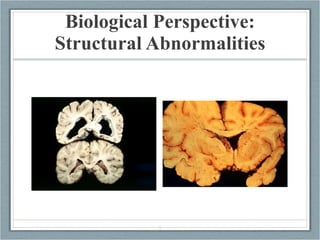
Biological Explanations of Psychopathology Brain anatomy : problems in brain structure Swelling Atrophy e.g. :  Huntington’s disease & basal ganglia (forebrain)    motor difficulties Stroke & temporal lobe swelling    speech deficits
Biological Perspective: Structural Abnormalities
Parts of the Brain
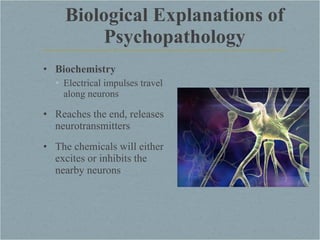
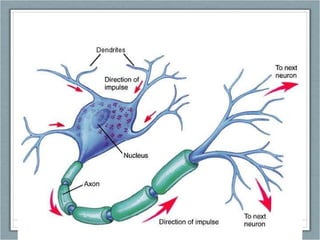
Biochemistry Electrical impulses travel along neurons Reaches the end, releases neurotransmitters  The chemicals will either excites or inhibits the nearby neurons Biological Explanations of Psychopathology
 
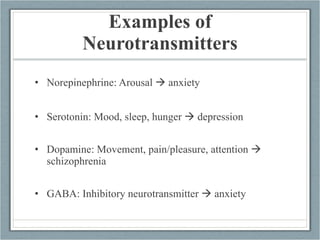
Examples of Neurotransmitters Norepinephrine: Arousal    anxiety  Serotonin: Mood, sleep, hunger    depression Dopamine: Movement, pain/pleasure, attention    schizophrenia GABA: Inhibitory neurotransmitter    anxiety
Biological Explanations of Psychopathology Also, the endocrine system  Implicated by working with neurons to release hormones E.g., hippocampus, stress and the release of cortisol Memory impairments
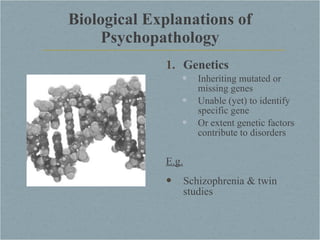
Biological Explanations of Psychopathology Genetics Inheriting mutated or missing genes Unable (yet) to identify specific gene Or extent genetic factors contribute to disorders E.g. Schizophrenia & twin studies
Biological Explanations of Psychopathology Family method: relatives of the affected individual  Twin studies: study pairs of MZ and DZ twins Adoption studies: study twins in/out of family home Linkage analysis: co-occurring genetics (e.g., eye colour and illness)
Biological Treatments Three main types of biological treatment: Drug therapy (1950s) Antianxiety drugs (anxiolytics, tranquilizers) Antidepressant drugs Antibipolar drugs (mood stabilizers) Antipsychotic drugs Electroconvulsive therapy (ECT) Psychosurgery (e.g., lobotomy)
Evaluating Biological Paradigm Strengths :  Huge progress on mental illness research Respected and accepted by society Weaknesses : Reductionism – making it too simple Inconclusive evidence Possibility of negative/severe side effects
 
The Psychoanalytic Paradigm Psychotherapy : social therapist-client interaction Sigmund Freud : father of psychodynamic theory and psychoanalytic therapy Guiding belief : behaviour is linked to  underlying dynamic psychological forces  of which she or he is  not aware
The Psychoanalytic Paradigm The  id : basic urges for survival (food, water…) Direct gratification or by primary process thinking The  ego : deals with reality The  superego : conscience Healthy personality: compromise between these forces
The Psychoanalytic Paradigm Psychosexual stages of development Oral stage: feeding Anal stage: bowel movements Phallic stage: genital stimulation Latency period Genital stage: adult sexual impulses
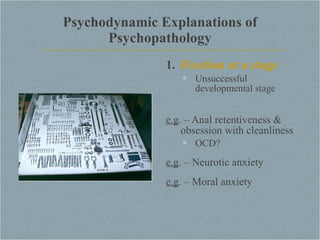
Psychodynamic Explanations of Psychopathology Fixation at a stage Unsuccessful developmental stage e.g . – Anal retentiveness & obsession with cleanliness OCD? e.g . – Neurotic anxiety e.g . – Moral anxiety
Psychodynamic Explanations of Psychopathology 2.  Resolving the Oedipal/Electra complex Freud claimed that resolving the complex was critical… … to superego development … to future romantic relationship success … to future views of intimacy and expression of sexual desires
Psychodynamic Explanations of Psychopathology 3.  Coping with anxiety – defense mechanisms Repression Denial  Projection Regression Rationalization
Variations on Freudian Theory Ego theorists Emphasize the role of the ego; consider it independent Self theorists Emphasize unified personality over any one component Object-relations  theorists Emphasize human need for interpersonal relationships
Psychodynamic Therapies Classical psychoanalysis:  Gain insight into repressed conflicts and resistances Ego analysis:  Use classical techniques but focus more on current living conditions Brief psychodynamic therapy:  Short-term, target specific problems Interpersonal therapy:  Emphasis on present relationships with others
Assessing Psychoanalytic Paradigm Strengths: Elevated psychological theories and “internal forces” as possible cause of illness First to apply theory and techniques systematically to treatment – monumental impact on the field Weaknesses: Unsupported ideas (anecdotal evidence) Lead the client into focusing on certain experiences Difficult to research
Cognitive & Behavioral Paradigms Guiding beliefs:  Behavioural : abnormal behaviour is learned and maintained over a time period  Cognitive : abnormal behaviour  results from how a person  attends to ,  interprets , and  uses  available information Looking at overt behaviour versus internal processes
Behavioural Explanations of Psychopathology Classical & operant conditioning, modeling  John B. Watson, B.F. Skinner, Albert Bandura Classical conditioning – Pavlov, Watson Events become associated in time, so person reacts same way to both events e.g.: Phobias – the Little Albert experiment
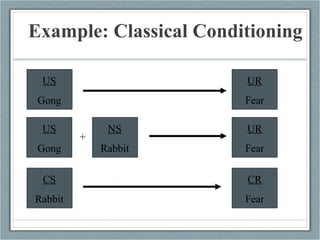
Example: Classical Conditioning UR Fear UR Fear US Gong NS Rabbit CS Rabbit CR Fear US Gong +
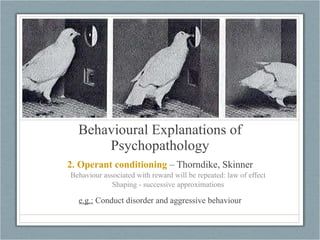
Behavioural Explanations of Psychopathology 2. Operant conditioning  – Thorndike, Skinner Behaviour associated with reward will be repeated: law of effect Shaping - successive approximations e.g.:  Conduct disorder and aggressive behaviour
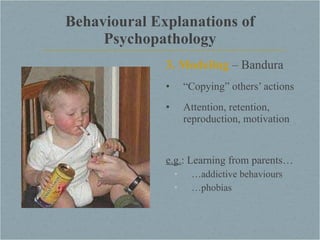
Behavioural Explanations of Psychopathology 3. Modeling  – Bandura “ Copying” others’ actions Attention, retention, reproduction, motivation e.g. : Learning from parents… … addictive behaviours … phobias
Behavioural Therapies The  goal : identify behaviors causing problems and replace them with more appropriate ones  Classical conditioning:  systematic desensitization   Operant conditioning:  token economies Modeling:  role playing
Assessing Behavioural Paradigm Strengths: Powerful force in the field Rooted in empiricism Significant research support for behavioral therapies Weaknesses: Too simplistic Unrealistic Downplays role of cognition
Cognitive Explanations of Psychopathology Schemas: past experiences shape interpretation Maladaptive thinking Faulty assumptions and attitudes Illogical thinking processes e.g. : overgeneralization – “Bad things ALWAYS happen to me” e.g. : Depression
Cognitive Therapies Beck’s cognitive therapy Recognize  and  restructure  their thinking Ellis: rational emotive therapy Eliminate self-defeating beliefs – “musts” & “shoulds”
Assessing Cognitive Paradigm Strengths: Clinically useful and effective therapies Focuses on a uniquely human process Research-based Weaknesses: Singular, narrow focus Overemphasis on the present Verification of cognition is difficult
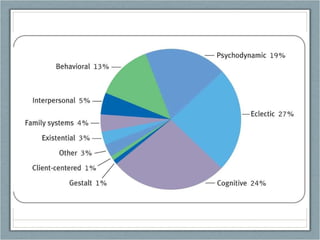
Integrative Approaches to Psychopathology General framework  for psychopathology … while also allowing for specification of factors especially relevant to a particular disorder Often called  “ eclectic ” Take strengths from each model, use in combination
Integrative Approaches to Psychopathology The  biopsychosocial  model Interaction of genetic, biological, developmental, emotional, behavioral, cognitive, social, and societal influences The  diathesis-stress  approach Diathesis = predisposition (bio, psycho, or social) Asserts that a predisposition to a disorder is triggered by an environmental stressor


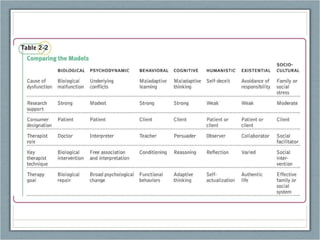
Viewpoints on Psychopathology

  • 1.
    PSYC 3553 –Psychopathology Week 3: Perspectives on Abnormality • September 22, 2009
  • 2.
    What is aparadigm? Framework Set of assumptions providing guidelines for research and practice Major schools of thought: Biological Psychoanalytic Behavioural Cognitive
  • 3.
    The Biological ParadigmAlso known as the medical or disease model Guiding belief : Behaviour is linked to physical causes, brought on by malfunctioning components of the body In psychopathology, mainly focuses on brain
  • 4.
    Biological Explanations ofPsychopathology Brain anatomy : problems in brain structure Swelling Atrophy e.g. : Huntington’s disease & basal ganglia (forebrain)  motor difficulties Stroke & temporal lobe swelling  speech deficits
  • 5.
  • 6.
  • 7.
    Biochemistry Electrical impulsestravel along neurons Reaches the end, releases neurotransmitters The chemicals will either excites or inhibits the nearby neurons Biological Explanations of Psychopathology
  • 8.
  • 9.
    Examples of NeurotransmittersNorepinephrine: Arousal  anxiety Serotonin: Mood, sleep, hunger  depression Dopamine: Movement, pain/pleasure, attention  schizophrenia GABA: Inhibitory neurotransmitter  anxiety
  • 10.
    Biological Explanations ofPsychopathology Also, the endocrine system Implicated by working with neurons to release hormones E.g., hippocampus, stress and the release of cortisol Memory impairments
  • 11.
    Biological Explanations ofPsychopathology Genetics Inheriting mutated or missing genes Unable (yet) to identify specific gene Or extent genetic factors contribute to disorders E.g. Schizophrenia & twin studies
  • 12.
    Biological Explanations ofPsychopathology Family method: relatives of the affected individual Twin studies: study pairs of MZ and DZ twins Adoption studies: study twins in/out of family home Linkage analysis: co-occurring genetics (e.g., eye colour and illness)
  • 13.
    Biological Treatments Threemain types of biological treatment: Drug therapy (1950s) Antianxiety drugs (anxiolytics, tranquilizers) Antidepressant drugs Antibipolar drugs (mood stabilizers) Antipsychotic drugs Electroconvulsive therapy (ECT) Psychosurgery (e.g., lobotomy)
  • 14.
    Evaluating Biological ParadigmStrengths : Huge progress on mental illness research Respected and accepted by society Weaknesses : Reductionism – making it too simple Inconclusive evidence Possibility of negative/severe side effects
  • 15.
  • 16.
    The Psychoanalytic ParadigmPsychotherapy : social therapist-client interaction Sigmund Freud : father of psychodynamic theory and psychoanalytic therapy Guiding belief : behaviour is linked to underlying dynamic psychological forces of which she or he is not aware
  • 17.
    The Psychoanalytic ParadigmThe id : basic urges for survival (food, water…) Direct gratification or by primary process thinking The ego : deals with reality The superego : conscience Healthy personality: compromise between these forces
  • 18.
    The Psychoanalytic ParadigmPsychosexual stages of development Oral stage: feeding Anal stage: bowel movements Phallic stage: genital stimulation Latency period Genital stage: adult sexual impulses
  • 19.
    Psychodynamic Explanations ofPsychopathology Fixation at a stage Unsuccessful developmental stage e.g . – Anal retentiveness & obsession with cleanliness OCD? e.g . – Neurotic anxiety e.g . – Moral anxiety
  • 20.
    Psychodynamic Explanations ofPsychopathology 2. Resolving the Oedipal/Electra complex Freud claimed that resolving the complex was critical… … to superego development … to future romantic relationship success … to future views of intimacy and expression of sexual desires
  • 21.
    Psychodynamic Explanations ofPsychopathology 3. Coping with anxiety – defense mechanisms Repression Denial Projection Regression Rationalization
  • 22.
    Variations on FreudianTheory Ego theorists Emphasize the role of the ego; consider it independent Self theorists Emphasize unified personality over any one component Object-relations theorists Emphasize human need for interpersonal relationships
  • 23.
    Psychodynamic Therapies Classicalpsychoanalysis: Gain insight into repressed conflicts and resistances Ego analysis: Use classical techniques but focus more on current living conditions Brief psychodynamic therapy: Short-term, target specific problems Interpersonal therapy: Emphasis on present relationships with others
  • 24.
    Assessing Psychoanalytic ParadigmStrengths: Elevated psychological theories and “internal forces” as possible cause of illness First to apply theory and techniques systematically to treatment – monumental impact on the field Weaknesses: Unsupported ideas (anecdotal evidence) Lead the client into focusing on certain experiences Difficult to research
  • 25.
    Cognitive & BehavioralParadigms Guiding beliefs: Behavioural : abnormal behaviour is learned and maintained over a time period Cognitive : abnormal behaviour results from how a person attends to , interprets , and uses available information Looking at overt behaviour versus internal processes
  • 26.
    Behavioural Explanations ofPsychopathology Classical & operant conditioning, modeling John B. Watson, B.F. Skinner, Albert Bandura Classical conditioning – Pavlov, Watson Events become associated in time, so person reacts same way to both events e.g.: Phobias – the Little Albert experiment
  • 27.
    Example: Classical ConditioningUR Fear UR Fear US Gong NS Rabbit CS Rabbit CR Fear US Gong +
  • 28.
    Behavioural Explanations ofPsychopathology 2. Operant conditioning – Thorndike, Skinner Behaviour associated with reward will be repeated: law of effect Shaping - successive approximations e.g.: Conduct disorder and aggressive behaviour
  • 29.
    Behavioural Explanations ofPsychopathology 3. Modeling – Bandura “ Copying” others’ actions Attention, retention, reproduction, motivation e.g. : Learning from parents… … addictive behaviours … phobias
  • 30.
    Behavioural Therapies The goal : identify behaviors causing problems and replace them with more appropriate ones Classical conditioning: systematic desensitization Operant conditioning: token economies Modeling: role playing
  • 31.
    Assessing Behavioural ParadigmStrengths: Powerful force in the field Rooted in empiricism Significant research support for behavioral therapies Weaknesses: Too simplistic Unrealistic Downplays role of cognition
  • 32.
    Cognitive Explanations ofPsychopathology Schemas: past experiences shape interpretation Maladaptive thinking Faulty assumptions and attitudes Illogical thinking processes e.g. : overgeneralization – “Bad things ALWAYS happen to me” e.g. : Depression
  • 33.
    Cognitive Therapies Beck’scognitive therapy Recognize and restructure their thinking Ellis: rational emotive therapy Eliminate self-defeating beliefs – “musts” & “shoulds”
  • 34.
    Assessing Cognitive ParadigmStrengths: Clinically useful and effective therapies Focuses on a uniquely human process Research-based Weaknesses: Singular, narrow focus Overemphasis on the present Verification of cognition is difficult
  • 35.
    Integrative Approaches toPsychopathology General framework for psychopathology … while also allowing for specification of factors especially relevant to a particular disorder Often called “ eclectic ” Take strengths from each model, use in combination
  • 36.
    Integrative Approaches toPsychopathology The biopsychosocial model Interaction of genetic, biological, developmental, emotional, behavioral, cognitive, social, and societal influences The diathesis-stress approach Diathesis = predisposition (bio, psycho, or social) Asserts that a predisposition to a disorder is triggered by an environmental stressor
  • 37.
  • 38.