


Assessing and nursing the person
with a psychotic mental health
problem
Working with psychotropic
medications
Paul McNamara
RGN (RAH), RPN (SAMHS), BN (Flin.), MMHN (USQ), Cert IMH (WCHN), CMHN, FACMHN
@meta4RN
#NS3360
Acknowledgements
Tanya Park @Tanya_M_Park
Elizabeth Emmanual via @SCUonline
+ Nurses 1988-2015
Learning Outcomes
 Identify hallucinations and delusions
 Identify psychotic features
 Understand the impact of symptoms
 Identify nursing diagnosis & interventions
 Use of psychotropic meds
 Side effects vs symptoms
 Therapeutic relationship + education + meds
 Monitoring side effects
 Z-track IMI
Today’s Presentation
 Psychosis
 Symptoms
 Disorders
 Treatment
 Psychotropic Medications
 Antipsychotics
 Antidepressants
 Mood Stabilisers
 Anxiolytics
Today’s Presentation
 Psychosis
 Symptoms
 Disorders
 Treatment
 Psychotropic Medications
 Antipsychotics
 Antidepressants
 Mood Stabilisers
 Anxiolytics
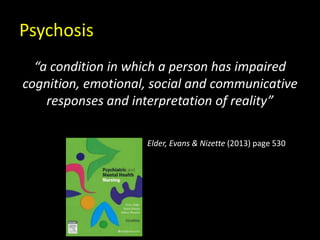
Psychosis
“a condition in which a person has impaired
cognition, emotional, social and communicative
responses and interpretation of reality”
Elder, Evans & Nizette (2013) page 530
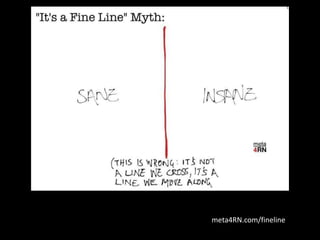
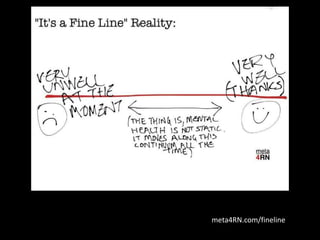
meta4RN.com/fineline
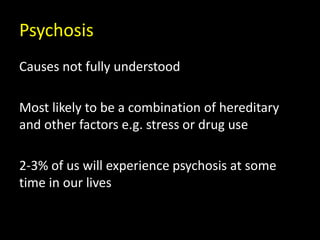
Psychosis
Causes not fully understood
Most likely to be a combination of hereditary
and other factors e.g. stress or drug use
2-3% of us will experience psychosis at some
time in our lives
Neurobiological Model
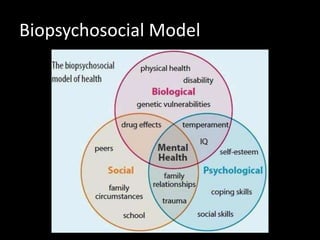
Biopsychosocial Model
Hallucination
“a sensory perception that seems real but occurs
without external stimulation (unlike an illusion,
which is a misinterpretation of real
phenomena)”
Elder, Evans & Nizette (2013) page 527
Types of Hallucinations
 Auditory
 Visual
 Olfactory
 Tactile
 Gustatory
 Somatic
Thought Disorder
“a disturbance of the form in which an individual
expresses their thoughts (structure, grammar,
syntax, logic), or sometimes the content of their
thoughts”
Elder, Evans & Nizette (2013) page 532
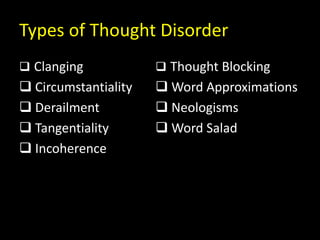
Types of Thought Disorder
 Clanging
 Circumstantiality
 Derailment
 Tangentiality
 Incoherence
 Thought Blocking
 Word Approximations
 Neologisms
 Word Salad
Delusion
“a false belief, based on incorrect inference
about external reality that is firmly sustained
despite what almost everyone else believes and
despite incontrovertible and obvious proof or
evidence to the contrary”
Elder, Evans & Nizette (2013) page 525
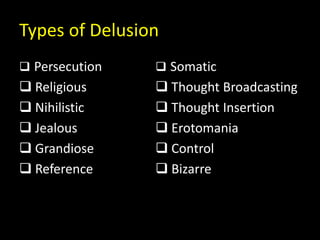
Types of Delusion
 Persecution
 Religious
 Nihilistic
 Jealous
 Grandiose
 Reference
 Somatic
 Thought Broadcasting
 Thought Insertion
 Erotomania
 Control
 Bizarre
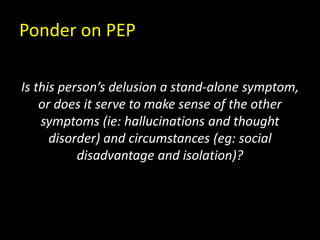
Ponder on PEP
Is this person’s delusion a stand-alone symptom,
or does it serve to make sense of the other
symptoms (ie: hallucinations and thought
disorder) and circumstances (eg: social
disadvantage and isolation)?
Today’s Presentation
 Psychosis
 Symptoms
 Disorders
 Treatment
 Psychotropic Medications
 Antipsychotics
 Antidepressants
 Mood Stabilisers
 Anxiolytics
“When you hear hoofbeats,
think of horses not zebras".
Prof Theodore Woodward, circa 1948
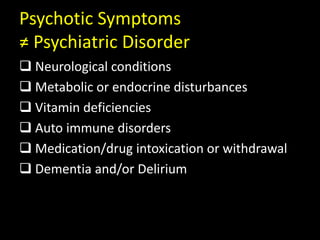
Psychotic Symptoms
≠ Psychiatric Disorder
 Neurological conditions
 Metabolic or endocrine disturbances
 Vitamin deficiencies
 Auto immune disorders
 Medication/drug intoxication or withdrawal
 Dementia and/or Delirium
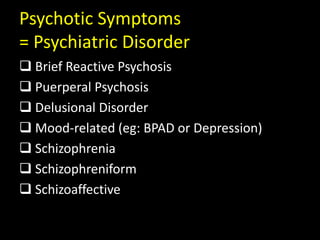
Psychotic Symptoms
= Psychiatric Disorder
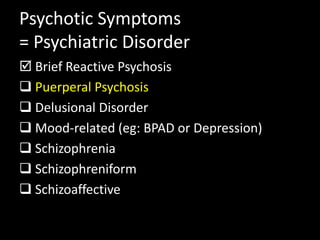
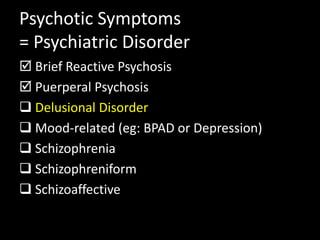
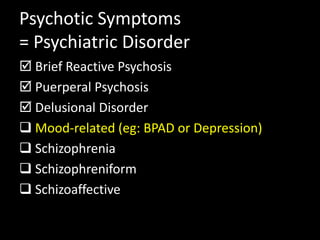
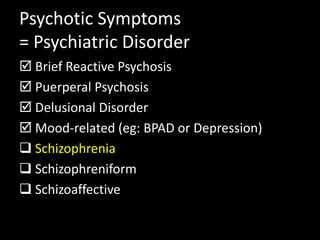
 Brief Reactive Psychosis
 Puerperal Psychosis
 Delusional Disorder
 Mood-related (eg: BPAD or Depression)
 Schizophrenia
 Schizophreniform
 Schizoaffective
Psychotic Symptoms
= Psychiatric Disorder
 Brief Reactive Psychosis
 Puerperal Psychosis
 Delusional Disorder
 Mood-related (eg: BPAD or Depression)
 Schizophrenia
 Schizophreniform
 Schizoaffective
Psychotic Symptoms
= Psychiatric Disorder
 Brief Reactive Psychosis
 Puerperal Psychosis
 Delusional Disorder
 Mood-related (eg: BPAD or Depression)
 Schizophrenia
 Schizophreniform
 Schizoaffective
Psychotic Symptoms
= Psychiatric Disorder
 Brief Reactive Psychosis
 Puerperal Psychosis
 Delusional Disorder
 Mood-related (eg: BPAD or Depression)
 Schizophrenia
 Schizophreniform
 Schizoaffective
Psychotic Symptoms
= Psychiatric Disorder
 Brief Reactive Psychosis
 Puerperal Psychosis
 Delusional Disorder
 Mood-related (eg: BPAD or Depression)
 Schizophrenia
 Schizophreniform
 Schizoaffective
Psychotic Symptoms
= Psychiatric Disorder
 Brief Reactive Psychosis
 Puerperal Psychosis
 Delusional Disorder
 Mood-related (eg: BPAD or Depression)
 Schizophrenia
 Schizophreniform
 Schizoaffective
Schizophrenia
“a [group of] disorder[s] characterised by a
major disturbance in thought, perception,
cognition and psychosocial functioning”
Elder, Evans & Nizette (2013) pp 525 + 265
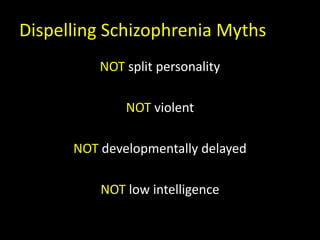
Dispelling Schizophrenia Myths
NOT split personality
NOT violent
NOT developmentally delayed
NOT low intelligence
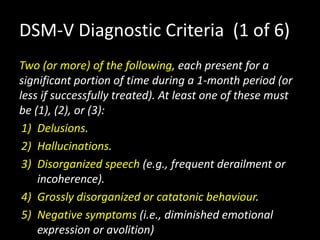
DSM-V Diagnostic Criteria (1 of 6)
Two (or more) of the following, each present for a
significant portion of time during a 1-month period (or
less if successfully treated). At least one of these must
be (1), (2), or (3):
1) Delusions.
2) Hallucinations.
3) Disorganized speech (e.g., frequent derailment or
incoherence).
4) Grossly disorganized or catatonic behaviour.
5) Negative symptoms (i.e., diminished emotional
expression or avolition)
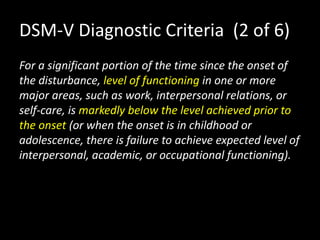
DSM-V Diagnostic Criteria (2 of 6)
For a significant portion of the time since the onset of
the disturbance, level of functioning in one or more
major areas, such as work, interpersonal relations, or
self-care, is markedly below the level achieved prior to
the onset (or when the onset is in childhood or
adolescence, there is failure to achieve expected level of
interpersonal, academic, or occupational functioning).
DSM-V Diagnostic Criteria (3 of 6)
Continuous signs of the disturbance persist for at least 6
months. This 6-month period must include at least 1
month of symptoms (or less if successfully treated) that
meet Criterion A (i.e., active-phase symptoms) and may
include periods of prodromal or residual symptoms.
During these prodromal or residual periods, the signs of
the disturbance may be manifested by only negative
symptoms or by two or more symptoms listed in
Criterion A present in an attenuated form (e.g., odd
beliefs, unusual perceptual experiences).
DSM-V Diagnostic Criteria (4 of 6)
Schizoaffective disorder and depressive or bipolar
disorder with psychotic features have been ruled out
because either 1) no major depressive or manic
episodes have occurred concurrently with the active-
phase symptoms, or 2) if mood episodes have occurred
during active-phase symptoms, they have been present
for a minority of the total duration of the active and
residual periods of the illness.
DSM-V Diagnostic Criteria (5 of 6)
The disturbance is not attributable to the physiological
effects of a substance (e.g., a drug of abuse, a
medication) or another medical condition.
DSM-V Diagnostic Criteria (6 of 6)
If there is a history of autism spectrum disorder or a
communication disorder of childhood onset, the
additional diagnosis of schizophrenia is made only if
prominent delusions or hallucinations, in addition to the
other required symptoms of schizophrenia, are also
present for at least 1 month (or less if successfully
treated).
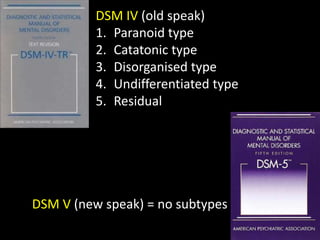
DSM IV (old speak)
1. Paranoid type
2. Catatonic type
3. Disorganised type
4. Undifferentiated type
5. Residual
DSM V (new speak) = no subtypes
Positive & Negative Symptoms
+ve [excess]
 Hallucinations
 Delusions
 Thought Disorder
-ve [deficit]
 Avolition (↓ drive)
 Anergia (↓ energy)
 Anhedonia (↓ pleasure)
 Affect Blunted
 Alogia (↓ speech)
Schizophrenia
Prevalence = 1%
Onset = late teens / early twenties
↑ Diabetes
↑ Cardiovascular disease
↑ Lipidemia
↑ Smoking
↑ Suicide
↓ Life Expectancy (getting worse)
Psychotic Symptoms
= Psychiatric Disorder
 Brief Reactive Psychosis
 Puerperal Psychosis
 Delusional Disorder
 Mood-related (eg: BPAD or Depression)
 Schizophrenia
 Schizophreniform
 Schizoaffective
Psychotic Symptoms
= Psychiatric Disorder
 Brief Reactive Psychosis
 Puerperal Psychosis
 Delusional Disorder
 Mood-related (eg: BPAD or Depression)
 Schizophrenia
 Schizophreniform
 Schizoaffective
Psychotic Symptoms
= Psychiatric Disorder
 Brief Reactive Psychosis
 Puerperal Psychosis
 Delusional Disorder
 Mood-related (eg: BPAD or Depression)
 Schizophrenia
 Schizophreniform
 Schizoaffective
Today’s Presentation
 Psychosis
 Symptoms
 Disorders
 Treatment
 Psychotropic Medications
 Antipsychotics
 Antidepressants
 Mood Stabilisers
 Anxiolytics
Treatment
1. Supportive Psychotherapy
Table 15.4, page 273
Treatment
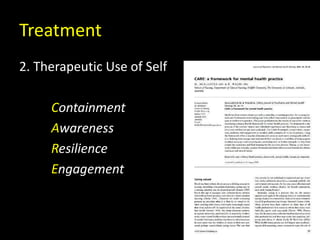
2. Therapeutic Use of Self
Containment
Awareness
Resilience
Engagement
Treatment
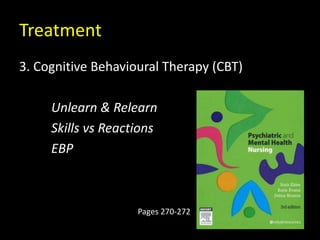
3. Cognitive Behavioural Therapy (CBT)
Unlearn & Relearn
Skills vs Reactions
EBP
Pages 270-272
Treatment
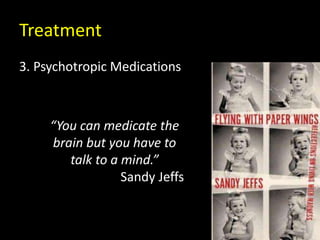
3. Psychotropic Medications
“You can medicate the
brain but you have to
talk to a mind.”
Sandy Jeffs
Today’s Presentation
 Psychosis
 Symptoms
 Disorders
 Treatment
 Psychotropic Medications
 Antipsychotics
 Antidepressants
 Mood Stabilisers
 Anxiolytics
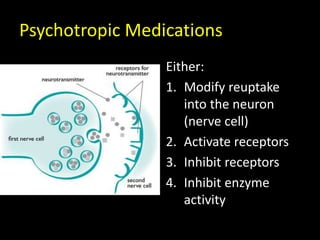
Psychotropic Medications
Either:
1. Modify reuptake
into the neuron
(nerve cell)
2. Activate receptors
3. Inhibit receptors
4. Inhibit enzyme
activity
Neurotransmitters
 Knowledge incomplete
 At least 40 different types
 Serotonin
 Noradrenaline (aka Norepiniphrene)
 Dopamine
 5 different subtypes of dopamine D1 –D5
 Antipsychotics act as antagonists at dopamine receptors
 Interfere with the binding of dopamine to the receptor
 Acetylcholine
 GABA (gamma-aminobutyric acid)
Nursing Roles
Administration
Education
Effects
Unwanted side effects
Adherence vs Non-adherence
Nursing Strategies
Correct misconceptions
Emphasis personal choice
Empathy
Support
Goal-setting/Motivational Interview
Explore
Lifestyle changes
Alternatives
How long will I need to take medications?
Cost
Today’s Presentation
 Psychosis
 Symptoms
 Disorders
 Treatment
 Psychotropic Medications
 Antipsychotics
 Antidepressants
 Mood Stabilisers
 Anxiolytics

Antipsychotic Indications Dx
 Acute Psychosis
 Chronic Psychosis
 Delusional Disorder
 Schizophrenia
Antipsychotic Indications Sx
+ve [excess]
 Hallucinations
 Delusions
 Thought Disorder
-ve [deficit]
 Avolition (↓ drive)
 Anergia (↓ energy)
 Anhedonia (↓ pleasure)
 Affect Blunted
 Alogia (↓ speech)
First Generation (1950s)
aka Typical, Traditional Antipsychotics:
 Phenothiazine's – Thioridazine (cardiotoxic)
 Thioxanthines - Flupenthixol
 Butyophenones - Haloperidol
 Diphenylbutylpipridines – Pimozide
 Trifluoperazine – Stelazine
 Chlorpromazine – Largactil
 Zuclopenthixol - Clopixol
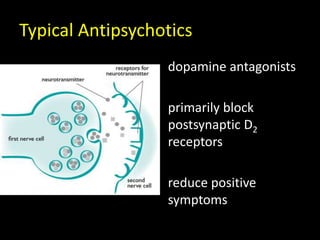
Typical Antipsychotics
dopamine antagonists
primarily block
postsynaptic D2
receptors
reduce positive
symptoms
Second Generation (1990s)
aka Atypical Antipsychotics
 Clozapine
 Risperidone
 Olanzapine
 Quetiapine
 Amisulpride
 Sulpiride
 Aripiprazole
 Paliperidone
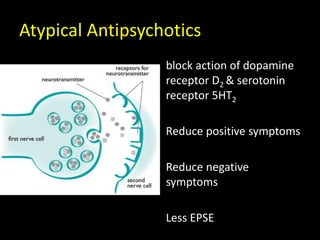
Atypical Antipsychotics
block action of dopamine
receptor D2 & serotonin
receptor 5HT2
Reduce positive symptoms
Reduce negative
symptoms
Less EPSE
Routes
Oral: tablet, wafer, liquid
eg: Zuclopenthixol dihydrochloride
tablets 10 & 20mg
Intramuscular Injection (IMI):
Depot or Long Acting Injection (LAI) = 1- 6 weeks
eg: Zuclopenthixol deconate
200mg/ml; typical dose = 200-400mg every 2-4 weeks
Short Acting = 1 hour to 3 days
eg: Zuclopenthixol Acuphase
50mg/ml; typical dose = 50-150 mg every 2-3 days; max. 400mg
Depot IMI
 Oily based solution
 Regular Administration
 Typically Weekly or Fortnightly
 Monthly more likely to be non-oily LAI (eg: Paliperidone)
Advantages?
Disadvantages?
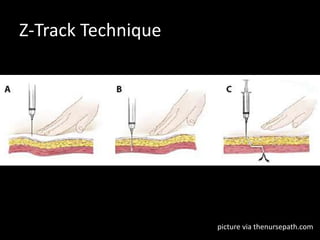
 Z-Track Technique
Z-Track Technique
picture via thenursepath.com
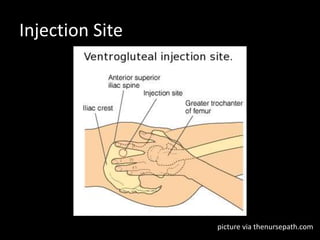
Injection Site
picture via thenursepath.com
picture via gumtree.com.au
Potential Side Effects:
 Extrapyramidal Side Effects (EPSE)
 Sedation
 Photosensitivity
 Anticholinergic
 Endocrine
 Metabolic
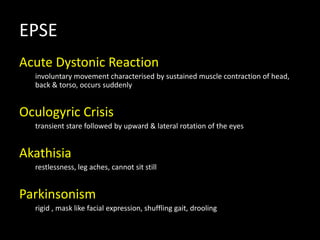
EPSE
Acute Dystonic Reaction
involuntary movement characterised by sustained muscle contraction of head,
back & torso, occurs suddenly
Oculogyric Crisis
transient stare followed by upward & lateral rotation of the eyes
Akathisia
restlessness, leg aches, cannot sit still
Parkinsonism
rigid , mask like facial expression, shuffling gait, drooling
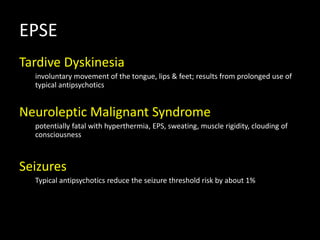
EPSE
Tardive Dyskinesia
involuntary movement of the tongue, lips & feet; results from prolonged use of
typical antipsychotics
Neuroleptic Malignant Syndrome
potentially fatal with hyperthermia, EPS, sweating, muscle rigidity, clouding of
consciousness
Seizures
Typical antipsychotics reduce the seizure threshold risk by about 1%
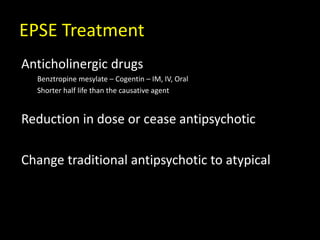
EPSE Treatment
Anticholinergic drugs
Benztropine mesylate – Cogentin – IM, IV, Oral
Shorter half life than the causative agent
Reduction in dose or cease antipsychotic
Change traditional antipsychotic to atypical
Today’s Presentation
 Psychosis
 Symptoms
 Disorders
 Treatment
 Psychotropic Medications
 Antipsychotics
 Antidepressants
 Mood Stabilisers
 Anxiolytics

Antidepressants
Tricyclic (TCAs)
Monoamine Oxidase Inhibitors (MAOIs)
Selective Serotonin Reuptake Inhibitors (SSRIs)
Serotonin-Norepinephrine Reuptake Inhibiters
(SNRIs)
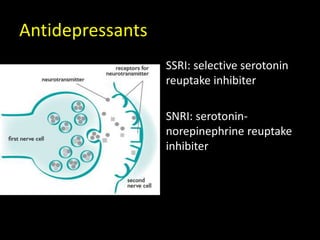
Antidepressants
SSRI: selective serotonin
reuptake inhibiter
SNRI: serotonin-
norepinephrine reuptake
inhibiter
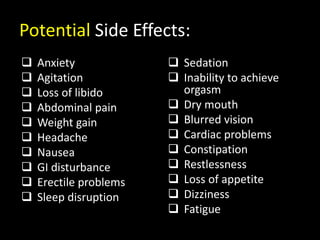
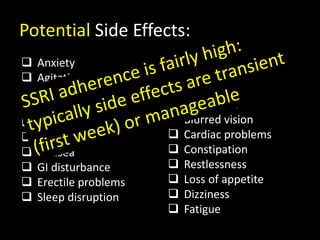
 Anxiety
 Agitation
 Loss of libido
 Abdominal pain
 Weight gain
 Headache
 Nausea
 GI disturbance
 Erectile problems
 Sleep disruption
 Sedation
 Inability to achieve
orgasm
 Dry mouth
 Blurred vision
 Cardiac problems
 Constipation
 Restlessness
 Loss of appetite
 Dizziness
 Fatigue
Potential Side Effects:
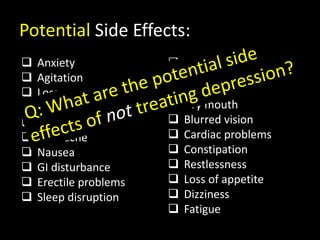
 Anxiety
 Agitation
 Loss of libido
 Abdominal pain
 Weight gain
 Headache
 Nausea
 GI disturbance
 Erectile problems
 Sleep disruption
 Sedation
 Inability to achieve
orgasm
 Dry mouth
 Blurred vision
 Cardiac problems
 Constipation
 Restlessness
 Loss of appetite
 Dizziness
 Fatigue
Potential Side Effects:
 Anxiety
 Agitation
 Loss of libido
 Abdominal pain
 Weight gain
 Headache
 Nausea
 GI disturbance
 Erectile problems
 Sleep disruption
 Sedation
 Inability to achieve
orgasm
 Dry mouth
 Blurred vision
 Cardiac problems
 Constipation
 Restlessness
 Loss of appetite
 Dizziness
 Fatigue
Potential Side Effects:
Today’s Presentation
 Psychosis
 Symptoms
 Disorders
 Treatment
 Psychotropic Medications
 Antipsychotics
 Antidepressants
 Mood Stabilisers
 Anxiolytics

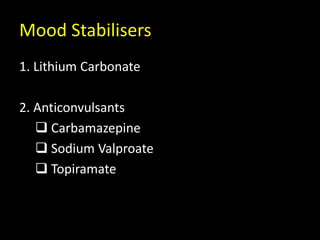
Mood Stabilisers
1. Lithium Carbonate
2. Anticonvulsants
 Carbamazepine
 Sodium Valproate
 Topiramate
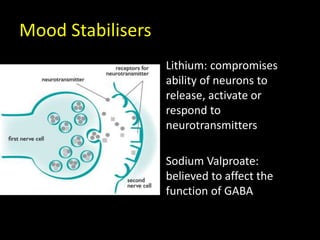
Mood Stabilisers
Lithium: compromises
ability of neurons to
release, activate or
respond to
neurotransmitters
Sodium Valproate:
believed to affect the
function of GABA
Lithium
 250mg tablets
 Dosage titrated until stable blood level
 Therapeutic range 0.6mmol/L-1.2mmol/L
 Regular blood tests- weekly then monthly
Watch for toxicity – vomiting, diarrhoea, tremor,
polydipsia, polyuria, drowsiness, anorexia,
muscle weakness, ataxia, blurred vision,
disorientation.
Dr John Cade On discovering the therapeutic
usefulness of lithium in 1949:
“I describe myself as an
enthusiastic amateur full of
curiosity with fair
determination, golden
opportunities, inadequate
knowledge and woeful
technique. But even the small
boy fishing a muddy pond after
school with string and bent pin
occasionally hauls forth a
handsome fish.”
Today’s Presentation
 Psychosis
 Symptoms
 Disorders
 Treatment
 Psychotropic Medications
 Antipsychotics
 Antidepressants
 Mood Stabilisers
 Anxiolytics
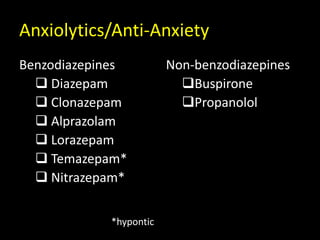
Anxiolytics/Anti-Anxiety
Benzodiazepines
 Diazepam
 Clonazepam
 Alprazolam
 Lorazepam
 Temazepam*
 Nitrazepam*
*hypontic
Non-benzodiazepines
Buspirone
Propanolol
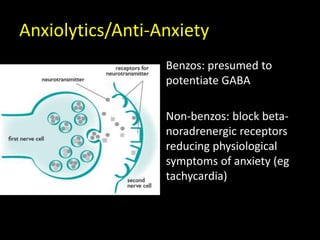
Anxiolytics/Anti-Anxiety
Benzos: presumed to
potentiate GABA
Non-benzos: block beta-
noradrenergic receptors
reducing physiological
symptoms of anxiety (eg
tachycardia)
Anxiolytic Indications
 Anxiety
 Insomnia
 Agitation
 Muscle relaxation
 Withdrawal states
 Seizures
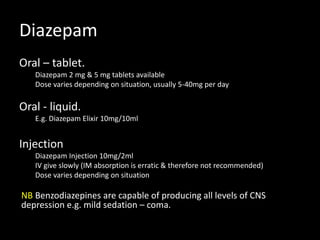
Diazepam
Oral – tablet.
Diazepam 2 mg & 5 mg tablets available
Dose varies depending on situation, usually 5-40mg per day
Oral - liquid.
E.g. Diazepam Elixir 10mg/10ml
Injection
Diazepam Injection 10mg/2ml
IV give slowly (IM absorption is erratic & therefore not recommended)
Dose varies depending on situation
NB Benzodiazepines are capable of producing all levels of CNS
depression e.g. mild sedation – coma.
Anxiolytic Side Effects
 Sedation/Drowsiness*
 Reduced mental acuity*
 Impaired motor
performance*
 Headache
 Dizziness
 Hypotension*
 Restlessness
 Rebound insomnia*
 Rebound anxiety*
 Tolerance*
 Dependence*
 Withdrawal syndrome
if abruptly ceased*
*rationale for limiting use to short-term only
Today’s Presentation
 Psychosis
 Symptoms
 Disorders
 Treatment
 Psychotropic Medications
 Antipsychotics
 Antidepressants
 Mood Stabilisers
 Anxiolytics

Psychosis and Psychotropic Meds

  • 1.
    Assessing and nursingthe person with a psychotic mental health problem Working with psychotropic medications Paul McNamara RGN (RAH), RPN (SAMHS), BN (Flin.), MMHN (USQ), Cert IMH (WCHN), CMHN, FACMHN @meta4RN #NS3360
  • 2.
    Acknowledgements Tanya Park @Tanya_M_Park ElizabethEmmanual via @SCUonline + Nurses 1988-2015
  • 3.
    Learning Outcomes  Identifyhallucinations and delusions  Identify psychotic features  Understand the impact of symptoms  Identify nursing diagnosis & interventions  Use of psychotropic meds  Side effects vs symptoms  Therapeutic relationship + education + meds  Monitoring side effects  Z-track IMI
  • 4.
    Today’s Presentation  Psychosis Symptoms  Disorders  Treatment  Psychotropic Medications  Antipsychotics  Antidepressants  Mood Stabilisers  Anxiolytics
  • 5.
    Today’s Presentation  Psychosis Symptoms  Disorders  Treatment  Psychotropic Medications  Antipsychotics  Antidepressants  Mood Stabilisers  Anxiolytics
  • 6.
    Psychosis “a condition inwhich a person has impaired cognition, emotional, social and communicative responses and interpretation of reality” Elder, Evans & Nizette (2013) page 530
  • 7.
  • 8.
  • 9.
    Psychosis Causes not fullyunderstood Most likely to be a combination of hereditary and other factors e.g. stress or drug use 2-3% of us will experience psychosis at some time in our lives
  • 10.
  • 11.
  • 12.
    Hallucination “a sensory perceptionthat seems real but occurs without external stimulation (unlike an illusion, which is a misinterpretation of real phenomena)” Elder, Evans & Nizette (2013) page 527
  • 13.
    Types of Hallucinations Auditory  Visual  Olfactory  Tactile  Gustatory  Somatic
  • 14.
    Thought Disorder “a disturbanceof the form in which an individual expresses their thoughts (structure, grammar, syntax, logic), or sometimes the content of their thoughts” Elder, Evans & Nizette (2013) page 532
  • 15.
    Types of ThoughtDisorder  Clanging  Circumstantiality  Derailment  Tangentiality  Incoherence  Thought Blocking  Word Approximations  Neologisms  Word Salad
  • 16.
    Delusion “a false belief,based on incorrect inference about external reality that is firmly sustained despite what almost everyone else believes and despite incontrovertible and obvious proof or evidence to the contrary” Elder, Evans & Nizette (2013) page 525
  • 17.
    Types of Delusion Persecution  Religious  Nihilistic  Jealous  Grandiose  Reference  Somatic  Thought Broadcasting  Thought Insertion  Erotomania  Control  Bizarre
  • 18.
    Ponder on PEP Isthis person’s delusion a stand-alone symptom, or does it serve to make sense of the other symptoms (ie: hallucinations and thought disorder) and circumstances (eg: social disadvantage and isolation)?
  • 19.
    Today’s Presentation  Psychosis Symptoms  Disorders  Treatment  Psychotropic Medications  Antipsychotics  Antidepressants  Mood Stabilisers  Anxiolytics
  • 20.
    “When you hearhoofbeats, think of horses not zebras". Prof Theodore Woodward, circa 1948
  • 21.
    Psychotic Symptoms ≠ PsychiatricDisorder  Neurological conditions  Metabolic or endocrine disturbances  Vitamin deficiencies  Auto immune disorders  Medication/drug intoxication or withdrawal  Dementia and/or Delirium
  • 22.
    Psychotic Symptoms = PsychiatricDisorder  Brief Reactive Psychosis  Puerperal Psychosis  Delusional Disorder  Mood-related (eg: BPAD or Depression)  Schizophrenia  Schizophreniform  Schizoaffective
  • 23.
    Psychotic Symptoms = PsychiatricDisorder  Brief Reactive Psychosis  Puerperal Psychosis  Delusional Disorder  Mood-related (eg: BPAD or Depression)  Schizophrenia  Schizophreniform  Schizoaffective
  • 24.
    Psychotic Symptoms = PsychiatricDisorder  Brief Reactive Psychosis  Puerperal Psychosis  Delusional Disorder  Mood-related (eg: BPAD or Depression)  Schizophrenia  Schizophreniform  Schizoaffective
  • 25.
    Psychotic Symptoms = PsychiatricDisorder  Brief Reactive Psychosis  Puerperal Psychosis  Delusional Disorder  Mood-related (eg: BPAD or Depression)  Schizophrenia  Schizophreniform  Schizoaffective
  • 26.
    Psychotic Symptoms = PsychiatricDisorder  Brief Reactive Psychosis  Puerperal Psychosis  Delusional Disorder  Mood-related (eg: BPAD or Depression)  Schizophrenia  Schizophreniform  Schizoaffective
  • 27.
    Psychotic Symptoms = PsychiatricDisorder  Brief Reactive Psychosis  Puerperal Psychosis  Delusional Disorder  Mood-related (eg: BPAD or Depression)  Schizophrenia  Schizophreniform  Schizoaffective
  • 28.
    Schizophrenia “a [group of]disorder[s] characterised by a major disturbance in thought, perception, cognition and psychosocial functioning” Elder, Evans & Nizette (2013) pp 525 + 265
  • 29.
    Dispelling Schizophrenia Myths NOTsplit personality NOT violent NOT developmentally delayed NOT low intelligence
  • 31.
    DSM-V Diagnostic Criteria(1 of 6) Two (or more) of the following, each present for a significant portion of time during a 1-month period (or less if successfully treated). At least one of these must be (1), (2), or (3): 1) Delusions. 2) Hallucinations. 3) Disorganized speech (e.g., frequent derailment or incoherence). 4) Grossly disorganized or catatonic behaviour. 5) Negative symptoms (i.e., diminished emotional expression or avolition)
  • 32.
    DSM-V Diagnostic Criteria(2 of 6) For a significant portion of the time since the onset of the disturbance, level of functioning in one or more major areas, such as work, interpersonal relations, or self-care, is markedly below the level achieved prior to the onset (or when the onset is in childhood or adolescence, there is failure to achieve expected level of interpersonal, academic, or occupational functioning).
  • 33.
    DSM-V Diagnostic Criteria(3 of 6) Continuous signs of the disturbance persist for at least 6 months. This 6-month period must include at least 1 month of symptoms (or less if successfully treated) that meet Criterion A (i.e., active-phase symptoms) and may include periods of prodromal or residual symptoms. During these prodromal or residual periods, the signs of the disturbance may be manifested by only negative symptoms or by two or more symptoms listed in Criterion A present in an attenuated form (e.g., odd beliefs, unusual perceptual experiences).
  • 34.
    DSM-V Diagnostic Criteria(4 of 6) Schizoaffective disorder and depressive or bipolar disorder with psychotic features have been ruled out because either 1) no major depressive or manic episodes have occurred concurrently with the active- phase symptoms, or 2) if mood episodes have occurred during active-phase symptoms, they have been present for a minority of the total duration of the active and residual periods of the illness.
  • 35.
    DSM-V Diagnostic Criteria(5 of 6) The disturbance is not attributable to the physiological effects of a substance (e.g., a drug of abuse, a medication) or another medical condition.
  • 36.
    DSM-V Diagnostic Criteria(6 of 6) If there is a history of autism spectrum disorder or a communication disorder of childhood onset, the additional diagnosis of schizophrenia is made only if prominent delusions or hallucinations, in addition to the other required symptoms of schizophrenia, are also present for at least 1 month (or less if successfully treated).
  • 37.
    DSM IV (oldspeak) 1. Paranoid type 2. Catatonic type 3. Disorganised type 4. Undifferentiated type 5. Residual DSM V (new speak) = no subtypes
  • 38.
    Positive & NegativeSymptoms +ve [excess]  Hallucinations  Delusions  Thought Disorder -ve [deficit]  Avolition (↓ drive)  Anergia (↓ energy)  Anhedonia (↓ pleasure)  Affect Blunted  Alogia (↓ speech)
  • 39.
    Schizophrenia Prevalence = 1% Onset= late teens / early twenties ↑ Diabetes ↑ Cardiovascular disease ↑ Lipidemia ↑ Smoking ↑ Suicide ↓ Life Expectancy (getting worse)
  • 41.
    Psychotic Symptoms = PsychiatricDisorder  Brief Reactive Psychosis  Puerperal Psychosis  Delusional Disorder  Mood-related (eg: BPAD or Depression)  Schizophrenia  Schizophreniform  Schizoaffective
  • 42.
    Psychotic Symptoms = PsychiatricDisorder  Brief Reactive Psychosis  Puerperal Psychosis  Delusional Disorder  Mood-related (eg: BPAD or Depression)  Schizophrenia  Schizophreniform  Schizoaffective
  • 43.
    Psychotic Symptoms = PsychiatricDisorder  Brief Reactive Psychosis  Puerperal Psychosis  Delusional Disorder  Mood-related (eg: BPAD or Depression)  Schizophrenia  Schizophreniform  Schizoaffective
  • 44.
    Today’s Presentation  Psychosis Symptoms  Disorders  Treatment  Psychotropic Medications  Antipsychotics  Antidepressants  Mood Stabilisers  Anxiolytics
  • 45.
  • 46.
    Treatment 2. Therapeutic Useof Self Containment Awareness Resilience Engagement
  • 47.
    Treatment 3. Cognitive BehaviouralTherapy (CBT) Unlearn & Relearn Skills vs Reactions EBP Pages 270-272
  • 48.
    Treatment 3. Psychotropic Medications “Youcan medicate the brain but you have to talk to a mind.” Sandy Jeffs
  • 49.
    Today’s Presentation  Psychosis Symptoms  Disorders  Treatment  Psychotropic Medications  Antipsychotics  Antidepressants  Mood Stabilisers  Anxiolytics
  • 50.
    Psychotropic Medications Either: 1. Modifyreuptake into the neuron (nerve cell) 2. Activate receptors 3. Inhibit receptors 4. Inhibit enzyme activity
  • 51.
    Neurotransmitters  Knowledge incomplete At least 40 different types  Serotonin  Noradrenaline (aka Norepiniphrene)  Dopamine  5 different subtypes of dopamine D1 –D5  Antipsychotics act as antagonists at dopamine receptors  Interfere with the binding of dopamine to the receptor  Acetylcholine  GABA (gamma-aminobutyric acid)
  • 52.
  • 53.
    Nursing Strategies Correct misconceptions Emphasispersonal choice Empathy Support Goal-setting/Motivational Interview Explore Lifestyle changes Alternatives How long will I need to take medications? Cost
  • 54.
    Today’s Presentation  Psychosis Symptoms  Disorders  Treatment  Psychotropic Medications  Antipsychotics  Antidepressants  Mood Stabilisers  Anxiolytics 
  • 55.
    Antipsychotic Indications Dx Acute Psychosis  Chronic Psychosis  Delusional Disorder  Schizophrenia
  • 56.
    Antipsychotic Indications Sx +ve[excess]  Hallucinations  Delusions  Thought Disorder -ve [deficit]  Avolition (↓ drive)  Anergia (↓ energy)  Anhedonia (↓ pleasure)  Affect Blunted  Alogia (↓ speech)
  • 57.
    First Generation (1950s) akaTypical, Traditional Antipsychotics:  Phenothiazine's – Thioridazine (cardiotoxic)  Thioxanthines - Flupenthixol  Butyophenones - Haloperidol  Diphenylbutylpipridines – Pimozide  Trifluoperazine – Stelazine  Chlorpromazine – Largactil  Zuclopenthixol - Clopixol
  • 58.
    Typical Antipsychotics dopamine antagonists primarilyblock postsynaptic D2 receptors reduce positive symptoms
  • 59.
    Second Generation (1990s) akaAtypical Antipsychotics  Clozapine  Risperidone  Olanzapine  Quetiapine  Amisulpride  Sulpiride  Aripiprazole  Paliperidone
  • 60.
    Atypical Antipsychotics block actionof dopamine receptor D2 & serotonin receptor 5HT2 Reduce positive symptoms Reduce negative symptoms Less EPSE
  • 61.
    Routes Oral: tablet, wafer,liquid eg: Zuclopenthixol dihydrochloride tablets 10 & 20mg Intramuscular Injection (IMI): Depot or Long Acting Injection (LAI) = 1- 6 weeks eg: Zuclopenthixol deconate 200mg/ml; typical dose = 200-400mg every 2-4 weeks Short Acting = 1 hour to 3 days eg: Zuclopenthixol Acuphase 50mg/ml; typical dose = 50-150 mg every 2-3 days; max. 400mg
  • 62.
    Depot IMI  Oilybased solution  Regular Administration  Typically Weekly or Fortnightly  Monthly more likely to be non-oily LAI (eg: Paliperidone) Advantages? Disadvantages?  Z-Track Technique
  • 63.
  • 64.
  • 65.
  • 66.
    Potential Side Effects: Extrapyramidal Side Effects (EPSE)  Sedation  Photosensitivity  Anticholinergic  Endocrine  Metabolic
  • 67.
    EPSE Acute Dystonic Reaction involuntarymovement characterised by sustained muscle contraction of head, back & torso, occurs suddenly Oculogyric Crisis transient stare followed by upward & lateral rotation of the eyes Akathisia restlessness, leg aches, cannot sit still Parkinsonism rigid , mask like facial expression, shuffling gait, drooling
  • 68.
    EPSE Tardive Dyskinesia involuntary movementof the tongue, lips & feet; results from prolonged use of typical antipsychotics Neuroleptic Malignant Syndrome potentially fatal with hyperthermia, EPS, sweating, muscle rigidity, clouding of consciousness Seizures Typical antipsychotics reduce the seizure threshold risk by about 1%
  • 69.
    EPSE Treatment Anticholinergic drugs Benztropinemesylate – Cogentin – IM, IV, Oral Shorter half life than the causative agent Reduction in dose or cease antipsychotic Change traditional antipsychotic to atypical
  • 70.
    Today’s Presentation  Psychosis Symptoms  Disorders  Treatment  Psychotropic Medications  Antipsychotics  Antidepressants  Mood Stabilisers  Anxiolytics 
  • 71.
    Antidepressants Tricyclic (TCAs) Monoamine OxidaseInhibitors (MAOIs) Selective Serotonin Reuptake Inhibitors (SSRIs) Serotonin-Norepinephrine Reuptake Inhibiters (SNRIs)
  • 72.
    Antidepressants SSRI: selective serotonin reuptakeinhibiter SNRI: serotonin- norepinephrine reuptake inhibiter
  • 73.
     Anxiety  Agitation Loss of libido  Abdominal pain  Weight gain  Headache  Nausea  GI disturbance  Erectile problems  Sleep disruption  Sedation  Inability to achieve orgasm  Dry mouth  Blurred vision  Cardiac problems  Constipation  Restlessness  Loss of appetite  Dizziness  Fatigue Potential Side Effects:
  • 74.
     Anxiety  Agitation Loss of libido  Abdominal pain  Weight gain  Headache  Nausea  GI disturbance  Erectile problems  Sleep disruption  Sedation  Inability to achieve orgasm  Dry mouth  Blurred vision  Cardiac problems  Constipation  Restlessness  Loss of appetite  Dizziness  Fatigue Potential Side Effects:
  • 75.
     Anxiety  Agitation Loss of libido  Abdominal pain  Weight gain  Headache  Nausea  GI disturbance  Erectile problems  Sleep disruption  Sedation  Inability to achieve orgasm  Dry mouth  Blurred vision  Cardiac problems  Constipation  Restlessness  Loss of appetite  Dizziness  Fatigue Potential Side Effects:
  • 76.
    Today’s Presentation  Psychosis Symptoms  Disorders  Treatment  Psychotropic Medications  Antipsychotics  Antidepressants  Mood Stabilisers  Anxiolytics 
  • 77.
    Mood Stabilisers 1. LithiumCarbonate 2. Anticonvulsants  Carbamazepine  Sodium Valproate  Topiramate
  • 78.
    Mood Stabilisers Lithium: compromises abilityof neurons to release, activate or respond to neurotransmitters Sodium Valproate: believed to affect the function of GABA
  • 79.
    Lithium  250mg tablets Dosage titrated until stable blood level  Therapeutic range 0.6mmol/L-1.2mmol/L  Regular blood tests- weekly then monthly Watch for toxicity – vomiting, diarrhoea, tremor, polydipsia, polyuria, drowsiness, anorexia, muscle weakness, ataxia, blurred vision, disorientation.
  • 80.
    Dr John CadeOn discovering the therapeutic usefulness of lithium in 1949: “I describe myself as an enthusiastic amateur full of curiosity with fair determination, golden opportunities, inadequate knowledge and woeful technique. But even the small boy fishing a muddy pond after school with string and bent pin occasionally hauls forth a handsome fish.”
  • 81.
    Today’s Presentation  Psychosis Symptoms  Disorders  Treatment  Psychotropic Medications  Antipsychotics  Antidepressants  Mood Stabilisers  Anxiolytics
  • 82.
    Anxiolytics/Anti-Anxiety Benzodiazepines  Diazepam  Clonazepam Alprazolam  Lorazepam  Temazepam*  Nitrazepam* *hypontic Non-benzodiazepines Buspirone Propanolol
  • 83.
    Anxiolytics/Anti-Anxiety Benzos: presumed to potentiateGABA Non-benzos: block beta- noradrenergic receptors reducing physiological symptoms of anxiety (eg tachycardia)
  • 84.
    Anxiolytic Indications  Anxiety Insomnia  Agitation  Muscle relaxation  Withdrawal states  Seizures
  • 85.
    Diazepam Oral – tablet. Diazepam2 mg & 5 mg tablets available Dose varies depending on situation, usually 5-40mg per day Oral - liquid. E.g. Diazepam Elixir 10mg/10ml Injection Diazepam Injection 10mg/2ml IV give slowly (IM absorption is erratic & therefore not recommended) Dose varies depending on situation NB Benzodiazepines are capable of producing all levels of CNS depression e.g. mild sedation – coma.
  • 86.
    Anxiolytic Side Effects Sedation/Drowsiness*  Reduced mental acuity*  Impaired motor performance*  Headache  Dizziness  Hypotension*  Restlessness  Rebound insomnia*  Rebound anxiety*  Tolerance*  Dependence*  Withdrawal syndrome if abruptly ceased* *rationale for limiting use to short-term only
  • 87.
    Today’s Presentation  Psychosis Symptoms  Disorders  Treatment  Psychotropic Medications  Antipsychotics  Antidepressants  Mood Stabilisers  Anxiolytics