Substance use
disorder
Dr. Sujit Kar
Substance use disorders
have world wide
distribution.
It affects both gender
and all races.
Pattern and type of
substance use depends
on several factors.
Epidemiology
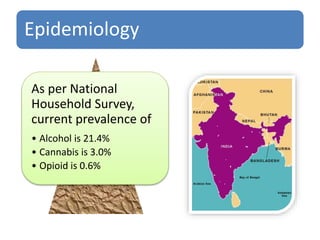
As per National
Household Survey,
current prevalence of
• Alcohol is 21.4%
• Cannabis is 3.0%
• Opioid is 0.6%
What is
addiction?
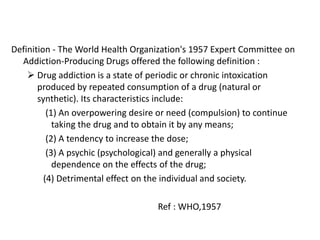
Definition - The World Health Organization's 1957 Expert Committee on
Addiction-Producing Drugs offered the following definition :
 Drug addiction is a state of periodic or chronic intoxication
produced by repeated consumption of a drug (natural or
synthetic). Its characteristics include:
(1) An overpowering desire or need (compulsion) to continue
taking the drug and to obtain it by any means;
(2) A tendency to increase the dose;
(3) A psychic (psychological) and generally a physical
dependence on the effects of the drug;
(4) Detrimental effect on the individual and society.
Ref : WHO,1957
The DSM, both in its revision of the third
edition (DSM–III–R; American Psychiatric
Association [APA] 1987) and in its most recent
edition (DSM– IV; APA 1994 and DSM-IV-TR;
2000), avoids the term addiction, preferring
instead to use the diagnoses of substance
abuse and dependence, collectively referred
to as substance use disorders.
Ref: APA: 1987, 1994, 2000
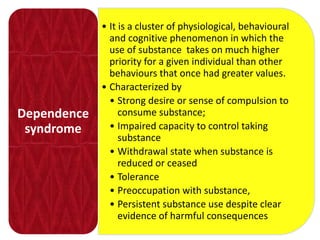
• It is a cluster of physiological, behavioural
and cognitive phenomenon in which the
use of substance takes on much higher
priority for a given individual than other
behaviours that once had greater values.
• Characterized by
• Strong desire or sense of compulsion to
consume substance;
• Impaired capacity to control taking
substance
• Withdrawal state when substance is
reduced or ceased
• Tolerance
• Preoccupation with substance,
• Persistent substance use despite clear
evidence of harmful consequences
Dependence
syndrome
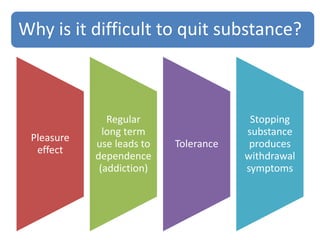
Why is it difficult to quit substance?
Pleasure
effect
Regular
long term
use leads to
dependence
(addiction)
Tolerance
Stopping
substance
produces
withdrawal
symptoms
Causes of substance use
Psychological – substance has calming effect
Stress
Socio-cultural
Environmental - parent (s) alcoholic
Biological – genetic
Psychiatric illnesses
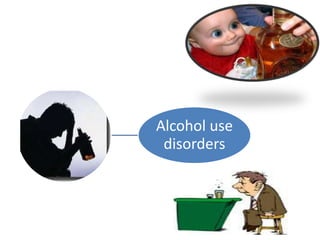
Alcohol use
disorders
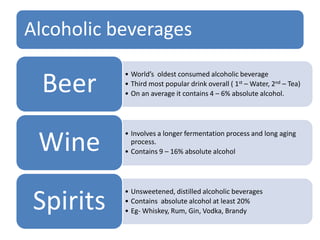
Alcoholic beverages
• World’s oldest consumed alcoholic beverage
• Third most popular drink overall ( 1st – Water, 2nd – Tea)
• On an average it contains 4 – 6% absolute alcohol.Beer
• Involves a longer fermentation process and long aging
process.
• Contains 9 – 16% absolute alcoholWine
• Unsweetened, distilled alcoholic beverages
• Contains absolute alcohol at least 20%
• Eg- Whiskey, Rum, Gin, Vodka, BrandySpirits
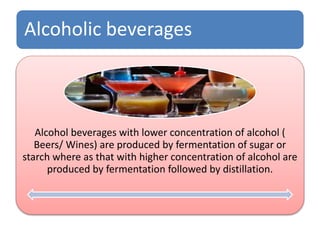
Alcoholic beverages
Alcohol beverages with lower concentration of alcohol (
Beers/ Wines) are produced by fermentation of sugar or
starch where as that with higher concentration of alcohol are
produced by fermentation followed by distillation.
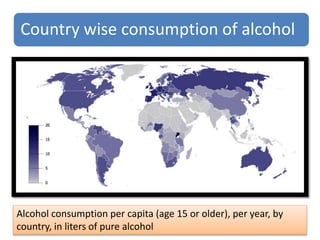
Country wise consumption of alcohol
Alcohol consumption per capita (age 15 or older), per year, by
country, in liters of pure alcohol
Scenario
Alcohol contributes to 1.8 million
deaths each year (worldwide).
In US 22,000 deaths and 2 million
non-fatal injuries each year are due
to alcohol.
In US 90% of population drink
alcohol at sometime during their life.
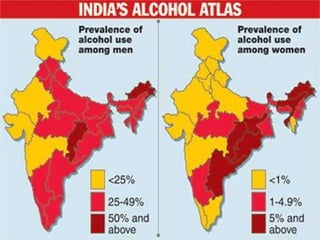
In India the data available
is just tip of the ice berg.
After nicotine, most commonly
psychotropic substance of use in India
• National House Hold Survey (NHS)- Prevalence
in general population (above 15 yrs) 21.4%
(National survey, 2004)
• Drug Abuse Monitoring Survey (DAMS)-
Prevalence in treatment seekers 43.9%
(National survey, 2004)
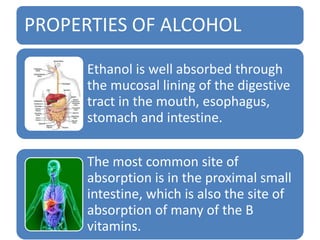
PROPERTIES OF ALCOHOL
Ethanol is well absorbed through
the mucosal lining of the digestive
tract in the mouth, esophagus,
stomach and intestine.
The most common site of
absorption is in the proximal small
intestine, which is also the site of
absorption of many of the B
vitamins.
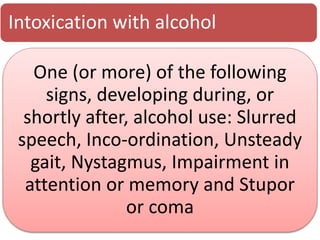
Intoxication with alcohol
One (or more) of the following
signs, developing during, or
shortly after, alcohol use: Slurred
speech, Inco-ordination, Unsteady
gait, Nystagmus, Impairment in
attention or memory and Stupor
or coma
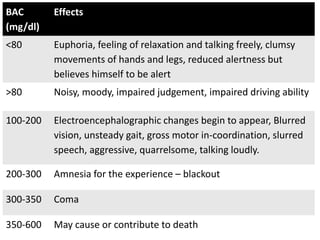
BAC
(mg/dl)
Effects
<80 Euphoria, feeling of relaxation and talking freely, clumsy
movements of hands and legs, reduced alertness but
believes himself to be alert
>80 Noisy, moody, impaired judgement, impaired driving ability
100-200 Electroencephalographic changes begin to appear, Blurred
vision, unsteady gait, gross motor in-coordination, slurred
speech, aggressive, quarrelsome, talking loudly.
200-300 Amnesia for the experience – blackout
300-350 Coma
350-600 May cause or contribute to death
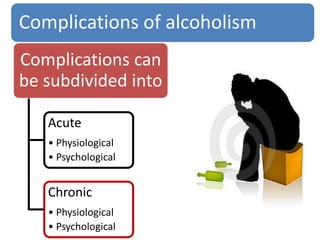
Complications of alcoholism
Complications can
be subdivided into
Acute
• Physiological
• Psychological
Chronic
• Physiological
• Psychological
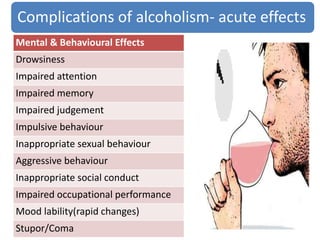
Complications of alcoholism- acute effects
Mental & Behavioural Effects
Drowsiness
Impaired attention
Impaired memory
Impaired judgement
Impulsive behaviour
Inappropriate sexual behaviour
Aggressive behaviour
Inappropriate social conduct
Impaired occupational performance
Mood lability(rapid changes)
Stupor/Coma
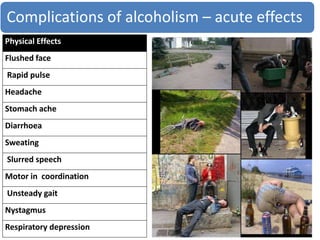
Complications of alcoholism – acute effects
Physical Effects
Flushed face
Rapid pulse
Headache
Stomach ache
Diarrhoea
Sweating
Slurred speech
Motor in coordination
Unsteady gait
Nystagmus
Respiratory depression
Complications of alcoholism- in long term
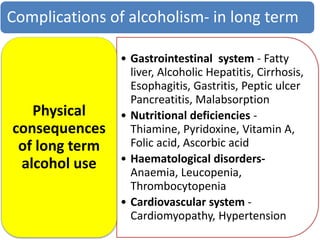
• Gastrointestinal system - Fatty
liver, Alcoholic Hepatitis, Cirrhosis,
Esophagitis, Gastritis, Peptic ulcer
Pancreatitis, Malabsorption
• Nutritional deficiencies -
Thiamine, Pyridoxine, Vitamin A,
Folic acid, Ascorbic acid
• Haematological disorders-
Anaemia, Leucopenia,
Thrombocytopenia
• Cardiovascular system -
Cardiomyopathy, Hypertension
Physical
consequences
of long term
alcohol use
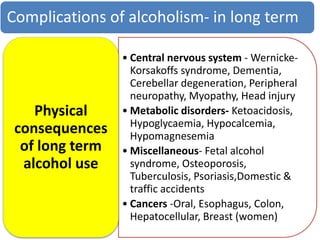
Complications of alcoholism- in long term
• Central nervous system - Wernicke-
Korsakoffs syndrome, Dementia,
Cerebellar degeneration, Peripheral
neuropathy, Myopathy, Head injury
• Metabolic disorders- Ketoacidosis,
Hypoglycaemia, Hypocalcemia,
Hypomagnesemia
• Miscellaneous- Fetal alcohol
syndrome, Osteoporosis,
Tuberculosis, Psoriasis,Domestic &
traffic accidents
• Cancers -Oral, Esophagus, Colon,
Hepatocellular, Breast (women)
Physical
consequences
of long term
alcohol use
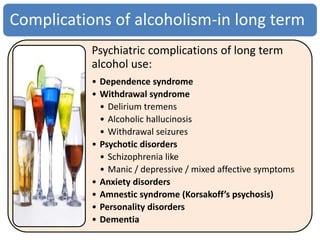
Complications of alcoholism-in long term
Psychiatric complications of long term
alcohol use:
• Dependence syndrome
• Withdrawal syndrome
• Delirium tremens
• Alcoholic hallucinosis
• Withdrawal seizures
• Psychotic disorders
• Schizophrenia like
• Manic / depressive / mixed affective symptoms
• Anxiety disorders
• Amnestic syndrome (Korsakoff’s psychosis)
• Personality disorders
• Dementia
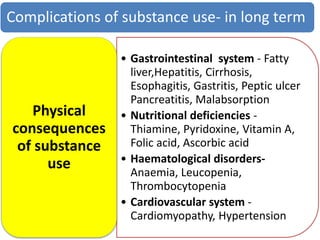
Complications of substance use- in long term
• Gastrointestinal system - Fatty
liver,Hepatitis, Cirrhosis,
Esophagitis, Gastritis, Peptic ulcer
Pancreatitis, Malabsorption
• Nutritional deficiencies -
Thiamine, Pyridoxine, Vitamin A,
Folic acid, Ascorbic acid
• Haematological disorders-
Anaemia, Leucopenia,
Thrombocytopenia
• Cardiovascular system -
Cardiomyopathy, Hypertension
Physical
consequences
of substance
use
Complications of substance use- in long term
• Central nervous system - Wernicke-
Korsakoffs syndrome, Dementia,
Cerebellar degeneration, Peripheral
neuropathy, Myopathy, Head injury
• Metabolic disorders- Ketoacidosis,
Hypoglycaemia, Hypocalcemia,
Hypomagnesemia
• Miscellaneous- Fetal alcohol
syndrome, Osteoporosis,
Tuberculosis, Psoriasis, Domestic &
traffic accidents
• Cancers -Oral, Esophagus, Colon,
Hepatocellular, Breast (women)
Physical
consequences
of substance
use
Complications of substance use
Psychiatric complications of substance use:
• Acute intoxication
• Harmful use
• Dependence syndrome
• Withdrawal syndrome
• Uncomplicated withdrawal (tremor, insomnia, hang
over)
• Complicated withdrawal (Delirium, Alcoholic
hallucinosis, Withdrawal seizures)
• Psychotic disorders
• Schizophrenia like
• Manic / depressive / mixed affective symptoms
• Anxiety disorders
• Amnesic syndrome (Korsakoff’s psychosis)
• Personality disorders
• Dementia
The patients may seek treatment for different
reasons like –
Heavy intake of substance
Dependence
Physical complications due to use of substance
Occupational impairment
Financial crisis
Social crisis
Legal problems
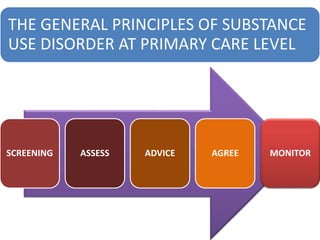
THE GENERAL PRINCIPLES OF SUBSTANCE
USE DISORDER AT PRIMARY CARE LEVEL
SCREENING ASSESS ADVICE AGREE MONITOR
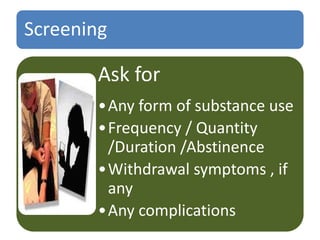
Screening
Ask for
•Any form of substance use
•Frequency / Quantity
/Duration /Abstinence
•Withdrawal symptoms , if
any
•Any complications
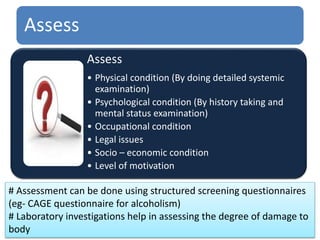
Assess
Assess
• Physical condition (By doing detailed systemic
examination)
• Psychological condition (By history taking and
mental status examination)
• Occupational condition
• Legal issues
• Socio – economic condition
• Level of motivation
# Assessment can be done using structured screening questionnaires
(eg- CAGE questionnaire for alcoholism)
# Laboratory investigations help in assessing the degree of damage to
body
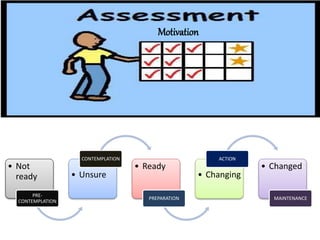
Motivation
• Not
ready
PRE-
CONTEMPLATION
• Unsure
CONTEMPLATION
• Ready
PREPARATION
• Changing
ACTION
• Changed
MAINTENANCE
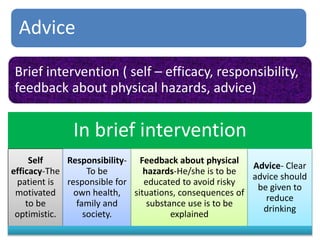
Advice
Brief intervention ( self – efficacy, responsibility,
feedback about physical hazards, advice)
In brief intervention
Self
efficacy-The
patient is
motivated
to be
optimistic.
Responsibility-
To be
responsible for
own health,
family and
society.
Feedback about physical
hazards-He/she is to be
educated to avoid risky
situations, consequences of
substance use is to be
explained
Advice- Clear
advice should
be given to
reduce
drinking
Agree
To convince
(make agree)
the person for
de-addiction
Monitor
Monitor
• For withdrawal symptoms
• During detoxification
• Treatment
Non pharmacological
Management of substance
use disorder is done with
abstinence, motivation of
the patient for quitting
substance and by brief
intervention.
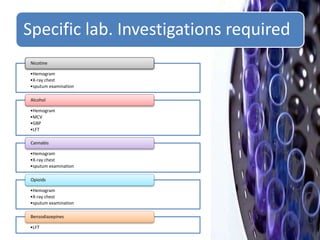
Specific lab. Investigations required
•Hemogram
•X-ray chest
•sputum examination
Nicotine
•Hemogram
•MCV
•GBP
•LFT
Alcohol
•Hemogram
•X-ray chest
•sputum examination
Cannabis
•Hemogram
•X-ray chest
•sputum examination
Opioids
•LFT
Benzodiazepines
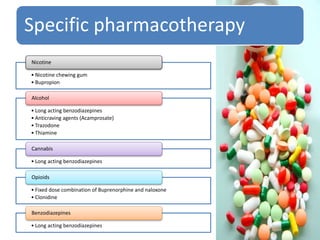
Specific pharmacotherapy
• Nicotine chewing gum
• Bupropion
Nicotine
• Long acting benzodiazepines
• Anticraving agents (Acamprosate)
• Trazodone
• Thiamine
Alcohol
• Long acting benzodiazepines
Cannabis
• Fixed dose combination of Buprenorphine and naloxone
• Clonidine
Opioids
• Long acting benzodiazepines
Benzodiazepines
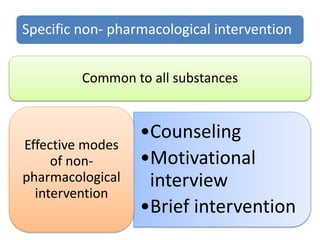
Specific non- pharmacological intervention
Common to all substances
•Counseling
•Motivational
interview
•Brief intervention
Effective modes
of non-
pharmacological
intervention
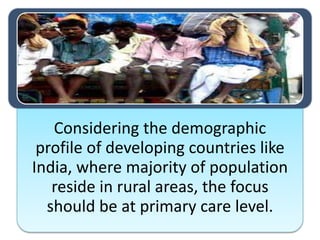
Considering the demographic
profile of developing countries like
India, where majority of population
reside in rural areas, the focus
should be at primary care level.
Pharmacological management is
specific for each substance of
abuse
Alcohol dependence is
managed with
• Supplementation of heavy dose
of thiamine along with vitamins
and nutrients
• Long acting benzodiazepines like
diazepam/ chlorodiazepoxide
• Anticraving agents-Acamprosate
• Trazodone (in low doses)-For
sleep
Delirium,
withdrawal
seizures are
treated with
benzodiazepines.
If status epilepticus
develops then only
antiepileptics are
recommended
along with
benzodiazepines .
Antipsychotics are
recommended for
•Uncontrollable
excitement
•Substance induced
psychosis
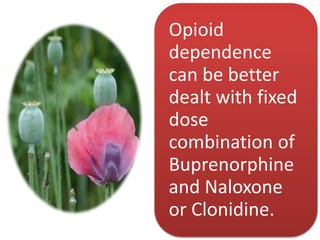
Opioid
dependence
can be better
dealt with fixed
dose
combination of
Buprenorphine
and Naloxone
or Clonidine.
Anxiety due to
substance
withdrawal can be
dealt with long
acting
benzodiazepines
which needs to be
tapered gradually
over time.
Sleep disturbances
associated with
substance use can
be treated with
low doses of
trazodone (50 -
200mg) or
benzodiazepines.
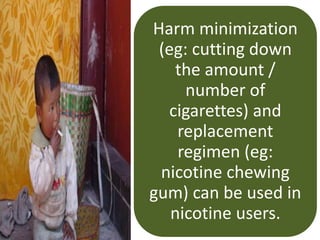
Harm minimization
(eg: cutting down
the amount /
number of
cigarettes) and
replacement
regimen (eg:
nicotine chewing
gum) can be used in
nicotine users.
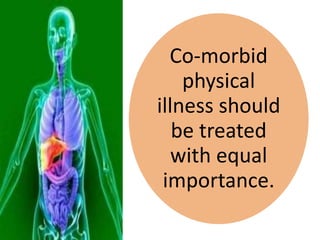
Co-morbid
physical
illness should
be treated
with equal
importance.

Substance use disorder

  • 1.
  • 3.
    Substance use disorders haveworld wide distribution. It affects both gender and all races. Pattern and type of substance use depends on several factors.
  • 4.
    Epidemiology As per National HouseholdSurvey, current prevalence of • Alcohol is 21.4% • Cannabis is 3.0% • Opioid is 0.6%
  • 5.
  • 6.
    Definition - TheWorld Health Organization's 1957 Expert Committee on Addiction-Producing Drugs offered the following definition :  Drug addiction is a state of periodic or chronic intoxication produced by repeated consumption of a drug (natural or synthetic). Its characteristics include: (1) An overpowering desire or need (compulsion) to continue taking the drug and to obtain it by any means; (2) A tendency to increase the dose; (3) A psychic (psychological) and generally a physical dependence on the effects of the drug; (4) Detrimental effect on the individual and society. Ref : WHO,1957
  • 7.
    The DSM, bothin its revision of the third edition (DSM–III–R; American Psychiatric Association [APA] 1987) and in its most recent edition (DSM– IV; APA 1994 and DSM-IV-TR; 2000), avoids the term addiction, preferring instead to use the diagnoses of substance abuse and dependence, collectively referred to as substance use disorders. Ref: APA: 1987, 1994, 2000
  • 8.
    • It isa cluster of physiological, behavioural and cognitive phenomenon in which the use of substance takes on much higher priority for a given individual than other behaviours that once had greater values. • Characterized by • Strong desire or sense of compulsion to consume substance; • Impaired capacity to control taking substance • Withdrawal state when substance is reduced or ceased • Tolerance • Preoccupation with substance, • Persistent substance use despite clear evidence of harmful consequences Dependence syndrome
  • 9.
    Why is itdifficult to quit substance? Pleasure effect Regular long term use leads to dependence (addiction) Tolerance Stopping substance produces withdrawal symptoms
  • 10.
    Causes of substanceuse Psychological – substance has calming effect Stress Socio-cultural Environmental - parent (s) alcoholic Biological – genetic Psychiatric illnesses
  • 12.
  • 13.
    Alcoholic beverages • World’soldest consumed alcoholic beverage • Third most popular drink overall ( 1st – Water, 2nd – Tea) • On an average it contains 4 – 6% absolute alcohol.Beer • Involves a longer fermentation process and long aging process. • Contains 9 – 16% absolute alcoholWine • Unsweetened, distilled alcoholic beverages • Contains absolute alcohol at least 20% • Eg- Whiskey, Rum, Gin, Vodka, BrandySpirits
  • 14.
    Alcoholic beverages Alcohol beverageswith lower concentration of alcohol ( Beers/ Wines) are produced by fermentation of sugar or starch where as that with higher concentration of alcohol are produced by fermentation followed by distillation.
  • 15.
    Country wise consumptionof alcohol Alcohol consumption per capita (age 15 or older), per year, by country, in liters of pure alcohol
  • 16.
    Scenario Alcohol contributes to1.8 million deaths each year (worldwide). In US 22,000 deaths and 2 million non-fatal injuries each year are due to alcohol. In US 90% of population drink alcohol at sometime during their life.
  • 17.
    In India thedata available is just tip of the ice berg. After nicotine, most commonly psychotropic substance of use in India • National House Hold Survey (NHS)- Prevalence in general population (above 15 yrs) 21.4% (National survey, 2004) • Drug Abuse Monitoring Survey (DAMS)- Prevalence in treatment seekers 43.9% (National survey, 2004)
  • 19.
    PROPERTIES OF ALCOHOL Ethanolis well absorbed through the mucosal lining of the digestive tract in the mouth, esophagus, stomach and intestine. The most common site of absorption is in the proximal small intestine, which is also the site of absorption of many of the B vitamins.
  • 20.
    Intoxication with alcohol One(or more) of the following signs, developing during, or shortly after, alcohol use: Slurred speech, Inco-ordination, Unsteady gait, Nystagmus, Impairment in attention or memory and Stupor or coma
  • 21.
    BAC (mg/dl) Effects <80 Euphoria, feelingof relaxation and talking freely, clumsy movements of hands and legs, reduced alertness but believes himself to be alert >80 Noisy, moody, impaired judgement, impaired driving ability 100-200 Electroencephalographic changes begin to appear, Blurred vision, unsteady gait, gross motor in-coordination, slurred speech, aggressive, quarrelsome, talking loudly. 200-300 Amnesia for the experience – blackout 300-350 Coma 350-600 May cause or contribute to death
  • 22.
  • 23.
    Complications of alcoholism Complicationscan be subdivided into Acute • Physiological • Psychological Chronic • Physiological • Psychological
  • 24.
    Complications of alcoholism-acute effects Mental & Behavioural Effects Drowsiness Impaired attention Impaired memory Impaired judgement Impulsive behaviour Inappropriate sexual behaviour Aggressive behaviour Inappropriate social conduct Impaired occupational performance Mood lability(rapid changes) Stupor/Coma
  • 25.
    Complications of alcoholism– acute effects Physical Effects Flushed face Rapid pulse Headache Stomach ache Diarrhoea Sweating Slurred speech Motor in coordination Unsteady gait Nystagmus Respiratory depression
  • 26.
    Complications of alcoholism-in long term • Gastrointestinal system - Fatty liver, Alcoholic Hepatitis, Cirrhosis, Esophagitis, Gastritis, Peptic ulcer Pancreatitis, Malabsorption • Nutritional deficiencies - Thiamine, Pyridoxine, Vitamin A, Folic acid, Ascorbic acid • Haematological disorders- Anaemia, Leucopenia, Thrombocytopenia • Cardiovascular system - Cardiomyopathy, Hypertension Physical consequences of long term alcohol use
  • 27.
    Complications of alcoholism-in long term • Central nervous system - Wernicke- Korsakoffs syndrome, Dementia, Cerebellar degeneration, Peripheral neuropathy, Myopathy, Head injury • Metabolic disorders- Ketoacidosis, Hypoglycaemia, Hypocalcemia, Hypomagnesemia • Miscellaneous- Fetal alcohol syndrome, Osteoporosis, Tuberculosis, Psoriasis,Domestic & traffic accidents • Cancers -Oral, Esophagus, Colon, Hepatocellular, Breast (women) Physical consequences of long term alcohol use
  • 28.
    Complications of alcoholism-inlong term Psychiatric complications of long term alcohol use: • Dependence syndrome • Withdrawal syndrome • Delirium tremens • Alcoholic hallucinosis • Withdrawal seizures • Psychotic disorders • Schizophrenia like • Manic / depressive / mixed affective symptoms • Anxiety disorders • Amnestic syndrome (Korsakoff’s psychosis) • Personality disorders • Dementia
  • 29.
    Complications of substanceuse- in long term • Gastrointestinal system - Fatty liver,Hepatitis, Cirrhosis, Esophagitis, Gastritis, Peptic ulcer Pancreatitis, Malabsorption • Nutritional deficiencies - Thiamine, Pyridoxine, Vitamin A, Folic acid, Ascorbic acid • Haematological disorders- Anaemia, Leucopenia, Thrombocytopenia • Cardiovascular system - Cardiomyopathy, Hypertension Physical consequences of substance use
  • 30.
    Complications of substanceuse- in long term • Central nervous system - Wernicke- Korsakoffs syndrome, Dementia, Cerebellar degeneration, Peripheral neuropathy, Myopathy, Head injury • Metabolic disorders- Ketoacidosis, Hypoglycaemia, Hypocalcemia, Hypomagnesemia • Miscellaneous- Fetal alcohol syndrome, Osteoporosis, Tuberculosis, Psoriasis, Domestic & traffic accidents • Cancers -Oral, Esophagus, Colon, Hepatocellular, Breast (women) Physical consequences of substance use
  • 31.
    Complications of substanceuse Psychiatric complications of substance use: • Acute intoxication • Harmful use • Dependence syndrome • Withdrawal syndrome • Uncomplicated withdrawal (tremor, insomnia, hang over) • Complicated withdrawal (Delirium, Alcoholic hallucinosis, Withdrawal seizures) • Psychotic disorders • Schizophrenia like • Manic / depressive / mixed affective symptoms • Anxiety disorders • Amnesic syndrome (Korsakoff’s psychosis) • Personality disorders • Dementia
  • 32.
    The patients mayseek treatment for different reasons like – Heavy intake of substance Dependence Physical complications due to use of substance Occupational impairment Financial crisis Social crisis Legal problems
  • 34.
    THE GENERAL PRINCIPLESOF SUBSTANCE USE DISORDER AT PRIMARY CARE LEVEL SCREENING ASSESS ADVICE AGREE MONITOR
  • 35.
    Screening Ask for •Any formof substance use •Frequency / Quantity /Duration /Abstinence •Withdrawal symptoms , if any •Any complications
  • 36.
    Assess Assess • Physical condition(By doing detailed systemic examination) • Psychological condition (By history taking and mental status examination) • Occupational condition • Legal issues • Socio – economic condition • Level of motivation # Assessment can be done using structured screening questionnaires (eg- CAGE questionnaire for alcoholism) # Laboratory investigations help in assessing the degree of damage to body
  • 37.
    Motivation • Not ready PRE- CONTEMPLATION • Unsure CONTEMPLATION •Ready PREPARATION • Changing ACTION • Changed MAINTENANCE
  • 38.
    Advice Brief intervention (self – efficacy, responsibility, feedback about physical hazards, advice) In brief intervention Self efficacy-The patient is motivated to be optimistic. Responsibility- To be responsible for own health, family and society. Feedback about physical hazards-He/she is to be educated to avoid risky situations, consequences of substance use is to be explained Advice- Clear advice should be given to reduce drinking
  • 39.
    Agree To convince (make agree) theperson for de-addiction
  • 40.
    Monitor Monitor • For withdrawalsymptoms • During detoxification • Treatment
  • 42.
    Non pharmacological Management ofsubstance use disorder is done with abstinence, motivation of the patient for quitting substance and by brief intervention.
  • 43.
    Specific lab. Investigationsrequired •Hemogram •X-ray chest •sputum examination Nicotine •Hemogram •MCV •GBP •LFT Alcohol •Hemogram •X-ray chest •sputum examination Cannabis •Hemogram •X-ray chest •sputum examination Opioids •LFT Benzodiazepines
  • 44.
    Specific pharmacotherapy • Nicotinechewing gum • Bupropion Nicotine • Long acting benzodiazepines • Anticraving agents (Acamprosate) • Trazodone • Thiamine Alcohol • Long acting benzodiazepines Cannabis • Fixed dose combination of Buprenorphine and naloxone • Clonidine Opioids • Long acting benzodiazepines Benzodiazepines
  • 45.
    Specific non- pharmacologicalintervention Common to all substances •Counseling •Motivational interview •Brief intervention Effective modes of non- pharmacological intervention
  • 47.
    Considering the demographic profileof developing countries like India, where majority of population reside in rural areas, the focus should be at primary care level.
  • 48.
    Pharmacological management is specificfor each substance of abuse
  • 49.
    Alcohol dependence is managedwith • Supplementation of heavy dose of thiamine along with vitamins and nutrients • Long acting benzodiazepines like diazepam/ chlorodiazepoxide • Anticraving agents-Acamprosate • Trazodone (in low doses)-For sleep
  • 50.
    Delirium, withdrawal seizures are treated with benzodiazepines. Ifstatus epilepticus develops then only antiepileptics are recommended along with benzodiazepines .
  • 51.
  • 52.
    Opioid dependence can be better dealtwith fixed dose combination of Buprenorphine and Naloxone or Clonidine.
  • 53.
    Anxiety due to substance withdrawalcan be dealt with long acting benzodiazepines which needs to be tapered gradually over time.
  • 54.
    Sleep disturbances associated with substanceuse can be treated with low doses of trazodone (50 - 200mg) or benzodiazepines.
  • 55.
    Harm minimization (eg: cuttingdown the amount / number of cigarettes) and replacement regimen (eg: nicotine chewing gum) can be used in nicotine users.
  • 56.