Covered by: Arwa H. Al-Onayzan.
Depressive
disorders
• Depressive disorders:
• Are characterized by sadness severe enough or persistent enough to
interfere with function and often by decreased interest or pleasure
in activities.
• Classification according to DSM-5 by specific symptoms:
• Major depressive disorder (often called major depression).
• Persistent depressive disorder (dysthymia).
• Other specified or unspecified depressive disorder.
• Others are classified by etiology:
• Premenstrual dysphoric disorder.
• Depressive disorder due to another medical condition.
• Substance/medication-induced depressive disorder.
• Heredity accounts for about half of the etiology. Thus, depression is more
common among 1st-degree relatives of depressed patients.
• Other theories focus on changes in neurotransmitter levels, including
abnormal regulation of cholinergic, catecholaminergic (noradrenergic or
dopaminergic), and serotonergic (5-hydroxytryptamine) neurotransmission.
• Psychosocial factors also seem to be involved. Major life stresses, especially
separations and losses.
• Depressive symptoms or disorders may accompany various physical disorders,
including thyroid disorders, adrenal gland disorders, benign and malignant
brain tumors, stroke, AIDS, Parkinson disease, and MS.
• Certain drugs, such as corticosteroids, some beta-blockers, interferon,
and reserpine, can also result in depressive disorders. Also, drug abuse.
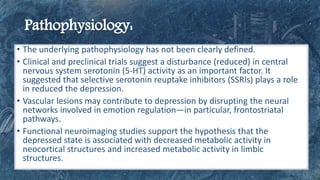
• The underlying pathophysiology has not been clearly defined.
• Clinical and preclinical trials suggest a disturbance (reduced) in central
nervous system serotonin (5-HT) activity as an important factor. It
suggested that selective serotonin reuptake inhibitors (SSRIs) plays a role
in reduced the depression.
• Vascular lesions may contribute to depression by disrupting the neural
networks involved in emotion regulation—in particular, frontostriatal
pathways.
• Functional neuroimaging studies support the hypothesis that the
depressed state is associated with decreased metabolic activity in
neocortical structures and increased metabolic activity in limbic
structures.
• Clinical criteria (DSM-5)  See previous slide.
• CBC, electrolytes, and TSH, vitamin B12, and folate levels to rule out
physical disorders that can cause depression.
• Several brief questionnaires are available for screening. They help
elicit some depressive symptoms but cannot be used alone for
diagnosis.
I. Support (a physician need to see patients weekly or biweekly to provide
support and education- doctor should encourage patients to gradually
increase simple activities (eg, taking walks, exercising regularly).
II. Psychotherapy (particularly cognitive-behavioral therapy and
interpersonal therapy, is effective, both to treat acute symptoms and to
decrease the likelihood of relapse).
III. Drugs (SSRIs, Serotonin modulators (5-HT2 blockers), Serotonin-
norepinephrine reuptake inhibitors, Norepinephrine-
dopamine reuptake inhibitor, Heterocyclic antidepressants, Monoamine
oxidase inhibitors (MAOIs)). Best choice is SSRI  has less side effects.
IV. Electroconvulsive therapy (ECT)  used if drug not affected.
• Major depressive disorder has significant potential morbidity and
mortality, contributing as it does to suicide.
• With appropriate treatment, 70-80% of individuals with major
depressive disorder can achieve a significant reduction in symptoms,
although as many as 50% of patients may not respond to the initial
treatment trial.
• Pretreatment irritability and psychotic symptoms may be associated
with poorer outcomes.
• Merk manual (nineteenth edition, page 1538-1548).
• Medscape:
• http://emedicine.medscape.com/article/286759-overview#a7
• Goegle images.
Depressive disorder (Depression Made Easy!)

Depressive disorder (Depression Made Easy!)

  • 1.
    Covered by: ArwaH. Al-Onayzan.
  • 2.
  • 3.
    • Depressive disorders: •Are characterized by sadness severe enough or persistent enough to interfere with function and often by decreased interest or pleasure in activities.
  • 4.
    • Classification accordingto DSM-5 by specific symptoms: • Major depressive disorder (often called major depression). • Persistent depressive disorder (dysthymia). • Other specified or unspecified depressive disorder. • Others are classified by etiology: • Premenstrual dysphoric disorder. • Depressive disorder due to another medical condition. • Substance/medication-induced depressive disorder.
  • 5.
    • Heredity accountsfor about half of the etiology. Thus, depression is more common among 1st-degree relatives of depressed patients. • Other theories focus on changes in neurotransmitter levels, including abnormal regulation of cholinergic, catecholaminergic (noradrenergic or dopaminergic), and serotonergic (5-hydroxytryptamine) neurotransmission. • Psychosocial factors also seem to be involved. Major life stresses, especially separations and losses. • Depressive symptoms or disorders may accompany various physical disorders, including thyroid disorders, adrenal gland disorders, benign and malignant brain tumors, stroke, AIDS, Parkinson disease, and MS. • Certain drugs, such as corticosteroids, some beta-blockers, interferon, and reserpine, can also result in depressive disorders. Also, drug abuse.
  • 6.
    • The underlyingpathophysiology has not been clearly defined. • Clinical and preclinical trials suggest a disturbance (reduced) in central nervous system serotonin (5-HT) activity as an important factor. It suggested that selective serotonin reuptake inhibitors (SSRIs) plays a role in reduced the depression. • Vascular lesions may contribute to depression by disrupting the neural networks involved in emotion regulation—in particular, frontostriatal pathways. • Functional neuroimaging studies support the hypothesis that the depressed state is associated with decreased metabolic activity in neocortical structures and increased metabolic activity in limbic structures.
  • 8.
    • Clinical criteria(DSM-5)  See previous slide. • CBC, electrolytes, and TSH, vitamin B12, and folate levels to rule out physical disorders that can cause depression. • Several brief questionnaires are available for screening. They help elicit some depressive symptoms but cannot be used alone for diagnosis.
  • 9.
    I. Support (aphysician need to see patients weekly or biweekly to provide support and education- doctor should encourage patients to gradually increase simple activities (eg, taking walks, exercising regularly). II. Psychotherapy (particularly cognitive-behavioral therapy and interpersonal therapy, is effective, both to treat acute symptoms and to decrease the likelihood of relapse). III. Drugs (SSRIs, Serotonin modulators (5-HT2 blockers), Serotonin- norepinephrine reuptake inhibitors, Norepinephrine- dopamine reuptake inhibitor, Heterocyclic antidepressants, Monoamine oxidase inhibitors (MAOIs)). Best choice is SSRI  has less side effects. IV. Electroconvulsive therapy (ECT)  used if drug not affected.
  • 10.
    • Major depressivedisorder has significant potential morbidity and mortality, contributing as it does to suicide. • With appropriate treatment, 70-80% of individuals with major depressive disorder can achieve a significant reduction in symptoms, although as many as 50% of patients may not respond to the initial treatment trial. • Pretreatment irritability and psychotic symptoms may be associated with poorer outcomes.
  • 12.
    • Merk manual(nineteenth edition, page 1538-1548). • Medscape: • http://emedicine.medscape.com/article/286759-overview#a7 • Goegle images.