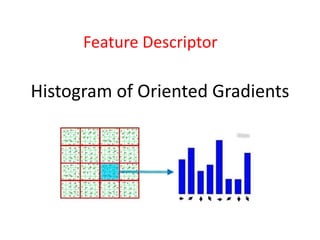
Histogram of Oriented Gradients
Feature Descriptor
Feature Descriptor
• A feature descriptor is a representation of an image or an
image patch that simplifies the image by extracting useful
information and throwing away extraneous information.
• Histogram of oriented gradients (HOG) is a feature
descriptor used to detect objects in computer vision and
image processing. The HOG descriptor technique counts
occurrences of gradient orientation in localized portions of
an image - detection window, or region of interest (ROI).
• Essentially represents a distribution of intensity
fluctuations along different orientations (directions)
Histogram of Oriented Gradients
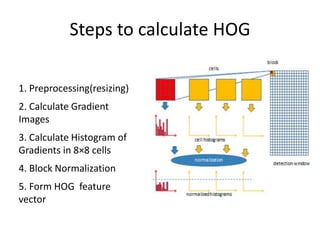
Steps to calculate HOG
1. Preprocessing(resizing)
2. Calculate Gradient
Images
3. Calculate Histogram of
Gradients in 8×8 cells
4. Block Normalization
5. Form HOG feature
vector
Pre-Processing
• Patches being analyzed should have a fixed aspect ratio.
For example, they can be 100×200, 128×256, or 1000×2000 but not 101×205.
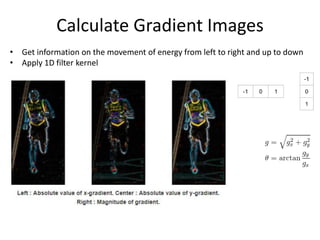
Calculate Gradient Images
• Get information on the movement of energy from left to right and up to down
• Apply 1D filter kernel
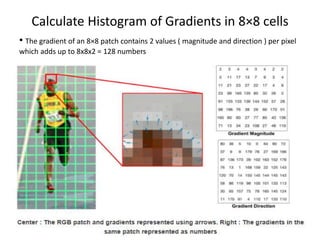
Calculate Histogram of Gradients in 8×8 cells
• The gradient of an 8×8 patch contains 2 values ( magnitude and direction ) per pixel
which adds up to 8x8x2 = 128 numbers
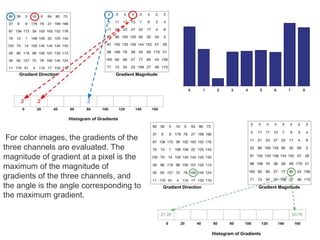
For color images, the gradients of the
three channels are evaluated. The
magnitude of gradient at a pixel is the
maximum of the magnitude of
gradients of the three channels, and
the angle is the angle corresponding to
the maximum gradient.
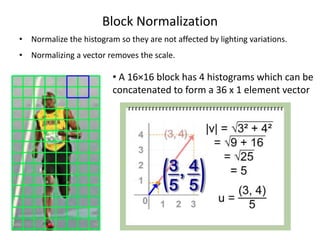
Block Normalization
• Normalize the histogram so they are not affected by lighting variations.
• Normalizing a vector removes the scale.
• A 16×16 block has 4 histograms which can be
concatenated to form a 36 x 1 element vector
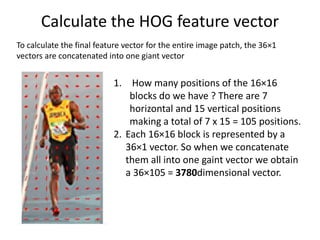
Calculate the HOG feature vector
To calculate the final feature vector for the entire image patch, the 36×1
vectors are concatenated into one giant vector
1. How many positions of the 16×16
blocks do we have ? There are 7
horizontal and 15 vertical positions
making a total of 7 x 15 = 105 positions.
2. Each 16×16 block is represented by a
36×1 vector. So when we concatenate
them all into one gaint vector we obtain
a 36×105 = 3780dimensional vector.

Hog

  • 1.
    Histogram of OrientedGradients Feature Descriptor
  • 2.
    Feature Descriptor • Afeature descriptor is a representation of an image or an image patch that simplifies the image by extracting useful information and throwing away extraneous information. • Histogram of oriented gradients (HOG) is a feature descriptor used to detect objects in computer vision and image processing. The HOG descriptor technique counts occurrences of gradient orientation in localized portions of an image - detection window, or region of interest (ROI). • Essentially represents a distribution of intensity fluctuations along different orientations (directions) Histogram of Oriented Gradients
  • 3.
    Steps to calculateHOG 1. Preprocessing(resizing) 2. Calculate Gradient Images 3. Calculate Histogram of Gradients in 8×8 cells 4. Block Normalization 5. Form HOG feature vector
  • 4.
    Pre-Processing • Patches beinganalyzed should have a fixed aspect ratio. For example, they can be 100×200, 128×256, or 1000×2000 but not 101×205.
  • 5.
    Calculate Gradient Images •Get information on the movement of energy from left to right and up to down • Apply 1D filter kernel
  • 6.
    Calculate Histogram ofGradients in 8×8 cells • The gradient of an 8×8 patch contains 2 values ( magnitude and direction ) per pixel which adds up to 8x8x2 = 128 numbers
  • 7.
    For color images,the gradients of the three channels are evaluated. The magnitude of gradient at a pixel is the maximum of the magnitude of gradients of the three channels, and the angle is the angle corresponding to the maximum gradient.
  • 8.
    Block Normalization • Normalizethe histogram so they are not affected by lighting variations. • Normalizing a vector removes the scale. • A 16×16 block has 4 histograms which can be concatenated to form a 36 x 1 element vector
  • 9.
    Calculate the HOGfeature vector To calculate the final feature vector for the entire image patch, the 36×1 vectors are concatenated into one giant vector 1. How many positions of the 16×16 blocks do we have ? There are 7 horizontal and 15 vertical positions making a total of 7 x 15 = 105 positions. 2. Each 16×16 block is represented by a 36×1 vector. So when we concatenate them all into one gaint vector we obtain a 36×105 = 3780dimensional vector.