Chapter 10:
Image Segmentation
Digital Image Processing
2
Preview
 Segmentation is to subdivide an image
into its component regions or objects.
 Segmentation should stop when the
objects of interest in an application have
been isolated.
3
Principal approaches
 Segmentation algorithms generally are
based on one of 2 basis properties of
intensity values
 discontinuity : to partition an image based
on sharp changes in intensity (such as edges)
 similarity : to partition an image into
regions that are similar according to a set
of predefined criteria.
4
Detection of Discontinuities
 detect the three basic types of gray-
level discontinuities
 points , lines , edges
 the common way is to run a mask through
the image
5
Point Detection
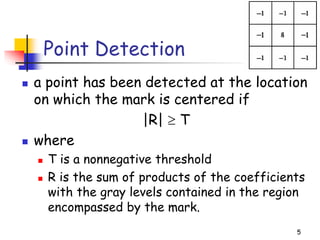
 a point has been detected at the location
on which the mark is centered if
|R|  T
 where
 T is a nonnegative threshold
 R is the sum of products of the coefficients
with the gray levels contained in the region
encompassed by the mark.
6
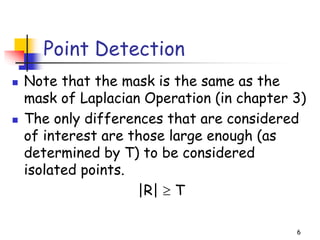
Point Detection
 Note that the mask is the same as the
mask of Laplacian Operation (in chapter 3)
 The only differences that are considered
of interest are those large enough (as
determined by T) to be considered
isolated points.
|R|  T
Example
7
8
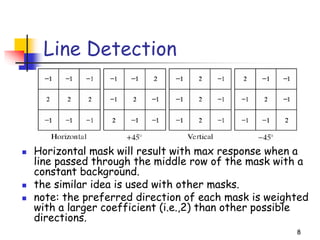
Line Detection
 Horizontal mask will result with max response when a
line passed through the middle row of the mask with a
constant background.
 the similar idea is used with other masks.
 note: the preferred direction of each mask is weighted
with a larger coefficient (i.e.,2) than other possible
directions.
9
Line Detection
 Apply every masks on the image
 let R1, R2, R3, R4 denotes the response of
the horizontal, +45 degree, vertical and -
45 degree masks, respectively.
 if, at a certain point in the image
|Ri| > |Rj|,
 for all ji, that point is said to be more
likely associated with a line in the
direction of mask i.
10
Line Detection
 Alternatively, if we are interested in
detecting all lines in an image in the
direction defined by a given mask, we
simply run the mask through the image and
threshold the absolute value of the result.
 The points that are left are the strongest
responses, which, for lines one pixel thick,
correspond closest to the direction
defined by the mask.
11
Example
12
Edge Detection
 we discussed approaches for implementing
 first-order derivative (Gradient operator)
 second-order derivative (Laplacian operator)
 Here, we will talk only about their properties for
edge detection.
 we have introduced both derivatives in chapter 3
13
Ideal and Ramp Edges
because of optics,
sampling, image
acquisition
imperfection
14
Thick edge
 The slope of the ramp is inversely proportional to the
degree of blurring in the edge.
 We no longer have a thin (one pixel thick) path.
 Instead, an edge point now is any point contained in the
ramp, and an edge would then be a set of such points
that are connected.
 The thickness is determined by the length of the ramp.
 The length is determined by the slope, which is in turn
determined by the degree of blurring.
 Blurred edges tend to be thick and sharp edges
tend to be thin
15
First and Second derivatives
the signs of the derivatives
would be reversed for an edge
that transitions from light to
dark
16
Second derivatives
 produces 2 values for every edge in an
image (an undesirable feature)
 an imaginary straight line joining the
extreme positive and negative values of
the second derivative would cross zero
near the midpoint of the edge. (zero-
crossing property)
17
Zero-crossing
 quite useful for locating the centers of
thick edges
 we will talk about it again later
18
Noise Images
 First column: images and
gray-level profiles of a
ramp edge corrupted by
random Gaussian noise of
mean 0 and  = 0.0, 0.1,
1.0 and 10.0,
respectively.
 Second column: first-
derivative images and
gray-level profiles.
 Third column : second-
derivative images and
gray-level profiles.
19
Keep in mind
 fairly little noise can have such a
significant impact on the two key
derivatives used for edge detection in
images
 image smoothing should be serious
consideration prior to the use of
derivatives in applications where noise is
likely to be present.
20
Edge point
 to determine a point as an edge point
 the transition in grey level associated with
the point has to be significantly stronger
than the background at that point.
 use threshold to determine whether a value
is “significant” or not.
 the point’s two-dimensional first-order
derivative must be greater than a specified
threshold.
21
Gradient Operator
 first derivatives are implemented using
the magnitude of the gradient.























y
f
x
f
G
G
y
x
f
2
1
2
2
2
1
2
2
]
[
)
f
(

































y
f
x
f
G
G
mag
f y
x
the magnitude becomes nonlinear
y
x G
G
f 


commonly approx.
22
Gradient Masks
23
Diagonal edges with Prewitt
and Sobel masks
24
Example
25
Example
26
Example
27
Laplacian
2
2
2
2
2 )
,
(
)
,
(
y
y
x
f
x
y
x
f
f







(linear operator)
Laplacian operator
)]
,
(
4
)
1
,
(
)
1
,
(
)
,
1
(
)
,
1
(
[
2
y
x
f
y
x
f
y
x
f
y
x
f
y
x
f
f










28
Laplacian of Gaussian
 Laplacian combined with smoothing to
find edges via zero-crossing.
2
2
2
)
( 
r
e
r
h



where r2 = x2+y2, and
 is the standard deviation
2
2
2
4
2
2
2
)
( 


r
e
r
r
h






 



29
Mexican hat
the coefficient must be sum to zero
positive central term
surrounded by an adjacent negative region (a function of distance)
zero outer region
30
Linear Operation
 second derivation is a linear operation
 thus, 2f is the same as convolving the
image with Gaussian smoothing function
first and then computing the Laplacian of
the result
31
Example
a). Original image
b). Sobel Gradient
c). Spatial Gaussian
smoothing function
d). Laplacian mask
e). LoG
f). Threshold LoG
g). Zero crossing
32
Zero crossing & LoG
 Approximate the zero crossing from LoG
image
 to threshold the LoG image by setting all
its positive values to white and all
negative values to black.
 the zero crossing occur between positive
and negative values of the thresholded
LoG.
33
Thresholding
image with dark
background and
a light object
image with dark
background and
two light objects
34
Multilevel thresholding
 a point (x,y) belongs to
 to an object class if T1 < f(x,y)  T2
 to another object class if f(x,y) > T2
 to background if f(x,y)  T1
 T depends on
 only f(x,y) : only on gray-level values  Global
threshold
 both f(x,y) and p(x,y) : on gray-level values and its
neighbors  Local threshold
35
The Role of Illumination
f(x,y) = i(x,y) r(x,y)
a). computer generated
reflectance function
b). histogram of
reflectance function
c). computer generated
illumination function
(poor)
d). product of a). and c).
e). histogram of product
image
easily use global thresholding
object and background are separated
difficult to segment
36
Basic Global Thresholding
generate binary image
use T midway
between the max
and min gray levels
37
Basic Global Thresholding
 based on visual inspection of histogram
1. Select an initial estimate for T.
2. Segment the image using T. This will produce two
groups of pixels: G1 consisting of all pixels with gray
level values > T and G2 consisting of pixels with gray
level values  T
3. Compute the average gray level values 1 and 2 for
the pixels in regions G1 and G2
4. Compute a new threshold value
5. T = 0.5 (1 + 2)
6. Repeat steps 2 through 4 until the difference in T in
successive iterations is smaller than a predefined
parameter To.
38
Example: Heuristic method
note: the clear valley
of the histogram and
the effective of the
segmentation
between object and
background
T0 = 0
3 iterations
with result T = 125
39
Basic Adaptive Thresholding
 subdivide original image into small areas.
 utilize a different threshold to segment
each subimages.
 since the threshold used for each pixel
depends on the location of the pixel in
terms of the subimages, this type of
thresholding is adaptive.
40
Example : Adaptive Thresholding
41
Further subdivision
a). Properly and improperly
segmented subimages from previous
example
b)-c). corresponding histograms
d). further subdivision of the
improperly segmented subimage.
e). histogram of small subimage at
top
f). result of adaptively segmenting d).
42
Boundary Characteristic for
Histogram Improvement and Local
Thresholding
 Gradient gives an indication of whether a pixel is on an edge
 Laplacian can yield information regarding whether a given
pixel lies on the dark or light side of the edge
 all pixels that are not on an edge are labeled 0
 all pixels that are on the dark side of an edge are labeled +
 all pixels that are on the light side an edge are labeled -
0
and
if
0
and
if
if
0
)
,
(
2
2


















f
T
f
f
T
f
T
f
y
x
s
light object of dark background
43
Example
44
Region-Based Segmentation
- Region Growing
 start with a set of “seed” points
 growing by appending to each seed those
neighbors that have similar properties
such as specific ranges of gray level
45
Region Growing
select all seed points with gray level 255
criteria:
1. the absolute gray-
level difference
between any pixel
and the seed has to
be less than 65
2. the pixel has to be
8-connected to at
least one pixel in
that region (if more,
the regions are
merged)

Chapter10_Segmentation.ppt

  • 1.
  • 2.
    2 Preview  Segmentation isto subdivide an image into its component regions or objects.  Segmentation should stop when the objects of interest in an application have been isolated.
  • 3.
    3 Principal approaches  Segmentationalgorithms generally are based on one of 2 basis properties of intensity values  discontinuity : to partition an image based on sharp changes in intensity (such as edges)  similarity : to partition an image into regions that are similar according to a set of predefined criteria.
  • 4.
    4 Detection of Discontinuities detect the three basic types of gray- level discontinuities  points , lines , edges  the common way is to run a mask through the image
  • 5.
    5 Point Detection  apoint has been detected at the location on which the mark is centered if |R|  T  where  T is a nonnegative threshold  R is the sum of products of the coefficients with the gray levels contained in the region encompassed by the mark.
  • 6.
    6 Point Detection  Notethat the mask is the same as the mask of Laplacian Operation (in chapter 3)  The only differences that are considered of interest are those large enough (as determined by T) to be considered isolated points. |R|  T
  • 7.
  • 8.
    8 Line Detection  Horizontalmask will result with max response when a line passed through the middle row of the mask with a constant background.  the similar idea is used with other masks.  note: the preferred direction of each mask is weighted with a larger coefficient (i.e.,2) than other possible directions.
  • 9.
    9 Line Detection  Applyevery masks on the image  let R1, R2, R3, R4 denotes the response of the horizontal, +45 degree, vertical and - 45 degree masks, respectively.  if, at a certain point in the image |Ri| > |Rj|,  for all ji, that point is said to be more likely associated with a line in the direction of mask i.
  • 10.
    10 Line Detection  Alternatively,if we are interested in detecting all lines in an image in the direction defined by a given mask, we simply run the mask through the image and threshold the absolute value of the result.  The points that are left are the strongest responses, which, for lines one pixel thick, correspond closest to the direction defined by the mask.
  • 11.
  • 12.
    12 Edge Detection  wediscussed approaches for implementing  first-order derivative (Gradient operator)  second-order derivative (Laplacian operator)  Here, we will talk only about their properties for edge detection.  we have introduced both derivatives in chapter 3
  • 13.
    13 Ideal and RampEdges because of optics, sampling, image acquisition imperfection
  • 14.
    14 Thick edge  Theslope of the ramp is inversely proportional to the degree of blurring in the edge.  We no longer have a thin (one pixel thick) path.  Instead, an edge point now is any point contained in the ramp, and an edge would then be a set of such points that are connected.  The thickness is determined by the length of the ramp.  The length is determined by the slope, which is in turn determined by the degree of blurring.  Blurred edges tend to be thick and sharp edges tend to be thin
  • 15.
    15 First and Secondderivatives the signs of the derivatives would be reversed for an edge that transitions from light to dark
  • 16.
    16 Second derivatives  produces2 values for every edge in an image (an undesirable feature)  an imaginary straight line joining the extreme positive and negative values of the second derivative would cross zero near the midpoint of the edge. (zero- crossing property)
  • 17.
    17 Zero-crossing  quite usefulfor locating the centers of thick edges  we will talk about it again later
  • 18.
    18 Noise Images  Firstcolumn: images and gray-level profiles of a ramp edge corrupted by random Gaussian noise of mean 0 and  = 0.0, 0.1, 1.0 and 10.0, respectively.  Second column: first- derivative images and gray-level profiles.  Third column : second- derivative images and gray-level profiles.
  • 19.
    19 Keep in mind fairly little noise can have such a significant impact on the two key derivatives used for edge detection in images  image smoothing should be serious consideration prior to the use of derivatives in applications where noise is likely to be present.
  • 20.
    20 Edge point  todetermine a point as an edge point  the transition in grey level associated with the point has to be significantly stronger than the background at that point.  use threshold to determine whether a value is “significant” or not.  the point’s two-dimensional first-order derivative must be greater than a specified threshold.
  • 21.
    21 Gradient Operator  firstderivatives are implemented using the magnitude of the gradient.                        y f x f G G y x f 2 1 2 2 2 1 2 2 ] [ ) f (                                  y f x f G G mag f y x the magnitude becomes nonlinear y x G G f    commonly approx.
  • 22.
  • 23.
    23 Diagonal edges withPrewitt and Sobel masks
  • 24.
  • 25.
  • 26.
  • 27.
    27 Laplacian 2 2 2 2 2 ) , ( ) , ( y y x f x y x f f        (linear operator) Laplacianoperator )] , ( 4 ) 1 , ( ) 1 , ( ) , 1 ( ) , 1 ( [ 2 y x f y x f y x f y x f y x f f          
  • 28.
    28 Laplacian of Gaussian Laplacian combined with smoothing to find edges via zero-crossing. 2 2 2 ) (  r e r h    where r2 = x2+y2, and  is the standard deviation 2 2 2 4 2 2 2 ) (    r e r r h           
  • 29.
    29 Mexican hat the coefficientmust be sum to zero positive central term surrounded by an adjacent negative region (a function of distance) zero outer region
  • 30.
    30 Linear Operation  secondderivation is a linear operation  thus, 2f is the same as convolving the image with Gaussian smoothing function first and then computing the Laplacian of the result
  • 31.
    31 Example a). Original image b).Sobel Gradient c). Spatial Gaussian smoothing function d). Laplacian mask e). LoG f). Threshold LoG g). Zero crossing
  • 32.
    32 Zero crossing &LoG  Approximate the zero crossing from LoG image  to threshold the LoG image by setting all its positive values to white and all negative values to black.  the zero crossing occur between positive and negative values of the thresholded LoG.
  • 33.
    33 Thresholding image with dark backgroundand a light object image with dark background and two light objects
  • 34.
    34 Multilevel thresholding  apoint (x,y) belongs to  to an object class if T1 < f(x,y)  T2  to another object class if f(x,y) > T2  to background if f(x,y)  T1  T depends on  only f(x,y) : only on gray-level values  Global threshold  both f(x,y) and p(x,y) : on gray-level values and its neighbors  Local threshold
  • 35.
    35 The Role ofIllumination f(x,y) = i(x,y) r(x,y) a). computer generated reflectance function b). histogram of reflectance function c). computer generated illumination function (poor) d). product of a). and c). e). histogram of product image easily use global thresholding object and background are separated difficult to segment
  • 36.
    36 Basic Global Thresholding generatebinary image use T midway between the max and min gray levels
  • 37.
    37 Basic Global Thresholding based on visual inspection of histogram 1. Select an initial estimate for T. 2. Segment the image using T. This will produce two groups of pixels: G1 consisting of all pixels with gray level values > T and G2 consisting of pixels with gray level values  T 3. Compute the average gray level values 1 and 2 for the pixels in regions G1 and G2 4. Compute a new threshold value 5. T = 0.5 (1 + 2) 6. Repeat steps 2 through 4 until the difference in T in successive iterations is smaller than a predefined parameter To.
  • 38.
    38 Example: Heuristic method note:the clear valley of the histogram and the effective of the segmentation between object and background T0 = 0 3 iterations with result T = 125
  • 39.
    39 Basic Adaptive Thresholding subdivide original image into small areas.  utilize a different threshold to segment each subimages.  since the threshold used for each pixel depends on the location of the pixel in terms of the subimages, this type of thresholding is adaptive.
  • 40.
  • 41.
    41 Further subdivision a). Properlyand improperly segmented subimages from previous example b)-c). corresponding histograms d). further subdivision of the improperly segmented subimage. e). histogram of small subimage at top f). result of adaptively segmenting d).
  • 42.
    42 Boundary Characteristic for HistogramImprovement and Local Thresholding  Gradient gives an indication of whether a pixel is on an edge  Laplacian can yield information regarding whether a given pixel lies on the dark or light side of the edge  all pixels that are not on an edge are labeled 0  all pixels that are on the dark side of an edge are labeled +  all pixels that are on the light side an edge are labeled - 0 and if 0 and if if 0 ) , ( 2 2                   f T f f T f T f y x s light object of dark background
  • 43.
  • 44.
    44 Region-Based Segmentation - RegionGrowing  start with a set of “seed” points  growing by appending to each seed those neighbors that have similar properties such as specific ranges of gray level
  • 45.
    45 Region Growing select allseed points with gray level 255 criteria: 1. the absolute gray- level difference between any pixel and the seed has to be less than 65 2. the pixel has to be 8-connected to at least one pixel in that region (if more, the regions are merged)

Editor's Notes