




-DAKSH VERMA
 “From a database of faces, identify or verify one or 
more persons in a given still or video image.” 
 A vital option for granting access to an individual in 
various physical and virtual domains. 
 Applications in fields like video surveillance, national 
id, passport, windows login 
 Popular area of research for the past decade.
2D and 3D Face Recognition 
 In 2D Recognition, features are extracted from the 
image and used to search images with similar features. 
 In 3D Recognition, the three-dimensional geometry of 
the human face is used. 
 3D face recognition methods can achieve higher 
accuracy than their 2D counterparts. 
 3D techniques do not suffer from illumination, facial 
expressions, pose changes as compared to 2D 
techniques.
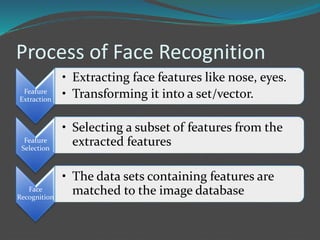
Process of Face Recognition 
Feature 
Extraction 
• Extracting face features like nose, eyes. 
• Transforming it into a set/vector. 
Feature 
Selection 
• Selecting a subset of features from the 
extracted features 
Face 
Recognition 
• The data sets containing features are 
matched to the image database
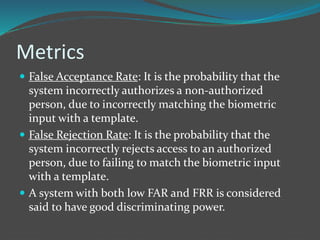
Metrics 
 False Acceptance Rate: It is the probability that the 
system incorrectly authorizes a non-authorized 
person, due to incorrectly matching the biometric 
input with a template. 
 False Rejection Rate: It is the probability that the 
system incorrectly rejects access to an authorized 
person, due to failing to match the biometric input 
with a template. 
 A system with both low FAR and FRR is considered 
said to have good discriminating power.
Advantages 
 Convenient, Social Adaptability 
 More User Friendly 
 Inexpensive Technique of Identification 
 Higher Success Rates 
 Non-Intrusive
Problems 
1. Pose Variations: Ideally Frontal images, Large pose 
variations lead to degradation of results 
2. Occlusions: Beard, Hat, Partially Covered Faces 
3. Age: Change in muscle tension 
4. Facial Expressions: Can run in thousands and hence 
provide a challenge 
5. Illumination: Can accentuate or diminish certain 
features of the face
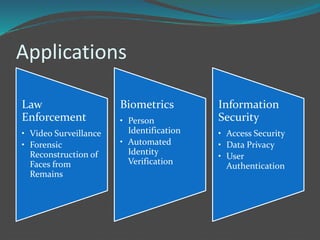
Applications 
Law 
Enforcement 
• Video Surveillance 
• Forensic 
Reconstruction of 
Faces from 
Remains 
Biometrics 
• Person 
Identification 
• Automated 
Identity 
Verification 
Information 
Security 
• Access Security 
• Data Privacy 
• User 
Authentication
Principal Component Analysis 
 Performs a dimensionality reduction by extracting the 
principal components from the multi-dimensional 
data. 
 Finds the uncorrelated variables called principal 
components from a set of correlated data variables. 
 PCA to reduce the dimensionality of the feature space 
by calculating the eigenvectors of the covariance 
matrix of the set of N2-dimensional feature vectors, 
and then projecting each feature vector onto the 
largest eigenvectors.
Linear Discriminant Analysis 
 A better alternative to the PCA 
 Provides discrimination among the classes 
 The main aim of LDA is to find a base of vectors which 
provides the best discrimination among the classes, 
maximize the between-class differences, and minimize 
the within-class differences 
 The difference between LDA and PCA is that LDA 
explicitly attempts to model the difference between 
the classes of data whereas PCA does not take into 
account any difference in class.
EigenFaces/EigenPictures 
 An NxN image I is linearized in a N2 vector, so that it 
represents a point in a N2-dimensional space. 
 Comparisons are performed on a low dimensional 
space found by dimensionality technique like PCA. 
 The images in the database are represented as vector of 
weights. 
 The test image is represented as a vector of weights, 
and the closest weight (in Euclidean distance) image is 
obtained from the database
Neural Networks 
 Most popular algorithm: Back Propagation Neural 
Network (BPNN) 
 It is used in multilayer perceptron (MLP) 
 MLP is a feed-forward (no directed cycle) network of 
nodes in a directed graph which are organized in 
multiple layers. 
 To reduce the amount of input data, PCA is used for 
feature extraction and BPNN for pattern recognition.
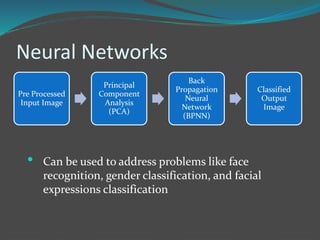
Neural Networks 
Pre Processed 
Input Image 
Principal 
Component 
Analysis 
(PCA) 
Back 
Propagation 
Neural 
Network 
(BPNN) 
Classified 
Output 
Image 
• Can be used to address problems like face 
recognition, gender classification, and facial 
expressions classification
Infrared Images 
 Insensitive to illumination 
 Alternate source of information for detection and 
recognition 
 Drawbacks: 
 Sensitive to changes in temperature 
Lower resolution of Infrared images 
 The radiated level of heat from the face can be used to 
find the stress levels in human and hence can be used 
for lie detection.
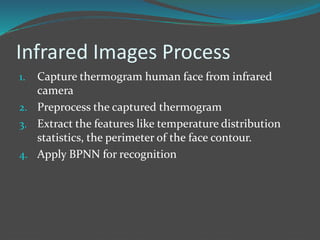
Infrared Images Process 
1. Capture thermogram human face from infrared 
camera 
2. Preprocess the captured thermogram 
3. Extract the features like temperature distribution 
statistics, the perimeter of the face contour. 
4. Apply BPNN for recognition
3D Assisted Face Recognition: Dealing 
With Expression Variations 
 Expressions- critical source of variation in face 
recognition. 
 An animatable 3D model is generated for each user 
based on 17 automatically located landmark points 
 This produces synthetic face images with different 
expressions 
 Apply recognition techniques like PCA and LDA
DeepFace 
 Uses a 3D model for rotating faces virtually so that the 
person in the photo appears to be looking at the 
camera. 
 Derive a face representation from a nine-layer deep 
neural network containing more than 120 million 
parameters (nodes) 
 Accuracy of 97.35% on the Labeled Faces in the Wild 
(LFW) dataset, as compared to the human accuracy of 
97.53%
Face Recognition after Plastic 
Surgery 
 Plastic Surgery - alter the original facial information to 
a great extent 
 Process is based on the assumption that the inner 
consistency of the face after plastic surgery is 
preserved 
 The face is divided into two patches and designing a 
classifier for each patch using Gabor feature and Fisher 
LDA 
 Fuse together the rank order list of each classifier
• Use gender classification, to show ads 
according to gender 
• Capture user’ facial expressions to know 
likeness of an ad, brand 
Advertising 
• Cameras at retail store to take pictures and 
identify customers 
• Deduct the bill from associated customer 
account 
Retailing 
• 3D Face Recognition is still very fresh 
research area 
• Combination of various feature extraction 
and selection techniques can be studied 
Research
Face Recognition Techniques

Face Recognition Techniques

  • 1.
  • 3.
     “From adatabase of faces, identify or verify one or more persons in a given still or video image.”  A vital option for granting access to an individual in various physical and virtual domains.  Applications in fields like video surveillance, national id, passport, windows login  Popular area of research for the past decade.
  • 4.
    2D and 3DFace Recognition  In 2D Recognition, features are extracted from the image and used to search images with similar features.  In 3D Recognition, the three-dimensional geometry of the human face is used.  3D face recognition methods can achieve higher accuracy than their 2D counterparts.  3D techniques do not suffer from illumination, facial expressions, pose changes as compared to 2D techniques.
  • 5.
    Process of FaceRecognition Feature Extraction • Extracting face features like nose, eyes. • Transforming it into a set/vector. Feature Selection • Selecting a subset of features from the extracted features Face Recognition • The data sets containing features are matched to the image database
  • 6.
    Metrics  FalseAcceptance Rate: It is the probability that the system incorrectly authorizes a non-authorized person, due to incorrectly matching the biometric input with a template.  False Rejection Rate: It is the probability that the system incorrectly rejects access to an authorized person, due to failing to match the biometric input with a template.  A system with both low FAR and FRR is considered said to have good discriminating power.
  • 7.
    Advantages  Convenient,Social Adaptability  More User Friendly  Inexpensive Technique of Identification  Higher Success Rates  Non-Intrusive
  • 8.
    Problems 1. PoseVariations: Ideally Frontal images, Large pose variations lead to degradation of results 2. Occlusions: Beard, Hat, Partially Covered Faces 3. Age: Change in muscle tension 4. Facial Expressions: Can run in thousands and hence provide a challenge 5. Illumination: Can accentuate or diminish certain features of the face
  • 9.
    Applications Law Enforcement • Video Surveillance • Forensic Reconstruction of Faces from Remains Biometrics • Person Identification • Automated Identity Verification Information Security • Access Security • Data Privacy • User Authentication
  • 11.
    Principal Component Analysis  Performs a dimensionality reduction by extracting the principal components from the multi-dimensional data.  Finds the uncorrelated variables called principal components from a set of correlated data variables.  PCA to reduce the dimensionality of the feature space by calculating the eigenvectors of the covariance matrix of the set of N2-dimensional feature vectors, and then projecting each feature vector onto the largest eigenvectors.
  • 12.
    Linear Discriminant Analysis  A better alternative to the PCA  Provides discrimination among the classes  The main aim of LDA is to find a base of vectors which provides the best discrimination among the classes, maximize the between-class differences, and minimize the within-class differences  The difference between LDA and PCA is that LDA explicitly attempts to model the difference between the classes of data whereas PCA does not take into account any difference in class.
  • 13.
    EigenFaces/EigenPictures  AnNxN image I is linearized in a N2 vector, so that it represents a point in a N2-dimensional space.  Comparisons are performed on a low dimensional space found by dimensionality technique like PCA.  The images in the database are represented as vector of weights.  The test image is represented as a vector of weights, and the closest weight (in Euclidean distance) image is obtained from the database
  • 14.
    Neural Networks Most popular algorithm: Back Propagation Neural Network (BPNN)  It is used in multilayer perceptron (MLP)  MLP is a feed-forward (no directed cycle) network of nodes in a directed graph which are organized in multiple layers.  To reduce the amount of input data, PCA is used for feature extraction and BPNN for pattern recognition.
  • 15.
    Neural Networks PreProcessed Input Image Principal Component Analysis (PCA) Back Propagation Neural Network (BPNN) Classified Output Image • Can be used to address problems like face recognition, gender classification, and facial expressions classification
  • 16.
    Infrared Images Insensitive to illumination  Alternate source of information for detection and recognition  Drawbacks:  Sensitive to changes in temperature Lower resolution of Infrared images  The radiated level of heat from the face can be used to find the stress levels in human and hence can be used for lie detection.
  • 17.
    Infrared Images Process 1. Capture thermogram human face from infrared camera 2. Preprocess the captured thermogram 3. Extract the features like temperature distribution statistics, the perimeter of the face contour. 4. Apply BPNN for recognition
  • 19.
    3D Assisted FaceRecognition: Dealing With Expression Variations  Expressions- critical source of variation in face recognition.  An animatable 3D model is generated for each user based on 17 automatically located landmark points  This produces synthetic face images with different expressions  Apply recognition techniques like PCA and LDA
  • 20.
    DeepFace  Usesa 3D model for rotating faces virtually so that the person in the photo appears to be looking at the camera.  Derive a face representation from a nine-layer deep neural network containing more than 120 million parameters (nodes)  Accuracy of 97.35% on the Labeled Faces in the Wild (LFW) dataset, as compared to the human accuracy of 97.53%
  • 21.
    Face Recognition afterPlastic Surgery  Plastic Surgery - alter the original facial information to a great extent  Process is based on the assumption that the inner consistency of the face after plastic surgery is preserved  The face is divided into two patches and designing a classifier for each patch using Gabor feature and Fisher LDA  Fuse together the rank order list of each classifier
  • 23.
    • Use genderclassification, to show ads according to gender • Capture user’ facial expressions to know likeness of an ad, brand Advertising • Cameras at retail store to take pictures and identify customers • Deduct the bill from associated customer account Retailing • 3D Face Recognition is still very fresh research area • Combination of various feature extraction and selection techniques can be studied Research