By Ashwini Awatare
Contents:- 
 Introduction 
 Face Recognition 
 Face Recognition using PCA algorithm 
 Strengths & Weaknesses 
Applications 
Conclusion 
Resources
Introduction 
Facial recognition (or face recognition) is a type 
of biometric software application that can identify a 
specific individual in a digital image by analyzing and 
comparing patterns. 
Facial recognition systems are commonly used for 
security purposes but are increasingly being used in a 
variety of other applications. For example, 
The Kinect motion gaming system, uses facial 
recognition to differentiate among players.
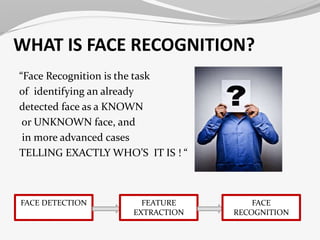
WHAT IS FACE RECOGNITION? 
“Face Recognition is the task 
of identifying an already 
detected face as a KNOWN 
or UNKNOWN face, and 
in more advanced cases 
TELLING EXACTLY WHO’S IT IS ! “ 
FACE DETECTION FEATURE 
EXTRACTION 
FACE 
RECOGNITION
All identification or authentication technologies 
operate using the following four stages: 
 Capture: A physical or behavioral sample is 
captured by the system during Enrollment and 
also in identification or verification process. 
 Extraction: unique data is extracted from the 
sample and a template is created. 
 Comparison: the template is then compared 
with a new sample. 
 Match/non-match: the system decides if the 
features extracted from the new Samples are a 
match or a non match. 
10/17/2014 5
PCA ALGORITHM 
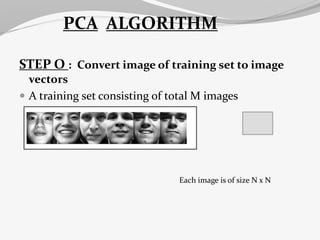
STEP O : Convert image of training set to image 
vectors 
 A training set consisting of total M images 
Each image is of size N x N
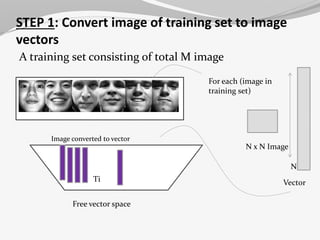
STEP 1: Convert image of training set to image 
vectors 
A training set consisting of total M image 
Image converted to vector 
For each (image in 
training set) 
N x N Image 
N 
Ti Vector 
Free vector space
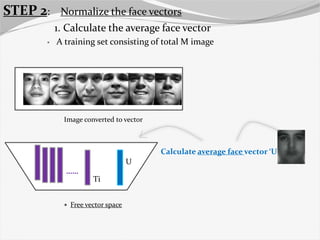
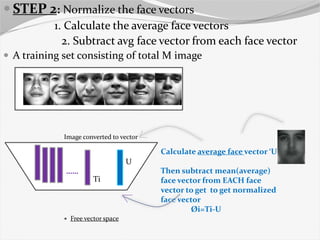
STEP 2: Normalize the face vectors 
1. Calculate the average face vector 
 A training set consisting of total M image 
Image converted to vector 
…… 
 Free vector space 
Calculate average face vector ‘U’ 
Ti 
U
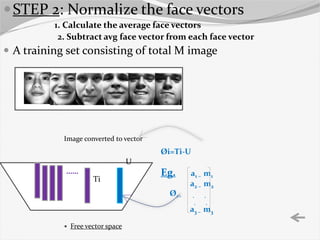
 STEP 2: Normalize the face vectors 
1. Calculate the average face vectors 
2. Subtract avg face vector from each face vector 
 A training set consisting of total M image 
Image converted to vector 
…… 
 Free vector space 
Calculate average face vector ‘U’ 
Then subtract mean(average) 
face vector from EACH face 
vector to get to get normalized 
face vector 
Øi=Ti-U 
Ti 
U
STEP 2: Normalize the face vectors 
1. Calculate the average face vectors 
2. Subtract avg face vector from each face vector 
 A training set consisting of total M image 
Image converted to vector 
…… 
 Free vector space 
Øi=Ti-U 
Eg. a1 – m1 
a2 – m2 
Ø1= . . 
. . 
a3 – m3 
Ti 
U
STEP 3: Calculate the Eigenvectors (Eigenvectors 
represent the variations in the faces ) 
A training set consisting of total M image 
Image converted to vector 
…… 
 Free vector space 
To calculate the eigenvectors , 
we need to calculate the 
covariance vector C 
C=A.AT 
where A=[Ø1, Ø2, Ø3,… ØM] 
N2 X M 
Ti 
U
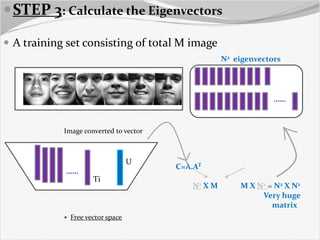
STEP 3: Calculate the Eigenvectors 
 A training set consisting of total M image 
Image converted to vector 
…… 
Ti 
 Free vector space 
U 
C=A.AT 
N2 X M M X N2 = N2 XN2 
Very huge 
matrix
STEP 3: Calculate the Eigenvectors 
 A training set consisting of total M image 
Image converted to vector 
…… 
Ti 
 Free vector space 
U 
C=A.AT 
N2 eigenvectors 
…… 
N2 X M MX N2 = N2 X N2 
Very huge 
matrix
STEP 3: Calculate the Eigenvectors 
A training set consisting of total M image 
Image converted to vector 
 
 
…… 
Ti 
 Free vector space 
U 
N2 eigenvectors 
…… 
But we need to find only K 
eigenvectors from the above 
N2 eigenvectors, where K<M 
Eg. If N=50 and K=100 , we 
need to find 100 eigenvectors 
from 2500 (i.e.N2 ) VERY TIME 
CONSUMING
STEP 3: Calculate the Eigenvectors 
A training set consisting of total M image 
Image converted to vector 
 
 
…… 
Ti 
 Free vector space 
U 
N2 eigenvectors 
…… 
SOLUTION 
“DIMENSIONALITY 
REDUCTION” 
i.e. Calculate eigenvectors from 
a covariance of reduced 
dimensionality
STEP 4: Calculating eigenvectors from reduced 
covariance matrix 
 A training set consisting of total M image 
Image converted to vector 
 
 
…… 
Ti 
 Free vector space 
U 
M2 eigenvectors 
…… 
New C=AT .A 
MXN2 N2 X M = M XM 
matrix
 STEP 5: Select K best eigenfaces such that 
K<=M and can represent the whole training 
set 
 Selected K eigenfaces MUST be in the ORIGINAL dimensionality of 
the face Vector Space
STEP 6: Convert lower dimension K eigenvectors to 
original face dimensionality 
 A training set consisting of total M image 
Image converted to vector 
 
…… 
 
Ti 
 Free vector space 
U 
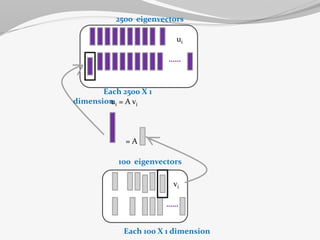
ui = A vi 
ui = ith eigenvector in 
the higher dimensional 
space 
vi = ith eigenvector in 
the lower dimensional 
space 
100 eigenvectors 
……
2500 eigenvectors 
…… 
Each 2500 X 1 
ui = A vi 
100 eigenvectors 
…… 
= A 
ui 
vi 
Each 100 X 1 dimension 
dimension
2500 eigenvectors 
ui 
…… 
Each 2500 X 1 
dimension 
yellow color shows K selected eigenfaces = ui
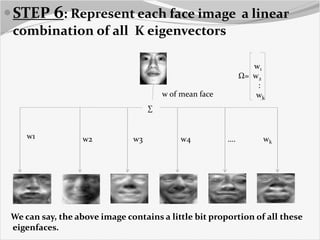
STEP 6: Represent each face image a linear 
combination of all K eigenvectors 
Σ 
w of mean face 
w1 
Ω= w2 
: 
wk 
w1 w2 w3 w4 …. wk 
We can say, the above image contains a little bit proportion of all these 
eigenfaces.
Calculating weight of each 
eigenfaces 
 The formula for calculating the weight is: 
wi= Øi. Ui 
For Eg. 
 w1= Ø1. U1 
 w2= Ø2. U2
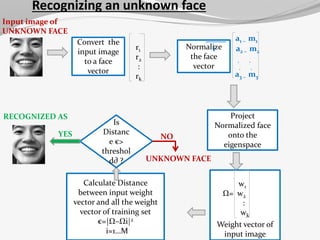
Recognizing an unknown face 
r1 
r2 
: 
rk 
Convert the 
input image 
to a face 
vector 
Normalize 
the face 
vector 
a1 – m1 
i a2 – m2 
. . 
. . 
a3 – m3 
Project 
Normalized face 
onto the 
eigenspace 
w1 
Ω= w2 
: 
wk 
Weight vector of 
input image 
Is 
Distanc 
e €> 
threshol 
d∂ ? UNKNOWN FACE 
Input image of 
UNKNOWN FACE 
YES NO 
Calculate Distance 
between input weight 
vector and all the weight 
vector of training set 
€=|Ω–Ωi|2 
i=1…M 
RECOGNIZED AS
Strengths 
It has the ability to leverage existing image 
acquisition equipment. 
 It can search against static images such as driver’s 
license photographs. 
 It is the only biometric able to operate without 
user cooperation. 
10/17/2014 24
Weaknesses 
Changes in acquisition environment reduce 
matching accuracy. 
 Changes in physiological characteristics reduce 
matching accuracy. 
 It has the potential for privacy abuse due to non 
cooperative enrollment and identification 
capabilities. 
10/17/2014 25
Applications..
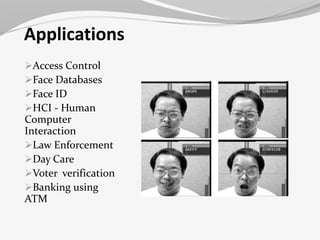
Applications 
Access Control 
Face Databases 
Face ID 
HCI - Human 
Computer 
Interaction 
Law Enforcement 
Day Care 
Voter verification 
Banking using 
ATM
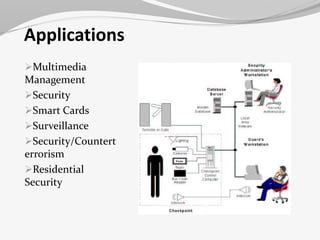
Applications 
Multimedia 
Management 
Security 
Smart Cards 
Surveillance 
Security/Countert 
errorism 
Residential 
Security
Conclusion 
 an algorithm to recognize faces present in the face 
database. The proposed algorithm uses 
 the concept of PCA and represents an improved 
version of PCA to deal with the problem of 
orientation and 
10/17/2014 29
Sources: 
[1]http://whatis.techtarget.com/definition/facial-recognition 
[2]http://en.wikipedia.org/wiki/Facial_recognition_system 
[3]http://sebastianraschka.com/Articles/2014_pca_step_by_s 
tep.html 
[4]M. Lam, H. Yan, An analytic-to-holistic approach for face 
recognition based on a single frontal view, IEEE Trans. 
Pattern Anal. Mach. Intel. 20 (1998) 673-686. 
[5]Zhang, Automatic adaptation of a face model using action 
units for semantic coding of videophone sequences, IEEE 
Trans. Circuits Systems Video Technol. 8 (6) (1998) 781- 
795.
THANK YOU

Face recogntion Using PCA Algorithm

  • 1.
  • 2.
    Contents:-  Introduction  Face Recognition  Face Recognition using PCA algorithm  Strengths & Weaknesses Applications Conclusion Resources
  • 3.
    Introduction Facial recognition(or face recognition) is a type of biometric software application that can identify a specific individual in a digital image by analyzing and comparing patterns. Facial recognition systems are commonly used for security purposes but are increasingly being used in a variety of other applications. For example, The Kinect motion gaming system, uses facial recognition to differentiate among players.
  • 4.
    WHAT IS FACERECOGNITION? “Face Recognition is the task of identifying an already detected face as a KNOWN or UNKNOWN face, and in more advanced cases TELLING EXACTLY WHO’S IT IS ! “ FACE DETECTION FEATURE EXTRACTION FACE RECOGNITION
  • 5.
    All identification orauthentication technologies operate using the following four stages:  Capture: A physical or behavioral sample is captured by the system during Enrollment and also in identification or verification process.  Extraction: unique data is extracted from the sample and a template is created.  Comparison: the template is then compared with a new sample.  Match/non-match: the system decides if the features extracted from the new Samples are a match or a non match. 10/17/2014 5
  • 6.
    PCA ALGORITHM STEPO : Convert image of training set to image vectors  A training set consisting of total M images Each image is of size N x N
  • 7.
    STEP 1: Convertimage of training set to image vectors A training set consisting of total M image Image converted to vector For each (image in training set) N x N Image N Ti Vector Free vector space
  • 8.
    STEP 2: Normalizethe face vectors 1. Calculate the average face vector  A training set consisting of total M image Image converted to vector ……  Free vector space Calculate average face vector ‘U’ Ti U
  • 9.
     STEP 2:Normalize the face vectors 1. Calculate the average face vectors 2. Subtract avg face vector from each face vector  A training set consisting of total M image Image converted to vector ……  Free vector space Calculate average face vector ‘U’ Then subtract mean(average) face vector from EACH face vector to get to get normalized face vector Øi=Ti-U Ti U
  • 10.
    STEP 2: Normalizethe face vectors 1. Calculate the average face vectors 2. Subtract avg face vector from each face vector  A training set consisting of total M image Image converted to vector ……  Free vector space Øi=Ti-U Eg. a1 – m1 a2 – m2 Ø1= . . . . a3 – m3 Ti U
  • 11.
    STEP 3: Calculatethe Eigenvectors (Eigenvectors represent the variations in the faces ) A training set consisting of total M image Image converted to vector ……  Free vector space To calculate the eigenvectors , we need to calculate the covariance vector C C=A.AT where A=[Ø1, Ø2, Ø3,… ØM] N2 X M Ti U
  • 12.
    STEP 3: Calculatethe Eigenvectors  A training set consisting of total M image Image converted to vector …… Ti  Free vector space U C=A.AT N2 X M M X N2 = N2 XN2 Very huge matrix
  • 13.
    STEP 3: Calculatethe Eigenvectors  A training set consisting of total M image Image converted to vector …… Ti  Free vector space U C=A.AT N2 eigenvectors …… N2 X M MX N2 = N2 X N2 Very huge matrix
  • 14.
    STEP 3: Calculatethe Eigenvectors A training set consisting of total M image Image converted to vector   …… Ti  Free vector space U N2 eigenvectors …… But we need to find only K eigenvectors from the above N2 eigenvectors, where K<M Eg. If N=50 and K=100 , we need to find 100 eigenvectors from 2500 (i.e.N2 ) VERY TIME CONSUMING
  • 15.
    STEP 3: Calculatethe Eigenvectors A training set consisting of total M image Image converted to vector   …… Ti  Free vector space U N2 eigenvectors …… SOLUTION “DIMENSIONALITY REDUCTION” i.e. Calculate eigenvectors from a covariance of reduced dimensionality
  • 16.
    STEP 4: Calculatingeigenvectors from reduced covariance matrix  A training set consisting of total M image Image converted to vector   …… Ti  Free vector space U M2 eigenvectors …… New C=AT .A MXN2 N2 X M = M XM matrix
  • 17.
     STEP 5:Select K best eigenfaces such that K<=M and can represent the whole training set  Selected K eigenfaces MUST be in the ORIGINAL dimensionality of the face Vector Space
  • 18.
    STEP 6: Convertlower dimension K eigenvectors to original face dimensionality  A training set consisting of total M image Image converted to vector  ……  Ti  Free vector space U ui = A vi ui = ith eigenvector in the higher dimensional space vi = ith eigenvector in the lower dimensional space 100 eigenvectors ……
  • 19.
    2500 eigenvectors …… Each 2500 X 1 ui = A vi 100 eigenvectors …… = A ui vi Each 100 X 1 dimension dimension
  • 20.
    2500 eigenvectors ui …… Each 2500 X 1 dimension yellow color shows K selected eigenfaces = ui
  • 21.
    STEP 6: Representeach face image a linear combination of all K eigenvectors Σ w of mean face w1 Ω= w2 : wk w1 w2 w3 w4 …. wk We can say, the above image contains a little bit proportion of all these eigenfaces.
  • 22.
    Calculating weight ofeach eigenfaces  The formula for calculating the weight is: wi= Øi. Ui For Eg.  w1= Ø1. U1  w2= Ø2. U2
  • 23.
    Recognizing an unknownface r1 r2 : rk Convert the input image to a face vector Normalize the face vector a1 – m1 i a2 – m2 . . . . a3 – m3 Project Normalized face onto the eigenspace w1 Ω= w2 : wk Weight vector of input image Is Distanc e €> threshol d∂ ? UNKNOWN FACE Input image of UNKNOWN FACE YES NO Calculate Distance between input weight vector and all the weight vector of training set €=|Ω–Ωi|2 i=1…M RECOGNIZED AS
  • 24.
    Strengths It hasthe ability to leverage existing image acquisition equipment.  It can search against static images such as driver’s license photographs.  It is the only biometric able to operate without user cooperation. 10/17/2014 24
  • 25.
    Weaknesses Changes inacquisition environment reduce matching accuracy.  Changes in physiological characteristics reduce matching accuracy.  It has the potential for privacy abuse due to non cooperative enrollment and identification capabilities. 10/17/2014 25
  • 26.
  • 27.
    Applications Access Control Face Databases Face ID HCI - Human Computer Interaction Law Enforcement Day Care Voter verification Banking using ATM
  • 28.
    Applications Multimedia Management Security Smart Cards Surveillance Security/Countert errorism Residential Security
  • 29.
    Conclusion  analgorithm to recognize faces present in the face database. The proposed algorithm uses  the concept of PCA and represents an improved version of PCA to deal with the problem of orientation and 10/17/2014 29
  • 30.
    Sources: [1]http://whatis.techtarget.com/definition/facial-recognition [2]http://en.wikipedia.org/wiki/Facial_recognition_system [3]http://sebastianraschka.com/Articles/2014_pca_step_by_s tep.html [4]M. Lam, H. Yan, An analytic-to-holistic approach for face recognition based on a single frontal view, IEEE Trans. Pattern Anal. Mach. Intel. 20 (1998) 673-686. [5]Zhang, Automatic adaptation of a face model using action units for semantic coding of videophone sequences, IEEE Trans. Circuits Systems Video Technol. 8 (6) (1998) 781- 795.
  • 31.