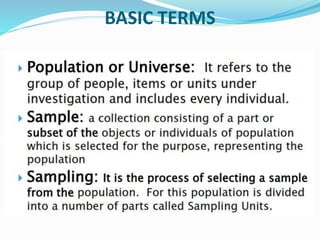
BASIC TERMS
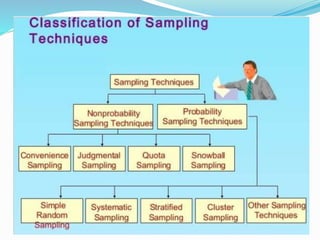
NON-PROBABILITY
SAMPLING
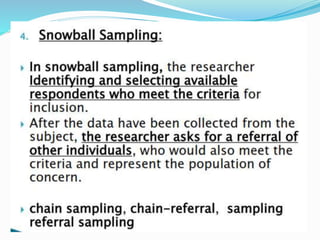
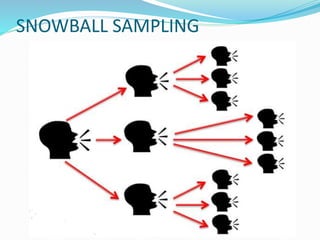
SNOWBALL SAMPLING
Tapan Kumar Mahato
Assistant Professor
B.Pharmacy College Rampura, Godhra, Gujarat
tapan.mahato@gmail.com
Type I and Type II
errors in sampling
Type I error is a false positive
conclusion
Type II error is a false negative
conclusion.
Example:
You decided to get tested for COVID-19
based on mild symptoms.
There are two errors that can occur:
Type I error (false positive): the test
result says you have coronavirus, but
you actually don’t.
Type II error (false negative): the test
result says you don’t have coronavirus,
but you actually do.
How to reduce the risk of making a
Type I error?
The significance level is set usually at
5% or 0.05.
This means that our results will have a
chance of only 5% if the null
hypothesis is actually true
Using this method type I error can be
minimized
How to reduce the risk of making a
Type II error?
To reduce the risk of a Type II
error,
We can increase the sample
size or the significance level
THANK YOU

Sampling & Sampling Errors in Biostatistics

  • 2.
  • 13.
  • 18.
  • 19.
    Tapan Kumar Mahato AssistantProfessor B.Pharmacy College Rampura, Godhra, Gujarat tapan.mahato@gmail.com
  • 20.
    Type I andType II errors in sampling
  • 21.
    Type I erroris a false positive conclusion Type II error is a false negative conclusion.
  • 22.
    Example: You decided toget tested for COVID-19 based on mild symptoms. There are two errors that can occur: Type I error (false positive): the test result says you have coronavirus, but you actually don’t. Type II error (false negative): the test result says you don’t have coronavirus, but you actually do.
  • 23.
    How to reducethe risk of making a Type I error? The significance level is set usually at 5% or 0.05. This means that our results will have a chance of only 5% if the null hypothesis is actually true Using this method type I error can be minimized
  • 24.
    How to reducethe risk of making a Type II error? To reduce the risk of a Type II error, We can increase the sample size or the significance level
  • 25.