In the context of testing of hypotheses, there are basically two types
   of errors we
can make:-
A type I error, also known as an error of the first kind, occurs when
the null hypothesis (H0) is true, but is rejected.
A type I error may be compared with a so called false positive.
A Type I error occurs when we believe a falsehood.
The rate of the type I error is called the size of the test and denoted by
the Greek letter α (alpha).
It usually equals the significance level of a test.
If type I error is fixed at 5 %, it means that there are about 5 chances
in 100 that we will reject H0 when H0 is true.
Type II error, also known as an error of the second kind, occurs when the
null hypothesis is false, but erroneously fails to be rejected.
Type II error means accepting the hypothesis which should have been
rejected.
A type II error may be compared with a so-called False Negative.
A Type II error is committed when we fail to believe a truth.
A type II error occurs when one rejects the alternative hypothesis (fails to
reject the null hypothesis) when the alternative hypothesis is true.
The rate of the type II error is denoted by the Greek letter β (beta) and related
to the power of a test (which equals 1-β ).
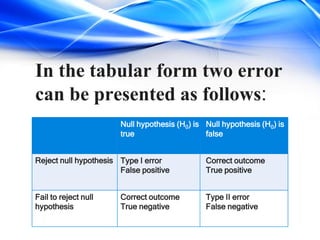
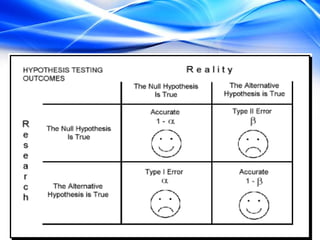
In the tabular form two error
can be presented as follows:
                       Null hypothesis (H0) is Null hypothesis (H0) is
                       true                    false


Reject null hypothesis Type I error            Correct outcome
                       False positive          True positive


Fail to reject null    Correct outcome         Type II error
hypothesis             True negative           False negative
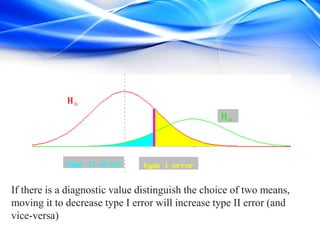
If there is a diagnostic value distinguish the choice of two means,
moving it to decrease type I error will increase type II error (and
vice-versa)
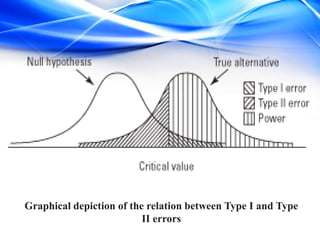
Graphical depiction of the relation between Type I and Type
                          II errors
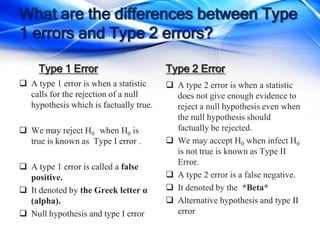
What are the differences between Type
1 errors and Type 2 errors?

     Type 1 Error                       Type 2 Error
 A type 1 error is when a statistic     A type 2 error is when a statistic
  calls for the rejection of a null       does not give enough evidence to
  hypothesis which is factually true.     reject a null hypothesis even when
                                          the null hypothesis should
 We may reject H0 when H0 is             factually be rejected.
  true is known as Type I error .        We may accept H0 when infect H0
                                          is not true is known as Type II
                                          Error.
 A type 1 error is called a false
  positive.                              A type 2 error is a false negative.
 It denoted by the Greek letter α       It denoted by the *Beta*
  (alpha).                               Alternative hypothesis and type II
 Null hypothesis and type I error        error
Reducing Type I Errors

• Prescriptive testing is used to increase the level of confidence,
  which in turn reduces Type I errors. The chances of making a Type I
  error are reduced by increasing the level of confidence.
Reducing Type II Errors
• Descriptive testing is used to better describe the test condition and
  acceptance criteria, which in turn reduces Type II errors. This
  increases the number of times we reject the Null hypothesis – with a
  resulting increase in the number of Type I errors (rejecting H0
  when it was really true and should not have been rejected).


    Therefore, reducing one type of error comes at the expense of
      increasing the other type of error! THE SAME MEANS
         CANNOT REDUCE BOTH TYPES OF ERRORS
                       SIMULTANEOUSLY!
 Many statisticians are now adopting a third type of
  error, a type III, which is where the null hypothesis was
  rejected for the wrong reason.

 In an experiment, a researcher might assume a
  hypothesis and perform research. After analyzing the
  results statistically, the null is rejected.

 The problem is, that there may be some relationship
  between the variables, but it could be for a different
  reason than stated in the hypothesis. An unknown
  process may underlie the relationship.
Type i and type ii errors