In the context of testing of hypotheses, there are basically two types
of errors we
can make:-
A type I error, also known as an error of the first kind, occurs when
the null hypothesis (H0) is true, but is rejected.
A type I error may be compared with a so called false positive.
A Type I error occurs when we believe a falsehood.
The rate of the type I error is called the size of the test and denoted by
the Greek letter α (alpha).
It usually equals the significance level of a test.
If type I error is fixed at 5 %, it means that there are about 5 chances
in 100 that we will reject H0 when H0 is true.
Type II error, also known as an error of the second kind, occurs when the
null hypothesis is false, but erroneously fails to be rejected.
Type II error means accepting the hypothesis which should have been
rejected.
A type II error may be compared with a so-called False Negative.
A Type II error is committed when we fail to believe a truth.
A type II error occurs when one rejects the alternative hypothesis (fails to
reject the null hypothesis) when the alternative hypothesis is true.
The rate of the type II error is denoted by the Greek letter β (beta) and related
to the power of a test (which equals 1-β ).
In the tabular form two error
can be presented as follows:
Null hypothesis (H0) is
true
Null hypothesis (H0) is
false
Reject null hypothesis Type I error
False positive
Correct outcome
True positive
Fail to reject null
hypothesis
Correct outcome
True negative
Type II error
False negative
If there is a diagnostic value distinguish the choice of two means,
moving it to decrease type I error will increase type II error (and
vice-versa)
Graphical depiction of the relation between Type I and Type
II errors
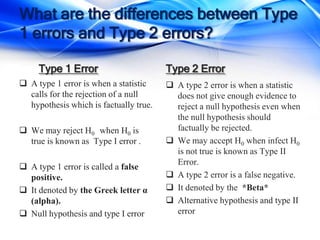
What are the differences between Type
1 errors and Type 2 errors?
Type 1 Error
 A type 1 error is when a statistic
calls for the rejection of a null
hypothesis which is factually true.
 We may reject H0 when H0 is
true is known as Type I error .
 A type 1 error is called a false
positive.
 It denoted by the Greek letter α
(alpha).
 Null hypothesis and type I error
Type 2 Error
 A type 2 error is when a statistic
does not give enough evidence to
reject a null hypothesis even when
the null hypothesis should
factually be rejected.
 We may accept H0 when infect H0
is not true is known as Type II
Error.
 A type 2 error is a false negative.
 It denoted by the *Beta*
 Alternative hypothesis and type II
error
Reducing Type I Errors
• Prescriptive testing is used to increase the level of confidence,
which in turn reduces Type I errors. The chances of making a Type I
error are reduced by increasing the level of confidence.
Reducing Type II Errors
• Descriptive testing is used to better describe the test condition and
acceptance criteria, which in turn reduces Type II errors. This
increases the number of times we reject the Null hypothesis – with a
resulting increase in the number of Type I errors (rejecting H0
when it was really true and should not have been rejected).
Therefore, reducing one type of error comes at the expense of
increasing the other type of error! THE SAME MEANS
CANNOT REDUCE BOTH TYPES OF ERRORS
SIMULTANEOUSLY!
 Many statisticians are now adopting a third type of
error, a type III, which is where the null hypothesis was
rejected for the wrong reason.
 In an experiment, a researcher might assume a
hypothesis and perform research. After analyzing the
results statistically, the null is rejected.
 The problem is, that there may be some relationship
between the variables, but it could be for a different
reason than stated in the hypothesis. An unknown
process may underlie the relationship.
typeiandtypeiierrors-130201094324-phpapp02.pdf

typeiandtypeiierrors-130201094324-phpapp02.pdf

  • 2.
    In the contextof testing of hypotheses, there are basically two types of errors we can make:-
  • 3.
    A type Ierror, also known as an error of the first kind, occurs when the null hypothesis (H0) is true, but is rejected. A type I error may be compared with a so called false positive. A Type I error occurs when we believe a falsehood. The rate of the type I error is called the size of the test and denoted by the Greek letter α (alpha). It usually equals the significance level of a test. If type I error is fixed at 5 %, it means that there are about 5 chances in 100 that we will reject H0 when H0 is true.
  • 4.
    Type II error,also known as an error of the second kind, occurs when the null hypothesis is false, but erroneously fails to be rejected. Type II error means accepting the hypothesis which should have been rejected. A type II error may be compared with a so-called False Negative. A Type II error is committed when we fail to believe a truth. A type II error occurs when one rejects the alternative hypothesis (fails to reject the null hypothesis) when the alternative hypothesis is true. The rate of the type II error is denoted by the Greek letter β (beta) and related to the power of a test (which equals 1-β ).
  • 5.
    In the tabularform two error can be presented as follows: Null hypothesis (H0) is true Null hypothesis (H0) is false Reject null hypothesis Type I error False positive Correct outcome True positive Fail to reject null hypothesis Correct outcome True negative Type II error False negative
  • 7.
    If there isa diagnostic value distinguish the choice of two means, moving it to decrease type I error will increase type II error (and vice-versa)
  • 8.
    Graphical depiction ofthe relation between Type I and Type II errors
  • 9.
    What are thedifferences between Type 1 errors and Type 2 errors? Type 1 Error  A type 1 error is when a statistic calls for the rejection of a null hypothesis which is factually true.  We may reject H0 when H0 is true is known as Type I error .  A type 1 error is called a false positive.  It denoted by the Greek letter α (alpha).  Null hypothesis and type I error Type 2 Error  A type 2 error is when a statistic does not give enough evidence to reject a null hypothesis even when the null hypothesis should factually be rejected.  We may accept H0 when infect H0 is not true is known as Type II Error.  A type 2 error is a false negative.  It denoted by the *Beta*  Alternative hypothesis and type II error
  • 10.
    Reducing Type IErrors • Prescriptive testing is used to increase the level of confidence, which in turn reduces Type I errors. The chances of making a Type I error are reduced by increasing the level of confidence.
  • 11.
    Reducing Type IIErrors • Descriptive testing is used to better describe the test condition and acceptance criteria, which in turn reduces Type II errors. This increases the number of times we reject the Null hypothesis – with a resulting increase in the number of Type I errors (rejecting H0 when it was really true and should not have been rejected). Therefore, reducing one type of error comes at the expense of increasing the other type of error! THE SAME MEANS CANNOT REDUCE BOTH TYPES OF ERRORS SIMULTANEOUSLY!
  • 12.
     Many statisticiansare now adopting a third type of error, a type III, which is where the null hypothesis was rejected for the wrong reason.  In an experiment, a researcher might assume a hypothesis and perform research. After analyzing the results statistically, the null is rejected.  The problem is, that there may be some relationship between the variables, but it could be for a different reason than stated in the hypothesis. An unknown process may underlie the relationship.