UNIVERSITY SCHOOL OF MANAGEMENT
KURUKSHETRA UNIVERSITY
YATINBHARDWAJ
48
MBA (2YR)
USM-KUK
BY : YATIN ROLL NO. 48 MBA(G)
PRESENTATION ON
BINOMIAL DISTRIBUTION
INTRODUCTION
Binomial distribution was
given by Swiss mathematician
James Bernouli(1654-1705)
in 1700 and it was first
published in 1713. It is also
known as ‘Bernouli
Distribution’.
MEANING...
Binomial distribution is a discrete
probability distribution which is
obtained when the probability p of
the happening of an event is same
in all the trials, and there are only
two events in each trial.
CONTINUE....
E.g...
The probability of getting a head,
when a coin is tossed a number of
times, must remains same in each
toss i.e. P= 1/2
CHARACTERISTICS OF
BINOMIAL DISTRIBUTION
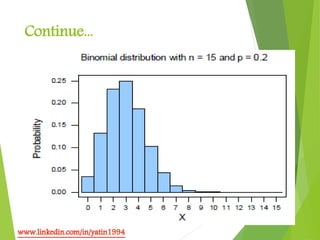
 It is a discrete distribution which gives the theoretical
probabilities.
 It depends on the parameter p or q, the probability of success
or failure and n(i.e. The number of trials). The parameter n is
always a positive integer.
 The distribution will be symmetrical if p=q. It is skew
symmetric or asymmetric if p is not equal to q.
CONTINUE...
 The statistics of the binomial distribution are: Mean=np,
Variance=npq, and Standard deviation = npq
 The mode of the binomial distribution is equal to that value of
x which has longer frequency.
Continue...
Conditions for binomial
distribution
 The random experiment is performed repeatedly a finite and
fixed number of times.
 The outcome of the random experiment(trials) results in the
dichotomous classification of events.
 All the trials are independent.
 The probability of success in any trial is p and is constant for
each trial. q= 1-p is then termed as the probability of failure
and is constant for each trial.
E.g...
If we toss a fair coin n times(which is fixed and finite), then the outcome of any trial
is one of the mutually exclusive events, viz, head(success) and tail(failure).
Further, all the trials are independent, since the result of any throw of coin does
not affect and is not affected by the result of other throws.
Ques. Ten unbiased coins are tossed simultaneously. Find the probability of obtaining,
(i) Exactly 6 heads
(ii) At least 8 heads
(iii) No head
(iv) At least one head
(v) Not more than three heads
(vi) At least 4 heads