E R R O R S
&
B I A S
I N
R E S E A R C H
S U K H E S W E R
SYNOPSIS:
7/22/2024 2
• INTRODUCTION
• ERROR
• BIAS
• CONFOUNDING
• CONCLUSION
ERROR:
• False or mistaken result obtained in a study or experiment that takes place in any
stage/process.
• Affect on the accuracy/validity/reliability of the study
• The term error in epidemiology refers to a phenemenon in which the result of finding of
the study does not reflect the truth or fact.
• It is difficult to make the study free from any type of error.
• Therefore, the aim is to maximize fact and minimize error so that the research work
would represent to the population they refer.
7/22/2024 3
CLASSIFICATION:
THERE ARE TWO TYPES OF ERROR , NAMELY:
1. RANDOM ERROR
2. SYSTEMIC ERROR
7/22/2024 4
RANDOM ERROR:
• By chance error
• Makes observed values differ from the true value.
• Error exist every time when we draw a random sample and
make a conclusion regarding the respective population.
• In epidemiologic studies , random error has many components
but major contributor is the process of selecting the specific
study subjects i.e. sampling error
7/22/2024 5
SAMPLING ERROR:
• Sampling error is the deviation of the selected sample from the true
characteristics, traits, behaviors, qualities or figures of the entire population.
• Because of chance, different samples will produce different results and therefore
must be taken into account when using a sample to make inferences about a
population.
• This difference is referred to as the sampling error and its variability is measured
by the standard error.
• The error which arise because of studying only a part of the total population are
called sampling errors.
7/22/2024 6
SAMPLING ERROR:
• When we take a sample, it is only a subset of the entire population;
therefore, there may be a difference between the sample and population.
• These may arise due to non representativeness of the samples and the
inadequacy of sample size. When several samples are drawn from a
population, their results would not be identical.
• Sample size and sampling error are thus negatively correlated.
• Sampling error can be reduced by increasing the sampling size with valid
scientific sample selection criteria.
7/22/2024 7
SAMPLING ERROR:
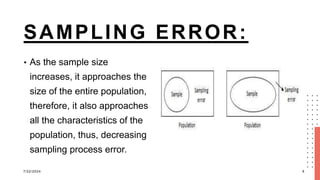
• As the sample size
increases, it approaches the
size of the entire population,
therefore, it also approaches
all the characteristics of the
population, thus, decreasing
sampling process error.
7/22/2024 8
TYPES OF RANDOM
ERROR:
THERE ARE TWO TYPES OF RANDOM ERROR ,
NAMELY
1. TYPE I ERROR (ALPHA ERROR)
2. TYPE II ERROR ( BETA ERROR)
7/22/2024 9
T Y P E I E R R O R ( A L P H A
E R R O R ) :
• Type I error is also known as Alpha error
• Exists when an investigator or study rejects a null hypothesis
when it is actually true in the population, so that the test result
is false positive.
• Example: a test that shows a patient to have a disease when in
fact the patient does not have the disease.
7/22/2024 10
T Y P E I I E R R O R ( B E TA
E R R O R ) :
• Type II error is also known as Beta error
• Exists when an investigator or a study accepts null hypothesis
when actually it is false in the population, so the test result is
false negative.
• Example: a blood test failing to detect the disease it was
designed to detect, in a patient who really has the disease
7/22/2024 11
T W O B A S I C A P P R O A C H E S F O R
R E D U C I N G
E R R O R S :
Minimize errors through research design:
• In this process effective use of research methods and techniques are
utilized to lessen the impact of both sampling and non-sampling errors.
Estimate and Measure Error:
• In spite of all the precautions undertaken, not all errors especially those
related to fieldwork would be eliminated.
• In such a situation if we can have an estimate of error we can say how
accurate the research design was?
7/22/2024 12
SYSTEMATIC ERROR OR
BIAS:
• It occurs when there is a difference between the true value (in the population) and the
observed value (in the study) from any cause other than random error.
• It is an error due to factors that exist in the study design, data collection, analysis and
interpretation to yete results or conclusions that depart from the truth.
• If there is misrepresentation of the effect, it is called bias and lf there is no
misrepresentation, it is called valid or no bias.
• Increasing of the sample size has no effect on it.
7/22/2024 13
SYSTEMATIC ERROR OR
BIAS:
• In an epidemiological study, it is defined as any systematic error that result an incorrect
estimate of the association between exposure and risk of disease.
• Example - testing for antibodies will consistently underestimate the prevalence of HIV
infection because individual who have been infected for less than six months will not yet
have developed antibodies.
7/22/2024 14
DEFINITION OF BIAS:
• Any trend in the collection, analysis, interpretation, publication
or review of data that can lead to conclusions that are
systematically different from the truth (Last, 2001).
• A process at any state of inference tending to produce results
that depart systematically from the true values (Fletcher et al,
1988).
7/22/2024 15
T Y P E S O F B I A S O R S Y S T E M AT I C
E R R O R :
1. Selection Bias
2. Information Bias
3. Confounding
7/22/2024 16
SELECTION BIAS:
• Selection bias occurs when there is a systematic difference between the characteristics of
the people selected for a study and the characteristics of those who are not and which
distorts in the estimate of effect (result).
• Sample obtained is not representative of the population to be analyzed
• There are fivetypes of selection bias, namely:
1. Publicity bias
2. Non-response bias
3. Healthy worker effect
4. Diagnostic bias
5. Loss to follow-up bias
7/22/2024 17
1.PUBLICITY BIAS:
• People referring themselves to the investigators following publicity of the study.
• Publicity bias can also occur from news reports not related to individuals.
• In a 1981 —1982 survey of individuals near two hazardous waste disposal sites in
Louisiana, people were asked about various symptoms. Air and water quality data
showed little evidence of hazardous concentrations of chemicals, but there had been
extensive media coverage at the time of the survey.
• Respondents living near the sites were two to three times as likely to report symptoms
as respondents in an unexposed community because of the influence of the publicity at
that moment in time.
7/22/2024 18
2.NON —RESPONSE
BIAS:
• A type of bias when an individual chosen for the sample cannot
be contacted or refuses to cooperate .
• When non response bias occurs, there is an unrepresentative
sample.
7/22/2024 19
3.HEALTHY WORKER
EFFECT:
• It is introduced when the disease or factor under investigation
itself make people unavailable for study.
• Relatively healthy people become or remain workers, whereas
those who remain unemployed, retired, disabled, or otherwise
out of the active worker population are as a group less healthy.
7/22/2024 20
4.DIAGNOSTIC BIAS:
• Diagnoses (case selection) may be influenced by physician's
knowledge of exposure
• E.g. Case control study — outcome is pulmonary disease,
exposure is smoking
• Radiologist aware of patient's smoking status when reading x-
ray — may look more carefully for abnormalities on x-ray and
differentially select cases in exposed group and less so in
control group.
7/22/2024 21
5.LOSS TO FOLLOW-UP
BIAS:
• Lost to follow-up refers to respondents who are at one point in
time were activelyBparticipating in a clinical research trial,
butNhave become lost at the point of follow-up in the trial.
• Design and implementation of the study should try to minimize
this and we should aim to ensure that all groups are followed
as completely as possible and with equal rigor
7/22/2024 22
INFORMATION BIAS:
• It is a distortion in the estimate of effect due to measurement
error or misclassification of subjects on one or more variables.
• It may also be called as Measurement bias, misclassification
bias.
• Major sources of measurement bias include invalid
measurement, incorrect diagnostic criteria, and omissions and
inadequacies in previously recorded data.
7/22/2024 23
C O M M O N T Y P E S O F
I N F O R M AT I O N B I A S E S :
1. Instrument bias,
2. Insensitive measure bias,
3. Expectation bias/observer bias
4. Recall or memory bias,
5. Attention bias, and
6. Verification or work-up bias.
7/22/2024 24
T Y P E S O F I N F O R M AT I O N
B I A S E S :
1. Instrument bias:
• Instrument bias occurs when calibration errors lead to inaccurate
measurements being recorded, e.g., an unbalanced weight scale.
2. Insensitive measure bias:
• Insensitive measure bias occurs when the measurement tool(s) used
are not sensitive (poor calibration) enough to detect what might be
important differences in the variable of interest.
7/22/2024 25
T Y P E S O F I N F O R M AT I O N
B I A S E S :
3. Expectation bias:
• Expectation bias occurs in the absence of masking or blinding,
when observer may have error in measuring data towards the
expected outcome.
• The observer-expectancy effect occurs when a researcher's
beliefs or expectations unconsciously affect the behavior of the
observed subject(s)
7/22/2024 26
T Y P E S O F I N F O R M AT I O N
B I A S E S :
4. Recall or memory bias:
• Systematic error due to differences in accuracy or completeness of recall to memory of past
events or experience.
• Often a person recalls positive events more than negative ones. Alternatively, certain
subjects may be questioned more vigorously than others, thereby improving their
recollections.
5.Attention bias:
• Attention bias occurs because people who are part of a study are usually aware of their
involvement, and as a result of the attention received may give more favorable responses or
perform better than people who are unaware of the study’s intent.
7/22/2024 27
T Y P E S O F I N F O R M AT I O N
B I A S E S :
6. Verification or workup or referral bias:
• It is a type of measurement bias in which the results of a diagnostic test
affect whether the gold standard procedure Is used to verify the test
result.
• It is mainly associated with test validation studies.
• In clinical practice, referral bias is more likely to occur when a preliminary
diagnostic test is negative. Because many gold standard tests can be
invasive, expensive, and carry a higher risk (eg: angiography, biopsy,
surgery) ,patients and physicians may be more reluctant to undergo
further workup if a preliminary test is negative.
7/22/2024 28
AV O I D I N G B I A S I N
R E S E A R C H :
1.Gather data from multiple sources: Be sure to collect data samples from the different
groups in your research population.
2.Verify your data: Before going ahead with the data analysis, try to check in with other
data sources, and confirm if you are on the right track.
3.If possible, ask research participants to help you review your findings: Ask the people
who provided the data whether your interpretations seem to be representative of their
beliefs.
4.Check for alternative explanations: Try to identify and account for alternative reasons
why you may have collected data samples the way you did.
5.Ask other members of your team to review your results: Ask others review your
conclusions. This will help you see things that you missed or identify gaps in your
argument that need to be addressed.
7/22/2024 29
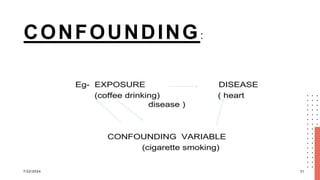
CONFOUNDING:
• The term ‘confounding’ refers to the effect of an extraneous variable that
entirely or partially explains the apparent association between the study
exposure and the disease.
• Confounding is a distortion in the estimated measure of effect due to the
mixing of the effect of the study factor with the effect of other risk factors.
Confounding effect may distort the true association in either direction.
• In a study of the association between exposure to a cause ( or risk factor
) and the occurrence of disease, confounding can occur when another
exposure exists in the study population and is associated both with the
disease and the exposure being studied.
7/22/2024 30
CONFOUNDING:
7/22/2024 31
C R I T E R I A F O R
C O N F O U N D E R S :
• It is the risk factor of the study disease (but it is not the
concequence)
• It is associated with exposure under study
• It is about of interest of current study (i.e. an extraneous
variables)
• In the absence of exposure it indendently able to cause
disease(outcome)
7/22/2024 32
T H E C O N T R O L O F
C O N F O U N D I N G :
The method commonly used to control confounding in the
design of an epidemiological study is:
• Randomization
• Restriction
• Matching
At the analysis stage , confounding can be controlled by;
• Stratification
• Statistical modeling
7/22/2024 33
RANDOMIZATION:
• RANDOMIZATION-is applicable only to experimental studies,
is the ideal method for ensuring that potential confounding
variables are equally distributed among the groups being
compared .
• The sample size has to be sufficiently large to avoid random
misdistribution of such variables.
• Randomization avoids the association between potentially
confounding variables and the exposure that is being
considered.
7/22/2024 34
RESTRICTION:
• RESTRICTION can be used to limit the study to people who
have particular characteristics.
• For Eg. In a study on the effects of coffee on coronary heart
disease, participation in the study could be restricted to
nonsmokers, thus removing any potential effect of confounding
by cigarette smoking.
7/22/2024 35
MATCHING:
• MATCHING — If matching is used to control confounding the
study participants are selected so as to ensure that potential
confounding variables are evenly distributed in the two groups
being compared .
• For eg in a case — control study of exercise and coronary
heart disease , each patient with heart disease can be
matched with a control of the same age group and sex to
ensure that confounding by age and sex does not occur.
7/22/2024 36
STRATIFCATION:
• STRATIFCATION- Confounding can be controlled by
stratification in which subject are split into groups or strata and
the association between exposure and outcome of interest is
then measure separately in each stratum, analysis can be
done separately men and women to remove confounding by
sex, for different age groups and so on. In practice, it is difficult
to remove all confounding .
7/22/2024 37
STATISTICAL
MODELING:
• MODELLING- Although stratification is conceptually simple and relatively easy to carry out, it
is often limited by the size of the study and it cannot help to control many factors
simultaneously, if we want to control by age, sex, and smoking by stratification, each stratum
will contain only few percent of study population and it can be difficult to obtain precise
estimates of association in each.
• Therefore, statistical modeling (multivariate) is used to control for all potential confounders
while controlling for a number of confounding variables simultaneously.
• The most common multivariate approach for unmatched case control study is multiple
logistic regression and for matched case control study is conditional logistic regression and
common technique used for cohort is Cox proportional hazards regression.
7/22/2024 38
CONCLUSION:
Errors:
• Can be random or systematic
• Random errors are due to chance and tend to even out over large studies
• Systematic errors consistently skew the results in one direction
Bias:
• Can be intentional or unintentional
• Occurs at any stage of research, from design to interpretation
• Different types of bias exist, such as selection bias, information bias, and confirmation bias
• Errors and bias in research are serious threats to the validity of research findings. They can lead to
misleading conclusions that are not supported by reality.
• In conclusion, recognizing and addressing errors and bias is essential for ensuring the quality and
trustworthiness of research. By employing strong research designs, being mindful of biases, and
fostering open communication, researchers can strive to produce accurate and impactful findings.
7/22/2024 39
THAN
K
YOU
7/22/2024 40

ERROR AND BIAS IN RESEARCH PRESENTATION.pptx

  • 1.
    E R RO R S & B I A S I N R E S E A R C H S U K H E S W E R
  • 2.
    SYNOPSIS: 7/22/2024 2 • INTRODUCTION •ERROR • BIAS • CONFOUNDING • CONCLUSION
  • 3.
    ERROR: • False ormistaken result obtained in a study or experiment that takes place in any stage/process. • Affect on the accuracy/validity/reliability of the study • The term error in epidemiology refers to a phenemenon in which the result of finding of the study does not reflect the truth or fact. • It is difficult to make the study free from any type of error. • Therefore, the aim is to maximize fact and minimize error so that the research work would represent to the population they refer. 7/22/2024 3
  • 4.
    CLASSIFICATION: THERE ARE TWOTYPES OF ERROR , NAMELY: 1. RANDOM ERROR 2. SYSTEMIC ERROR 7/22/2024 4
  • 5.
    RANDOM ERROR: • Bychance error • Makes observed values differ from the true value. • Error exist every time when we draw a random sample and make a conclusion regarding the respective population. • In epidemiologic studies , random error has many components but major contributor is the process of selecting the specific study subjects i.e. sampling error 7/22/2024 5
  • 6.
    SAMPLING ERROR: • Samplingerror is the deviation of the selected sample from the true characteristics, traits, behaviors, qualities or figures of the entire population. • Because of chance, different samples will produce different results and therefore must be taken into account when using a sample to make inferences about a population. • This difference is referred to as the sampling error and its variability is measured by the standard error. • The error which arise because of studying only a part of the total population are called sampling errors. 7/22/2024 6
  • 7.
    SAMPLING ERROR: • Whenwe take a sample, it is only a subset of the entire population; therefore, there may be a difference between the sample and population. • These may arise due to non representativeness of the samples and the inadequacy of sample size. When several samples are drawn from a population, their results would not be identical. • Sample size and sampling error are thus negatively correlated. • Sampling error can be reduced by increasing the sampling size with valid scientific sample selection criteria. 7/22/2024 7
  • 8.
    SAMPLING ERROR: • Asthe sample size increases, it approaches the size of the entire population, therefore, it also approaches all the characteristics of the population, thus, decreasing sampling process error. 7/22/2024 8
  • 9.
    TYPES OF RANDOM ERROR: THEREARE TWO TYPES OF RANDOM ERROR , NAMELY 1. TYPE I ERROR (ALPHA ERROR) 2. TYPE II ERROR ( BETA ERROR) 7/22/2024 9
  • 10.
    T Y PE I E R R O R ( A L P H A E R R O R ) : • Type I error is also known as Alpha error • Exists when an investigator or study rejects a null hypothesis when it is actually true in the population, so that the test result is false positive. • Example: a test that shows a patient to have a disease when in fact the patient does not have the disease. 7/22/2024 10
  • 11.
    T Y PE I I E R R O R ( B E TA E R R O R ) : • Type II error is also known as Beta error • Exists when an investigator or a study accepts null hypothesis when actually it is false in the population, so the test result is false negative. • Example: a blood test failing to detect the disease it was designed to detect, in a patient who really has the disease 7/22/2024 11
  • 12.
    T W OB A S I C A P P R O A C H E S F O R R E D U C I N G E R R O R S : Minimize errors through research design: • In this process effective use of research methods and techniques are utilized to lessen the impact of both sampling and non-sampling errors. Estimate and Measure Error: • In spite of all the precautions undertaken, not all errors especially those related to fieldwork would be eliminated. • In such a situation if we can have an estimate of error we can say how accurate the research design was? 7/22/2024 12
  • 13.
    SYSTEMATIC ERROR OR BIAS: •It occurs when there is a difference between the true value (in the population) and the observed value (in the study) from any cause other than random error. • It is an error due to factors that exist in the study design, data collection, analysis and interpretation to yete results or conclusions that depart from the truth. • If there is misrepresentation of the effect, it is called bias and lf there is no misrepresentation, it is called valid or no bias. • Increasing of the sample size has no effect on it. 7/22/2024 13
  • 14.
    SYSTEMATIC ERROR OR BIAS: •In an epidemiological study, it is defined as any systematic error that result an incorrect estimate of the association between exposure and risk of disease. • Example - testing for antibodies will consistently underestimate the prevalence of HIV infection because individual who have been infected for less than six months will not yet have developed antibodies. 7/22/2024 14
  • 15.
    DEFINITION OF BIAS: •Any trend in the collection, analysis, interpretation, publication or review of data that can lead to conclusions that are systematically different from the truth (Last, 2001). • A process at any state of inference tending to produce results that depart systematically from the true values (Fletcher et al, 1988). 7/22/2024 15
  • 16.
    T Y PE S O F B I A S O R S Y S T E M AT I C E R R O R : 1. Selection Bias 2. Information Bias 3. Confounding 7/22/2024 16
  • 17.
    SELECTION BIAS: • Selectionbias occurs when there is a systematic difference between the characteristics of the people selected for a study and the characteristics of those who are not and which distorts in the estimate of effect (result). • Sample obtained is not representative of the population to be analyzed • There are fivetypes of selection bias, namely: 1. Publicity bias 2. Non-response bias 3. Healthy worker effect 4. Diagnostic bias 5. Loss to follow-up bias 7/22/2024 17
  • 18.
    1.PUBLICITY BIAS: • Peoplereferring themselves to the investigators following publicity of the study. • Publicity bias can also occur from news reports not related to individuals. • In a 1981 —1982 survey of individuals near two hazardous waste disposal sites in Louisiana, people were asked about various symptoms. Air and water quality data showed little evidence of hazardous concentrations of chemicals, but there had been extensive media coverage at the time of the survey. • Respondents living near the sites were two to three times as likely to report symptoms as respondents in an unexposed community because of the influence of the publicity at that moment in time. 7/22/2024 18
  • 19.
    2.NON —RESPONSE BIAS: • Atype of bias when an individual chosen for the sample cannot be contacted or refuses to cooperate . • When non response bias occurs, there is an unrepresentative sample. 7/22/2024 19
  • 20.
    3.HEALTHY WORKER EFFECT: • Itis introduced when the disease or factor under investigation itself make people unavailable for study. • Relatively healthy people become or remain workers, whereas those who remain unemployed, retired, disabled, or otherwise out of the active worker population are as a group less healthy. 7/22/2024 20
  • 21.
    4.DIAGNOSTIC BIAS: • Diagnoses(case selection) may be influenced by physician's knowledge of exposure • E.g. Case control study — outcome is pulmonary disease, exposure is smoking • Radiologist aware of patient's smoking status when reading x- ray — may look more carefully for abnormalities on x-ray and differentially select cases in exposed group and less so in control group. 7/22/2024 21
  • 22.
    5.LOSS TO FOLLOW-UP BIAS: •Lost to follow-up refers to respondents who are at one point in time were activelyBparticipating in a clinical research trial, butNhave become lost at the point of follow-up in the trial. • Design and implementation of the study should try to minimize this and we should aim to ensure that all groups are followed as completely as possible and with equal rigor 7/22/2024 22
  • 23.
    INFORMATION BIAS: • Itis a distortion in the estimate of effect due to measurement error or misclassification of subjects on one or more variables. • It may also be called as Measurement bias, misclassification bias. • Major sources of measurement bias include invalid measurement, incorrect diagnostic criteria, and omissions and inadequacies in previously recorded data. 7/22/2024 23
  • 24.
    C O MM O N T Y P E S O F I N F O R M AT I O N B I A S E S : 1. Instrument bias, 2. Insensitive measure bias, 3. Expectation bias/observer bias 4. Recall or memory bias, 5. Attention bias, and 6. Verification or work-up bias. 7/22/2024 24
  • 25.
    T Y PE S O F I N F O R M AT I O N B I A S E S : 1. Instrument bias: • Instrument bias occurs when calibration errors lead to inaccurate measurements being recorded, e.g., an unbalanced weight scale. 2. Insensitive measure bias: • Insensitive measure bias occurs when the measurement tool(s) used are not sensitive (poor calibration) enough to detect what might be important differences in the variable of interest. 7/22/2024 25
  • 26.
    T Y PE S O F I N F O R M AT I O N B I A S E S : 3. Expectation bias: • Expectation bias occurs in the absence of masking or blinding, when observer may have error in measuring data towards the expected outcome. • The observer-expectancy effect occurs when a researcher's beliefs or expectations unconsciously affect the behavior of the observed subject(s) 7/22/2024 26
  • 27.
    T Y PE S O F I N F O R M AT I O N B I A S E S : 4. Recall or memory bias: • Systematic error due to differences in accuracy or completeness of recall to memory of past events or experience. • Often a person recalls positive events more than negative ones. Alternatively, certain subjects may be questioned more vigorously than others, thereby improving their recollections. 5.Attention bias: • Attention bias occurs because people who are part of a study are usually aware of their involvement, and as a result of the attention received may give more favorable responses or perform better than people who are unaware of the study’s intent. 7/22/2024 27
  • 28.
    T Y PE S O F I N F O R M AT I O N B I A S E S : 6. Verification or workup or referral bias: • It is a type of measurement bias in which the results of a diagnostic test affect whether the gold standard procedure Is used to verify the test result. • It is mainly associated with test validation studies. • In clinical practice, referral bias is more likely to occur when a preliminary diagnostic test is negative. Because many gold standard tests can be invasive, expensive, and carry a higher risk (eg: angiography, biopsy, surgery) ,patients and physicians may be more reluctant to undergo further workup if a preliminary test is negative. 7/22/2024 28
  • 29.
    AV O ID I N G B I A S I N R E S E A R C H : 1.Gather data from multiple sources: Be sure to collect data samples from the different groups in your research population. 2.Verify your data: Before going ahead with the data analysis, try to check in with other data sources, and confirm if you are on the right track. 3.If possible, ask research participants to help you review your findings: Ask the people who provided the data whether your interpretations seem to be representative of their beliefs. 4.Check for alternative explanations: Try to identify and account for alternative reasons why you may have collected data samples the way you did. 5.Ask other members of your team to review your results: Ask others review your conclusions. This will help you see things that you missed or identify gaps in your argument that need to be addressed. 7/22/2024 29
  • 30.
    CONFOUNDING: • The term‘confounding’ refers to the effect of an extraneous variable that entirely or partially explains the apparent association between the study exposure and the disease. • Confounding is a distortion in the estimated measure of effect due to the mixing of the effect of the study factor with the effect of other risk factors. Confounding effect may distort the true association in either direction. • In a study of the association between exposure to a cause ( or risk factor ) and the occurrence of disease, confounding can occur when another exposure exists in the study population and is associated both with the disease and the exposure being studied. 7/22/2024 30
  • 31.
  • 32.
    C R IT E R I A F O R C O N F O U N D E R S : • It is the risk factor of the study disease (but it is not the concequence) • It is associated with exposure under study • It is about of interest of current study (i.e. an extraneous variables) • In the absence of exposure it indendently able to cause disease(outcome) 7/22/2024 32
  • 33.
    T H EC O N T R O L O F C O N F O U N D I N G : The method commonly used to control confounding in the design of an epidemiological study is: • Randomization • Restriction • Matching At the analysis stage , confounding can be controlled by; • Stratification • Statistical modeling 7/22/2024 33
  • 34.
    RANDOMIZATION: • RANDOMIZATION-is applicableonly to experimental studies, is the ideal method for ensuring that potential confounding variables are equally distributed among the groups being compared . • The sample size has to be sufficiently large to avoid random misdistribution of such variables. • Randomization avoids the association between potentially confounding variables and the exposure that is being considered. 7/22/2024 34
  • 35.
    RESTRICTION: • RESTRICTION canbe used to limit the study to people who have particular characteristics. • For Eg. In a study on the effects of coffee on coronary heart disease, participation in the study could be restricted to nonsmokers, thus removing any potential effect of confounding by cigarette smoking. 7/22/2024 35
  • 36.
    MATCHING: • MATCHING —If matching is used to control confounding the study participants are selected so as to ensure that potential confounding variables are evenly distributed in the two groups being compared . • For eg in a case — control study of exercise and coronary heart disease , each patient with heart disease can be matched with a control of the same age group and sex to ensure that confounding by age and sex does not occur. 7/22/2024 36
  • 37.
    STRATIFCATION: • STRATIFCATION- Confoundingcan be controlled by stratification in which subject are split into groups or strata and the association between exposure and outcome of interest is then measure separately in each stratum, analysis can be done separately men and women to remove confounding by sex, for different age groups and so on. In practice, it is difficult to remove all confounding . 7/22/2024 37
  • 38.
    STATISTICAL MODELING: • MODELLING- Althoughstratification is conceptually simple and relatively easy to carry out, it is often limited by the size of the study and it cannot help to control many factors simultaneously, if we want to control by age, sex, and smoking by stratification, each stratum will contain only few percent of study population and it can be difficult to obtain precise estimates of association in each. • Therefore, statistical modeling (multivariate) is used to control for all potential confounders while controlling for a number of confounding variables simultaneously. • The most common multivariate approach for unmatched case control study is multiple logistic regression and for matched case control study is conditional logistic regression and common technique used for cohort is Cox proportional hazards regression. 7/22/2024 38
  • 39.
    CONCLUSION: Errors: • Can berandom or systematic • Random errors are due to chance and tend to even out over large studies • Systematic errors consistently skew the results in one direction Bias: • Can be intentional or unintentional • Occurs at any stage of research, from design to interpretation • Different types of bias exist, such as selection bias, information bias, and confirmation bias • Errors and bias in research are serious threats to the validity of research findings. They can lead to misleading conclusions that are not supported by reality. • In conclusion, recognizing and addressing errors and bias is essential for ensuring the quality and trustworthiness of research. By employing strong research designs, being mindful of biases, and fostering open communication, researchers can strive to produce accurate and impactful findings. 7/22/2024 39
  • 40.