Download to read offline
![Applications of stack
Checking the validity of an arithmetic expression
Checking an expression is nothing but checking
1. Whether there are equal number of right and left parenthesis.
2. Whether right parenthesis is preceded by a matching left parenthesis.
If both the above conditions are satisfied, expression is valid.
Ex:
((A+B) or A+B( are not valid expressions because they violate condition 1.
)a+b(-c violate condition 2.
(a+b)) violate both the conditions.
(a+b) * (c+d) is a valid expression.
Stacks can be used to check this.
Exp: [ ( A + B ) - { C + D } ] - [ F + G ]
Symbol Scanned STACK
[ [
( [, (
A [, (
+ [, (
B [, (
) [
- [
{ [, {
C [, {
+ [, {
D [, {
} [
]
-
[ [
F [
+ [
G [
]
In the above example we see the stack is empty at the end, so the expression is valid.](https://image.slidesharecdn.com/applicationsofstack-210706151807/85/Applications-of-stack-1-320.jpg)
![Applications of stack
Checking the validity of an arithmetic expression
Checking an expression is nothing but checking
1. Whether there are equal number of right and left parenthesis.
2. Whether right parenthesis is preceded by a matching left parenthesis.
If both the above conditions are satisfied, expression is valid.
Ex:
((A+B) or A+B( are not valid expressions because they violate condition 1.
)a+b(-c violate condition 2.
(a+b)) violate both the conditions.
(a+b) * (c+d) is a valid expression.
Stacks can be used to check this.
Exp: [ ( A + B ) - { C + D } ] - [ F + G ]
Symbol Scanned STACK
[ [
( [, (
A [, (
+ [, (
B [, (
) [
- [
{ [, {
C [, {
+ [, {
D [, {
} [
]
-
[ [
F [
+ [
G [
]
In the above example we see the stack is empty at the end, so the expression is valid.](https://image.slidesharecdn.com/applicationsofstack-210706151807/75/Applications-of-stack-1-2048.jpg)
![Sample Code
#include<stdio.h>
#include<conio.h>
#include<string.h>
int main()
{
char str[50],stack[50];
int i,len,top=0;
printf("Enter an arithmatic expression:n");
gets(str);
len=strlen(str);
for(i=0;i<len;i++)
{
if(str[i]=='['||str[i]=='{'||str[i]=='(')
{
top++;
stack[top]=str[i];
}
else if(str[i]==']'||str[i]=='}'||str[i]==')')
top--;
}
if(top==0)
printf("The expression is valid.");
else
printf("The expression is not valid.");
getch();
}](https://image.slidesharecdn.com/applicationsofstack-210706151807/85/Applications-of-stack-2-320.jpg)
![Sample Output
Case 1:
Enter an arithmatic expression:
[ ( A + B ) - { C + D } ] - [ F + G ]
The expression is valid.
Case 2:
Enter an arithmatic expression:
[ ( A + B ) - { C + D } ] - [ F + G
The expression is not valid.
Converting an infix arithmetic expression to its postfix form
Expressions are usually represented in what is known as Infix notation, in which each operator is
written between two operands (i.e., A + B).
Polish notation (prefix notation) - It refers to the notation in which the operator is placed before its
two operands. Here no parentheses are required, i.e., +AB.
Reverse Polish notation (postfix notation) - It refers to the analogous notation in which the operator
is placed after its two operands. Again, no parentheses is required in Reverse Polish notation, i.e.,
AB+.
There are 3 levels of precedence for 5 binary operators as given below:
Highest: Exponentiation (^ or ↑)
Next highest: Multiplication (* or x) and division (/ or ÷)
Lowest: Addition (+) and Subtraction (-)
Algorithm for Infix to Postfix
Step 1: Consider the next element in the input.
Step 2: If it is operand, display it.
Step 3: If it is opening parenthesis, insert it on stack.
Step 4: If it is an operator, then
If stack is empty, insert operator on stack.
If the top of stack is opening parenthesis, insert the operator on stack](https://image.slidesharecdn.com/applicationsofstack-210706151807/85/Applications-of-stack-3-320.jpg)
![ If it has higher priority than the top of stack, insert the operator on stack.
Else, delete the operator from the stack and display it, repeat Step 4.
Step 5: If it is a closing parenthesis, delete the operator from stack and display them until an
opening parenthesis is encountered. Delete and discard the opening parenthesis.
Step 6: If there is more input, go to Step 1.
Step 7: If there is no more input, delete the remaining operators to output.
Exp: 3 * 3 / ( 4 – 1 ) + 6 * 2
Expression STACK Postfix expression
3 3
* * 3
3 * 3, 3
/ / 3, 3, *
( / ( 3, 3, *
4 / ( 3, 3, *, 4
- / ( - 3, 3, *, 4
1 / ( - 3, 3, *, 4, 1
) / 3, 3, *, 4, 1, -
+ + 3, 3, *, 4, 1, -, /
6 + 3, 3, *, 4, 1, -, /, 6
* + * 3, 3, *, 4, 1, -, /, 6, 2
2 + * 3, 3, *, 4, 1, -, /, 6, 2
3, 3, *, 4, 1, -, /, 6, 2, *, +
Sample Code
#include<stdio.h>
#include<ctype.h>
char stack[100];
int top = -1;](https://image.slidesharecdn.com/applicationsofstack-210706151807/85/Applications-of-stack-4-320.jpg)
![void push(char x)
{
stack[++top] = x;
}
char pop()
{
if(top == -1)
return -1;
else
return stack[top--];
}
int priority(char x)
{
if(x == '(')
return 0;
if(x == '+' || x == '-')
return 1;
if(x == '*' || x == '/')
return 2;
return 0;
}
int main()](https://image.slidesharecdn.com/applicationsofstack-210706151807/85/Applications-of-stack-5-320.jpg)
![{
char exp[100];
char *e, x;
printf("Enter the expression : ");
scanf("%s",exp);
printf("n");
e = exp;
while(*e != '0')
{
if(isalnum(*e))
printf("%c ",*e);
else if(*e == '(')
push(*e);
else if(*e == ')')
{
while((x = pop()) != '(')
printf("%c ", x);
}
else
{
while(priority(stack[top]) >= priority(*e))
printf("%c ",pop());
push(*e);](https://image.slidesharecdn.com/applicationsofstack-210706151807/85/Applications-of-stack-6-320.jpg)
![}
e++;
}
while(top != -1)
{
printf("%c ",pop());
}return 0;
}
Sample Output
Enter the expression : 3*3/(4-1)+6*2
Postfix expression: 3 3 * 4 1 - / 6 2 * +
Evaluating a postfix expression
To evaluate the postfix expression we scan the expression from left to right. The steps involved
in evaluating a postfix expression are:
Step 1: If an operand is encountered, push it on STACK.
Step 2: If an operator “op” is encountered
i. Pop two elements of STACK, where A is the top element and B is the next top element.
ii. Evaluate B op A.
iii. Push the result on STACK.
Step3: The evaluated value is equal to the value at the top of STACK.
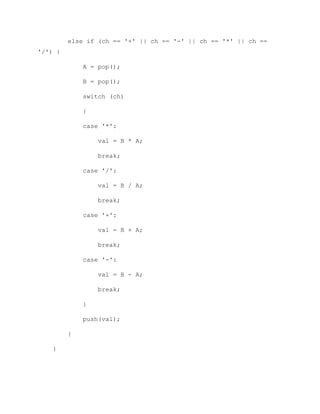
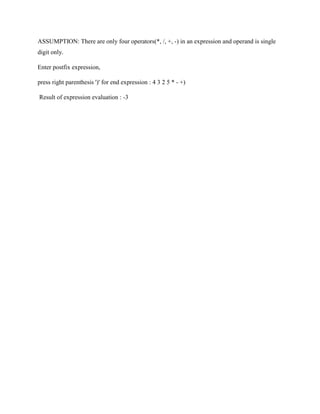
Exp: 4 3 2 5 * - +
Input symbol STACK Operation (B op A)
4 4
3 4, 3
2 4, 3, 2
5 4, 3, 2, 5
* 4, 3, 10 [2*5] (A=5, B=2)](https://image.slidesharecdn.com/applicationsofstack-210706151807/85/Applications-of-stack-7-320.jpg)
![- 4, -7 [3-10] (A=10, B=3)
+ -3 [4+(-7)] (A=-7, B=4)
Sample Code
#include <stdio.h>
#include <ctype.h>
#define MAXSTACK 100
#define POSTFIXSIZE 100
int stack[MAXSTACK];
int top = -1;
void push(int item)
{
if (top >= MAXSTACK - 1) {
printf("stack over flow");
return;
}
else {
top = top + 1;
stack[top] = item;
}
}
int pop()
{](https://image.slidesharecdn.com/applicationsofstack-210706151807/85/Applications-of-stack-8-320.jpg)
![int item;
if (top < 0) {
printf("stack under flow");
}
else {
item = stack[top];
top = top - 1;
return item;
}
}
void EvalPostfix(char postfix[])
{
int i;
char ch;
int val;
int A, B;
for (i = 0; postfix[i] != ')'; i++) {
ch = postfix[i];
if (isdigit(ch)) {
push(ch - '0');
}](https://image.slidesharecdn.com/applicationsofstack-210706151807/85/Applications-of-stack-9-320.jpg)
![printf(" n Result of expression evaluation : %d n",
pop());
}
int main()
{
int i;
char postfix[POSTFIXSIZE];
printf("ASSUMPTION: There are only four operators(*, /, +, -
) in an expression and operand is single digit only.n");
printf(" nEnter postfix expression,npress right
parenthesis ')' for end expression : ");
for (i = 0; i <= POSTFIXSIZE - 1; i++) {
scanf("%c", &postfix[i]);
if (postfix[i] == ')')
{
break;
}
}
EvalPostfix(postfix);
return 0;
}
Sample Output](https://image.slidesharecdn.com/applicationsofstack-210706151807/85/Applications-of-stack-11-320.jpg)

This document discusses the use of stacks to validate arithmetic expressions, converting infix expressions to postfix notation, and evaluating postfix expressions. It outlines the algorithms for checking expression validity, transforming infix to postfix with precedence rules, and evaluating the resulting postfix using a stack. Sample code snippets are provided for each process, demonstrating their implementation in C programming.


![FUNCTIONS IN PYTHON[RANDOM FUNCTION]](https://cdn.slidesharecdn.com/ss_thumbnails/functions2-200924082810-thumbnail.jpg?width=640&height=640&fit=bounds)


