REDUNDACY IN ROBOTICS
GUIDED BY:
Dr. H.J.NAGARSETH
Prof. ANIL MAHTO
PREPARED BY:
MIHIR PATEL
P18CC002
SARDAR VALLABHBHAI PATEL NATIONAL INSTITUTE OF TECHNOLOGY
WHAT IS REDUNDACY ?
• A kinematically redundant robot manipulator is a manipulator that has
more degrees of freedom than necessary to place the end effector at a
desired location.
• For example, if we want to place the end effector in a three
dimensional-space, we need six degrees of freedom: three for
translation and three for orientation.
• Thus, a robot manipulator with more than six degrees of freedom is
kinematically redundant in the three-dimensional space.
• When dealing with redundant manipulators, as the robot has more
degrees of freedom than necessary to perform a certain task, the
remaining degrees of freedom give a set of feasible solutions of the
inverse kinematics. Among these solutions, it is recommended to
choose the one satisfying a certain criterion
• “redundancy” of a robot is thus a relative concept, i.e., it holds with
respect to a given task.
Some tasks and their dimensions
• A planar robot with N=3 joints is redundant for the task of positioning
its E-E in the plane (M=2), but NOT for the task of positioning AND
orienting the E-E in the plane (M=3).
TASKS [ For the end-effector(E-E)] DIMENSION(M)
 Position in the plane 2
 Position in 3D space 3
 Orientation in the plane 1
 Pointing in 3D space 2
 Position and orientation in 3D space 6
INVERSE KINEMATICS
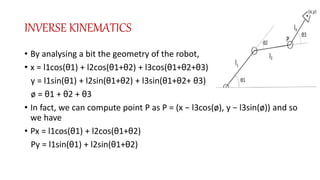
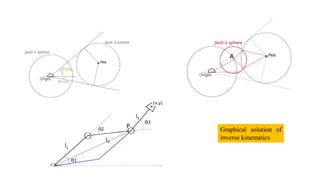
• By analysing a bit the geometry of the robot,
• x = l1cos(θ1) + l2cos(θ1+θ2) + l3cos(θ1+θ2+θ3)
y = l1sin(θ1) + l2sin(θ1+θ2) + l3sin(θ1+θ2+ θ3)
ø = θ1 + θ2 + θ3
• In fact, we can compute point P as P = (x − l3cos(ø), y − l3sin(ø)) and so
we have
• Px = l1cos(θ1) + l2cos(θ1+θ2)
Py = l1sin(θ1) + l2sin(θ1+θ2)
Graphical solution of
inverse kinematics
Typical cases of redundant robots
• 6R robot mounted on a linear track/rail
(For positioning and orienting its end-effector in 3D space)
• 6-dof robot used for arc welding tasks
(Task does not prescribe the final roll angle of the welding gun)
• Manipulator on a mobile base
• Team of cooperating manipulators (or mobile robots)
• Humanoid robots ...
• “kinematic” redundancy is not the only type…
1.Redundancy of components (actuators, sensors)
2.Redundancy in the control/supervision architecture
Uses of robot redundancy
• Avoid collision with obstacles (in Cartesian space) …
• … or kinematic singularities (in joint space)
• Stay within the admissible joint ranges
• Increase manipulability in specified directions
• Uniformly distribute/limit joint velocities and/or accelerations
• Minimize energy consumption or needed motion torques
• Optimize execution time
• Increase dependability with respect to faults
All objectives should be
Quantitatively “measurable”
Disadvantages of redundancy
• Potential benefits should be traded off against
• A greater structural complexity of construction
• Mechanical (more links, transmissions, ...)
• More actuators, sensors, ...
• Costs
• More complicated algorithms for inverse kinematics and motion
control
References
• Smooth Inverse Kinematics Algorithms for Serial Redundant Robots by Adri`a
Colom´
• Robots with kinematic redundancy by Prof. Alessandro De Luca
• Analysis and Control of Robot Manipulators with Kinematic Redundancy by
Pyung H. Chang(MIT Artificial Intelligence Laboratory)
• Inverse Kinematics Solution for Redundant Robot Manipulator using Combination
of GA and NN by Hind Z. Khaleel (Department of Control and Systems
Engineering/ University of Technology/ Baghdad/ Iraq)

Robotics

  • 1.
    REDUNDACY IN ROBOTICS GUIDEDBY: Dr. H.J.NAGARSETH Prof. ANIL MAHTO PREPARED BY: MIHIR PATEL P18CC002 SARDAR VALLABHBHAI PATEL NATIONAL INSTITUTE OF TECHNOLOGY
  • 2.
    WHAT IS REDUNDACY? • A kinematically redundant robot manipulator is a manipulator that has more degrees of freedom than necessary to place the end effector at a desired location. • For example, if we want to place the end effector in a three dimensional-space, we need six degrees of freedom: three for translation and three for orientation. • Thus, a robot manipulator with more than six degrees of freedom is kinematically redundant in the three-dimensional space.
  • 3.
    • When dealingwith redundant manipulators, as the robot has more degrees of freedom than necessary to perform a certain task, the remaining degrees of freedom give a set of feasible solutions of the inverse kinematics. Among these solutions, it is recommended to choose the one satisfying a certain criterion • “redundancy” of a robot is thus a relative concept, i.e., it holds with respect to a given task.
  • 4.
    Some tasks andtheir dimensions • A planar robot with N=3 joints is redundant for the task of positioning its E-E in the plane (M=2), but NOT for the task of positioning AND orienting the E-E in the plane (M=3). TASKS [ For the end-effector(E-E)] DIMENSION(M)  Position in the plane 2  Position in 3D space 3  Orientation in the plane 1  Pointing in 3D space 2  Position and orientation in 3D space 6
  • 5.
    INVERSE KINEMATICS • Byanalysing a bit the geometry of the robot, • x = l1cos(θ1) + l2cos(θ1+θ2) + l3cos(θ1+θ2+θ3) y = l1sin(θ1) + l2sin(θ1+θ2) + l3sin(θ1+θ2+ θ3) ø = θ1 + θ2 + θ3 • In fact, we can compute point P as P = (x − l3cos(ø), y − l3sin(ø)) and so we have • Px = l1cos(θ1) + l2cos(θ1+θ2) Py = l1sin(θ1) + l2sin(θ1+θ2)
  • 6.
  • 7.
    Typical cases ofredundant robots • 6R robot mounted on a linear track/rail (For positioning and orienting its end-effector in 3D space) • 6-dof robot used for arc welding tasks (Task does not prescribe the final roll angle of the welding gun) • Manipulator on a mobile base • Team of cooperating manipulators (or mobile robots) • Humanoid robots ... • “kinematic” redundancy is not the only type… 1.Redundancy of components (actuators, sensors) 2.Redundancy in the control/supervision architecture
  • 8.
    Uses of robotredundancy • Avoid collision with obstacles (in Cartesian space) … • … or kinematic singularities (in joint space) • Stay within the admissible joint ranges • Increase manipulability in specified directions • Uniformly distribute/limit joint velocities and/or accelerations • Minimize energy consumption or needed motion torques • Optimize execution time • Increase dependability with respect to faults All objectives should be Quantitatively “measurable”
  • 9.
    Disadvantages of redundancy •Potential benefits should be traded off against • A greater structural complexity of construction • Mechanical (more links, transmissions, ...) • More actuators, sensors, ... • Costs • More complicated algorithms for inverse kinematics and motion control
  • 10.
    References • Smooth InverseKinematics Algorithms for Serial Redundant Robots by Adri`a Colom´ • Robots with kinematic redundancy by Prof. Alessandro De Luca • Analysis and Control of Robot Manipulators with Kinematic Redundancy by Pyung H. Chang(MIT Artificial Intelligence Laboratory) • Inverse Kinematics Solution for Redundant Robot Manipulator using Combination of GA and NN by Hind Z. Khaleel (Department of Control and Systems Engineering/ University of Technology/ Baghdad/ Iraq)