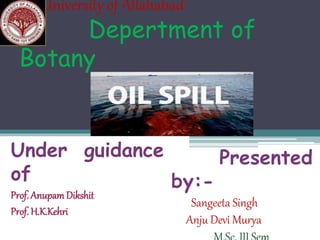
University of Allahabad
Depertment of
Botany
Under guidance
of
Prof. AnupamDikshit
Prof. H.K.Kehri
Presented
by:-
Sangeeta Singh
Anju Devi Murya
What is an Oil Spill?
• An oil spills is the
release of a liquid
petroleum
hydrocarbon into the
environment,
especially marine
areas due to human
activity and is a form
of pollution.
• The term is usually applied to marine oil spills,
where oil is released into the ocean or coastal
waters, but spills may also occur on land.
• It may be due to released of crude oil from
tankers, offshore platforms, drilling rigs and oil
wells as well as during the transport of the
refined petrolium product in vessels and
tankers.
Some important Oil Spills:-
Torrey Canyon -
England
(March 1967)
• By an error in ship
manoeuvring,
releasing 93,000
tonnes of crude oil.
Contaminated 300
kilometres of both
England and France.
Exxon Valdez - United States (March
24, 1989)
• Eight of the eleven tanks damaged, releasing
41,000 tonnes of Alaska Northslope Crude Oil.
• Contaminated 1,900 kilometers of coast.
Kuroshima - United States
(November 26, 1997)
• A 368 foot seafood freighter broke away from its
anchorage during a severe storm and ran around
spilling 145 tonnes of oil. Contaminated
approximately 10 kilometres of shoreline of Summer
Bay on the Aleutian Island of Alaska.
How do oil spills occur?
• Oil Spills may happen for several reasons:-
1. When oil tankers have equipment faults
2. From nature and human activities on
land
3. Water Sports
4. Drilling works carried out in sea
What are the effects of oil spills?
• Effects on fauna in the sea
• Seabirds are strongly affected by oil spills.
• When they get covered in oil, the heavy oil
weights down the birds and is unable to fly.
• Eventually, the bird will die.
The second groups of animals affected
strongly are Killer Whales:-
• Oil affects the killer whales in two ways.
1. Firstly, it plugs up the blowholes of the killer
whales, and the killer whale will be unable to
breathe.
2.Secondly, the Killer Whale may eat fish that
swam through the oil, or fish already poisoned
by the oil, and the killer whales too will get
poisoned by the oil, and will die.
Effects on plants in the sea
• Oil Spills also affect marine plants. The oil forms
a thick layer on the water surface, and this layer
blocks out light and prevents gaseous exchange.
Methods Of Cleaning
• High or low pressure hoses to
spray oil off beaches.
• Sorbents
▫ Large sponges that collect
oil.
• Booms
▫ Collects oil off the water.
• Controlled Burning
▫ Reduces amount of oil.
• Skimmers
▫ Boats that removes the oil.
Ways of Preventing Oil Spills
• Navigation
▫ Coast Guard must know where
the tankers can drive.
• Inspect equipment more.
• Double Hulling
▫ 2 layers of watertight hull surface
▫ Prevent/reduces oil spills.
• Careful as possible when transporting.
Double Hull
Control of Oil spills
• Oil spills on land and at sea represents some of
the most dramatic examples of chemical
pollution.
• Bacteria, that are especially effective in
degrading petroleum products can be selected
and applied to such spill.
• Pseudomonas, Desufovibria deslfuricans
are used in controlling of oil spills.
Bioremediation
• Indigenous bacteria that can utilize “the spilled
oil are also stimulated into activity by the
additional nutrients. This is termed
Bioremediation.
• Some bacteria such as Sulfate reducing bacteria
which are anaerobic (can survive without
oxygen) can be used to clean up oil spills are
they are oil consuming bacteria.
• Bio-remediation accelerator is
another approach which entails
using chemicals to chemically
and physically bond the
hydrocarbon oil molecules.
• What this does is to cause the
oil molecules to aggregate and
float towards the surface of the
water column.
• Undetected hydrocarbon
molecules can be aggregated in
this way.
Superbug:-
• Psedomonas that is able to consume all types
of hydrocarbons of the oil and petrol.
• This unique strain is called “Superbug”.
• This unique strain was created by Ananda
Chakrabarty(1979).
Impacts of a Major Oil Spill
• Destroys Marine Life
• Destabilizes Marine
Communities
• Degrades Shore
Amenities
• Harms Economic
Activities
• Impacts Human Welfare
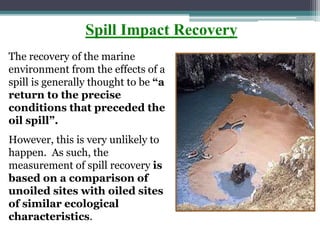
Spill Impact Recovery
The recovery of the marine
environment from the effects of a
spill is generally thought to be “a
return to the precise
conditions that preceded the
oil spill”.
However, this is very unlikely to
happen. As such, the
measurement of spill recovery is
based on a comparison of
unoiled sites with oiled sites
of similar ecological
characteristics.
Shoreline Cleanup and Assessment
When a spill occurs, Canada utilizes the Shoreline Cleanup and
Assessment Team (SCAT) process adopted from Alaska to
determine when and how each individual shoreline will be cleaned
based on geomorphological, ecological and archaeological factors.
References:-
• Principles of Microbiology by Ronald M.
Atlas.
• Microbiology an Introduction by Torta
Funke Case.
• Microbiology- sixth edition by John M.
Prescott, John P. Harley, Donald A. Klen.
• WWW. Google Com.
Questions:-
• What is Oil Spills?
• How do oil spills occur?
• What are effects on fauna in the sea?
• What are effects on flora in the sea?
• How do control of oil Spills?
• What is Bioremediation?
• What is Superbug?
Thank you

Oil splis 2

  • 1.
    University of Allahabad Depertmentof Botany Under guidance of Prof. AnupamDikshit Prof. H.K.Kehri Presented by:- Sangeeta Singh Anju Devi Murya
  • 2.
    What is anOil Spill? • An oil spills is the release of a liquid petroleum hydrocarbon into the environment, especially marine areas due to human activity and is a form of pollution.
  • 3.
    • The termis usually applied to marine oil spills, where oil is released into the ocean or coastal waters, but spills may also occur on land. • It may be due to released of crude oil from tankers, offshore platforms, drilling rigs and oil wells as well as during the transport of the refined petrolium product in vessels and tankers.
  • 4.
    Some important OilSpills:- Torrey Canyon - England (March 1967) • By an error in ship manoeuvring, releasing 93,000 tonnes of crude oil. Contaminated 300 kilometres of both England and France.
  • 5.
    Exxon Valdez -United States (March 24, 1989) • Eight of the eleven tanks damaged, releasing 41,000 tonnes of Alaska Northslope Crude Oil. • Contaminated 1,900 kilometers of coast.
  • 6.
    Kuroshima - UnitedStates (November 26, 1997) • A 368 foot seafood freighter broke away from its anchorage during a severe storm and ran around spilling 145 tonnes of oil. Contaminated approximately 10 kilometres of shoreline of Summer Bay on the Aleutian Island of Alaska.
  • 7.
    How do oilspills occur? • Oil Spills may happen for several reasons:- 1. When oil tankers have equipment faults 2. From nature and human activities on land 3. Water Sports 4. Drilling works carried out in sea
  • 8.
    What are theeffects of oil spills? • Effects on fauna in the sea • Seabirds are strongly affected by oil spills. • When they get covered in oil, the heavy oil weights down the birds and is unable to fly. • Eventually, the bird will die.
  • 9.
    The second groupsof animals affected strongly are Killer Whales:- • Oil affects the killer whales in two ways. 1. Firstly, it plugs up the blowholes of the killer whales, and the killer whale will be unable to breathe.
  • 10.
    2.Secondly, the KillerWhale may eat fish that swam through the oil, or fish already poisoned by the oil, and the killer whales too will get poisoned by the oil, and will die.
  • 11.
    Effects on plantsin the sea • Oil Spills also affect marine plants. The oil forms a thick layer on the water surface, and this layer blocks out light and prevents gaseous exchange.
  • 12.
    Methods Of Cleaning •High or low pressure hoses to spray oil off beaches. • Sorbents ▫ Large sponges that collect oil. • Booms ▫ Collects oil off the water. • Controlled Burning ▫ Reduces amount of oil. • Skimmers ▫ Boats that removes the oil.
  • 13.
    Ways of PreventingOil Spills • Navigation ▫ Coast Guard must know where the tankers can drive. • Inspect equipment more. • Double Hulling ▫ 2 layers of watertight hull surface ▫ Prevent/reduces oil spills. • Careful as possible when transporting. Double Hull
  • 14.
    Control of Oilspills • Oil spills on land and at sea represents some of the most dramatic examples of chemical pollution. • Bacteria, that are especially effective in degrading petroleum products can be selected and applied to such spill. • Pseudomonas, Desufovibria deslfuricans are used in controlling of oil spills.
  • 15.
    Bioremediation • Indigenous bacteriathat can utilize “the spilled oil are also stimulated into activity by the additional nutrients. This is termed Bioremediation. • Some bacteria such as Sulfate reducing bacteria which are anaerobic (can survive without oxygen) can be used to clean up oil spills are they are oil consuming bacteria.
  • 16.
    • Bio-remediation acceleratoris another approach which entails using chemicals to chemically and physically bond the hydrocarbon oil molecules. • What this does is to cause the oil molecules to aggregate and float towards the surface of the water column. • Undetected hydrocarbon molecules can be aggregated in this way.
  • 17.
    Superbug:- • Psedomonas thatis able to consume all types of hydrocarbons of the oil and petrol. • This unique strain is called “Superbug”. • This unique strain was created by Ananda Chakrabarty(1979).
  • 18.
    Impacts of aMajor Oil Spill • Destroys Marine Life • Destabilizes Marine Communities • Degrades Shore Amenities • Harms Economic Activities • Impacts Human Welfare
  • 19.
    Spill Impact Recovery Therecovery of the marine environment from the effects of a spill is generally thought to be “a return to the precise conditions that preceded the oil spill”. However, this is very unlikely to happen. As such, the measurement of spill recovery is based on a comparison of unoiled sites with oiled sites of similar ecological characteristics.
  • 20.
    Shoreline Cleanup andAssessment When a spill occurs, Canada utilizes the Shoreline Cleanup and Assessment Team (SCAT) process adopted from Alaska to determine when and how each individual shoreline will be cleaned based on geomorphological, ecological and archaeological factors.
  • 21.
    References:- • Principles ofMicrobiology by Ronald M. Atlas. • Microbiology an Introduction by Torta Funke Case. • Microbiology- sixth edition by John M. Prescott, John P. Harley, Donald A. Klen. • WWW. Google Com.
  • 22.
    Questions:- • What isOil Spills? • How do oil spills occur? • What are effects on fauna in the sea? • What are effects on flora in the sea? • How do control of oil Spills? • What is Bioremediation? • What is Superbug?
  • 23.