11/8/2021 A Chandran ACE Learning Hub Mob:93600 48588 1
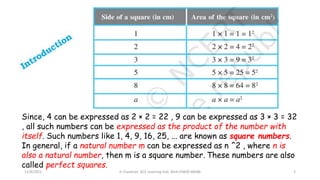
Since, 4 can be expressed as 2 × 2 = 22 , 9 can be expressed as 3 × 3 = 32
, all such numbers can be expressed as the product of the number with
itself. Such numbers like 1, 4, 9, 16, 25, ... are known as square numbers.
In general, if a natural number m can be expressed as n ^2 , where n is
also a natural number, then m is a square number. These numbers are also
called perfect squares.
11/8/2021 A Chandran ACE Learning Hub Mob:93600 48588 2
11/8/2021 A Chandran ACE Learning Hub Mob:93600 48588 3
11/8/2021 A Chandran ACE Learning Hub Mob:93600 48588 4
11/8/2021 A Chandran ACE Learning Hub Mob:93600 48588 5
11/8/2021 A Chandran ACE Learning Hub Mob:93600 48588 6
Numbers between square numbers
11/8/2021 A Chandran ACE Learning Hub Mob:93600 48588 7
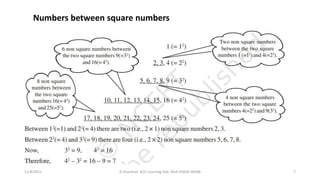
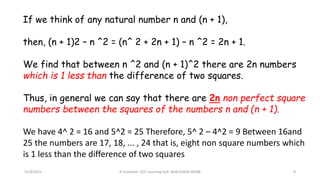
If we think of any natural number n and (n + 1),
then, (n + 1)2 – n ^2 = (n^ 2 + 2n + 1) – n ^2 = 2n + 1.
We find that between n ^2 and (n + 1)^2 there are 2n numbers
which is 1 less than the difference of two squares.
Thus, in general we can say that there are 2n non perfect square
numbers between the squares of the numbers n and (n + 1).
We have 4^ 2 = 16 and 5^2 = 25 Therefore, 5^ 2 – 4^2 = 9 Between 16and
25 the numbers are 17, 18, ... , 24 that is, eight non square numbers which
is 1 less than the difference of two squares
11/8/2021 A Chandran ACE Learning Hub Mob:93600 48588 8
11/8/2021 A Chandran ACE Learning Hub Mob:93600 48588 9
11/8/2021 A Chandran ACE Learning Hub Mob:93600 48588 10
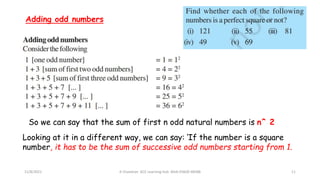
Adding odd numbers
So we can say that the sum of first n odd natural numbers is n^ 2
Looking at it in a different way, we can say: ‘If the number is a square
number, it has to be the sum of successive odd numbers starting from 1.
11/8/2021 A Chandran ACE Learning Hub Mob:93600 48588 11
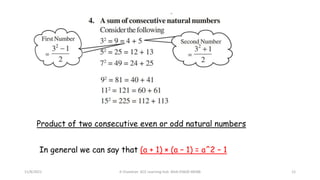
Product of two consecutive even or odd natural numbers
In general we can say that (a + 1) × (a – 1) = a^2 – 1
11/8/2021 A Chandran ACE Learning Hub Mob:93600 48588 12
11/8/2021 A Chandran ACE Learning Hub Mob:93600 48588 13
11/8/2021 A Chandran ACE Learning Hub Mob:93600 48588 14
11/8/2021 A Chandran ACE Learning Hub Mob:93600 48588 15
11/8/2021 A Chandran ACE Learning Hub Mob:93600 48588 16
11/8/2021 A Chandran ACE Learning Hub Mob:93600 48588 17
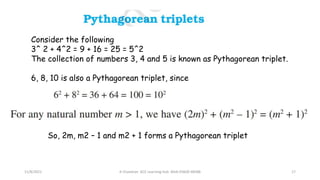
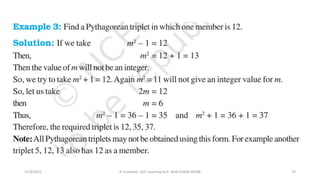
Consider the following
3^ 2 + 4^2 = 9 + 16 = 25 = 5^2
The collection of numbers 3, 4 and 5 is known as Pythagorean triplet.
6, 8, 10 is also a Pythagorean triplet, since
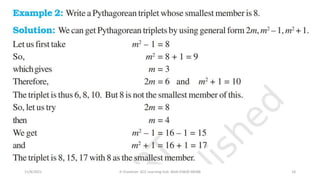
So, 2m, m2 – 1 and m2 + 1 forms a Pythagorean triplet
11/8/2021 A Chandran ACE Learning Hub Mob:93600 48588 18
11/8/2021 A Chandran ACE Learning Hub Mob:93600 48588 19
11/8/2021 A Chandran ACE Learning Hub Mob:93600 48588 20
11/8/2021 A Chandran ACE Learning Hub Mob:93600 48588 21
11/8/2021 A Chandran ACE Learning Hub Mob:93600 48588 22
11/8/2021 A Chandran ACE Learning Hub Mob:93600 48588 23
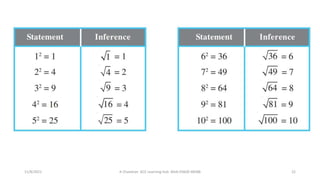
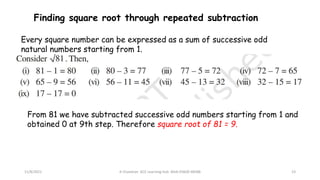
Finding square root through repeated subtraction
Every square number can be expressed as a sum of successive odd
natural numbers starting from 1.
From 81 we have subtracted successive odd numbers starting from 1 and
obtained 0 at 9th step. Therefore square root of 81 = 9.
11/8/2021 A Chandran ACE Learning Hub Mob:93600 48588 24
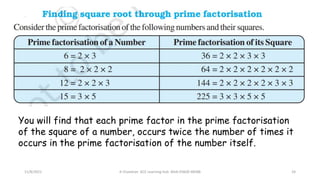
You will find that each prime factor in the prime factorisation
of the square of a number, occurs twice the number of times it
occurs in the prime factorisation of the number itself.
11/8/2021 A Chandran ACE Learning Hub Mob:93600 48588 25
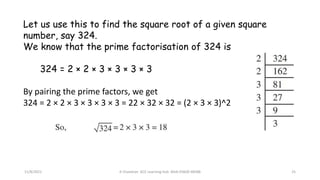
Let us use this to find the square root of a given square
number, say 324.
We know that the prime factorisation of 324 is
324 = 2 × 2 × 3 × 3 × 3 × 3
By pairing the prime factors, we get
324 = 2 × 2 × 3 × 3 × 3 × 3 = 22 × 32 × 32 = (2 × 3 × 3)^2
11/8/2021 A Chandran ACE Learning Hub Mob:93600 48588 26
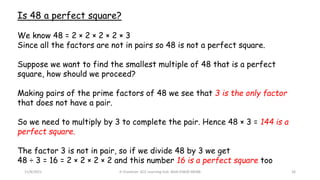
Is 48 a perfect square?
We know 48 = 2 × 2 × 2 × 2 × 3
Since all the factors are not in pairs so 48 is not a perfect square.
Suppose we want to find the smallest multiple of 48 that is a perfect
square, how should we proceed?
Making pairs of the prime factors of 48 we see that 3 is the only factor
that does not have a pair.
So we need to multiply by 3 to complete the pair. Hence 48 × 3 = 144 is a
perfect square.
The factor 3 is not in pair, so if we divide 48 by 3 we get
48 ÷ 3 = 16 = 2 × 2 × 2 × 2 and this number 16 is a perfect square too
11/8/2021 A Chandran ACE Learning Hub Mob:93600 48588 27
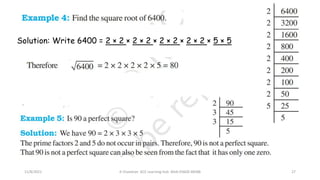
Solution: Write 6400 = 2 × 2 × 2 × 2 × 2 × 2 × 2 × 2 × 5 × 5
11/8/2021 A Chandran ACE Learning Hub Mob:93600 48588 28
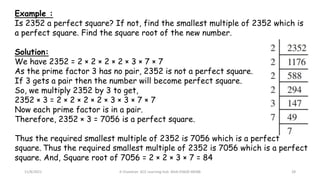
Example :
Is 2352 a perfect square? If not, find the smallest multiple of 2352 which is
a perfect square. Find the square root of the new number.
Solution:
We have 2352 = 2 × 2 × 2 × 2 × 3 × 7 × 7
As the prime factor 3 has no pair, 2352 is not a perfect square.
If 3 gets a pair then the number will become perfect square.
So, we multiply 2352 by 3 to get,
2352 × 3 = 2 × 2 × 2 × 2 × 3 × 3 × 7 × 7
Now each prime factor is in a pair.
Therefore, 2352 × 3 = 7056 is a perfect square.
Thus the required smallest multiple of 2352 is 7056 which is a perfect
square. Thus the required smallest multiple of 2352 is 7056 which is a perfect
square. And, Square root of 7056 = 2 × 2 × 3 × 7 = 84
11/8/2021 A Chandran ACE Learning Hub Mob:93600 48588 29
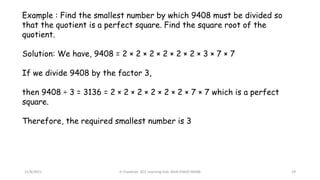
Example : Find the smallest number by which 9408 must be divided so
that the quotient is a perfect square. Find the square root of the
quotient.
Solution: We have, 9408 = 2 × 2 × 2 × 2 × 2 × 2 × 3 × 7 × 7
If we divide 9408 by the factor 3,
then 9408 ÷ 3 = 3136 = 2 × 2 × 2 × 2 × 2 × 2 × 7 × 7 which is a perfect
square.
Therefore, the required smallest number is 3
11/8/2021 A Chandran ACE Learning Hub Mob:93600 48588 30
11/8/2021 A Chandran ACE Learning Hub Mob:93600 48588 31
11/8/2021 A Chandran ACE Learning Hub Mob:93600 48588 32
11/8/2021 A Chandran ACE Learning Hub Mob:93600 48588 33

Ch 6. square and squareroots

  • 1.
    11/8/2021 A ChandranACE Learning Hub Mob:93600 48588 1
  • 2.
    Since, 4 canbe expressed as 2 × 2 = 22 , 9 can be expressed as 3 × 3 = 32 , all such numbers can be expressed as the product of the number with itself. Such numbers like 1, 4, 9, 16, 25, ... are known as square numbers. In general, if a natural number m can be expressed as n ^2 , where n is also a natural number, then m is a square number. These numbers are also called perfect squares. 11/8/2021 A Chandran ACE Learning Hub Mob:93600 48588 2
  • 3.
    11/8/2021 A ChandranACE Learning Hub Mob:93600 48588 3
  • 4.
    11/8/2021 A ChandranACE Learning Hub Mob:93600 48588 4
  • 5.
    11/8/2021 A ChandranACE Learning Hub Mob:93600 48588 5
  • 6.
    11/8/2021 A ChandranACE Learning Hub Mob:93600 48588 6
  • 7.
    Numbers between squarenumbers 11/8/2021 A Chandran ACE Learning Hub Mob:93600 48588 7
  • 8.
    If we thinkof any natural number n and (n + 1), then, (n + 1)2 – n ^2 = (n^ 2 + 2n + 1) – n ^2 = 2n + 1. We find that between n ^2 and (n + 1)^2 there are 2n numbers which is 1 less than the difference of two squares. Thus, in general we can say that there are 2n non perfect square numbers between the squares of the numbers n and (n + 1). We have 4^ 2 = 16 and 5^2 = 25 Therefore, 5^ 2 – 4^2 = 9 Between 16and 25 the numbers are 17, 18, ... , 24 that is, eight non square numbers which is 1 less than the difference of two squares 11/8/2021 A Chandran ACE Learning Hub Mob:93600 48588 8
  • 9.
    11/8/2021 A ChandranACE Learning Hub Mob:93600 48588 9
  • 10.
    11/8/2021 A ChandranACE Learning Hub Mob:93600 48588 10
  • 11.
    Adding odd numbers Sowe can say that the sum of first n odd natural numbers is n^ 2 Looking at it in a different way, we can say: ‘If the number is a square number, it has to be the sum of successive odd numbers starting from 1. 11/8/2021 A Chandran ACE Learning Hub Mob:93600 48588 11
  • 12.
    Product of twoconsecutive even or odd natural numbers In general we can say that (a + 1) × (a – 1) = a^2 – 1 11/8/2021 A Chandran ACE Learning Hub Mob:93600 48588 12
  • 13.
    11/8/2021 A ChandranACE Learning Hub Mob:93600 48588 13
  • 14.
    11/8/2021 A ChandranACE Learning Hub Mob:93600 48588 14
  • 15.
    11/8/2021 A ChandranACE Learning Hub Mob:93600 48588 15
  • 16.
    11/8/2021 A ChandranACE Learning Hub Mob:93600 48588 16
  • 17.
    11/8/2021 A ChandranACE Learning Hub Mob:93600 48588 17 Consider the following 3^ 2 + 4^2 = 9 + 16 = 25 = 5^2 The collection of numbers 3, 4 and 5 is known as Pythagorean triplet. 6, 8, 10 is also a Pythagorean triplet, since So, 2m, m2 – 1 and m2 + 1 forms a Pythagorean triplet
  • 18.
    11/8/2021 A ChandranACE Learning Hub Mob:93600 48588 18
  • 19.
    11/8/2021 A ChandranACE Learning Hub Mob:93600 48588 19
  • 20.
    11/8/2021 A ChandranACE Learning Hub Mob:93600 48588 20
  • 21.
    11/8/2021 A ChandranACE Learning Hub Mob:93600 48588 21
  • 22.
    11/8/2021 A ChandranACE Learning Hub Mob:93600 48588 22
  • 23.
    11/8/2021 A ChandranACE Learning Hub Mob:93600 48588 23 Finding square root through repeated subtraction Every square number can be expressed as a sum of successive odd natural numbers starting from 1. From 81 we have subtracted successive odd numbers starting from 1 and obtained 0 at 9th step. Therefore square root of 81 = 9.
  • 24.
    11/8/2021 A ChandranACE Learning Hub Mob:93600 48588 24 You will find that each prime factor in the prime factorisation of the square of a number, occurs twice the number of times it occurs in the prime factorisation of the number itself.
  • 25.
    11/8/2021 A ChandranACE Learning Hub Mob:93600 48588 25 Let us use this to find the square root of a given square number, say 324. We know that the prime factorisation of 324 is 324 = 2 × 2 × 3 × 3 × 3 × 3 By pairing the prime factors, we get 324 = 2 × 2 × 3 × 3 × 3 × 3 = 22 × 32 × 32 = (2 × 3 × 3)^2
  • 26.
    11/8/2021 A ChandranACE Learning Hub Mob:93600 48588 26 Is 48 a perfect square? We know 48 = 2 × 2 × 2 × 2 × 3 Since all the factors are not in pairs so 48 is not a perfect square. Suppose we want to find the smallest multiple of 48 that is a perfect square, how should we proceed? Making pairs of the prime factors of 48 we see that 3 is the only factor that does not have a pair. So we need to multiply by 3 to complete the pair. Hence 48 × 3 = 144 is a perfect square. The factor 3 is not in pair, so if we divide 48 by 3 we get 48 ÷ 3 = 16 = 2 × 2 × 2 × 2 and this number 16 is a perfect square too
  • 27.
    11/8/2021 A ChandranACE Learning Hub Mob:93600 48588 27 Solution: Write 6400 = 2 × 2 × 2 × 2 × 2 × 2 × 2 × 2 × 5 × 5
  • 28.
    11/8/2021 A ChandranACE Learning Hub Mob:93600 48588 28 Example : Is 2352 a perfect square? If not, find the smallest multiple of 2352 which is a perfect square. Find the square root of the new number. Solution: We have 2352 = 2 × 2 × 2 × 2 × 3 × 7 × 7 As the prime factor 3 has no pair, 2352 is not a perfect square. If 3 gets a pair then the number will become perfect square. So, we multiply 2352 by 3 to get, 2352 × 3 = 2 × 2 × 2 × 2 × 3 × 3 × 7 × 7 Now each prime factor is in a pair. Therefore, 2352 × 3 = 7056 is a perfect square. Thus the required smallest multiple of 2352 is 7056 which is a perfect square. Thus the required smallest multiple of 2352 is 7056 which is a perfect square. And, Square root of 7056 = 2 × 2 × 3 × 7 = 84
  • 29.
    11/8/2021 A ChandranACE Learning Hub Mob:93600 48588 29 Example : Find the smallest number by which 9408 must be divided so that the quotient is a perfect square. Find the square root of the quotient. Solution: We have, 9408 = 2 × 2 × 2 × 2 × 2 × 2 × 3 × 7 × 7 If we divide 9408 by the factor 3, then 9408 ÷ 3 = 3136 = 2 × 2 × 2 × 2 × 2 × 2 × 7 × 7 which is a perfect square. Therefore, the required smallest number is 3
  • 30.
    11/8/2021 A ChandranACE Learning Hub Mob:93600 48588 30
  • 31.
    11/8/2021 A ChandranACE Learning Hub Mob:93600 48588 31
  • 32.
    11/8/2021 A ChandranACE Learning Hub Mob:93600 48588 32
  • 33.
    11/8/2021 A ChandranACE Learning Hub Mob:93600 48588 33