Retroperitoneal Endoscopic Necrosectomy & “NOTES Pancreatic Necrosectomy” Hakan Yanar MD İstanbul Faculty of Medicine General Surgery Service İstanbul, Turkey  12 th European Congress of Trauma and Emergency Surgery April, 27-30, 2011, Milan
Acute Pancreatitis Parenchymal necrosis: 10-25% Mild: Non-necrotizing – edematous (80-85%) Mortality 0-3% Severe: Necrotizing pancreatitis (15-20%) Steril necrosis: 0-11% Infected necrosis: 40 % on average, up to 70% Hughes SJ, et al. Clin N Am, 2007 Isaji S, J Hepatobiliary Pancreat surg, 2006
 
Management of the severe pancreatitis  Early Phase Interventions -  Diagnosis of pancreatic necrosis: Role of Imaging, CT The use of prophylactic Ab Nutrition Renal insufficiency and medical management considerations Indications for early operative intervention
Management of the severe pancreatitis  Late Phase Interventions Surgical approaches, timing, and complications ->  Delayed intervention (>2 weeks)  ->  decreased mortality The standart of care for operative management is not well estabilished!!
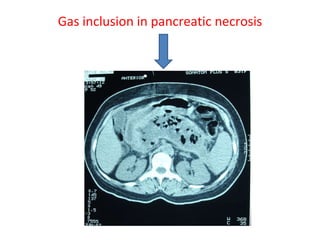
Infected necrosis diagnosis Infection of the necrotic tissue should be considered   in case of fever  >  38.5 ° C, leukocytosis, increasing plasma   C-reactive protein (CRP)  and procalcitonine (PCT)  or rapid clinical deterioration. Signs of gas inclusion in pancreatic or extrapancreatic necrosis   are highly suspicious for infection  . Whitcomb DC: N Engl J  Med 2006; 354: 2142–215
Hughes SJ, et al. Gastroenterol Clin N Am, 2007
When? T iming of surgery to   debride non-viable pancreas (necrosectomy) after acute   pancreatitis is clearly changing,  N ecrosectomy is usually reserved   for persistently febrile patients who fail to respond to broad   spectrum   a b’s  with or without percutaneous drainage   of fluid collections over 72 h or more.
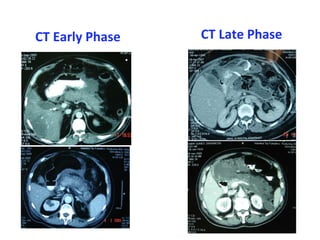
CT Diagnosis  As classified  in  Atlanta   Symposium ,  on contrast-enhanced   CT, the necrotic pancreatic tissue presents as diffuse or   focal area with decreased or missing contrast enhancement   compared to normal pancreatic parenchyma .
CT Early Phase CT Late Phase
Endo US Endoscopic ultrasound:  - to define the optimal puncture   position  - to exclude vessel interposition.
Conventional management Open necrosectomy and po irrigation With MOF mortality 40-60% Charnley RM. Endoscopy, 2006,  Slavin J, et al. World J Gastroenterol .  2001 Rau B, et al.  Gut. 1997
 
OPEN SURGERY IS
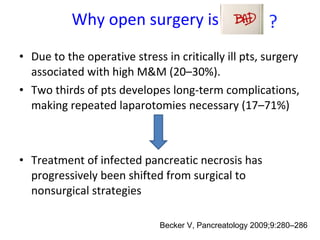
Why open surgery is D ue to the operative stress in critically ill pts,  surgery  associated with high  M&M  (20–30%).  T wo thirds of pts develope s  long-term complications,   making repeated laparotomies necessary (17–71%) T reatment of infected pancreatic necrosis   has progressively been shifted from surgical to nonsurgical   strategies Becker V, Pancreatology 2009;9:280–286 ?
Which  management  technique  of infected necroses
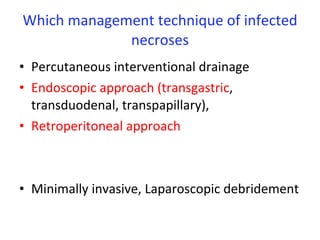
Which  management  technique  of infected necroses Percutaneous interventional drainage Endoscopic approach (transgastric , transduodenal, transpapillary),  Retroperitoneal approach Minimally invasive, Laparoscopic debridement
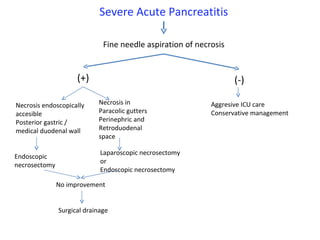
Severe Acute Pancreatitis Fine needle aspiration of necrosis (+) (-) Aggresive ICU care Conservative management Necrosis endoscopically accesible  Posterior gastric / medical duodenal wall Necrosis in Paracolic gutters Perinephric and Retroduodenal space Endoscopic necrosectomy Laparoscopic necrosectomy or Endoscopic necrosectomy No improvement Surgical drainage
“ Laparoscopic debridement” Advantages: -Complete removal of sequestrum possible  -Access to the lesser sac, paracolic gutters,   perinephric space, retro duodenal space for drainage possible Disadvantage: -More invasive compared to other endoscopic techni q ues  -Safety of pneumoperitoneum in critically il l  patients questionable  -Risk of intraperitoneal infection transmission rate (36%)
“ Percutaneous interventional drainage” Advantages: -Avoids the need for surgery in criticaly ill patients -Drainage of infected fluid under pressure aids healing Disadvantage: -Need for repeated drainage with   high morbidity  -Central gland necrosis not   amenable to curative treatment  -Increased risk of fistula  -Failure rate of 31-87%  -Adjunctive treatment often  required. Freeny PC, AJR Am J Roentgenol.1998
“ Endoscopic approach” Advantages: - Risk of fistula formation less - Less invasive and lesser   morbidity and mortality  - Can be used in poor risk  surgical candidates Disadvantage: Necrosis needs to  w alled off for effective drainage Local bleeding risk (0-32%) Single endoscopic procedures   are often insufficient in   treatment of huge necrotic areas   containing  large  amounts of solid or purulent necrotic   material.
 
Equipment Duodenoscope EUS  Pig tail  Balloon dilatation Basket catheter Double J stent Guide wire Needle knife Electrocautery
Case 1/  Percutaneous drainage plus endoscopic trans-gastric necrosectomy 53 yo, F Referred necrotizing pancreatitis, vomiting, abdominal distantion,  WBC: 18300, temperature: 39  º C, CRP: 254 mg/L, CT: huge pseudocyst Percutaneous drainage was unsuccesfull
 
Gas inclusion in pancreatic necrosis
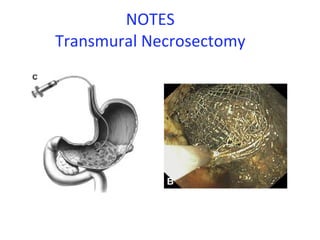
NOTES Transmural Necrosectomy
 
 
Vaka 4
Retroperitoneal approach Advantages: -Can be used in critically  ill  patients  w here laparoscopic access not possible  -Subsequent liquefied necrosis drained by  g ravity -No intraperitoneal infection transmission  -Lesser bleeding risk Disadvantage: -More invasive compared to other endoscopic techniques  -Need for repeated procedures for effective drainage  (May not be required if liquefied)
The endoscope introduced   through   the mature drainage tube sinus tract after formal open   necrosectomy.  “ S inus tract endoscopy” can remove   both the residual necrosum and the ongoing developing   necrosis. In a series of 11 consecutive patients   this procedure had no added   morbidity/mortality, facilitated lavage, minimised the   need for subsequent surgeries .
Minimally Invasive Technique Retroperitoneal Necrosectomy
Case 2/  Minimally Invasive Technique Retroperitoneal Necrosectomy 57,M Temp: 38,9  º C CRP: 215 WBC: 16700 Percutaneous drainage was ineffective (2 times)
 
 
Before After
Case 3/ Endoscopic cystogastrostomy- stending 62 yo M Abdominal pain, vomiting Acute biliary pancreatitis,
August 18
September 15 Before endoscopic cystogastrostomy
 
October 3  After endoscopic cystogastrostomy
October 18, re-cyctogastrostomy /2nd seance
December, 13
 
THANK YOU!
 
 
46, M Ranson 3, biliary pancreatitis Vomiting in 3th week, abdominal distantion BT:


Retroperitoneal endoscopic necrosectomy

  • 1.
    Retroperitoneal Endoscopic Necrosectomy& “NOTES Pancreatic Necrosectomy” Hakan Yanar MD İstanbul Faculty of Medicine General Surgery Service İstanbul, Turkey 12 th European Congress of Trauma and Emergency Surgery April, 27-30, 2011, Milan
  • 2.
    Acute Pancreatitis Parenchymalnecrosis: 10-25% Mild: Non-necrotizing – edematous (80-85%) Mortality 0-3% Severe: Necrotizing pancreatitis (15-20%) Steril necrosis: 0-11% Infected necrosis: 40 % on average, up to 70% Hughes SJ, et al. Clin N Am, 2007 Isaji S, J Hepatobiliary Pancreat surg, 2006
  • 3.
  • 4.
    Management of thesevere pancreatitis Early Phase Interventions - Diagnosis of pancreatic necrosis: Role of Imaging, CT The use of prophylactic Ab Nutrition Renal insufficiency and medical management considerations Indications for early operative intervention
  • 5.
    Management of thesevere pancreatitis Late Phase Interventions Surgical approaches, timing, and complications -> Delayed intervention (>2 weeks) -> decreased mortality The standart of care for operative management is not well estabilished!!
  • 6.
    Infected necrosis diagnosisInfection of the necrotic tissue should be considered in case of fever > 38.5 ° C, leukocytosis, increasing plasma C-reactive protein (CRP) and procalcitonine (PCT) or rapid clinical deterioration. Signs of gas inclusion in pancreatic or extrapancreatic necrosis are highly suspicious for infection . Whitcomb DC: N Engl J Med 2006; 354: 2142–215
  • 7.
    Hughes SJ, etal. Gastroenterol Clin N Am, 2007
  • 8.
    When? T imingof surgery to debride non-viable pancreas (necrosectomy) after acute pancreatitis is clearly changing, N ecrosectomy is usually reserved for persistently febrile patients who fail to respond to broad spectrum a b’s with or without percutaneous drainage of fluid collections over 72 h or more.
  • 9.
    CT Diagnosis As classified in Atlanta Symposium , on contrast-enhanced CT, the necrotic pancreatic tissue presents as diffuse or focal area with decreased or missing contrast enhancement compared to normal pancreatic parenchyma .
  • 10.
    CT Early PhaseCT Late Phase
  • 11.
    Endo US Endoscopicultrasound: - to define the optimal puncture position - to exclude vessel interposition.
  • 12.
    Conventional management Opennecrosectomy and po irrigation With MOF mortality 40-60% Charnley RM. Endoscopy, 2006, Slavin J, et al. World J Gastroenterol . 2001 Rau B, et al. Gut. 1997
  • 13.
  • 14.
  • 15.
    Why open surgeryis D ue to the operative stress in critically ill pts, surgery associated with high M&M (20–30%). T wo thirds of pts develope s long-term complications, making repeated laparotomies necessary (17–71%) T reatment of infected pancreatic necrosis has progressively been shifted from surgical to nonsurgical strategies Becker V, Pancreatology 2009;9:280–286 ?
  • 16.
    Which management technique of infected necroses
  • 17.
    Which management technique of infected necroses Percutaneous interventional drainage Endoscopic approach (transgastric , transduodenal, transpapillary), Retroperitoneal approach Minimally invasive, Laparoscopic debridement
  • 18.
    Severe Acute PancreatitisFine needle aspiration of necrosis (+) (-) Aggresive ICU care Conservative management Necrosis endoscopically accesible Posterior gastric / medical duodenal wall Necrosis in Paracolic gutters Perinephric and Retroduodenal space Endoscopic necrosectomy Laparoscopic necrosectomy or Endoscopic necrosectomy No improvement Surgical drainage
  • 19.
    “ Laparoscopic debridement”Advantages: -Complete removal of sequestrum possible -Access to the lesser sac, paracolic gutters, perinephric space, retro duodenal space for drainage possible Disadvantage: -More invasive compared to other endoscopic techni q ues -Safety of pneumoperitoneum in critically il l patients questionable -Risk of intraperitoneal infection transmission rate (36%)
  • 20.
    “ Percutaneous interventionaldrainage” Advantages: -Avoids the need for surgery in criticaly ill patients -Drainage of infected fluid under pressure aids healing Disadvantage: -Need for repeated drainage with high morbidity -Central gland necrosis not amenable to curative treatment -Increased risk of fistula -Failure rate of 31-87% -Adjunctive treatment often required. Freeny PC, AJR Am J Roentgenol.1998
  • 21.
    “ Endoscopic approach”Advantages: - Risk of fistula formation less - Less invasive and lesser morbidity and mortality - Can be used in poor risk surgical candidates Disadvantage: Necrosis needs to w alled off for effective drainage Local bleeding risk (0-32%) Single endoscopic procedures are often insufficient in treatment of huge necrotic areas containing large amounts of solid or purulent necrotic material.
  • 22.
  • 23.
    Equipment Duodenoscope EUS Pig tail Balloon dilatation Basket catheter Double J stent Guide wire Needle knife Electrocautery
  • 24.
    Case 1/ Percutaneous drainage plus endoscopic trans-gastric necrosectomy 53 yo, F Referred necrotizing pancreatitis, vomiting, abdominal distantion, WBC: 18300, temperature: 39 º C, CRP: 254 mg/L, CT: huge pseudocyst Percutaneous drainage was unsuccesfull
  • 25.
  • 26.
    Gas inclusion inpancreatic necrosis
  • 27.
  • 28.
  • 29.
  • 30.
  • 31.
    Retroperitoneal approach Advantages:-Can be used in critically ill patients w here laparoscopic access not possible -Subsequent liquefied necrosis drained by g ravity -No intraperitoneal infection transmission -Lesser bleeding risk Disadvantage: -More invasive compared to other endoscopic techniques -Need for repeated procedures for effective drainage (May not be required if liquefied)
  • 32.
    The endoscope introduced through the mature drainage tube sinus tract after formal open necrosectomy. “ S inus tract endoscopy” can remove both the residual necrosum and the ongoing developing necrosis. In a series of 11 consecutive patients this procedure had no added morbidity/mortality, facilitated lavage, minimised the need for subsequent surgeries .
  • 33.
    Minimally Invasive TechniqueRetroperitoneal Necrosectomy
  • 34.
    Case 2/ Minimally Invasive Technique Retroperitoneal Necrosectomy 57,M Temp: 38,9 º C CRP: 215 WBC: 16700 Percutaneous drainage was ineffective (2 times)
  • 35.
  • 36.
  • 37.
  • 38.
    Case 3/ Endoscopiccystogastrostomy- stending 62 yo M Abdominal pain, vomiting Acute biliary pancreatitis,
  • 39.
  • 40.
    September 15 Beforeendoscopic cystogastrostomy
  • 41.
  • 42.
    October 3 After endoscopic cystogastrostomy
  • 43.
  • 44.
  • 45.
  • 46.
  • 47.
  • 48.
  • 49.
    46, M Ranson3, biliary pancreatitis Vomiting in 3th week, abdominal distantion BT:
  • 50.
  • 51.

Editor's Notes

  • #3 Parenchymal necrosis, as a complication of acute pancreatitis, occurs in 10% to 25% of patients requiring hospital admission, and continues to be associated with mortality rate of approximately 25%.
  • #6 -Delayed intervention (>2 weeks) is associated with reduced mortality -With later surgical intervention leading to better demarcation of extent of necrosis and maturation of the local inflammatory ressponce
  • #8 Practically if pt has more than 50 % necrosis it indicates 80 % infection rates.
  • #9 In our institution, necrosectomy is usually
  • #12 Endoscopic ultrasound was used to define the optimal puncture position and to exclude vessel interposition. However the use of EUS did not prevent bleeding complications
  • #17 In pancreatitis thanks got we do not have that kind of tecnique
  • #33 Castellanos et al concluded that
  • #34 There are various surgical approaches for removing the necrosum. Minimally invasive retroperitoneal pancreatic necrosectomy (MIRP) is a relatively novel approach with early encouraging results and is safe in the surgical management of well-selected cases of necrotising pancreatitis.
  • #44 A large fragment of necrosis extruding from the cavity posterior to stomach