Reversal of Stoma in case of open abdomen management
This study analyzes stoma reversals in patients undergoing open abdomen management, highlighting that jejunostomy patients experience more complications than ileostomy and colostomy patients. The average waiting time for jejunostomy reversals was shorter, and while loop stomas have lower morbidity rates, end stomas result in higher complications post-reversal. The findings suggest early stoma reversal, particularly for jejunostomies, can mitigate complications, emphasizing that loop stomas should be preferred for open abdomen management.
Reversal of Stoma in case of open abdomen management
1.
THE REVERSAL OFSTOMA
FOLLOWING OPEN ABDOMEN
MANAGEMENT
DR. DAVINDER PAL SINGH
A Journal Club Presentation
2.
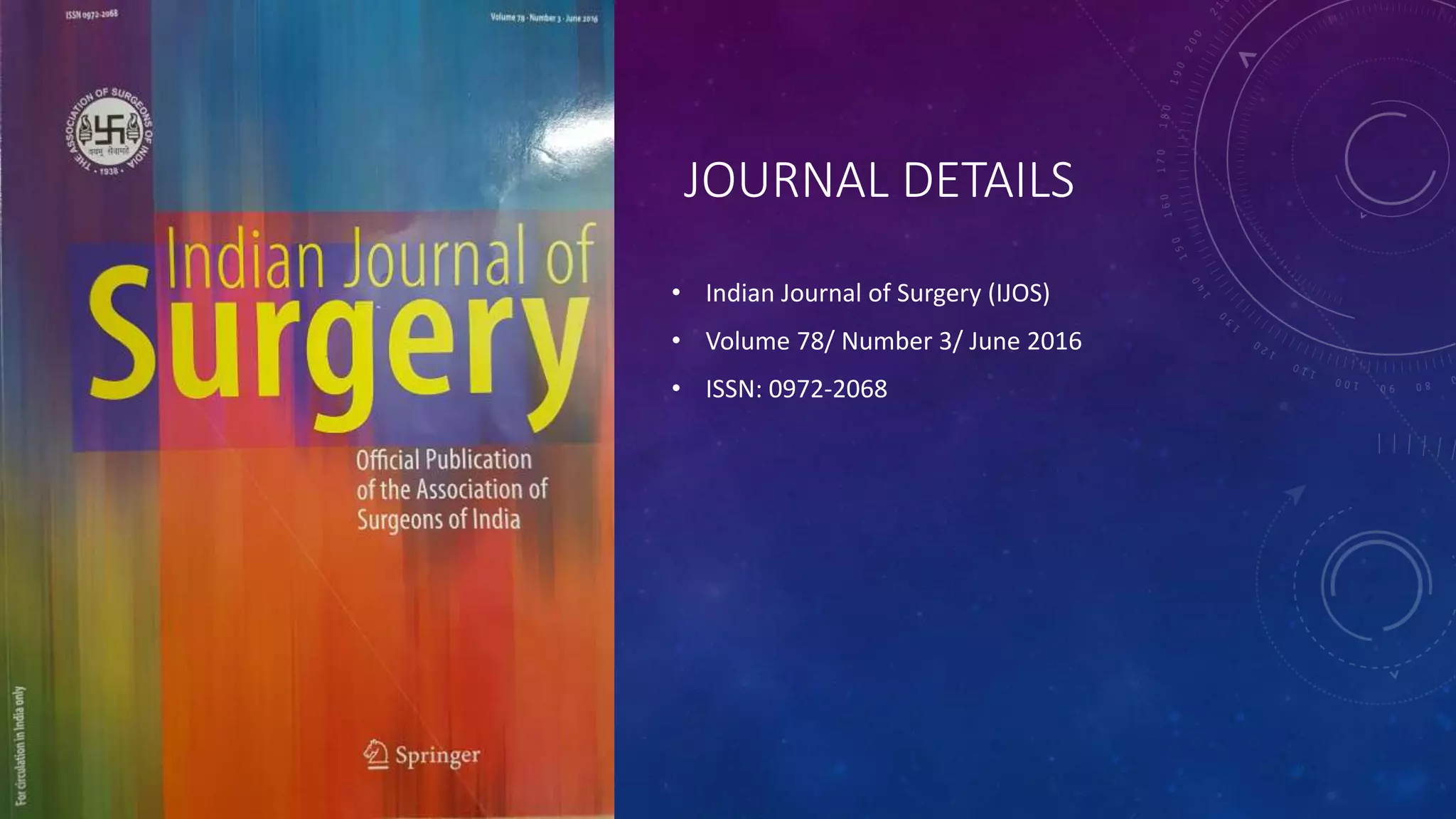
JOURNAL DETAILS
• IndianJournal of Surgery (IJOS)
• Volume 78/ Number 3/ June 2016
• ISSN: 0972-2068
3.
ABSTRACT
• Bowel stomaformation is very often required during open abdomen (OA) management; this study aims
to report stoma reversal series carried out by the authors during OA management between January
2008 and September 2014.
• 28 out of 31 patients were included in this study.
• The stoma related complications are more common after OA management i.e. during waiting time
interval for reversal.
• Patients with ‘jejunostomy’ had more complications then with ileostomy and colostomy.
• Operative time for reversal of jejunostomy and colostomy was significantly longer than ileostomy.
• Waiting time interval was shorter for reversal of jejunostomy than reversal of ileostomy and colostomy.
• No difference between early and late reversal of stoma regarding morbidity and mortality was noted.
4.
ABSTRACT
• For loopstoma created during OA management, the reversal may be performed after 50 days without
increasing morbidity and mortality.
• The reversal of end stoma created during OA management has high morbidity.
• If it is possible, loop stoma should be preferred during OA management.
5.
INTRODUCTION
• The creationof a stoma is a common procedure performed as a part of the treatment for lots
of bowel surgeries.
• The most common stoma classification can be done according to bowel part where they are
created i.e. jejunostomy, ileostomy, colostomy.
• They are also classified as “End” or “loop” ostomy.
• Stoma can be permanent or a part of emergent operations.
• Complication rate of stoma increases, when reversal time of stoma is delayed.
6.
• Reversal ofthe temporary stoma is the optimum solution of stoma related complications and
resulted in improvement in quality of life.
• For temporary stoma, the reversal time is important.
• In old reports, reversal time more than 8 weeks was accepted for temporary ileostomy created
during low anterior resection for rectal carcinoma.
• However during this period, stoma related complications occur in a quarter of patients, with
adverse effects on quality of life.
• In last four decades, it has been the subject of debate. It has been shown that early reversal within
1 month and even 10 days can be done without increasing morbidity and mortality.
7.
MATERIALS AND METHODS
•Retrospective analysis of 31 patients who underwent the reversal of stoma created during open
abdomen management between January 2008 and September 2014 was done
• 3 of them were excluded from the study, two of them did not come to control, and other one
had insufficient data.
• 28 patients were included into the study.
8.
ANALYZED VARIABLES
• Patients’demographics
• American Society of Anesthesiologists (ASA) classification for operative risk score,
• body mass index (BMI),
• Type of stoma (jejunostomy, ileostomy, colostomy with end or loop),
• Waiting time for reversal (time interval between the end of the delayed abdominal closure and
stoma reversal),
• Stoma related complications during this period
• Surgical technique
9.
SURGICAL TECHNIQUE
• Acontrast radiograph via stoma or endoscopic intervention was performed in all patients
before stoma reversal, to assess the integrity of the distal bowel.
• Irrigation of the distal bowel was usually performed with 500-1000 cm3 saline 1 or 2 days
before reversal.
• All reversal surgeries were performed under general anesthesia with antibiotic prophylaxis
(ceftriaxone) prior to surgery by same surgeon.
10.
LOOP STOMA REVERSAL
•Regarding reversal, a peristomal oval skin incision was performed around the stoma.
• End-to-end or side-to-side iso-peristaltic anastomosis with resection by a hand sewn or
stapled anastomosis was performed.
• Double barrel ostomy was accepted as loop ostomy.
11.
END STOMA REVERSAL
•Midline incision was used.
• The distal and proximal end of the bowel was visualized with gentle dissection.
• A peristomal oval skin incision was performed around the stoma to release the proximal end.
• Anastomosis were performed like loop stoma.
• Closure of the abdominal fascial wall was performed with absorbable sutures (PDS)
• Skin closed with interrupted sutures.
• If there was giant hernia with loop stoma, first of all, stoma reversal was performed, and
hernia repair with mesh was planned 2-3 months later. If there was a small hernia which
could be repaired without mesh, it is usually repaired during stoma reversal.
12.
OUTCOMES
• All stomareversal patients came to last control at December 2014.
• The primary end points were morbidity and mortality rates related with reversal of stoma
type.
• The secondary end point were operation time, length of hospital stay and stoma related
complications during waiting time interval for reversal.
13.
RESULTS
• Average follow-upperiod was 17.3+/- 11.2 months.
• 28 (90.3%) of 31 stoma reversal patients were included into the study.
• 50% had malignancy
14.
RESULTS
• Waiting timeinterval was shorter for reversal of jejunostomy than reversal of ileostomy and
colostomy
• Operation time for jejunostomy and colostomy reversal were significantly longer than the
ileostomy reversal
• Stoma related complications during waiting time interval: Patients with jejunostomy had more
stoma related complications than patients with ileostomy and colostomy.
• Dehydration, stoma herniation and prolapses were most common complications.
15.
COMPLICATIONS OF STOMAREVERSAL
• 15 out of the 28 patients developed complications.
• The most common was:
• Surgical wound infection (28.6%)
• Intestinal Obstruction (17.5%)- Resolved on conservative management
• Intra abdominal abscess (1 patient)
• One had anastomotic leak (3.5%) – Re-operated
16.
• There were6 end colostomies and 22 loop ostomies
• After reversal of the 6 end colostomies, complication developed in 83% of patients.
• After loop stoma reversal, minor complications developed in 45% of the patients.
• Patients with end stoma have significantly more reversal complications than patients with loop
stoma
• The mean length of hospital stay was 7.0+-4.1 days.
• There was no relation between length of hospital stay and stoma type
17.
DISCUSSION
• In theretrospective case study, the stoma related complications, morbidity, mortality and the waiting
time interval of the reversal of stoma created during open abdomen management were analyzed in
detail according to stoma type.
• Important difference between stomas created following OA management and the elective cases:
• Interventions have to be performed during peritonitis or to achieve source control. Because of
that, intraabdominal adhesions may be more common after OA management and stoma reversal
may be difficult.
• Both these factors make reversal time of stoma following OA management more critical.
• If reversal is delayed, patients would have more stoma related complications, on other hand if reversal
is performed early, complications after reversal might increase due to intra-abdominal adhesions.
18.
• Predisposing factorsfor development of stoma related complications based on three
categories:
• Patient – Age, gender, BMI, nutritional status
• Operation – Jejunostomy, Ileostomy or Colostomy
• Disease specific issues
19.
• The stomacreated in emergency increase the complication rate and the type of stoma also
affect the result.
• Malignancy, obesity, and comorbid disease also increase the complication rate.
• In study, patients have most of these risk factors; they were elderly, 50% had malignancy, and
creation of stoma in open abdomen management was performed in edematous, fragile
bowel with short mesentery under emergent conditions.
• Because of that stoma matured hardly.
• Necrosis, muco-cutaneous separation and retraction may occur more than the elective stoma
due to high tension between the bowel mucosa and skin.
• There was more stoma herniation and prolapses compared to literature because opening the
fascia and skin was opened larger, so edematous bowel could be inserted.
20.
• The patientwith jejunostomy had more stoma related complications due to the creation
conditions of jejunostomy was worse than others.
• In patients with jejunostomy, dehydration, electrolyte abnormalities and need for TPN was
more common.
• As waiting time interval for jejunostomy prolongs, life threatening organ failure may develop
• Usually to overcome this challenging problem, early stoma reversal may be the only option.
• In the study, the reversal of jejunostomies had to be performed earlier than ileostomy and
colostomy to avoid stoma related complications
21.
• One ofthe controversies in literature is the uncertainity about optimum time interval between
the creation of the stoma and the reversal time of it.
• Recently there is incline towards early closure.
• It was reported that the waiting time interval between the creation and the reversal of
Hartmann’s procedure was between 50 and 330 days.
• Mean operative time of the reversal of Hartman procedure reported in literature is 167 min
• Morbidity with Hartmann’s reversal is reported at 4-43% and mortality rate ranges from 4
to 10%.
• In study: Time for reversal, mean operative time and morbidity was: 156 days, 135 min and
83% and no mortality
22.
CONCLUSION
• Stoma relatedcomplications are more common following OA management during waiting
time interval for stoma reversal
• Reversal time is more critical for this kind of patients especially with life threatening
complicated jejunostomy
• For loop stoma created during OA management, the reversal may be performed after 50 days
without increasing morbidity and mortality.
• There is no need to wait more than 8 weeks even if it is following OA management
• The reversal of end stoma created during OA management was performed with high
morbidity
• If possible, loop stoma should be preferred during OA management.