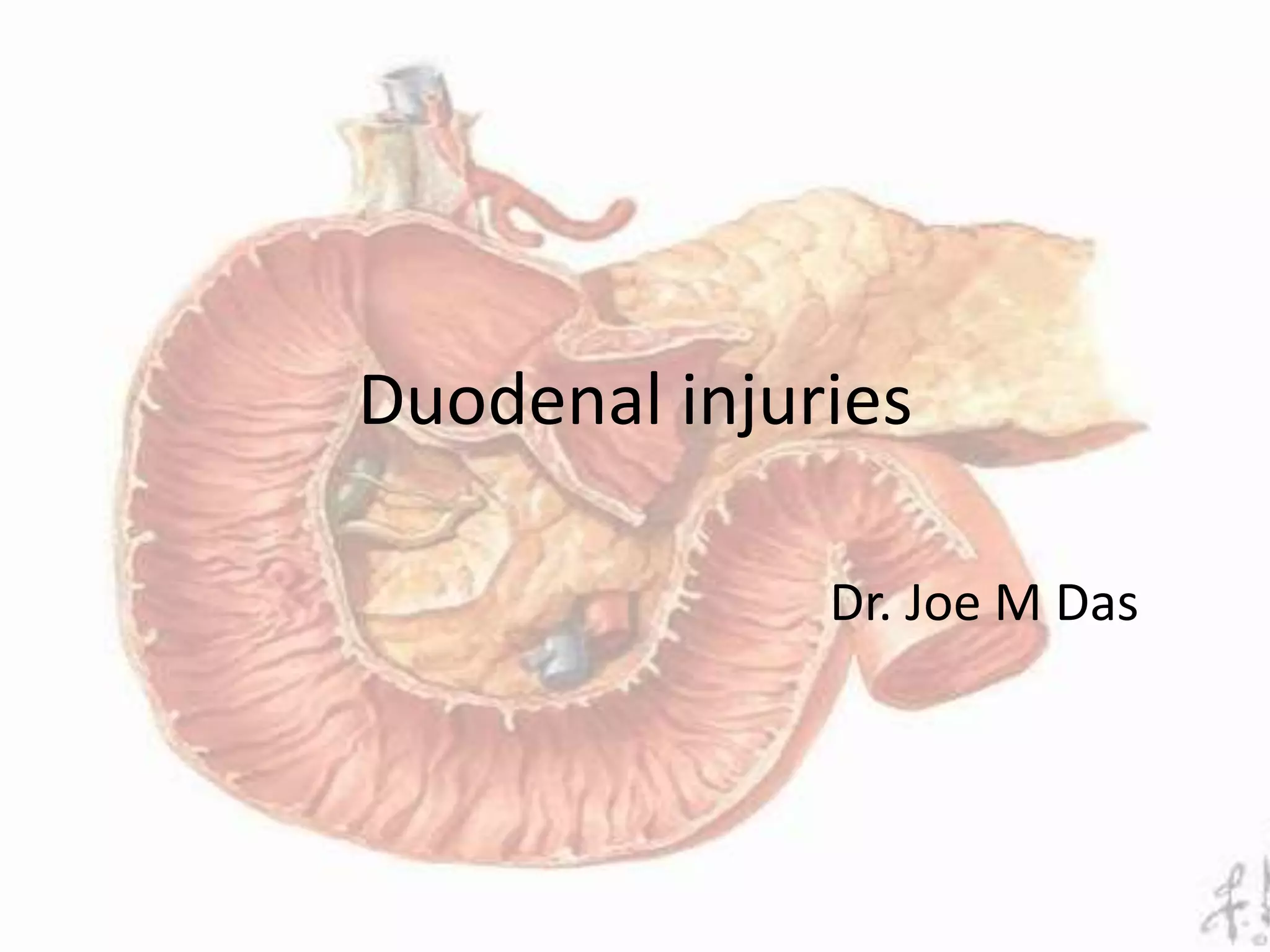
Duodenal injuries
Dr. Joe M Das
• Duodenum
- Do-deka-dactulos (Gk)
- duodenum digitorum (Latin) =
- breadth of 12 fingers
• 12 inches (24-26 cm)
• Herophilus (300 B.C.)
• 3.7 – 5 % of laparotomies for trauma
Part Length From To Level
1st (Superior) 5 cm Pyloric V of
Mayo
Sup: CBD
Inf: GDA
L1
2nd
(Descending)
8-10 cm Sup: CBD
Inf: GDA
Ampulla L1
3rd
(Horizontal)
10 cm Ampulla SMA L3
4th
(Ascending)
2.5 cm SMA Lig of Treitz L2
First 2 cm of superior part is mobile
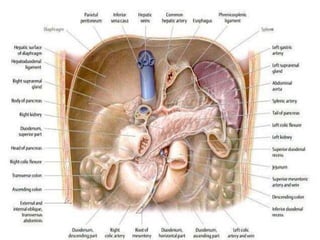
Relations
• Medial : HOP
• Superior : Quadrate lobe and GB
• Posterior : (R) kidney & psoas, IVC & portal V,
L1-L3
• Anterior : liver that overlies D1 & D2;
the hepatic flexure of the colon, right
transverse colon, mesocolon and stomach
that overlies D4.
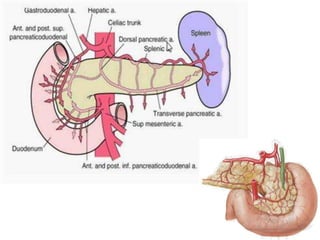
Arterial supply
• Superior anterior pancreatico duodenal
• Superior posterior pancreatico duodenal
GDA from Hepatic A
• Inferior anterior pancreatico duodenal
• Inferior posterior pancreatico duodenal
SMA
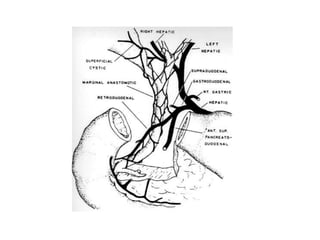
• Others:
– (R) gastric
– Gastroepiploic
– Supraduodenal artery (Wilkie)
– Retroduodenal artery
• Venous drainage:
– SMV → Portal V
Physiology
• Mixing point for the partially digested chyle
and the proteolytic and lipolytic secretions of
the biliary tract and pancreas
• Powerful activated digestive enzymes including
lipase, trypsin, amylase, elastase, and
peptidases
• Approximately 6 L of fluid from the stomach,
bile duct, and pancreas passes through the
duodenum in a 24-hour period
• Escape of duodenal contents into the free
peritoneal cavity or retroperitoneum →
destructive process that is compounded by
the inflammatory response that it provokes.
History
• The earliest recorded cases of successful
outcomes from penetrating duodenal
injuries is credited to Larrey (Fr.)
• The first successful repair of a duodenal
injury after blunt trauma was reported by
Herczel in 1896
• Moynihan repaired a penetrating duodenal
injury; he performed a gastrojejunostomy
in a patient who lived for 104 days. (1901)
• Penetrating trauma accounts for 78% of all
duodenal injuries, whereas blunt trauma
accounts for 22%.
• D2 is most commonly injured
• ‘The epitome of an organ poorly designed
to withstand the ravages of trauma.’
• Asso: with injuries to liver, pancreas, small
bowel, colon
• Blunt trauma from:
– Crushing of duodenum b/w spine and steering
wheel
– Flexion-distraction fracture of L1-L2 (Chance
fracture)
– Stomping and striking in midepigastrium
– Sudden deceleration
Clinical features
• Abdominal pain especially when the right upper
quadrant is injured –
– Intensified with apparent peritoneal stimulation and
– Radiation pain to the back
• Retching or vomiting with blood in the vomitus
• Abdominal distension especially in the upper
quadrant with infrequent or muted borborygmus
• Detection of fluid like bile or intestinal juice by
diagnostic paracentesis.
When to suspect intra-operatively?
• Free gas or fluid looking like bile with
undetermined origin
• Extraction of intestinal juice or fluid like bile
from retro-peritoneal hematoma and
• Edema, hematoma, ecchymosis or crepitus in
the periduodenal retroperitoneum or root of
mesentery and mesocolon.
• Instillation of methylene blue via NG tube
(Brotman et al)
A test to help diagnosis of rupture in the injured duodenum. Injury 1981; 12:464-5
Severe duodenal injury (Snyder)
• Missile or blunt injury
• Injury of the first or second portion of the
duodenum
• Adjacent common bile duct injury.
Snyder WH 3rd, et al. The surgical management of duodenal trauma. Precepts based on a review of 247 cases.
Arch Surg 1980;115(4):422-429.
Problems in management
• The retroperitoneal location
• Proximity to important abdominal structures
• Marginal blood supply
• Biliary, pancreatic and gastro-intestinal
secretions in it
• Delay in the diagnosis
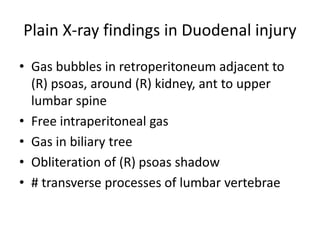
Plain X-ray findings in Duodenal injury
• Gas bubbles in retroperitoneum adjacent to
(R) psoas, around (R) kidney, ant to upper
lumbar spine
• Free intraperitoneal gas
• Gas in biliary tree
• Obliteration of (R) psoas shadow
• # transverse processes of lumbar vertebrae
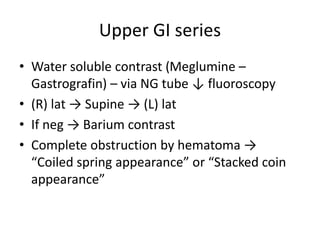
Upper GI series
• Water soluble contrast (Meglumine –
Gastrografin) – via NG tube ↓ fluoroscopy
• (R) lat → Supine → (L) lat
• If neg → Barium contrast
• Complete obstruction by hematoma →
“Coiled spring appearance” or “Stacked coin
appearance”
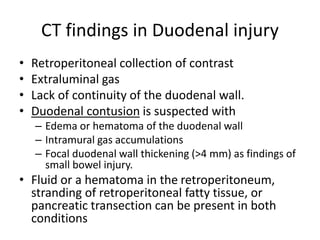
CT findings in Duodenal injury
• Retroperitoneal collection of contrast
• Extraluminal gas
• Lack of continuity of the duodenal wall.
• Duodenal contusion is suspected with
– Edema or hematoma of the duodenal wall
– Intramural gas accumulations
– Focal duodenal wall thickening (>4 mm) as findings of
small bowel injury.
• Fluid or a hematoma in the retroperitoneum,
stranding of retroperitoneal fatty tissue, or
pancreatic transection can be present in both
conditions
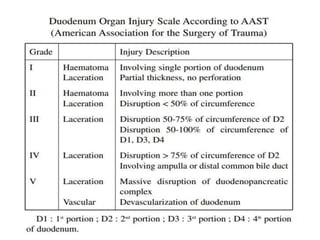
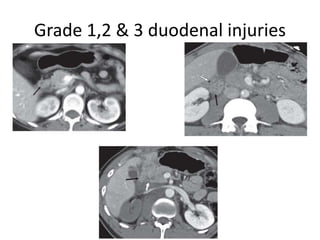
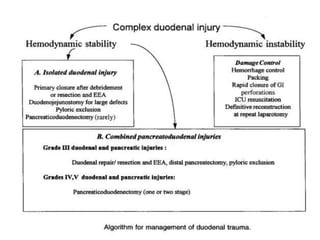
Grade 1,2 & 3 duodenal injuries
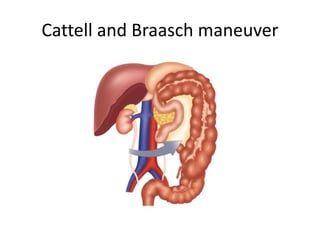
Cattell and Braasch maneuver
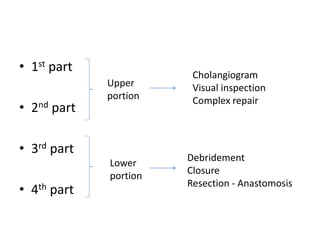
• 1st part
• 2nd part
• 3rd part
• 4th part
Upper
portion
Lower
portion
Cholangiogram
Visual inspection
Complex repair
Debridement
Closure
Resection - Anastomosis
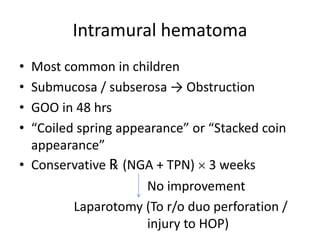
Intramural hematoma
• Most common in children
• Submucosa / subserosa → Obstruction
• GOO in 48 hrs
• “Coiled spring appearance” or “Stacked coin
appearance”
• Conservative ℞ (NGA + TPN)  3 weeks
No improvement
Laparotomy (To r/o duo perforation /
injury to HOP)
Intramural hematoma
• If detected intra-operatively,
– Open serosa, evacuate hematoma, repair the wall
( May convert partial tear to a full thickness one)
– Explore to exclude perforation, leaving hematoma
intact with post-op NGA
Principles in the management
4 basic principles in managing duodenal trauma:
– Restore intestinal continuity
– Decompress the duodenal lumen
– Provide wide, external drainage
– Provide nutritional support
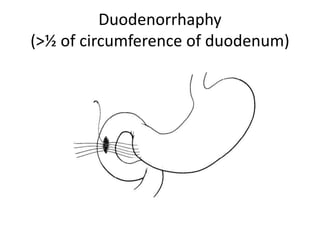
Duodenorrhaphy
(>½ of circumference of duodenum)
Duodenorrhaphy
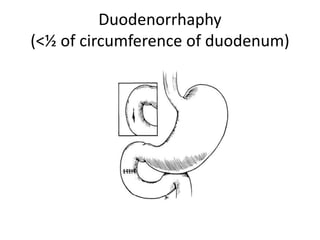
(<½ of circumference of duodenum)
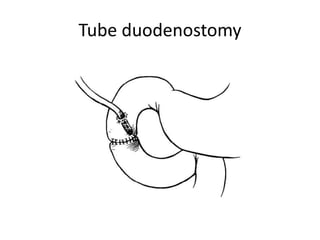
Tube duodenostomy
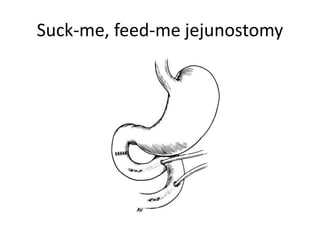
Suck-me, feed-me jejunostomy
Addition of gastrostomy
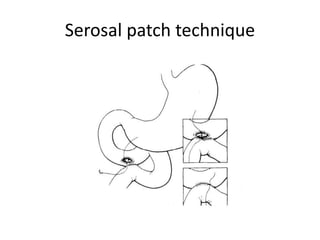
Serosal patch technique
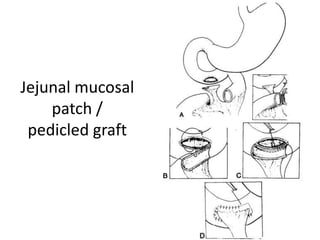
Jejunal mucosal
patch /
pedicled graft
Duodenal perforation
• High risk injuries:
– Associated pancreatic injury
– Blunt / Missile injury
– Involvement of >75% of duodenal wall
– Injury to D1 / D2
– Time interval between injury & repair > 24 hrs
– Associated CBD injury
• Repair / Diversion / Pancreaticoduodenectomy
Repair
• Most injuries – primary closure in one or two
layers
• Longitudinal duodenotomies closed
transversely if length of duo injury < 50% of
circumference
• If chance of lumen compromise:
– Pedicled mucosal graft (segment of jejunum /
gastric island flap)
– Jejunal serosal patch
– Buttress of duo repair by jejunal loop
Repair of complete transection
• First part:
– Antrectomy + Closure of duodenal stump +
Billroth II GJ
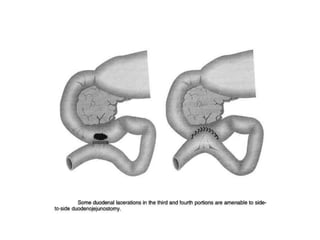
• Third / Fourth parts (Distal to ampulla):
– Closure of distal duodenum + Roux-en-Y DJ
• Second part:
– Direct E-S duodenal defect to Roux-en-Y loop
• Soft silicone rubber closed system drainage
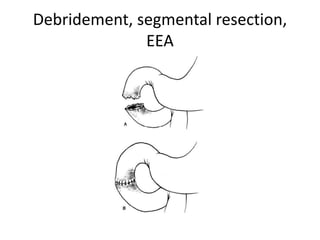
Debridement, segmental resection,
EEA
Vaughan / Jordan pyloric exclusion
technique
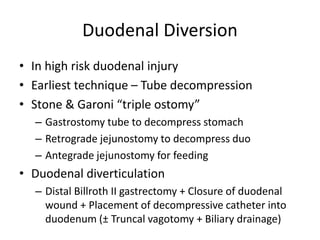
Duodenal Diversion
• In high risk duodenal injury
• Earliest technique – Tube decompression
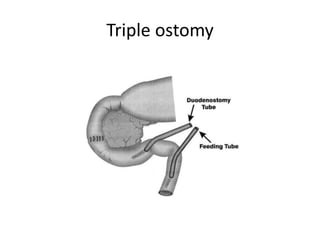
• Stone & Garoni “triple ostomy”
– Gastrostomy tube to decompress stomach
– Retrograde jejunostomy to decompress duo
– Antegrade jejunostomy for feeding
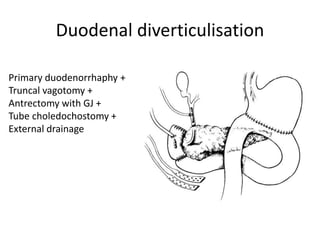
• Duodenal diverticulation
– Distal Billroth II gastrectomy + Closure of duodenal
wound + Placement of decompressive catheter into
duodenum (± Truncal vagotomy + Biliary drainage)
Triple ostomy
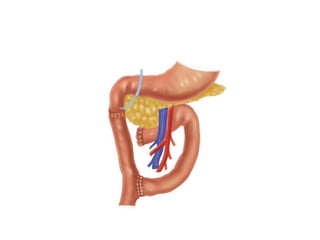
Duodenal diverticulisation
Primary duodenorrhaphy +
Truncal vagotomy +
Antrectomy with GJ +
Tube choledochostomy +
External drainage
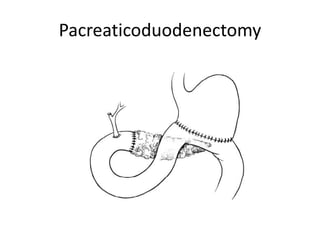
Pacreaticoduodenectomy
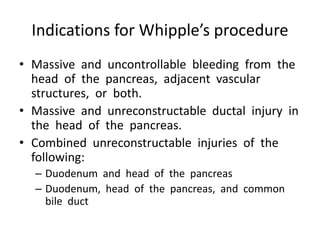
Indications for Whipple’s procedure
• Massive and uncontrollable bleeding from the
head of the pancreas, adjacent vascular
structures, or both.
• Massive and unreconstructable ductal injury in
the head of the pancreas.
• Combined unreconstructable injuries of the
following:
– Duodenum and head of the pancreas
– Duodenum, head of the pancreas, and common
bile duct
Complications
• Duodenal fistula
• Intra-abdominal abscess
• Pancreatitis
• Duodenal obstruction
• Bile duct fistula
• Mortality ≈ 17%
Bibliography
• Complex duodenal injuries - Rao R. Ivatury, MD
et al
• Diagnosis and Classification of Pancreatic and
Duodenal Injuries in Emergency Radiology - Ulrich
Linsenmaier, MD, PhD et al -Radiographics
• Management of duodenal trauma - CHEN Guo-
qing and YANG Hua - Chinese Journal of
Traumatology 2011; 14(1):61-64
• Duodenal injuries – E Degiannis – BJS 2000, 87,
1473-79
Duodenal injuries

Duodenal injuries

  • 1.
  • 2.
    • Duodenum - Do-deka-dactulos(Gk) - duodenum digitorum (Latin) = - breadth of 12 fingers • 12 inches (24-26 cm) • Herophilus (300 B.C.) • 3.7 – 5 % of laparotomies for trauma
  • 3.
    Part Length FromTo Level 1st (Superior) 5 cm Pyloric V of Mayo Sup: CBD Inf: GDA L1 2nd (Descending) 8-10 cm Sup: CBD Inf: GDA Ampulla L1 3rd (Horizontal) 10 cm Ampulla SMA L3 4th (Ascending) 2.5 cm SMA Lig of Treitz L2 First 2 cm of superior part is mobile
  • 4.
    Relations • Medial :HOP • Superior : Quadrate lobe and GB • Posterior : (R) kidney & psoas, IVC & portal V, L1-L3 • Anterior : liver that overlies D1 & D2; the hepatic flexure of the colon, right transverse colon, mesocolon and stomach that overlies D4.
  • 6.
    Arterial supply • Superioranterior pancreatico duodenal • Superior posterior pancreatico duodenal GDA from Hepatic A • Inferior anterior pancreatico duodenal • Inferior posterior pancreatico duodenal SMA
  • 9.
    • Others: – (R)gastric – Gastroepiploic – Supraduodenal artery (Wilkie) – Retroduodenal artery • Venous drainage: – SMV → Portal V
  • 10.
    Physiology • Mixing pointfor the partially digested chyle and the proteolytic and lipolytic secretions of the biliary tract and pancreas • Powerful activated digestive enzymes including lipase, trypsin, amylase, elastase, and peptidases • Approximately 6 L of fluid from the stomach, bile duct, and pancreas passes through the duodenum in a 24-hour period • Escape of duodenal contents into the free peritoneal cavity or retroperitoneum → destructive process that is compounded by the inflammatory response that it provokes.
  • 11.
    History • The earliestrecorded cases of successful outcomes from penetrating duodenal injuries is credited to Larrey (Fr.) • The first successful repair of a duodenal injury after blunt trauma was reported by Herczel in 1896 • Moynihan repaired a penetrating duodenal injury; he performed a gastrojejunostomy in a patient who lived for 104 days. (1901)
  • 12.
    • Penetrating traumaaccounts for 78% of all duodenal injuries, whereas blunt trauma accounts for 22%. • D2 is most commonly injured • ‘The epitome of an organ poorly designed to withstand the ravages of trauma.’ • Asso: with injuries to liver, pancreas, small bowel, colon
  • 13.
    • Blunt traumafrom: – Crushing of duodenum b/w spine and steering wheel – Flexion-distraction fracture of L1-L2 (Chance fracture) – Stomping and striking in midepigastrium – Sudden deceleration
  • 14.
    Clinical features • Abdominalpain especially when the right upper quadrant is injured – – Intensified with apparent peritoneal stimulation and – Radiation pain to the back • Retching or vomiting with blood in the vomitus • Abdominal distension especially in the upper quadrant with infrequent or muted borborygmus • Detection of fluid like bile or intestinal juice by diagnostic paracentesis.
  • 15.
    When to suspectintra-operatively? • Free gas or fluid looking like bile with undetermined origin • Extraction of intestinal juice or fluid like bile from retro-peritoneal hematoma and • Edema, hematoma, ecchymosis or crepitus in the periduodenal retroperitoneum or root of mesentery and mesocolon. • Instillation of methylene blue via NG tube (Brotman et al) A test to help diagnosis of rupture in the injured duodenum. Injury 1981; 12:464-5
  • 16.
    Severe duodenal injury(Snyder) • Missile or blunt injury • Injury of the first or second portion of the duodenum • Adjacent common bile duct injury. Snyder WH 3rd, et al. The surgical management of duodenal trauma. Precepts based on a review of 247 cases. Arch Surg 1980;115(4):422-429.
  • 17.
    Problems in management •The retroperitoneal location • Proximity to important abdominal structures • Marginal blood supply • Biliary, pancreatic and gastro-intestinal secretions in it • Delay in the diagnosis
  • 19.
    Plain X-ray findingsin Duodenal injury • Gas bubbles in retroperitoneum adjacent to (R) psoas, around (R) kidney, ant to upper lumbar spine • Free intraperitoneal gas • Gas in biliary tree • Obliteration of (R) psoas shadow • # transverse processes of lumbar vertebrae
  • 20.
    Upper GI series •Water soluble contrast (Meglumine – Gastrografin) – via NG tube ↓ fluoroscopy • (R) lat → Supine → (L) lat • If neg → Barium contrast • Complete obstruction by hematoma → “Coiled spring appearance” or “Stacked coin appearance”
  • 21.
    CT findings inDuodenal injury • Retroperitoneal collection of contrast • Extraluminal gas • Lack of continuity of the duodenal wall. • Duodenal contusion is suspected with – Edema or hematoma of the duodenal wall – Intramural gas accumulations – Focal duodenal wall thickening (>4 mm) as findings of small bowel injury. • Fluid or a hematoma in the retroperitoneum, stranding of retroperitoneal fatty tissue, or pancreatic transection can be present in both conditions
  • 22.
    Grade 1,2 &3 duodenal injuries
  • 23.
  • 24.
    • 1st part •2nd part • 3rd part • 4th part Upper portion Lower portion Cholangiogram Visual inspection Complex repair Debridement Closure Resection - Anastomosis
  • 25.
    Intramural hematoma • Mostcommon in children • Submucosa / subserosa → Obstruction • GOO in 48 hrs • “Coiled spring appearance” or “Stacked coin appearance” • Conservative ℞ (NGA + TPN)  3 weeks No improvement Laparotomy (To r/o duo perforation / injury to HOP)
  • 26.
    Intramural hematoma • Ifdetected intra-operatively, – Open serosa, evacuate hematoma, repair the wall ( May convert partial tear to a full thickness one) – Explore to exclude perforation, leaving hematoma intact with post-op NGA
  • 28.
    Principles in themanagement 4 basic principles in managing duodenal trauma: – Restore intestinal continuity – Decompress the duodenal lumen – Provide wide, external drainage – Provide nutritional support
  • 29.
  • 30.
  • 31.
  • 32.
  • 33.
  • 34.
  • 35.
  • 36.
    Duodenal perforation • Highrisk injuries: – Associated pancreatic injury – Blunt / Missile injury – Involvement of >75% of duodenal wall – Injury to D1 / D2 – Time interval between injury & repair > 24 hrs – Associated CBD injury • Repair / Diversion / Pancreaticoduodenectomy
  • 37.
    Repair • Most injuries– primary closure in one or two layers • Longitudinal duodenotomies closed transversely if length of duo injury < 50% of circumference • If chance of lumen compromise: – Pedicled mucosal graft (segment of jejunum / gastric island flap) – Jejunal serosal patch – Buttress of duo repair by jejunal loop
  • 38.
    Repair of completetransection • First part: – Antrectomy + Closure of duodenal stump + Billroth II GJ • Third / Fourth parts (Distal to ampulla): – Closure of distal duodenum + Roux-en-Y DJ • Second part: – Direct E-S duodenal defect to Roux-en-Y loop • Soft silicone rubber closed system drainage
  • 39.
  • 43.
    Vaughan / Jordanpyloric exclusion technique
  • 44.
    Duodenal Diversion • Inhigh risk duodenal injury • Earliest technique – Tube decompression • Stone & Garoni “triple ostomy” – Gastrostomy tube to decompress stomach – Retrograde jejunostomy to decompress duo – Antegrade jejunostomy for feeding • Duodenal diverticulation – Distal Billroth II gastrectomy + Closure of duodenal wound + Placement of decompressive catheter into duodenum (± Truncal vagotomy + Biliary drainage)
  • 45.
  • 46.
    Duodenal diverticulisation Primary duodenorrhaphy+ Truncal vagotomy + Antrectomy with GJ + Tube choledochostomy + External drainage
  • 47.
  • 48.
    Indications for Whipple’sprocedure • Massive and uncontrollable bleeding from the head of the pancreas, adjacent vascular structures, or both. • Massive and unreconstructable ductal injury in the head of the pancreas. • Combined unreconstructable injuries of the following: – Duodenum and head of the pancreas – Duodenum, head of the pancreas, and common bile duct
  • 50.
    Complications • Duodenal fistula •Intra-abdominal abscess • Pancreatitis • Duodenal obstruction • Bile duct fistula • Mortality ≈ 17%
  • 51.
    Bibliography • Complex duodenalinjuries - Rao R. Ivatury, MD et al • Diagnosis and Classification of Pancreatic and Duodenal Injuries in Emergency Radiology - Ulrich Linsenmaier, MD, PhD et al -Radiographics • Management of duodenal trauma - CHEN Guo- qing and YANG Hua - Chinese Journal of Traumatology 2011; 14(1):61-64 • Duodenal injuries – E Degiannis – BJS 2000, 87, 1473-79