LAPAROSCOPIC PANCREATIC SURGERY George Ferzli MD, FACS
? What is the current role of laparoscopic surgery with regard to pancreatic disease?
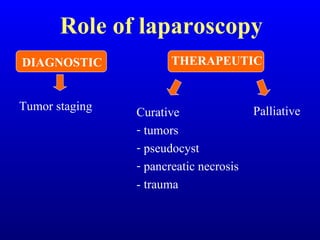
Role of laparoscopy DIAGNOSTIC Tumor staging THERAPEUTIC Curative tumors pseudocyst pancreatic necrosis - trauma Palliative
I- Diagnostic
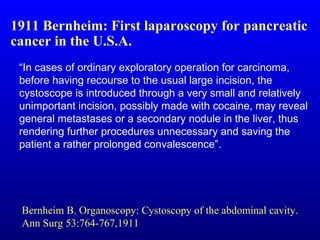
“ In cases of ordinary exploratory operation for carcinoma, before having recourse to the usual large incision, the cystoscope is introduced through a very small and relatively unimportant incision, possibly made with cocaine, may reveal general metastases or a secondary nodule in the liver, thus rendering further procedures unnecessary and saving the patient a rather prolonged convalescence”.  1911 Bernheim: First laparoscopy for pancreatic cancer in the U.S.A. Bernheim B. Organoscopy: Cystoscopy of the abdominal cavity. Ann Surg 53:764-767,1911
Prospective study of 88 consecutive patients Pancreatic and periampullary adenocarcinoma Preoperative evaluation CT scan with contrast 88 pts MRI 20 pts Laparoscopy 47 pts Angiography 85 pts Preoperative Staging and Assessment of Resectability of Pancreatic Cancer Warshaw,A et al: Arch Surg 1990; 125:230-233
Results Overall resectability 33/88 (38%) Laparoscopy found metastatic disease when present in 22/23 patients (96%) Laparoscopy found no metastatic disease in 24/24 patients (100%) Warshaw,A et al: Arch Surg 1990; 125:230-233
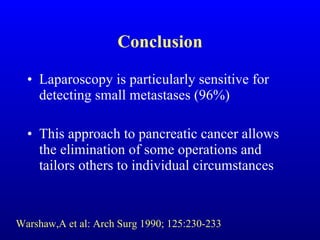
Conclusion Laparoscopy is particularly sensitive for detecting small metastases (96%) This approach to pancreatic cancer allows the elimination of some operations and tailors others to individual circumstances Warshaw,A et al: Arch Surg 1990; 125:230-233
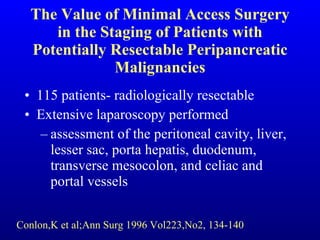
The Value of Minimal Access Surgery in the Staging of Patients with Potentially Resectable Peripancreatic Malignancies 115 patients- radiologically resectable Extensive laparoscopy performed assessment of the peritoneal cavity, liver, lesser sac, porta hepatis, duodenum, transverse mesocolon, and celiac and portal vessels Conlon,K et al;Ann Surg 1996 Vol223,No2, 134-140
Unresectability Metastases hepatic, serosal, peritoneal Extrapancreatic extension mesocolic involvement Nodal involvement celiac or portal Vascular invasion celiac axis or hepatic artery portal vein, SMV, SMA Conlon,K et al;Ann Surg 1996 Vol223,No2, 134-140
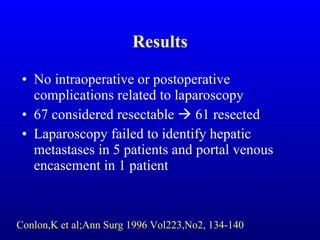
No intraoperative or postoperative complications related to laparoscopy 67 considered resectable    61 resected Laparoscopy failed to identify hepatic metastases in 5 patients and portal venous encasement in 1 patient Results Conlon,K et al;Ann Surg 1996 Vol223,No2, 134-140
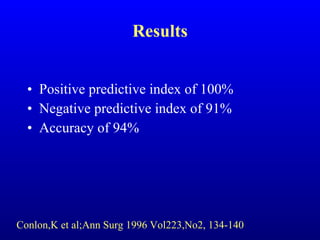
Positive predictive index of 100% Negative predictive index of 91% Accuracy of 94% Results Conlon,K et al;Ann Surg 1996 Vol223,No2, 134-140
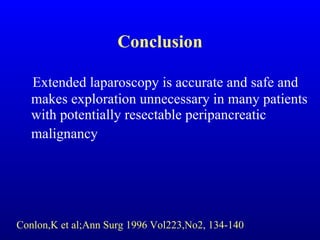
Extended laparoscopy is accurate and safe and makes exploration unnecessary in many patients with potentially resectable peripancreatic malignancy   Conclusion Conlon,K et al;Ann Surg 1996 Vol223,No2, 134-140
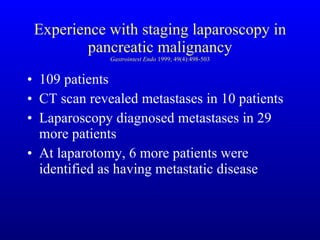
Experience with staging laparoscopy in pancreatic malignancy Gastrointest Endo  1999; 49(4):498-503 109 patients  CT scan revealed metastases in 10 patients Laparoscopy diagnosed metastases in 29 more patients At laparotomy, 6 more patients were identified as having metastatic disease
Results Negative predictive value was 94% Positive predictive value was 88%
Conclusion In patients with a negative CT scan for metastasis, laparoscopic identification of metastasis avoided unnecessary laparotomy in 29 of 99 (29%) patients with pancreatic cancer.  Staging laparoscopy is indicated in all cases of pancreatic malignancy before laparotomy.
Laparoscopic Ultrasound in the Staging of Pancreatic Cancer Prospective evaluation of 90 patients All patients had preoperative CT abdomen/pelvis and either ERCP or transabdominal sonography  All patients had laparoscopy and laparoscopic ultrasound Minnard, E. Conlon, K et al, Ann Surg, 1998, 228(2)
Tumor location       Pancreatic head 64  (72%) Pancreatic body 19  (21%) Pancreatic tail   3  (3%) Ampulla     4  (4%) Minnard, E. Conlon, K et al, Ann Surg, 1998, 228(2)                                                                                         
Results Minnard, E. Conlon, K et al, Ann Surg, 1998, 228(2) ___ ___ 13 (14%) 8 (9%) EQUIVOCAL 50 (56%) 49 (54%) 41 (46%) 17 (19%) UNRESECTABLE ACTUAL LAP SONO LAP CT
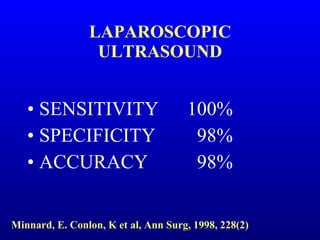
LAPAROSCOPIC ULTRASOUND SENSITIVITY  100% SPECIFICITY   98% ACCURACY    98% Minnard, E. Conlon, K et al, Ann Surg, 1998, 228(2)
Conclusion The addition of laparoscopic ultrasound offers improved assessment and preoperative staging of pancreatic cancer.   Minnard, E. Conlon, K et al, Ann Surg, 1998, 228(2)
Summary Staging laparoscopy should be performed for all cases of pancreatic cancer prior to attempted resection The addition of laparoscopic ultrasound  improves assessment and preoperative staging of pancreatic cancer
II- Therapeutic Laparoscopy
1- LAPAROSCOPIC PANCREATICODUODENECTOMY Gagner and Pomp – 1996 Strasberg, Drebin, and Soper – 1997 Cuschieri – 1998 CONCLUSION: THE MAGNITUDE OF THE RECONSTRUCTION MAY OUTWEIGH THE BENEFIT OF THE MINIMALLY INVASIVE APPROACH
2- MISCELLANEOUS PANCREATIC NEOPLASMS
Videolaparoscopic Resection of Insulinomas World Journal of Surgery Vol. 26, 2002 Laparoscopic Pancreatic Resection: Single Institution Experience of 19 Patients PETERSON, et al J Am Coll Surg 193(2),2001 Ultrasound Guided Laparoscopic Resection Of Pancreatic Islet Cell Tumors SPITZ, et al Surg Lap Endo Vol 10, 2000 DESCRIPTION STUDY
 
3- Management of pancreatic pseudocyst and necrotizing pancreatitis
Laparoscopic Cholecystectomy and Acute Biliary Pancreatitis E Tang , NJ Soper , JJT Tate,  W Uhl 271 biliary pancreatitis,  22 % Ranson  ≥  3 Laparoscopic cholecystectomy 86 % Early operation and Ranson  ≥  3 were associated with: - more technical difficulties - more conversions - more CBD stones
Conclusions Past pancreatitis is a poor indicator of CBDS.  IOC is indicated regardless of the risk of CBDS. Prognostic systems can discriminate patients with non  severe ABP (Negative Predictive Value). Timing of open or laparoscopic biliary surgery depends on AP severity
Urgent ERC/ES in Benign Acute Biliary Pancreatitis   Neoptolemos      Fan ERC  Controls ERC Controls n (%) n (%) n (%) n (%)  N patients 28 29 34 35 Complications - local 3 (11) 4 (14) 7 (21) 1 (3)  - general  1  (4) 0 3  (9) 1 (3) Deaths 0 0 0 0
Conclusions Past pancreatitis is a poor indicator of CBDS.  IOC is indicated regardless of the risk of CBDS. Prognostic systems can discriminate patients with non  severe ABP (Negative Predictive Value). Timing of open or laparoscopic   biliary surgery depends on AP severity. Endoscopic sphincterotomy is NOT indicated in Benign Acute Biliary Pancreatitis
Surgery vs Endoscopic Sphincterotomy in Severe Cholangitis Endoscopy Surgery  p Leese (non randomized) Mortality (%) 4.7 21.4 Lai (randomized)   N patients 41 41 N (%) with Complications 14 (34) 27 (66) < 0.05   Deaths 4 (10) 13 (32) < 0.03
Conclusions Past pancreatitis is a poor indicator of CBDS.  IOC is indicated regardless of the risk of CBDS. Prognostic systems can discriminate patients with non  severe ABP (Negative Predictive Value). Timing of open or laparoscopic   biliary surgery depends on AP severity. Endoscopic sphincterotomy is NOT indicated in Benign Acute Biliary Pancreatitis. Endoscopic sphincterotomy is indicated in  Severe  Cholangitis  associated  with Severe ABP
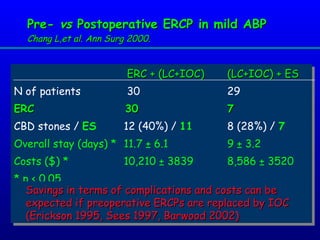
Pre-  vs  Postoperative ERCP in mild ABP Chang L,et al. Ann Surg 2000.   ERC + (LC+IOC) (LC+IOC) + ES N of patients   30 29 ERC    30  7  CBD stones /  ES  12 (40%) /  11 8 (28%) /  7 Overall stay (days) *   11.7 ± 6.1 9 ± 3.2 Costs ($) *   10,210 ± 3839 8,586 ± 3520 * p < 0.05 Savings in terms of complications and costs can be expected if preoperative ERCPs are replaced by IOC ( Erickson 1995, Sees 1997,  Barwood 2002)
Conclusions Past pancreatitis is a poor indicator of CBDS.  IOC is indicated regardless of the risk of CBDS. Prognostic systems can discriminate patients with non  severe ABP (Negative Predictive Value). Timing of open or laparoscopic   biliary surgery depends on AP severity. Endoscopic sphincterotomy is NOT indicated in Benign Acute Biliary Pancreatitis . Endoscopic sphincterotomy is indicated in case of Severe Cholangitis associated with Severe ABP. CBD exploration is more efficient than ERC/ES. Performing ERC  after  LC+IOC rather than before LC minimizes costs and morbidity 
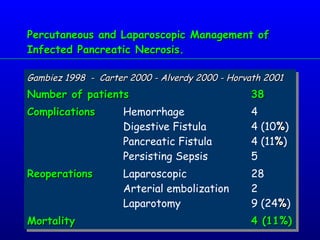
Percutaneous and Laparoscopic Management of Infected Pancreatic Necrosis.  Gambiez 1998  -  Carter 2000 - Alverdy 2000 - Horvath 2001 Number of patients   38 Complications Hemorrhage 4 Digestive Fistula 4 (10 % ) Pancreatic Fistula 4 (11 % ) Persisting Sepsis  5 Reoperations Laparoscopic   28 Arterial embolization  2 Laparotomy 9 (24 % ) Mortality 4 (11%)
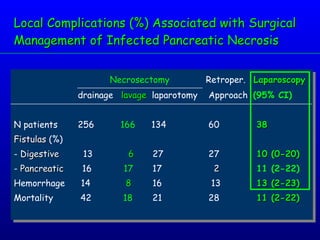
Local Complications (%) Associated with Surgical Management of Infected Pancreatic Necrosis Necrosectomy   Retroper.  Laparoscopy   drainage  lavage   laparotomy   Approach  (95% CI) N patients 256   166   134  60   38 Fistulas  (%)  -  Digestive   13    6   27   27   10 (0-20) -  Pancreatic   16  17     17    2   11 (2-22) Hemorrhage  14   8     16    13   13 (2-23) Mortality   42   18   21  28   11 (2-22)
Conclusions Past pancreatitis is a poor indicator of CBDS.IOC is indicated regardless of the risk of CBDS. Prognostic systems can discriminate patients with non  severe ABP (Negative Predictive Value). Timing of open or laparoscopic biliary surgery depends on AP severity. ES is NOT indicated in BENIGN ABP . ES is indicated in case of Severe Cholangitis associated with Severe ABP. CBD exploration is more efficient than ERC/ES. Performing ERC after LC+IOC rather than before LC minimizes costs and morbidity. The l aparoscopic approach for necrotic collections is not a standard of care
Pancreatic pseudocysts Non surgical techniques Percutaneous aspiration-drainage Endoscopic transgastric drainage Endoscopic transpapillary procedures Laparoscopic alternatives   * Pancreatic cystogastrostomy Pancreatic cystojejunostomy * Cuschieri, Gagner, Meltzer, Mouiel, Park, Way.
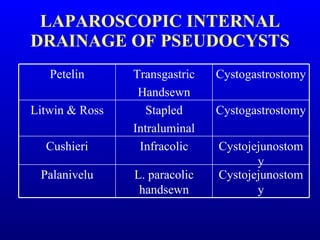
LAPAROSCOPIC INTERNAL DRAINAGE OF PSEUDOCYSTS Cystojejunostomy L. paracolic handsewn Palanivelu Cystojejunostomy Infracolic Cushieri Cystogastrostomy Stapled Intraluminal Litwin & Ross Cystogastrostomy Transgastric Handsewn Petelin
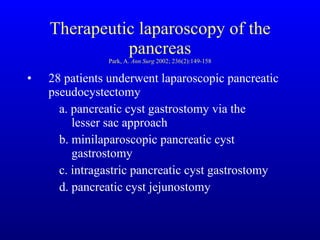
Therapeutic laparoscopy of the pancreas Park, A.  Ann Surg  2002; 236(2):149-158 28 patients underwent laparoscopic pancreatic pseudocystectomy a. pancreatic cyst gastrostomy via the      lesser sac approach b. minilaparoscopic pancreatic cyst      gastrostomy c. intragastric pancreatic cyst gastrostomy d. pancreatic cyst jejunostomy
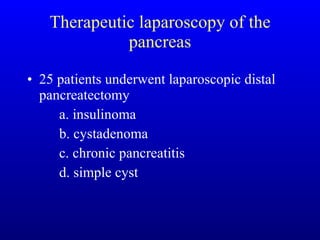
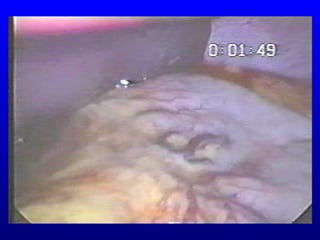
Therapeutic laparoscopy of the pancreas 25 patients underwent laparoscopic distal pancreatectomy  a. insulinoma b. cystadenoma c. chronic pancreatitis d. simple cyst
 
4- Pancreatic trauma
Laparoscopic Distal Pancreatectomy for Blunt Injury to the Pancreas with Splenic Preservation 10 yo handle bar injury CT –free fluid and distal transection of the pancreas Distal pancreatectomy with splenic preservation performed Reg diet POD 2 D/C POD 3 Ferzli,G et al; Surg Endosc July2001
 
III-Palliative Laparoscopy for Unresectable Pancreatic Cancer
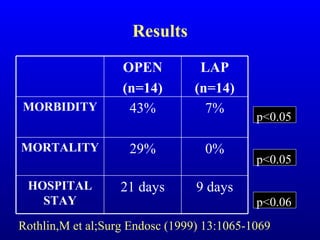
Laparoscopic Gastro- and Hepaticojejunostomy CASE-CONTROL STUDY  14 patients – open palliation 10 patients – laparoscopic palliation 4 patients – diagnostic laparoscopy Rothlin,M et al;Surg Endosc (1999) 13:1065-1069
Results p<0.06 p<0.05 p<0.05 Rothlin,M et al;Surg Endosc (1999) 13:1065-1069 9 days 21 days HOSPITAL STAY 0% 29% MORTALITY 7% 43% MORBIDITY LAP (n=14) OPEN (n=14)
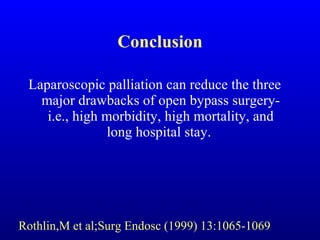
Conclusion Laparoscopic palliation can reduce the three major drawbacks of open bypass surgery-i.e., high morbidity, high mortality, and long hospital stay.  Rothlin,M et al;Surg Endosc (1999) 13:1065-1069
SUMMARY Laparoscopy and laparoscopic ultrasound are sensitive and specific tools for determining resectability in patients with pancreatic cancer Laparoscopic techniques can be used for the treatment of benign and malignant pancreatic diseases and pancreatic trauma

Laparoscopic Pancreatic Surgery

  • 1.
    LAPAROSCOPIC PANCREATIC SURGERYGeorge Ferzli MD, FACS
  • 2.
    ? What isthe current role of laparoscopic surgery with regard to pancreatic disease?
  • 3.
    Role of laparoscopyDIAGNOSTIC Tumor staging THERAPEUTIC Curative tumors pseudocyst pancreatic necrosis - trauma Palliative
  • 4.
  • 5.
    “ In casesof ordinary exploratory operation for carcinoma, before having recourse to the usual large incision, the cystoscope is introduced through a very small and relatively unimportant incision, possibly made with cocaine, may reveal general metastases or a secondary nodule in the liver, thus rendering further procedures unnecessary and saving the patient a rather prolonged convalescence”. 1911 Bernheim: First laparoscopy for pancreatic cancer in the U.S.A. Bernheim B. Organoscopy: Cystoscopy of the abdominal cavity. Ann Surg 53:764-767,1911
  • 6.
    Prospective study of88 consecutive patients Pancreatic and periampullary adenocarcinoma Preoperative evaluation CT scan with contrast 88 pts MRI 20 pts Laparoscopy 47 pts Angiography 85 pts Preoperative Staging and Assessment of Resectability of Pancreatic Cancer Warshaw,A et al: Arch Surg 1990; 125:230-233
  • 7.
    Results Overall resectability33/88 (38%) Laparoscopy found metastatic disease when present in 22/23 patients (96%) Laparoscopy found no metastatic disease in 24/24 patients (100%) Warshaw,A et al: Arch Surg 1990; 125:230-233
  • 8.
    Conclusion Laparoscopy isparticularly sensitive for detecting small metastases (96%) This approach to pancreatic cancer allows the elimination of some operations and tailors others to individual circumstances Warshaw,A et al: Arch Surg 1990; 125:230-233
  • 9.
    The Value ofMinimal Access Surgery in the Staging of Patients with Potentially Resectable Peripancreatic Malignancies 115 patients- radiologically resectable Extensive laparoscopy performed assessment of the peritoneal cavity, liver, lesser sac, porta hepatis, duodenum, transverse mesocolon, and celiac and portal vessels Conlon,K et al;Ann Surg 1996 Vol223,No2, 134-140
  • 10.
    Unresectability Metastases hepatic,serosal, peritoneal Extrapancreatic extension mesocolic involvement Nodal involvement celiac or portal Vascular invasion celiac axis or hepatic artery portal vein, SMV, SMA Conlon,K et al;Ann Surg 1996 Vol223,No2, 134-140
  • 11.
    No intraoperative orpostoperative complications related to laparoscopy 67 considered resectable  61 resected Laparoscopy failed to identify hepatic metastases in 5 patients and portal venous encasement in 1 patient Results Conlon,K et al;Ann Surg 1996 Vol223,No2, 134-140
  • 12.
    Positive predictive indexof 100% Negative predictive index of 91% Accuracy of 94% Results Conlon,K et al;Ann Surg 1996 Vol223,No2, 134-140
  • 13.
    Extended laparoscopy isaccurate and safe and makes exploration unnecessary in many patients with potentially resectable peripancreatic malignancy Conclusion Conlon,K et al;Ann Surg 1996 Vol223,No2, 134-140
  • 14.
    Experience with staginglaparoscopy in pancreatic malignancy Gastrointest Endo 1999; 49(4):498-503 109 patients CT scan revealed metastases in 10 patients Laparoscopy diagnosed metastases in 29 more patients At laparotomy, 6 more patients were identified as having metastatic disease
  • 15.
    Results Negative predictivevalue was 94% Positive predictive value was 88%
  • 16.
    Conclusion In patientswith a negative CT scan for metastasis, laparoscopic identification of metastasis avoided unnecessary laparotomy in 29 of 99 (29%) patients with pancreatic cancer. Staging laparoscopy is indicated in all cases of pancreatic malignancy before laparotomy.
  • 17.
    Laparoscopic Ultrasound inthe Staging of Pancreatic Cancer Prospective evaluation of 90 patients All patients had preoperative CT abdomen/pelvis and either ERCP or transabdominal sonography All patients had laparoscopy and laparoscopic ultrasound Minnard, E. Conlon, K et al, Ann Surg, 1998, 228(2)
  • 18.
    Tumor location Pancreatic head 64 (72%) Pancreatic body 19 (21%) Pancreatic tail 3 (3%) Ampulla 4 (4%) Minnard, E. Conlon, K et al, Ann Surg, 1998, 228(2)                                                                                         
  • 19.
    Results Minnard, E.Conlon, K et al, Ann Surg, 1998, 228(2) ___ ___ 13 (14%) 8 (9%) EQUIVOCAL 50 (56%) 49 (54%) 41 (46%) 17 (19%) UNRESECTABLE ACTUAL LAP SONO LAP CT
  • 20.
    LAPAROSCOPIC ULTRASOUND SENSITIVITY 100% SPECIFICITY 98% ACCURACY 98% Minnard, E. Conlon, K et al, Ann Surg, 1998, 228(2)
  • 21.
    Conclusion The additionof laparoscopic ultrasound offers improved assessment and preoperative staging of pancreatic cancer. Minnard, E. Conlon, K et al, Ann Surg, 1998, 228(2)
  • 22.
    Summary Staging laparoscopyshould be performed for all cases of pancreatic cancer prior to attempted resection The addition of laparoscopic ultrasound improves assessment and preoperative staging of pancreatic cancer
  • 23.
  • 24.
    1- LAPAROSCOPIC PANCREATICODUODENECTOMYGagner and Pomp – 1996 Strasberg, Drebin, and Soper – 1997 Cuschieri – 1998 CONCLUSION: THE MAGNITUDE OF THE RECONSTRUCTION MAY OUTWEIGH THE BENEFIT OF THE MINIMALLY INVASIVE APPROACH
  • 25.
  • 26.
    Videolaparoscopic Resection ofInsulinomas World Journal of Surgery Vol. 26, 2002 Laparoscopic Pancreatic Resection: Single Institution Experience of 19 Patients PETERSON, et al J Am Coll Surg 193(2),2001 Ultrasound Guided Laparoscopic Resection Of Pancreatic Islet Cell Tumors SPITZ, et al Surg Lap Endo Vol 10, 2000 DESCRIPTION STUDY
  • 27.
  • 28.
    3- Management ofpancreatic pseudocyst and necrotizing pancreatitis
  • 29.
    Laparoscopic Cholecystectomy andAcute Biliary Pancreatitis E Tang , NJ Soper , JJT Tate, W Uhl 271 biliary pancreatitis, 22 % Ranson ≥ 3 Laparoscopic cholecystectomy 86 % Early operation and Ranson ≥ 3 were associated with: - more technical difficulties - more conversions - more CBD stones
  • 30.
    Conclusions Past pancreatitisis a poor indicator of CBDS. IOC is indicated regardless of the risk of CBDS. Prognostic systems can discriminate patients with non severe ABP (Negative Predictive Value). Timing of open or laparoscopic biliary surgery depends on AP severity
  • 31.
    Urgent ERC/ES inBenign Acute Biliary Pancreatitis Neoptolemos Fan ERC Controls ERC Controls n (%) n (%) n (%) n (%) N patients 28 29 34 35 Complications - local 3 (11) 4 (14) 7 (21) 1 (3) - general 1 (4) 0 3 (9) 1 (3) Deaths 0 0 0 0
  • 32.
    Conclusions Past pancreatitisis a poor indicator of CBDS. IOC is indicated regardless of the risk of CBDS. Prognostic systems can discriminate patients with non severe ABP (Negative Predictive Value). Timing of open or laparoscopic biliary surgery depends on AP severity. Endoscopic sphincterotomy is NOT indicated in Benign Acute Biliary Pancreatitis
  • 33.
    Surgery vs EndoscopicSphincterotomy in Severe Cholangitis Endoscopy Surgery p Leese (non randomized) Mortality (%) 4.7 21.4 Lai (randomized) N patients 41 41 N (%) with Complications 14 (34) 27 (66) < 0.05 Deaths 4 (10) 13 (32) < 0.03
  • 34.
    Conclusions Past pancreatitisis a poor indicator of CBDS. IOC is indicated regardless of the risk of CBDS. Prognostic systems can discriminate patients with non severe ABP (Negative Predictive Value). Timing of open or laparoscopic biliary surgery depends on AP severity. Endoscopic sphincterotomy is NOT indicated in Benign Acute Biliary Pancreatitis. Endoscopic sphincterotomy is indicated in Severe Cholangitis associated with Severe ABP
  • 35.
    Pre- vs Postoperative ERCP in mild ABP Chang L,et al. Ann Surg 2000. ERC + (LC+IOC) (LC+IOC) + ES N of patients 30 29 ERC 30 7 CBD stones / ES 12 (40%) / 11 8 (28%) / 7 Overall stay (days) * 11.7 ± 6.1 9 ± 3.2 Costs ($) * 10,210 ± 3839 8,586 ± 3520 * p < 0.05 Savings in terms of complications and costs can be expected if preoperative ERCPs are replaced by IOC ( Erickson 1995, Sees 1997, Barwood 2002)
  • 36.
    Conclusions Past pancreatitisis a poor indicator of CBDS. IOC is indicated regardless of the risk of CBDS. Prognostic systems can discriminate patients with non severe ABP (Negative Predictive Value). Timing of open or laparoscopic biliary surgery depends on AP severity. Endoscopic sphincterotomy is NOT indicated in Benign Acute Biliary Pancreatitis . Endoscopic sphincterotomy is indicated in case of Severe Cholangitis associated with Severe ABP. CBD exploration is more efficient than ERC/ES. Performing ERC after LC+IOC rather than before LC minimizes costs and morbidity 
  • 37.
    Percutaneous and LaparoscopicManagement of Infected Pancreatic Necrosis. Gambiez 1998 - Carter 2000 - Alverdy 2000 - Horvath 2001 Number of patients 38 Complications Hemorrhage 4 Digestive Fistula 4 (10 % ) Pancreatic Fistula 4 (11 % ) Persisting Sepsis 5 Reoperations Laparoscopic 28 Arterial embolization 2 Laparotomy 9 (24 % ) Mortality 4 (11%)
  • 38.
    Local Complications (%)Associated with Surgical Management of Infected Pancreatic Necrosis Necrosectomy Retroper. Laparoscopy drainage lavage laparotomy Approach (95% CI) N patients 256 166 134 60 38 Fistulas (%) - Digestive 13 6 27 27 10 (0-20) - Pancreatic 16 17 17 2 11 (2-22) Hemorrhage 14 8 16 13 13 (2-23) Mortality 42 18 21 28 11 (2-22)
  • 39.
    Conclusions Past pancreatitisis a poor indicator of CBDS.IOC is indicated regardless of the risk of CBDS. Prognostic systems can discriminate patients with non severe ABP (Negative Predictive Value). Timing of open or laparoscopic biliary surgery depends on AP severity. ES is NOT indicated in BENIGN ABP . ES is indicated in case of Severe Cholangitis associated with Severe ABP. CBD exploration is more efficient than ERC/ES. Performing ERC after LC+IOC rather than before LC minimizes costs and morbidity. The l aparoscopic approach for necrotic collections is not a standard of care
  • 40.
    Pancreatic pseudocysts Nonsurgical techniques Percutaneous aspiration-drainage Endoscopic transgastric drainage Endoscopic transpapillary procedures Laparoscopic alternatives * Pancreatic cystogastrostomy Pancreatic cystojejunostomy * Cuschieri, Gagner, Meltzer, Mouiel, Park, Way.
  • 41.
    LAPAROSCOPIC INTERNAL DRAINAGEOF PSEUDOCYSTS Cystojejunostomy L. paracolic handsewn Palanivelu Cystojejunostomy Infracolic Cushieri Cystogastrostomy Stapled Intraluminal Litwin & Ross Cystogastrostomy Transgastric Handsewn Petelin
  • 42.
    Therapeutic laparoscopy ofthe pancreas Park, A. Ann Surg 2002; 236(2):149-158 28 patients underwent laparoscopic pancreatic pseudocystectomy a. pancreatic cyst gastrostomy via the lesser sac approach b. minilaparoscopic pancreatic cyst gastrostomy c. intragastric pancreatic cyst gastrostomy d. pancreatic cyst jejunostomy
  • 43.
    Therapeutic laparoscopy ofthe pancreas 25 patients underwent laparoscopic distal pancreatectomy a. insulinoma b. cystadenoma c. chronic pancreatitis d. simple cyst
  • 44.
  • 45.
  • 46.
    Laparoscopic Distal Pancreatectomyfor Blunt Injury to the Pancreas with Splenic Preservation 10 yo handle bar injury CT –free fluid and distal transection of the pancreas Distal pancreatectomy with splenic preservation performed Reg diet POD 2 D/C POD 3 Ferzli,G et al; Surg Endosc July2001
  • 47.
  • 48.
    III-Palliative Laparoscopy forUnresectable Pancreatic Cancer
  • 49.
    Laparoscopic Gastro- andHepaticojejunostomy CASE-CONTROL STUDY 14 patients – open palliation 10 patients – laparoscopic palliation 4 patients – diagnostic laparoscopy Rothlin,M et al;Surg Endosc (1999) 13:1065-1069
  • 50.
    Results p<0.06 p<0.05p<0.05 Rothlin,M et al;Surg Endosc (1999) 13:1065-1069 9 days 21 days HOSPITAL STAY 0% 29% MORTALITY 7% 43% MORBIDITY LAP (n=14) OPEN (n=14)
  • 51.
    Conclusion Laparoscopic palliationcan reduce the three major drawbacks of open bypass surgery-i.e., high morbidity, high mortality, and long hospital stay. Rothlin,M et al;Surg Endosc (1999) 13:1065-1069
  • 52.
    SUMMARY Laparoscopy andlaparoscopic ultrasound are sensitive and specific tools for determining resectability in patients with pancreatic cancer Laparoscopic techniques can be used for the treatment of benign and malignant pancreatic diseases and pancreatic trauma

Editor's Notes

  • #6 IN 1911, Bernheim at The Johns Hopkins University performed the first