Dr. Sreenath K
Dept of surgery, RIMS Imphal
Introduction
Bile duct injury (BDI)
 Rare but potentially devastating condition
 Biliary peritonitis & sepsis, cholangitis, portal
hypertension & secondary biliary cirrhosis
 Significant morbidity & mortality
Iatrogenic BDI
 Increased financial burden (patient or hospital)
Anatomy
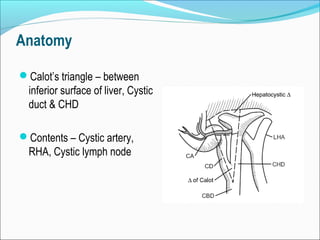
Calot’s triangle – between
inferior surface of liver, Cystic
duct & CHD
Contents – Cystic artery,
RHA, Cystic lymph node
Bile Duct Injuries (BDI)
Iatrogenic injury
 Cholecystectomy
 Gastrectomy
 Pancreatectomy
 ERCP
Trauma
Duodenal ulcer
Risk factors
Inflammation in the porta,
Variable biiary anatomy,
Inappropriate exposure,
Aggressive attempts at hemostasis,
Surgeon inexperience.
97% due to visual misperception, only 3% accounts for
technical skills and knowledge.
Misperception ..
With sufficient cephalad retraction of the gall bladder fundus ,the cystic
duct overlies the common hepatc duct running in a parrellel path.
without inferolateral traction of the gallbladder infundibulum to
dossociate this structures, the dissection of apparent cystic duct may
actually include CBD…
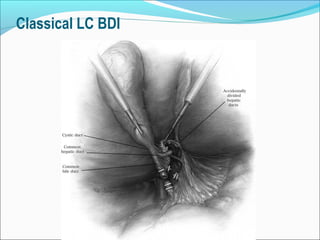
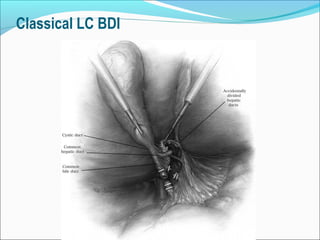
Classical LC BDI
Laparoscopic cholecystectomy (LC)
Gold standard for management of benign gallbladder disease
Compared with laparotomy
 Less post-op pain
 Shorter hospital stay
 Earlier return to normal activity
 Better cosmesis
 Iatrogenic bile duct injury rate
 0.1% to 0.2% (open) vs 0.4% to 0.6% (lap)
‘’Learning curve phenomenon’’
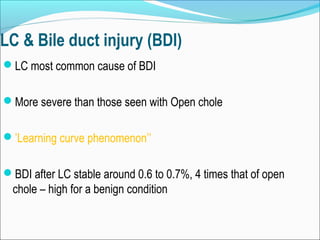
LC & Bile duct injury (BDI)
LC most common cause of BDI
More severe than those seen with Open chole
’Learning curve phenomenon’’
BDI after LC stable around 0.6 to 0.7%, 4 times that of open
chole – high for a benign condition
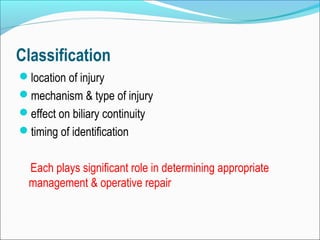
Classification
location of injury
mechanism & type of injury
effect on biliary continuity
timing of identification
Each plays significant role in determining appropriate
management & operative repair
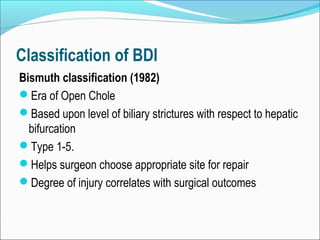
Classification of BDI
Bismuth classification (1982)
Era of Open Chole
Based upon level of biliary strictures with respect to hepatic
bifurcation
Type 1-5.
Helps surgeon choose appropriate site for repair
Degree of injury correlates with surgical outcomes
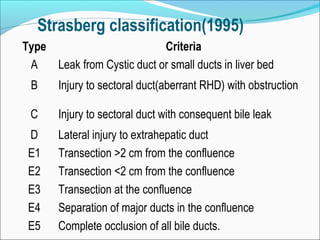
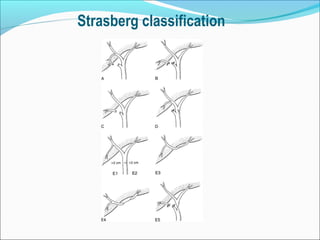
Strasberg classification(1995)
Type Criteria
A Leak from Cystic duct or small ducts in liver bed
B Injury to sectoral duct(aberrant RHD) with obstruction
C Injury to sectoral duct with consequent bile leak
D Lateral injury to extrahepatic duct
E1 Transection >2 cm from the confluence
E2 Transection <2 cm from the confluence
E3 Transection at the confluence
E4 Separation of major ducts in the confluence
E5 Complete occlusion of all bile ducts.
Strasberg classification
Clinical Presentation (post-op)
Obstruction
 Clip ligation or resection of CBD  obstructive
jaundice, cholangitis
Bile Leak
 Bile from intra-op drain or
 More commonly, localized biloma or free bile ascites /
peritonitis, if no drain
Fever,abd pain , jaundice, or bile leakage from incision.
 Diffuse abdominal pain & persistent ileus several days
post-op  high index of suspicion  possible
unrecognized BDI
Classical LC BDI
Reasons
Misidentification
 CBD or aberrant RHD mistaken for cystic duct
 Risk factors  inexperience, inflammation or aberrant
anatomy
 Infundibular technique – flaring of cystic duct as it
becomes infundibulum  misleading in inflammation
Technical errors
 Cautery induced injury
Prevention
 30° laparoscope, high quality imaging equipment
 Firm cephalic traction on fundus & lateral traction on
infundibulum, so cystic duct perpendicular to CBD
 Dissect infundibulo-cystic junction
 Expose “Critical view of safety” before dividing cystic duct
 Convert to open, if unable to mobilise infundibulum or
bleeding or inflammation in Calot’s triangle
 Routine intra-op cholangiogram
 “Fundus-first” dissection
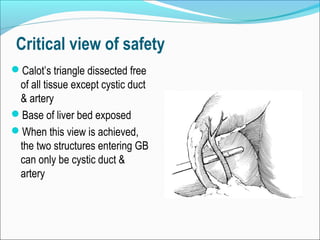
Critical view of safety
Calot’s triangle dissected free
of all tissue except cystic duct
& artery
Base of liver bed exposed
When this view is achieved,
the two structures entering GB
can only be cystic duct &
artery
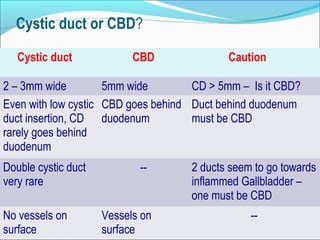
Cystic duct or CBD?
Cystic duct CBD Caution
2 – 3mm wide 5mm wide CD > 5mm – Is it CBD?
Even with low cystic
duct insertion, CD
rarely goes behind
duodenum
CBD goes behind
duodenum
Duct behind duodenum
must be CBD
Double cystic duct
very rare
-- 2 ducts seem to go towards
inflammed Gallbladder –
one must be CBD
No vessels on
surface
Vessels on
surface
--
Management
Recognized at the Time of Cholecystectomy
Conversion to an open operation and use of
cholangiography.
Goals ..
Maintenance of ductal length, elimination of any bile
leakage that would affect subsequent management, and
creation of a tension-free repair.
Ducts smaller than 3 mm drain only a single segment or
subsegment of liver..simple ligation.
 Ducts larger than 3 mm usually drain more than a single
segment of liver,if transected.. should be reimplanted into
the biliary tree.
Injury occurs to a larger duct, but is not caused by
electrocautery and involves less than 50% of the
circumference of the wall, a T tube placed through the
injury
 Low injuries to the bile duct can be reimplanted into the
duodenum.
Most injuries to the bile duct occur higher in the biliary tree,
close to the hilum, thus not allowing for tension-free anastomosis
to the duodenum. Therefore, in almost all cases of bile duct
injury, a resection of the injured segment with mucosa to
mucosa anastomosis using a Roux-en-Y jejunal limb (end-
to-side choledochojejunostomy ) is preferred.
Transanastomotic stenting has been shown to improve
anastomotic patency.
Identified After Cholecystectomy
Goals of Therapy in Iatrogenic Bile Duct Injury
1.Control of infection limiting inflammation
Parenteral antibiotics
Percutaneous drainage
2.Clear and thorough delineation of entire biliary anatomy.
MRCP/PTC , ERCP
3.Re-establishment of biliary enteric continuity
Tension-free, mucosa-to-mucosa anastomosis
Roux-en-Y hepaticojejunostomy
Long-term transanastomotic stents if involving
bifurcation or higher
Approach..
Should undergo imaging to assess for a fluid collection and
evaluate the biliary tree.
Ultrasonography can achieve both these goals.
 Cross-sectional imaging via CT will generally provide more
useful data.
Radionucleotide scanning to confirm bile leakage, but with
any documentation of a leak, CT will be necessary to plan
management.
CT or U/S guided (or surgical) drainage
Sepsis control  Broad-spectrum antibiotics &
percutaneous biliary drainage to control any bile leak 
most fistulas will be controlled or even close.
1.5% mortality rate due to uncontrolled sepsis
No rush to proceed with definitive management of BDI.
Delay of several weeks allows local inflammation to resolve
& almost certainly improves final outcome.
Definitive management is to reestablish durable biliary
enteric drainage.
Combination of percutaneous and endoscopic biliary
dilations and stenting may establish continuity.
Surgical reconstruction has the highest patency rates.
performed between a minimally inflamed bile duct to
intestines in a tension-free, mucosa to mucosa fashion.
 If the anastomosis is within 2 cm of the hepatic duct
bifurcation, or involves intrahepatic ducts, long-term stenting
appears to improve patency
If the bifurcation is involved, stenting of both right and left
ducts should be performed
When the reconstruction involves the common bile duct or
common hepatic duct more than 2 cm from the bifurcation,
stenting is not necessary.
Interventional Radiologic and Endoscopic Techniques
Using balloon dilation techniques, the stricture is dilated and
a catheter is left in place to decompress the system, allow
healing, document resolution and, if necessary guide repeat
dilations.
This approach is successful in up to 70% of patients.
Endoscopic balloon dilation of bile duct strictures is generally
reserved for those with primary bile duct strictures or patients
who have undergone choledochoduodenostomy for
reconstruction, because the Roux limb does not usually allow
for endoscopic strategies.
Two large retrospective reviews have been performed and 
both have shown higher success rates from surgical 
therapy, with lower morbidity and lower mortality 
following operative management compared with those for 
nonoperative strategies
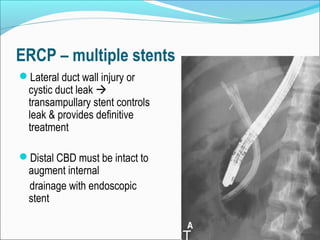
ERCP – multiple stents
Lateral duct wall injury or
cystic duct leak 
transampullary stent controls
leak & provides definitive
treatment
Distal CBD must be intact to
augment internal
drainage with endoscopic
stent
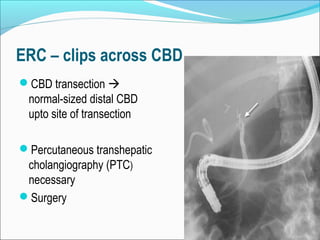
ERC – clips across CBD
CBD transection 
normal-sized distal CBD
upto site of transection
Percutaneous transhepatic
cholangiography (PTC)
necessary
Surgery
Cholangiography (ERCP + PTC)
Percutaneous transhepatic cholangiography (PTC)
 Defines proximal anatomy
 Allows placement of percutaneous transhepatic biliary
catheters to decompress biliary tree  treats or
prevents cholangitis & controls bile leak
MRCP / CT cholangiography
Noninvasive
May avoid invasive procedures like ERCP or PTC
Do not allow intervention
Interpretatation in presence of bile collection difficult
Biliary enteric anastomosis
Most laparoscopic BDI –
complete discontinuity of
biliary tree
Surgical reconstruction,
Roux-en-Y
hepaticojejunostomy
tension-free, mucosa-to-
mucosa anastomosis with
healthy, nonischemic bile duct
Treatment summary
Strasberg Type A – ERCP + sphincterotomy + stent
Type B & C – traditional surgical hepaticojejunostomy
Type D – primary repair over an adjacently placed T-tube (if
no evidence of significant ischemia or cautery damage at site
of injury)
More extensive type D & E injuries – Roux an-Y
hepaticojejunostomy with biliary stent
Risk Factors for BDI
Acute inflammation at Calot’s triangle
Atypical anatomy
 aberrant RHD (most common)
 complex cystic duct insertion
Conditons that impair “Critical view of safety”
 Obesity & periportal fat
 Complex biliary disease – choledocholithiasis ,
gallstone pancreatitis, cholangitis
 Intra-op bleeding
Reasons
Misidentification
 CBD or aberrant RHD mistaken for cystic duct
 Risk factors  inexperience, inflammation or aberrant
anatomy
 Infundibular technique – flaring of cystic duct as it
becomes infundibulum  misleading in inflammation
Technical errors
 Cautery induced injury
Anatomic illusion?
Misperception (97%) rather than technical error (3%)
Everyone is susceptible – experience, knowledge & technical
skill alone may not be adequate
All BDI may not represent “substandard practice”
Improvements may have to depend on technology
Summary
Multidisciplinary management of BDI  expertise of
surgeons, radiologists & gastroenterologists
Mismanagement  lifelong disability & chronic liver
disease
BDI with lap. Chole  results of operative repair is
excellent in Specialist Centres
Thank you…

Bile duct injuries.slideshare

  • 1.
    Dr. Sreenath K Deptof surgery, RIMS Imphal
  • 2.
    Introduction Bile duct injury(BDI)  Rare but potentially devastating condition  Biliary peritonitis & sepsis, cholangitis, portal hypertension & secondary biliary cirrhosis  Significant morbidity & mortality Iatrogenic BDI  Increased financial burden (patient or hospital)
  • 3.
    Anatomy Calot’s triangle –between inferior surface of liver, Cystic duct & CHD Contents – Cystic artery, RHA, Cystic lymph node
  • 4.
    Bile Duct Injuries(BDI) Iatrogenic injury  Cholecystectomy  Gastrectomy  Pancreatectomy  ERCP Trauma Duodenal ulcer
  • 5.
    Risk factors Inflammation inthe porta, Variable biiary anatomy, Inappropriate exposure, Aggressive attempts at hemostasis, Surgeon inexperience. 97% due to visual misperception, only 3% accounts for technical skills and knowledge.
  • 6.
    Misperception .. With sufficientcephalad retraction of the gall bladder fundus ,the cystic duct overlies the common hepatc duct running in a parrellel path. without inferolateral traction of the gallbladder infundibulum to dossociate this structures, the dissection of apparent cystic duct may actually include CBD…
  • 7.
  • 8.
    Laparoscopic cholecystectomy (LC) Goldstandard for management of benign gallbladder disease Compared with laparotomy  Less post-op pain  Shorter hospital stay  Earlier return to normal activity  Better cosmesis  Iatrogenic bile duct injury rate  0.1% to 0.2% (open) vs 0.4% to 0.6% (lap) ‘’Learning curve phenomenon’’
  • 9.
    LC & Bileduct injury (BDI) LC most common cause of BDI More severe than those seen with Open chole ’Learning curve phenomenon’’ BDI after LC stable around 0.6 to 0.7%, 4 times that of open chole – high for a benign condition
  • 10.
    Classification location of injury mechanism& type of injury effect on biliary continuity timing of identification Each plays significant role in determining appropriate management & operative repair
  • 11.
    Classification of BDI Bismuthclassification (1982) Era of Open Chole Based upon level of biliary strictures with respect to hepatic bifurcation Type 1-5. Helps surgeon choose appropriate site for repair Degree of injury correlates with surgical outcomes
  • 12.
    Strasberg classification(1995) Type Criteria ALeak from Cystic duct or small ducts in liver bed B Injury to sectoral duct(aberrant RHD) with obstruction C Injury to sectoral duct with consequent bile leak D Lateral injury to extrahepatic duct E1 Transection >2 cm from the confluence E2 Transection <2 cm from the confluence E3 Transection at the confluence E4 Separation of major ducts in the confluence E5 Complete occlusion of all bile ducts.
  • 13.
  • 14.
    Clinical Presentation (post-op) Obstruction Clip ligation or resection of CBD  obstructive jaundice, cholangitis Bile Leak  Bile from intra-op drain or  More commonly, localized biloma or free bile ascites / peritonitis, if no drain Fever,abd pain , jaundice, or bile leakage from incision.  Diffuse abdominal pain & persistent ileus several days post-op  high index of suspicion  possible unrecognized BDI
  • 15.
  • 16.
    Reasons Misidentification  CBD oraberrant RHD mistaken for cystic duct  Risk factors  inexperience, inflammation or aberrant anatomy  Infundibular technique – flaring of cystic duct as it becomes infundibulum  misleading in inflammation Technical errors  Cautery induced injury
  • 17.
    Prevention  30° laparoscope,high quality imaging equipment  Firm cephalic traction on fundus & lateral traction on infundibulum, so cystic duct perpendicular to CBD  Dissect infundibulo-cystic junction  Expose “Critical view of safety” before dividing cystic duct  Convert to open, if unable to mobilise infundibulum or bleeding or inflammation in Calot’s triangle  Routine intra-op cholangiogram  “Fundus-first” dissection
  • 18.
    Critical view ofsafety Calot’s triangle dissected free of all tissue except cystic duct & artery Base of liver bed exposed When this view is achieved, the two structures entering GB can only be cystic duct & artery
  • 19.
    Cystic duct orCBD? Cystic duct CBD Caution 2 – 3mm wide 5mm wide CD > 5mm – Is it CBD? Even with low cystic duct insertion, CD rarely goes behind duodenum CBD goes behind duodenum Duct behind duodenum must be CBD Double cystic duct very rare -- 2 ducts seem to go towards inflammed Gallbladder – one must be CBD No vessels on surface Vessels on surface --
  • 20.
  • 21.
    Recognized at theTime of Cholecystectomy Conversion to an open operation and use of cholangiography. Goals .. Maintenance of ductal length, elimination of any bile leakage that would affect subsequent management, and creation of a tension-free repair.
  • 22.
    Ducts smaller than3 mm drain only a single segment or subsegment of liver..simple ligation.  Ducts larger than 3 mm usually drain more than a single segment of liver,if transected.. should be reimplanted into the biliary tree. Injury occurs to a larger duct, but is not caused by electrocautery and involves less than 50% of the circumference of the wall, a T tube placed through the injury
  • 23.
     Low injuries tothe bile duct can be reimplanted into the duodenum. Most injuries to the bile duct occur higher in the biliary tree, close to the hilum, thus not allowing for tension-free anastomosis to the duodenum. Therefore, in almost all cases of bile duct injury, a resection of the injured segment with mucosa to mucosa anastomosis using a Roux-en-Y jejunal limb (end- to-side choledochojejunostomy ) is preferred. Transanastomotic stenting has been shown to improve anastomotic patency.
  • 24.
    Identified After Cholecystectomy Goalsof Therapy in Iatrogenic Bile Duct Injury 1.Control of infection limiting inflammation Parenteral antibiotics Percutaneous drainage 2.Clear and thorough delineation of entire biliary anatomy. MRCP/PTC , ERCP 3.Re-establishment of biliary enteric continuity Tension-free, mucosa-to-mucosa anastomosis Roux-en-Y hepaticojejunostomy Long-term transanastomotic stents if involving bifurcation or higher
  • 25.
    Approach.. Should undergo imagingto assess for a fluid collection and evaluate the biliary tree. Ultrasonography can achieve both these goals.  Cross-sectional imaging via CT will generally provide more useful data. Radionucleotide scanning to confirm bile leakage, but with any documentation of a leak, CT will be necessary to plan management.
  • 26.
    CT or U/Sguided (or surgical) drainage Sepsis control  Broad-spectrum antibiotics & percutaneous biliary drainage to control any bile leak  most fistulas will be controlled or even close. 1.5% mortality rate due to uncontrolled sepsis No rush to proceed with definitive management of BDI. Delay of several weeks allows local inflammation to resolve & almost certainly improves final outcome.
  • 27.
    Definitive management isto reestablish durable biliary enteric drainage. Combination of percutaneous and endoscopic biliary dilations and stenting may establish continuity. Surgical reconstruction has the highest patency rates. performed between a minimally inflamed bile duct to intestines in a tension-free, mucosa to mucosa fashion.
  • 28.
     If theanastomosis is within 2 cm of the hepatic duct bifurcation, or involves intrahepatic ducts, long-term stenting appears to improve patency If the bifurcation is involved, stenting of both right and left ducts should be performed When the reconstruction involves the common bile duct or common hepatic duct more than 2 cm from the bifurcation, stenting is not necessary.
  • 29.
    Interventional Radiologic andEndoscopic Techniques Using balloon dilation techniques, the stricture is dilated and a catheter is left in place to decompress the system, allow healing, document resolution and, if necessary guide repeat dilations. This approach is successful in up to 70% of patients. Endoscopic balloon dilation of bile duct strictures is generally reserved for those with primary bile duct strictures or patients who have undergone choledochoduodenostomy for reconstruction, because the Roux limb does not usually allow for endoscopic strategies.
  • 30.
  • 31.
    ERCP – multiplestents Lateral duct wall injury or cystic duct leak  transampullary stent controls leak & provides definitive treatment Distal CBD must be intact to augment internal drainage with endoscopic stent
  • 32.
    ERC – clipsacross CBD CBD transection  normal-sized distal CBD upto site of transection Percutaneous transhepatic cholangiography (PTC) necessary Surgery
  • 33.
    Cholangiography (ERCP +PTC) Percutaneous transhepatic cholangiography (PTC)  Defines proximal anatomy  Allows placement of percutaneous transhepatic biliary catheters to decompress biliary tree  treats or prevents cholangitis & controls bile leak
  • 34.
    MRCP / CTcholangiography Noninvasive May avoid invasive procedures like ERCP or PTC Do not allow intervention Interpretatation in presence of bile collection difficult
  • 35.
    Biliary enteric anastomosis Mostlaparoscopic BDI – complete discontinuity of biliary tree Surgical reconstruction, Roux-en-Y hepaticojejunostomy tension-free, mucosa-to- mucosa anastomosis with healthy, nonischemic bile duct
  • 36.
    Treatment summary Strasberg TypeA – ERCP + sphincterotomy + stent Type B & C – traditional surgical hepaticojejunostomy Type D – primary repair over an adjacently placed T-tube (if no evidence of significant ischemia or cautery damage at site of injury) More extensive type D & E injuries – Roux an-Y hepaticojejunostomy with biliary stent
  • 37.
    Risk Factors forBDI Acute inflammation at Calot’s triangle Atypical anatomy  aberrant RHD (most common)  complex cystic duct insertion Conditons that impair “Critical view of safety”  Obesity & periportal fat  Complex biliary disease – choledocholithiasis , gallstone pancreatitis, cholangitis  Intra-op bleeding
  • 38.
    Reasons Misidentification  CBD oraberrant RHD mistaken for cystic duct  Risk factors  inexperience, inflammation or aberrant anatomy  Infundibular technique – flaring of cystic duct as it becomes infundibulum  misleading in inflammation Technical errors  Cautery induced injury
  • 39.
    Anatomic illusion? Misperception (97%)rather than technical error (3%) Everyone is susceptible – experience, knowledge & technical skill alone may not be adequate All BDI may not represent “substandard practice” Improvements may have to depend on technology
  • 40.
    Summary Multidisciplinary management ofBDI  expertise of surgeons, radiologists & gastroenterologists Mismanagement  lifelong disability & chronic liver disease BDI with lap. Chole  results of operative repair is excellent in Specialist Centres
  • 41.