Safe Laparoscopic
Cholecystectomy
Presented by
Dr Rahul Singh
JR3 , General Surgery
K.G.M.U , Lucknow
Moderator:
Prof. Sandeep Tewari
( MS, FACS, FIAGES,FICS)
Professor
Dept. Of General Surgery
K.G.M.U , Lucknow
• More than 1,00,000 laparoscopic
cholecystectomies are performed every year
in India.1
• Reduced pain, faster return to normal
activities, and reduced risk of surgical site
infection with a laparoscopic approach
compared to an open operation.2
1. http://www.thelaparoscopicsurgeon.in/service/laparoscopic-cholecystectomy/
2.Keus F, de Jong JAF, Gooszen HG, van Laarhoven CJHM. Laparoscopic versus open cholecystectomy for patients with
symptomatic cholecystolithiasis. Cochrane Database of Systematic Reviews 2006:CD006231
Indications
• Symptomatic cholelithiasis
• Biliary colic
• Acute cholecystitis
• Asymptomatic cholelithiasis
• Sickle cell disease
Blumgart's Surgery of the Liver, Biliary Tract and Pancreas, Chapter 34, 511531
• Total parenteral nutrition
• Chronic immunosuppression
• Incidental cholecystectomy for patients
undergoing laparoscopic procedure for other
indications
• Acalculous cholecystitis (biliary dyskinesia)
Blumgart's Surgery of the Liver, Biliary Tract and Pancreas, Chapter 34, 511531
• Gallstone pancreatitis
• Gallbladder polyps greater than 1 cm in
diameter
• Porcelain gallbladder
• Blumgart's Surgery of the Liver, Biliary Tract and Pancreas, Chapter 34, 511531.
Contraindications
• Absolute
Unable to tolerate general anesthesia
Refractory coagulopathy
Suspicion of carcinoma*
Blumgart's Surgery of the Liver, Biliary Tract and Pancreas, Chapter 34, 511531.
• Relative
Previous upper abdominal surgery
Cholangitis
Diffuse peritonitis
Cirrhosis or portal hypertension
Blumgart's Surgery of the Liver, Biliary Tract and Pancreas, Chapter 34, 511531.
Chronic obstructive pulmonary disease
Cholecystoenteric fistula
Morbid obesity
Pregnancy
Blumgart's Surgery of the Liver, Biliary Tract and Pancreas, Chapter 34, 511531.
Safe Laparoscopic Cholecystectomy
• Preoperative Preparation
• Basic operative technique
• Postoperative Care
Preoperative Preparation
• Antibiotic prophylaxis
i. Antibiotics are not required in low risk patients
undergoing laparoscopic cholecystectomy. (Level I, Grade
A).2
ii. Antibiotics may reduce the incidence of wound
infection in high risk patients (age > 60 years, the
presence of diabetes, acute colic within 30 days of
operation, jaundice, acute cholecystitis, or cholangitis).
(Level I, Grade B).2,3
2.Choudhary A, Bechtold ML, Puli SR, Othman MO, Roy PK. Role of prophylactic antibiotics in laparoscopic cholecystectomy: a meta-analysis. J
Gastrointest Surg 2008;12:1847-53; discussion 53.
3.Dervisoglou A, Tsiodras S, Kanellakopoulou K, et al. The value of chemoprophylaxis against Enterococcus species in elective
cholecystectomy: a randomized study of cefuroxime vs ampicillin-sulbactam. Arch Surg 2006;141:1162-7
iii. If given, they should be limited to a single
preoperative dose given within one hour of skin
incision. (Level II, Grade A).4 and re-dosed if the
procedure is more than 4 hours long .5
4.Chang WT, Lee KT, Chuang SC, et al. The impact of prophylactic antibiotics on postoperative infection complication in
elective laparoscopic cholecystectomy: a prospective randomized study. Am J Surg 2006;191:721-5.
5.Steinberg JP, Braun BI, Hellinger WC, et al. Timing of antimicrobial prophylaxis and the risk of surgical site infections:
results from the Trial to Reduce Antimicrobial Prophylaxis Errors. Ann Surg 2009;250:10-6.
Deep Venous Thrombosis Prophylaxis
• Increased risk :
1. Increased intra abdominal pressure as a result of
pneumoperitoneum,
2. Reverse Trendelenburg position, and
3. Systemic vasodilation associated with
general anesthesia.
Blumgart's Surgery of the Liver, Biliary Tract and Pancreas, Chapter 34, 511531
• In the absence of convincing evidence in the literature, DVT
prophylaxis with calf length pneumatic compression
devices in all patients undergoing laparoscopic
cholecystectomy .
( Level III , Grade C )
• Blumgart's Surgery of the Liver, Biliary Tract and Pancreas, Chapter 34, 511531
• Guidelines for deep venous thrombosis prophylaxis during laparoscopic surgery. Surg Endosc 2007;21:1007-9.
• Haas S, Flosbach CW. Prevention of postoperative thromboembolism with Enoxaparin in general surgery: a German multicenter trial. Semin Thromb
Hemost. 1993;19 suppl 1:164-73
• Gonzalez QH, ishler DS, Plata-Munoz JJ, Bondora A, Vickers SM, Leath T, Clements RH. Incidence of clinically evident deep venous thrombosis after
laparoscopic roux-en-Y gastric bypass. Surg Endosc. 2004 jul;18(7):1082-4
• In patients with additional risk factors—
Previous DVT
Cancer
Obesity
Exogenous estrogens
Blumgart's Surgery of the Liver, Biliary Tract and Pancreas, Chapter 34, 511531
Projected operating time > 2 hrs
Age over 40 yrs
Recommend the addition of pharmacologic
prophylaxis.( Level III , Grade C )
Blumgart's Surgery of the Liver, Biliary Tract and Pancreas, Chapter 34, 511531
• Guidelines for deep venous thrombosis prophylaxis during laparoscopic surgery. Surg Endosc 2007;21:1007-9.
• Haas S, Flosbach CW. Prevention of postoperative thromboembolism with Enoxaparin in general surgery: a German multicenter trial.
Semin Thromb Hemost. 1993;19 suppl 1:164-73
• Gonzalez QH, ishler DS, Plata-Munoz JJ, Bondora A, Vickers SM, Leath T, Clements RH. Incidence of clinically evident deep venous
thrombosis after laparoscopic roux-en-Y gastric bypass. Surg Endosc. 2004 jul;18(7):1082-4
Basic operative technique
• Room set-up and patient positioning:
With no data to guide choices, surgeon preference
should dictate room set-up. (Level III, Grade A).9
9.Scott-Conner CEH, ed. The SAGES manual: fundamentals of laparoscopy, thoracoscopy, and GI endoscopy. 2 ed: Birkhäuser; 2005.
• Using the “American” technique, the surgeon
stands to the left of the patient, the first
assistant stands to the patient's right, and the
laparoscopic video camera operator stands to
the left of the surgeon
• Blumgart's Surgery of the Liver, Biliary Tract and Pancreas, Chapter 34, 511531
Blumgart's Surgery of the Liver, Biliary Tract and Pancreas, Chapter 34, 511531
• In the “French” technique, the patient's legs
are abducted, and the surgeon stands
between them.
• Ergonomic assessment of the French and
American position for laparoscopic
cholecystectomy in the MIS Suite.
No statistical difference was observed in the
mean body angles or in the percentages of
operation time within an acceptable range
between the French and the American position.
• Kramp KH , van Det MJ, Totte ER, Hoff C, Pierie JP. SurgEndosg. 2014 May;28(5):1571-8. doi: 10.1007/s00464-013-3353-1.
Epub 2014 Jan 1
• Equipment:
In the absence of data, surgeon preference
should dictate choice of equipment. (Level III,
Grade A).
. ScottConner CEH, ed. The SAGES manual: fundamentals of laparoscopy, thoracoscopy, and GI endoscopy. 2 ed: Birkhäuser; 2005.
• Abdominal Access
There are a variety of techniques for gaining
initial abdominal access for laparoscopic
surgery
i. Veress needle
ii. The open Hasson’s technique.
iii. Direct trocar placement without prior
pneumoperitoneum.
iv. The optical view technique, in which the
laparoscope is placed within the trocar so that
the layers of the abdominal wall are visualized
as they are being traversed.
In general, all of the mentioned approaches to
abdominal access are safe.
• Abdominal access:
No demonstrable differences in the safety of open
versus closed techniques for establishing access;
Decisions regarding choice of technique are left to
the surgeon and should be based on individual
training, skill, case assessment. (Level I, Grade A).
.Larobina M, Nottle P. Complete evidence regarding major vascular injuries during laparoscopic access. Surg Laparosc Endosc Percutan Tech
2005;15:119-23.
.Ahmad G, Duffy JM, Phillips K, Watson A. Laparoscopic entry techniques. Cochrane Database Syst Rev 2008:CD006583.
• Sharp instruments should never be moved
intracorporeally unless they are under direct
videoscopic vision.
• Blumgart's Surgery of the Liver, Biliary Tract and Pancreas, Chapter 34, 511531
Low pressure versus standard pressure
pneumoperitoneum in laparoscopic
cholecystectomy
• No evidence is currently available to support the
use of low pressure pneumoperitoneum in low
anaesthetic risk patients undergoing elective
laparoscopic cholecystectomy.(Level I,Grade A)
• Kurinchi Selvan Gurusamy,Jessica Vaughan,Brian R Davidson ; Low pressure versus standard pressure pneumoperitoneum in
laparoscopic cholecystectomy, Cochrane Database Syst Rev 2014: CD006930
Monopolar electrocautery versus ultrasonic
dissection of the gallbladder from the gallbladder
bed in laparoscopic cholecystectomy: a randomized
controlled trial
• Ultrasonic Dissection Provides a superior alternative
to high frequency monopolar technology in terms of
lower incidence of gallbladder perforation and a
shorter duration of surgery.
• Varun Mahabaleshwar, Lileswar Kaman, Javid Iqbal, Rajinder Singh; Monopolar electrocautery versus ultrasonic dissection
of the gallbladder from the gallbladder bed in laparoscopic cholecystectomy: a randomized controlled trial; J can chir, Vol.
55, No 5, octobre 2012
Safe laparoscopic cholecystectomy
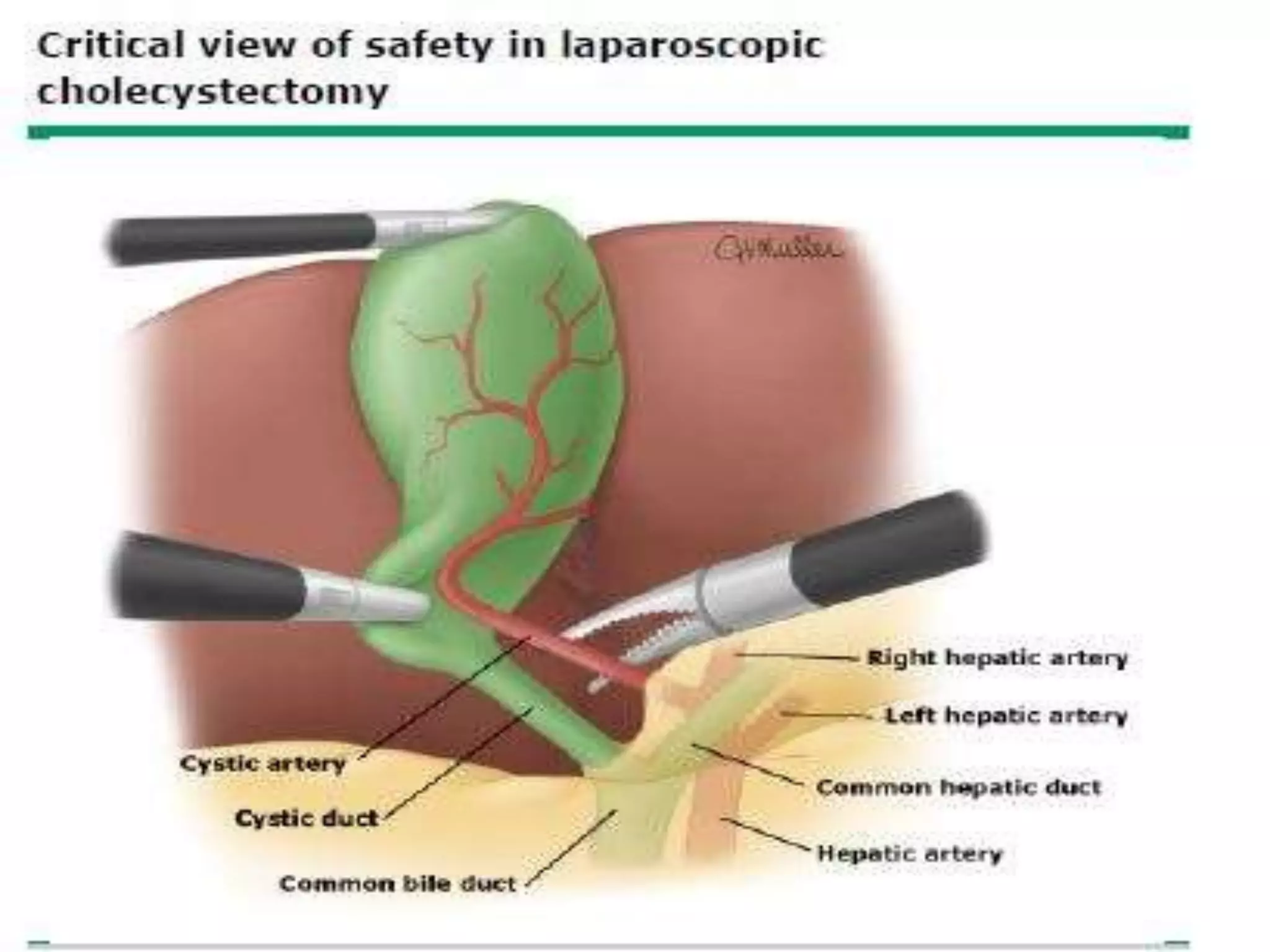
• 1. Critical View of Safety (CVS)
Three criteria are required to achieve the CVS:
A. The hepatocystic triangle (triangle of cholecystectomy) is cleared
of fat and fibrous tissue.
The hepatocystic triangle is defined as the triangle formed by the
cystic duct, the common hepatic duct, and inferior edge of the
liver.
The common bile duct and common hepatic duct do not have to be
exposed.
B. The lower one third of the gallbladder is
separated from the liver to expose the cystic
plate. The cystic plate is also known as liver bed
of the gallbladder and lies in the gallbladder
fossa.
C. Two and only two structures should be seen
entering the gallbladder.
• Strasberg SM, Brunt LM. Rationale and use of the critical view of safety in laparoscopic cholecystectomy. Journal of the
American College of Surgeons 2010; 211:1328.
• Yegiyants S, Collins JC. Operative strategy can reduce the incidence of major bile duct injury in laparoscopic cholecystectomy.
Am Surg 2008;74:985-7.
A : Anterior view B: Posterior view
Anterior view of CVS
Posterior View of CVS
Calot’s Vs Hepatocystic triangle
2. Consider an Intraoperative Time Out during
laparoscopic cholecystectomy prior to clipping,
cutting or transecting any ductal structures.
• The Intraoperative Time Out should consist of
a stop point in the operation to confirm that
the CVS has been achieved utilizing the
Doublet View.
3. Understand the potential for aberrant anatomy in
all cases.
• Aberrant anatomy may include a short cystic
duct, aberrant hepatic ducts, or a right hepatic
artery that crosses anterior to the common bile
duct . These are some but not all common
variants.
• Strasberg SM. A teaching program for the “culture of safety in cholecystectomy” and avoidance of bile duct injury. Journal of the
American College of Surgeons 2013; 217:751.
Cystic duct variability
4. Make liberal use of cholangiography or other
methods to image the biliary tree intraoperatively.
• Cholangiography may be especially important in
difficult cases or unclear anatomy.
• Several studies have found that cholangiography
reduces the incidence and extent of bile duct
injury but controversy remains on this subject.10
10. Traverso LW. Intraoperative cholangiography reduces bile duct injury during cholecystectomy. Surg Endosc 2006;20:16591661.
5. Recognize when the dissection is
approaching a zone of significant risk and halt
the dissection before entering the zone.
• Failure to obtain adequate exposure of the
anatomy of the hepatocystic triangle or
when the dissection is not progressing due
to bleeding, inflammation or fibrosis.
• Consider laparoscopic subtotal
cholecystectomy or cholecystostomy tube
placement, and/or conversion to an open
procedure based on the judgment of the
attending surgeon.
6. Get help from another surgeon when the
dissection or conditions are difficult.
• Advice of a second surgeon is helpful under
conditions in which the dissection is stalled,
the anatomy is unclear or under other
conditions deemed “difficult” by the surgeon.
The safety of laparoscopic cholecystectomy
requires correct identification of relevant
anatomy. (Level I, Grade A).
• Avgerinos C, Kelgiorgi D, Touloumis Z, Baltatzi L, Dervenis C. One Thousand Laparoscopic Cholecystectomies in a Single
Surgical Unit Using the “Critical View of Safety” Technique. J Gastrointest Surg 2008.
• Singh K, Ohri A. Anatomic landmarks: their usefulness in safe laparoscopic cholecystectomy. Surg Endosc 2006;20:1754-8
• Intraoperative cholangiogram may reduce the
rate or severity of injury and improve injury
recognition. (Level II, Grade B).
• Nuzzo G, Giuliante F, Giovannini I, et al. Bile duct injury during laparoscopic cholecystectomy: results of an Italian national
survey on 56 591 cholecystectomies. Arch Surg 2005;140:986-92.
• Kholdebarin R, Boetto J, Harnish JL, Urbach DR. Risk factors for bile duct injury during laparoscopic cholecystectomy: a case-
control study. Surg Innov 2008;15:114-9.
Six anatomical landmarks for safe
Laparoscopic Cholecystectomy
1. Hartmann’s pouch
2. Cystic node of Lund (Mascagne’s Node )
3. Calot’s triangle
4. Union of cystic duct with bile duct
5. Cystic artery and right hepatic artery
6. Rouviere’s sulcus
• Rachit Arora, Bhavinder AroraI; Six anatomical landmarks for safeLaparoscopic Cholecystectomy International Journal
of Enhanced Research in Medicines & Dental Care, ISSN: 2349-1590 Vol. 1 Issue 10, December-2014, pp: (30-34),
Operative photograph of Calot node.
This node is useful for identification of the common location of the cystic artery.
Rouviere Sulcus
• The Rouviere’s sulcus is a fissure in the liver
between the right lobe and caudate process
seen during posterior dissection in majority
of patients.
• It corresponds to the level of porta hepatis
where the right pedicle enters the liver.
• All dissection be kept to a level anterior to this
sulcus to avoid injury to bile duct.
• This is an extrabiliary landmark and does not
get distorted due to retraction during
laparoscopic cholecystectomy.
• Peti N, Moser MAJ. Graphic reminder of Rouviere’s sulcus: a useful landmark in cholecystectomy.ANZ J Surg 2012;82(5):367-
8.
• Nagral S. Anatomy relevant to cholecystectomy. J Min Access Surg 2005;1:53-8.
Dissection of the gallbladder from the
liver bed
• The more conventional approach starting at the
gallbladder infundibulum and working superiorly,
or the top down approach, may be used with
electrocautery, ultrasonic dissection, or
hydrodissection as the surgeon prefers. (Level II,
Grade B).
• Neri V, Ambrosi A, Fersini A, Tartaglia N, Valentino TP. Antegrade dissection in laparoscopic cholecystectomy. JSLS 2007;11:225-8.
• Cengiz Y, Janes A, Grehn A, Israelsson LA. Randomized trial of traditional dissection with electrocautery versus ultrasonic fundus-first
dissection in patients undergoing laparoscopic cholecystectomy. Br J Surg 2005;92:810-3.
• Fullum TM, Kim S, Dan D, Turner PL. Laparoscopic “Dome-down” cholecystectomy with the LCS-5 Harmonic scalpel. JSLS 2005;9:51-7.
• Bessa SS, Al-Fayoumi TA, Katri KM, Awad AT. Clipless laparoscopic cholecystectomy by ultrasonic dissection. J Laparoendosc Adv Surg
Tech A 2008;18:593-8.
• Caliskan K, Nursal TZ, Yildirim S, et al. Hydrodissection with adrenaline-lidocaine-saline solution in laparoscopic cholecystectomy.
Langenbecks Arch Surg 2006;391:359-63.
• Posterior dissection of Gall bladder from GB
fossa followed by anterior dissection .
• Skeletonisation of cystic duct and artery .
• Cystic duct & Cystic artery not to be clipped
together .
• Guidelines for the Clinical Application of Laparoscopic Biliary Tract Surgery A SAGES Guideline
• Extraction of the gallbladder:
With no data to guide choice of technique, the
gallbladder may be extracted as the surgeon
prefers. (Level III, Grade C).
• Guidelines for the Clinical Application of Laparoscopic Biliary Tract Surgery A SAGES Guideline
• Use of Drains:
Drains are not needed after elective
laparoscopic cholecystectomy and their use
may increase complication rates. (Level I,
Grade A).
Drains may be useful in complicated cases
particularly if choledochotomy is performed.
(Level III, Grade C).
• Gurusamy KS, Samraj K, Mullerat P, Davidson BR. Routine abdominal drainage for uncomplicated laparoscopic
cholecystectomy. Cochrane Database Syst Rev 2007:CD006004.
• Tzovaras G, Liakou P, Fafoulakis F, Baloyiannis I, Zacharoulis D, Hatzitheofilou C. Is there a role for drain use in elective
laparoscopic cholecystectomy? A controlled randomized trial. Am J Surg 2009;197:759-63.
Conversion to laparotomy:
• Conversion should not be considered a
complication and surgeons should have a low
threshold for conversion;
The decision to convert to an open procedure
must be based on intraoperative assessment
of anatomy and surgeon’s skill. (Level II,
Grade A).
• Zhang WJ, Li JM, Wu GZ, Luo KL, Dong ZT. Risk factors affecting conversion in patients undergoing laparoscopic
cholecystectomy. ANZ J Surg 2008;78:973-6.
• Visser BC, Parks RW, Garden OJ. Open cholecystectomy in the laparoendoscopic era. Am J Surg 2008;195:108-14.
Postoperative Management
• Prophylactic antibiotics not necessary in low-risk
patients undergoing laparoscopic
cholecystectomy. Should be given in high risk
patients
• Turk Emin, Karagulle Erdal, Serefhanoglu Kivanc, Turan Hale, Moray Gokhan. Effect of Cefazolin Prophylaxis on Postoperative Infectious
Complication in Elective Laparoscopic Cholecystectomy: A Prospective Randomized Study. Iranian red cresent med j. 2013;15(7):581–6.
• Sanabria A, Dominguez LC, Valdivieso E, Gomez G. Antibiotic prophylaxis for Patients undergoing elective laparoscopic cholecystectomy.
Cochrane Database Syst Rev. 2010;(12):CD005265. doi: 10.1002/14651858.cd005265.pub2
• Koc M, Zulfikaroglu B, Kece C, Ozalp N. A prospective randomized study of prophylactic antibiotics in elective laparoscopic
cholecystectomy. Surg Endosc. 2003;17(11):1716-8
Summary
• Laparoscopic cholecystectomy is the
treatment modality of choice for cholelithiasis
• Antibiotic prophylaxis is not required in low
risk patients undergoing laparoscopic
cholecystectomy.
• DVT prophylaxis is required in high risk cases.
• Surgeon preference should dictate Room set-
up , patient positioning and choice of
equipment.
• No demonstrable differences in the safety of
open versus closed techniques for establishing
abdominal access .
• Sharp instruments should never be moved
intracorporeally unless they are under direct
videoscopic vision.
• Ultrasonic Dissection Provides a superior
alternative to high frequency monopolar
technology in terms of lower incidence of
gallbladder perforation and a shorter duration of
surgery
• The safety of laparoscopic cholecystectomy
requires correct identification of relevant
anatomy , CVS & Rouvier Sulcus.
• Intraoperative cholangiogram is Useful to
reduce the rate or severity of injury and
improve injury recognition.
• Drains are not needed after elective
laparoscopic cholecystectomy and their use
may increase complication rates .
• Surgeons should have a low threshold for
conversion to open cholecystectomy .
• Use Of antibiotics in postoperative phase is
not recommended .
• These strategies are based on best available
evidence. They are intended to make a safe
operation safer. They do not supplant surgical
judgment in the individual patient. The final
decision on how to proceed should be made by
the operating surgeon, according to his/her
experience and judgment.
Thanks

Safe laparoscopic cholecystectomy finale

  • 1.
    Safe Laparoscopic Cholecystectomy Presented by DrRahul Singh JR3 , General Surgery K.G.M.U , Lucknow Moderator: Prof. Sandeep Tewari ( MS, FACS, FIAGES,FICS) Professor Dept. Of General Surgery K.G.M.U , Lucknow
  • 3.
    • More than1,00,000 laparoscopic cholecystectomies are performed every year in India.1 • Reduced pain, faster return to normal activities, and reduced risk of surgical site infection with a laparoscopic approach compared to an open operation.2 1. http://www.thelaparoscopicsurgeon.in/service/laparoscopic-cholecystectomy/ 2.Keus F, de Jong JAF, Gooszen HG, van Laarhoven CJHM. Laparoscopic versus open cholecystectomy for patients with symptomatic cholecystolithiasis. Cochrane Database of Systematic Reviews 2006:CD006231
  • 4.
    Indications • Symptomatic cholelithiasis •Biliary colic • Acute cholecystitis • Asymptomatic cholelithiasis • Sickle cell disease Blumgart's Surgery of the Liver, Biliary Tract and Pancreas, Chapter 34, 511531
  • 5.
    • Total parenteralnutrition • Chronic immunosuppression • Incidental cholecystectomy for patients undergoing laparoscopic procedure for other indications • Acalculous cholecystitis (biliary dyskinesia) Blumgart's Surgery of the Liver, Biliary Tract and Pancreas, Chapter 34, 511531
  • 6.
    • Gallstone pancreatitis •Gallbladder polyps greater than 1 cm in diameter • Porcelain gallbladder • Blumgart's Surgery of the Liver, Biliary Tract and Pancreas, Chapter 34, 511531.
  • 7.
    Contraindications • Absolute Unable totolerate general anesthesia Refractory coagulopathy Suspicion of carcinoma* Blumgart's Surgery of the Liver, Biliary Tract and Pancreas, Chapter 34, 511531.
  • 8.
    • Relative Previous upperabdominal surgery Cholangitis Diffuse peritonitis Cirrhosis or portal hypertension Blumgart's Surgery of the Liver, Biliary Tract and Pancreas, Chapter 34, 511531.
  • 9.
    Chronic obstructive pulmonarydisease Cholecystoenteric fistula Morbid obesity Pregnancy Blumgart's Surgery of the Liver, Biliary Tract and Pancreas, Chapter 34, 511531.
  • 10.
    Safe Laparoscopic Cholecystectomy •Preoperative Preparation • Basic operative technique • Postoperative Care
  • 11.
    Preoperative Preparation • Antibioticprophylaxis i. Antibiotics are not required in low risk patients undergoing laparoscopic cholecystectomy. (Level I, Grade A).2 ii. Antibiotics may reduce the incidence of wound infection in high risk patients (age > 60 years, the presence of diabetes, acute colic within 30 days of operation, jaundice, acute cholecystitis, or cholangitis). (Level I, Grade B).2,3 2.Choudhary A, Bechtold ML, Puli SR, Othman MO, Roy PK. Role of prophylactic antibiotics in laparoscopic cholecystectomy: a meta-analysis. J Gastrointest Surg 2008;12:1847-53; discussion 53. 3.Dervisoglou A, Tsiodras S, Kanellakopoulou K, et al. The value of chemoprophylaxis against Enterococcus species in elective cholecystectomy: a randomized study of cefuroxime vs ampicillin-sulbactam. Arch Surg 2006;141:1162-7
  • 12.
    iii. If given,they should be limited to a single preoperative dose given within one hour of skin incision. (Level II, Grade A).4 and re-dosed if the procedure is more than 4 hours long .5 4.Chang WT, Lee KT, Chuang SC, et al. The impact of prophylactic antibiotics on postoperative infection complication in elective laparoscopic cholecystectomy: a prospective randomized study. Am J Surg 2006;191:721-5. 5.Steinberg JP, Braun BI, Hellinger WC, et al. Timing of antimicrobial prophylaxis and the risk of surgical site infections: results from the Trial to Reduce Antimicrobial Prophylaxis Errors. Ann Surg 2009;250:10-6.
  • 13.
    Deep Venous ThrombosisProphylaxis • Increased risk : 1. Increased intra abdominal pressure as a result of pneumoperitoneum, 2. Reverse Trendelenburg position, and 3. Systemic vasodilation associated with general anesthesia. Blumgart's Surgery of the Liver, Biliary Tract and Pancreas, Chapter 34, 511531
  • 14.
    • In theabsence of convincing evidence in the literature, DVT prophylaxis with calf length pneumatic compression devices in all patients undergoing laparoscopic cholecystectomy . ( Level III , Grade C ) • Blumgart's Surgery of the Liver, Biliary Tract and Pancreas, Chapter 34, 511531 • Guidelines for deep venous thrombosis prophylaxis during laparoscopic surgery. Surg Endosc 2007;21:1007-9. • Haas S, Flosbach CW. Prevention of postoperative thromboembolism with Enoxaparin in general surgery: a German multicenter trial. Semin Thromb Hemost. 1993;19 suppl 1:164-73 • Gonzalez QH, ishler DS, Plata-Munoz JJ, Bondora A, Vickers SM, Leath T, Clements RH. Incidence of clinically evident deep venous thrombosis after laparoscopic roux-en-Y gastric bypass. Surg Endosc. 2004 jul;18(7):1082-4
  • 15.
    • In patientswith additional risk factors— Previous DVT Cancer Obesity Exogenous estrogens Blumgart's Surgery of the Liver, Biliary Tract and Pancreas, Chapter 34, 511531
  • 16.
    Projected operating time> 2 hrs Age over 40 yrs Recommend the addition of pharmacologic prophylaxis.( Level III , Grade C ) Blumgart's Surgery of the Liver, Biliary Tract and Pancreas, Chapter 34, 511531 • Guidelines for deep venous thrombosis prophylaxis during laparoscopic surgery. Surg Endosc 2007;21:1007-9. • Haas S, Flosbach CW. Prevention of postoperative thromboembolism with Enoxaparin in general surgery: a German multicenter trial. Semin Thromb Hemost. 1993;19 suppl 1:164-73 • Gonzalez QH, ishler DS, Plata-Munoz JJ, Bondora A, Vickers SM, Leath T, Clements RH. Incidence of clinically evident deep venous thrombosis after laparoscopic roux-en-Y gastric bypass. Surg Endosc. 2004 jul;18(7):1082-4
  • 17.
    Basic operative technique •Room set-up and patient positioning: With no data to guide choices, surgeon preference should dictate room set-up. (Level III, Grade A).9 9.Scott-Conner CEH, ed. The SAGES manual: fundamentals of laparoscopy, thoracoscopy, and GI endoscopy. 2 ed: Birkhäuser; 2005.
  • 18.
    • Using the“American” technique, the surgeon stands to the left of the patient, the first assistant stands to the patient's right, and the laparoscopic video camera operator stands to the left of the surgeon • Blumgart's Surgery of the Liver, Biliary Tract and Pancreas, Chapter 34, 511531
  • 19.
    Blumgart's Surgery ofthe Liver, Biliary Tract and Pancreas, Chapter 34, 511531
  • 20.
    • In the“French” technique, the patient's legs are abducted, and the surgeon stands between them.
  • 21.
    • Ergonomic assessmentof the French and American position for laparoscopic cholecystectomy in the MIS Suite. No statistical difference was observed in the mean body angles or in the percentages of operation time within an acceptable range between the French and the American position. • Kramp KH , van Det MJ, Totte ER, Hoff C, Pierie JP. SurgEndosg. 2014 May;28(5):1571-8. doi: 10.1007/s00464-013-3353-1. Epub 2014 Jan 1
  • 22.
    • Equipment: In theabsence of data, surgeon preference should dictate choice of equipment. (Level III, Grade A). . ScottConner CEH, ed. The SAGES manual: fundamentals of laparoscopy, thoracoscopy, and GI endoscopy. 2 ed: Birkhäuser; 2005.
  • 23.
    • Abdominal Access Thereare a variety of techniques for gaining initial abdominal access for laparoscopic surgery i. Veress needle ii. The open Hasson’s technique. iii. Direct trocar placement without prior pneumoperitoneum.
  • 24.
    iv. The opticalview technique, in which the laparoscope is placed within the trocar so that the layers of the abdominal wall are visualized as they are being traversed. In general, all of the mentioned approaches to abdominal access are safe.
  • 25.
    • Abdominal access: Nodemonstrable differences in the safety of open versus closed techniques for establishing access; Decisions regarding choice of technique are left to the surgeon and should be based on individual training, skill, case assessment. (Level I, Grade A). .Larobina M, Nottle P. Complete evidence regarding major vascular injuries during laparoscopic access. Surg Laparosc Endosc Percutan Tech 2005;15:119-23. .Ahmad G, Duffy JM, Phillips K, Watson A. Laparoscopic entry techniques. Cochrane Database Syst Rev 2008:CD006583.
  • 26.
    • Sharp instrumentsshould never be moved intracorporeally unless they are under direct videoscopic vision. • Blumgart's Surgery of the Liver, Biliary Tract and Pancreas, Chapter 34, 511531
  • 27.
    Low pressure versusstandard pressure pneumoperitoneum in laparoscopic cholecystectomy • No evidence is currently available to support the use of low pressure pneumoperitoneum in low anaesthetic risk patients undergoing elective laparoscopic cholecystectomy.(Level I,Grade A) • Kurinchi Selvan Gurusamy,Jessica Vaughan,Brian R Davidson ; Low pressure versus standard pressure pneumoperitoneum in laparoscopic cholecystectomy, Cochrane Database Syst Rev 2014: CD006930
  • 28.
    Monopolar electrocautery versusultrasonic dissection of the gallbladder from the gallbladder bed in laparoscopic cholecystectomy: a randomized controlled trial • Ultrasonic Dissection Provides a superior alternative to high frequency monopolar technology in terms of lower incidence of gallbladder perforation and a shorter duration of surgery. • Varun Mahabaleshwar, Lileswar Kaman, Javid Iqbal, Rajinder Singh; Monopolar electrocautery versus ultrasonic dissection of the gallbladder from the gallbladder bed in laparoscopic cholecystectomy: a randomized controlled trial; J can chir, Vol. 55, No 5, octobre 2012
  • 29.
    Safe laparoscopic cholecystectomy •1. Critical View of Safety (CVS) Three criteria are required to achieve the CVS: A. The hepatocystic triangle (triangle of cholecystectomy) is cleared of fat and fibrous tissue. The hepatocystic triangle is defined as the triangle formed by the cystic duct, the common hepatic duct, and inferior edge of the liver. The common bile duct and common hepatic duct do not have to be exposed.
  • 30.
    B. The lowerone third of the gallbladder is separated from the liver to expose the cystic plate. The cystic plate is also known as liver bed of the gallbladder and lies in the gallbladder fossa. C. Two and only two structures should be seen entering the gallbladder. • Strasberg SM, Brunt LM. Rationale and use of the critical view of safety in laparoscopic cholecystectomy. Journal of the American College of Surgeons 2010; 211:1328. • Yegiyants S, Collins JC. Operative strategy can reduce the incidence of major bile duct injury in laparoscopic cholecystectomy. Am Surg 2008;74:985-7.
  • 32.
    A : Anteriorview B: Posterior view
  • 33.
  • 34.
  • 35.
  • 36.
    2. Consider anIntraoperative Time Out during laparoscopic cholecystectomy prior to clipping, cutting or transecting any ductal structures. • The Intraoperative Time Out should consist of a stop point in the operation to confirm that the CVS has been achieved utilizing the Doublet View.
  • 37.
    3. Understand thepotential for aberrant anatomy in all cases. • Aberrant anatomy may include a short cystic duct, aberrant hepatic ducts, or a right hepatic artery that crosses anterior to the common bile duct . These are some but not all common variants. • Strasberg SM. A teaching program for the “culture of safety in cholecystectomy” and avoidance of bile duct injury. Journal of the American College of Surgeons 2013; 217:751.
  • 39.
  • 40.
    4. Make liberaluse of cholangiography or other methods to image the biliary tree intraoperatively. • Cholangiography may be especially important in difficult cases or unclear anatomy. • Several studies have found that cholangiography reduces the incidence and extent of bile duct injury but controversy remains on this subject.10 10. Traverso LW. Intraoperative cholangiography reduces bile duct injury during cholecystectomy. Surg Endosc 2006;20:16591661.
  • 41.
    5. Recognize whenthe dissection is approaching a zone of significant risk and halt the dissection before entering the zone. • Failure to obtain adequate exposure of the anatomy of the hepatocystic triangle or when the dissection is not progressing due to bleeding, inflammation or fibrosis.
  • 42.
    • Consider laparoscopicsubtotal cholecystectomy or cholecystostomy tube placement, and/or conversion to an open procedure based on the judgment of the attending surgeon.
  • 43.
    6. Get helpfrom another surgeon when the dissection or conditions are difficult. • Advice of a second surgeon is helpful under conditions in which the dissection is stalled, the anatomy is unclear or under other conditions deemed “difficult” by the surgeon.
  • 44.
    The safety oflaparoscopic cholecystectomy requires correct identification of relevant anatomy. (Level I, Grade A). • Avgerinos C, Kelgiorgi D, Touloumis Z, Baltatzi L, Dervenis C. One Thousand Laparoscopic Cholecystectomies in a Single Surgical Unit Using the “Critical View of Safety” Technique. J Gastrointest Surg 2008. • Singh K, Ohri A. Anatomic landmarks: their usefulness in safe laparoscopic cholecystectomy. Surg Endosc 2006;20:1754-8
  • 45.
    • Intraoperative cholangiogrammay reduce the rate or severity of injury and improve injury recognition. (Level II, Grade B). • Nuzzo G, Giuliante F, Giovannini I, et al. Bile duct injury during laparoscopic cholecystectomy: results of an Italian national survey on 56 591 cholecystectomies. Arch Surg 2005;140:986-92. • Kholdebarin R, Boetto J, Harnish JL, Urbach DR. Risk factors for bile duct injury during laparoscopic cholecystectomy: a case- control study. Surg Innov 2008;15:114-9.
  • 46.
    Six anatomical landmarksfor safe Laparoscopic Cholecystectomy 1. Hartmann’s pouch 2. Cystic node of Lund (Mascagne’s Node ) 3. Calot’s triangle 4. Union of cystic duct with bile duct 5. Cystic artery and right hepatic artery 6. Rouviere’s sulcus • Rachit Arora, Bhavinder AroraI; Six anatomical landmarks for safeLaparoscopic Cholecystectomy International Journal of Enhanced Research in Medicines & Dental Care, ISSN: 2349-1590 Vol. 1 Issue 10, December-2014, pp: (30-34),
  • 47.
    Operative photograph ofCalot node. This node is useful for identification of the common location of the cystic artery.
  • 48.
    Rouviere Sulcus • TheRouviere’s sulcus is a fissure in the liver between the right lobe and caudate process seen during posterior dissection in majority of patients. • It corresponds to the level of porta hepatis where the right pedicle enters the liver.
  • 49.
    • All dissectionbe kept to a level anterior to this sulcus to avoid injury to bile duct. • This is an extrabiliary landmark and does not get distorted due to retraction during laparoscopic cholecystectomy. • Peti N, Moser MAJ. Graphic reminder of Rouviere’s sulcus: a useful landmark in cholecystectomy.ANZ J Surg 2012;82(5):367- 8. • Nagral S. Anatomy relevant to cholecystectomy. J Min Access Surg 2005;1:53-8.
  • 51.
    Dissection of thegallbladder from the liver bed • The more conventional approach starting at the gallbladder infundibulum and working superiorly, or the top down approach, may be used with electrocautery, ultrasonic dissection, or hydrodissection as the surgeon prefers. (Level II, Grade B). • Neri V, Ambrosi A, Fersini A, Tartaglia N, Valentino TP. Antegrade dissection in laparoscopic cholecystectomy. JSLS 2007;11:225-8. • Cengiz Y, Janes A, Grehn A, Israelsson LA. Randomized trial of traditional dissection with electrocautery versus ultrasonic fundus-first dissection in patients undergoing laparoscopic cholecystectomy. Br J Surg 2005;92:810-3. • Fullum TM, Kim S, Dan D, Turner PL. Laparoscopic “Dome-down” cholecystectomy with the LCS-5 Harmonic scalpel. JSLS 2005;9:51-7. • Bessa SS, Al-Fayoumi TA, Katri KM, Awad AT. Clipless laparoscopic cholecystectomy by ultrasonic dissection. J Laparoendosc Adv Surg Tech A 2008;18:593-8. • Caliskan K, Nursal TZ, Yildirim S, et al. Hydrodissection with adrenaline-lidocaine-saline solution in laparoscopic cholecystectomy. Langenbecks Arch Surg 2006;391:359-63.
  • 52.
    • Posterior dissectionof Gall bladder from GB fossa followed by anterior dissection . • Skeletonisation of cystic duct and artery . • Cystic duct & Cystic artery not to be clipped together . • Guidelines for the Clinical Application of Laparoscopic Biliary Tract Surgery A SAGES Guideline
  • 53.
    • Extraction ofthe gallbladder: With no data to guide choice of technique, the gallbladder may be extracted as the surgeon prefers. (Level III, Grade C). • Guidelines for the Clinical Application of Laparoscopic Biliary Tract Surgery A SAGES Guideline
  • 54.
    • Use ofDrains: Drains are not needed after elective laparoscopic cholecystectomy and their use may increase complication rates. (Level I, Grade A). Drains may be useful in complicated cases particularly if choledochotomy is performed. (Level III, Grade C). • Gurusamy KS, Samraj K, Mullerat P, Davidson BR. Routine abdominal drainage for uncomplicated laparoscopic cholecystectomy. Cochrane Database Syst Rev 2007:CD006004. • Tzovaras G, Liakou P, Fafoulakis F, Baloyiannis I, Zacharoulis D, Hatzitheofilou C. Is there a role for drain use in elective laparoscopic cholecystectomy? A controlled randomized trial. Am J Surg 2009;197:759-63.
  • 55.
    Conversion to laparotomy: •Conversion should not be considered a complication and surgeons should have a low threshold for conversion; The decision to convert to an open procedure must be based on intraoperative assessment of anatomy and surgeon’s skill. (Level II, Grade A). • Zhang WJ, Li JM, Wu GZ, Luo KL, Dong ZT. Risk factors affecting conversion in patients undergoing laparoscopic cholecystectomy. ANZ J Surg 2008;78:973-6. • Visser BC, Parks RW, Garden OJ. Open cholecystectomy in the laparoendoscopic era. Am J Surg 2008;195:108-14.
  • 56.
    Postoperative Management • Prophylacticantibiotics not necessary in low-risk patients undergoing laparoscopic cholecystectomy. Should be given in high risk patients • Turk Emin, Karagulle Erdal, Serefhanoglu Kivanc, Turan Hale, Moray Gokhan. Effect of Cefazolin Prophylaxis on Postoperative Infectious Complication in Elective Laparoscopic Cholecystectomy: A Prospective Randomized Study. Iranian red cresent med j. 2013;15(7):581–6. • Sanabria A, Dominguez LC, Valdivieso E, Gomez G. Antibiotic prophylaxis for Patients undergoing elective laparoscopic cholecystectomy. Cochrane Database Syst Rev. 2010;(12):CD005265. doi: 10.1002/14651858.cd005265.pub2 • Koc M, Zulfikaroglu B, Kece C, Ozalp N. A prospective randomized study of prophylactic antibiotics in elective laparoscopic cholecystectomy. Surg Endosc. 2003;17(11):1716-8
  • 57.
    Summary • Laparoscopic cholecystectomyis the treatment modality of choice for cholelithiasis • Antibiotic prophylaxis is not required in low risk patients undergoing laparoscopic cholecystectomy. • DVT prophylaxis is required in high risk cases. • Surgeon preference should dictate Room set- up , patient positioning and choice of equipment.
  • 58.
    • No demonstrabledifferences in the safety of open versus closed techniques for establishing abdominal access . • Sharp instruments should never be moved intracorporeally unless they are under direct videoscopic vision. • Ultrasonic Dissection Provides a superior alternative to high frequency monopolar technology in terms of lower incidence of gallbladder perforation and a shorter duration of surgery
  • 59.
    • The safetyof laparoscopic cholecystectomy requires correct identification of relevant anatomy , CVS & Rouvier Sulcus. • Intraoperative cholangiogram is Useful to reduce the rate or severity of injury and improve injury recognition.
  • 60.
    • Drains arenot needed after elective laparoscopic cholecystectomy and their use may increase complication rates . • Surgeons should have a low threshold for conversion to open cholecystectomy . • Use Of antibiotics in postoperative phase is not recommended .
  • 61.
    • These strategiesare based on best available evidence. They are intended to make a safe operation safer. They do not supplant surgical judgment in the individual patient. The final decision on how to proceed should be made by the operating surgeon, according to his/her experience and judgment.
  • 62.