EXTRALEVATOR
ABDOMINOPERINEAL
RESECTION(ELAPE)
Dr.A.Joseph Stalin M.Ch PG
PROF.DR.R.RAJARAMAN’S UNIT
CENTRE FOR ONCOLOGY
GOVT ROYAPETTAH HOSPITAL
CHENNAI
CONTENTS
• CONCEPT OF ELAPE
• SURGICAL TECHNIQUE
• MERITS/DEMERITS
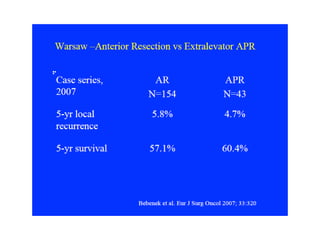
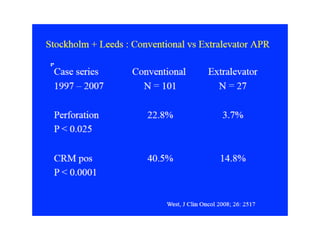
• EVIDENCE BASED MEDICINE IN ELAPE
• VIDEO
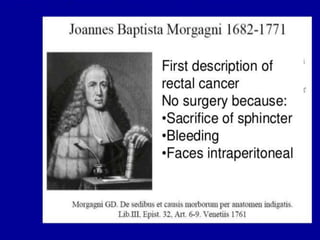
ELAPE- HISTORY
• First successful rectal excision by Jacques Lisfranc – 1826 –
perineal approach.
• Next 70 – 80 yrs rectal cancer treated through perineal
approach with high morbidity and local recurrance.
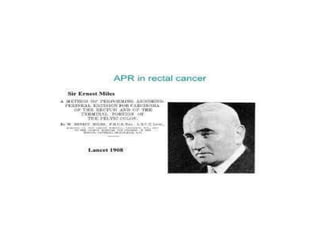
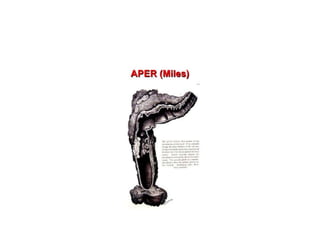
• 1908 – Earnest Miles described Abdomino perineal
excision(APE)
MILES CONCEPT
• After a decade-long audit of his rectal resections, he noted a
local recurrance rate of over 95% within 1–3 years.
• He described “three zones of local spread” from rectal
cancers:
-Downward to perianal skin,
-Lateral along levator ani and internal iliac nodes,
-Upward corresponding with proximal lymphatic drainage to
the mesocolon.
• When performing the operation, the abdominal phase is
performed first with the patient in ‘an exaggerated
Trendelenburg posture’.
• Once a laparotomy has been performed, via a median
incision, a loop colostomy is fashioned in the left iliac fossa
with the apex of the sigmoid colon.
• The sigmoid colon is then divided about 2 inches distal to
the stoma site (thus creating a loop sigmoid colostomy
with a blind ending distal portion).
• The ‘pelvic colon’ (sigmoid colon) is then mobilized and
the inferior mesenteric artery is divided below the sigmoid
branches.
• Attention then turns to the rectal mobilization and ‘the
remainder of the operation is now practically bloodless
and should be rapidly proceeded with’.
• The anterior and posterior rectal mobilization is done
bluntly whereas the ‘lateral ligaments of the rectum are
divided with scissor’.
• The rectal mobilization continues ‘down to the upper
surface of the levatores ani’.
• The abdominal cavity is then lavaged with saline and
closed.
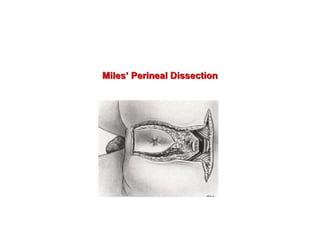
• The patient is now placed in the right lateral position ‘so that
the perineal portion of the operation can be proceeded with’.
• An incision is made from the sacro-coccygeal joint to within
an inch of the anus.
• A semicircular incision is then made around the anus, in such
a manner as to take a wide area of skin and fat.
• The coccyx is removed and the levatores ‘divided as far
outward as their origin from the white line’.
• Any residual attachments of the rectum to the sacrum or
vagina/prostate are divided and the specimen is removed.
• The ‘chasm’ is then irrigated with saline and the skin closed
over two drains.
• The patient is then placed in the supine position and ‘a small
opening is made into the extruded bowel to allow of the
escape of flatus’.”
• First major modification in 1930s with adoption of the
lithotomy-Trendelenberg position popularized by Lloyd Davis.
• For a large part of the rest of the century, Miles’ APE with or
without lithotomy positioning remained the gold standard.
• Local recurrance rate around 15%
TME CONCEPT
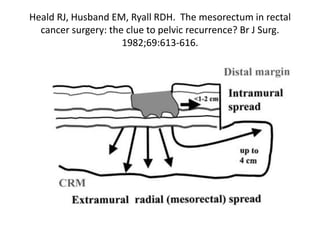
• Based on pathological-clinical studies from the 1980s showing
distal spread in the mesorectum and a significant relation
between CRM involvement and local recurrence
Encompasses:
• Excision of complete mesorectum in mid and lower third
cancers – down to the pelvic floor
• Complete CRM clearance by sharp dissection
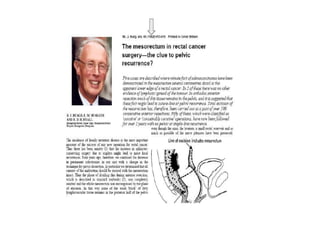
Heald RJ, Husband EM, Ryall RDH. The mesorectum in rectal
cancer surgery: the clue to pelvic recurrence? Br J Surg.
1982;69:613-616.
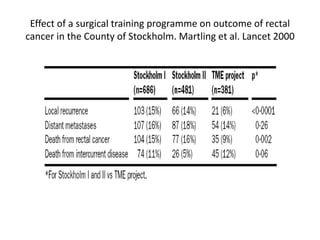
Effect of a surgical training programme on outcome of rectal
cancer in the County of Stockholm. Martling et al. Lancet 2000
21 st Century
• The use of mechanical stapling devices ,
• Increasing knowledge of patterns of spread with acceptance of
smaller distal margins ,
• Development of neoadjuvant therapies and
• Application of local excision and transanal endoscopic microsurgery
have led to
• Sphincter-sparing surgery becoming a priority after oncological
safety for most rectal cancers
• APR is performed in less than 15% of cases
• INDICATION :
Invasion of external sphincter.
Low AR cannot be done.
• The widespread adoption of total mesorectal excision has
improved outcomes in anterior resection but a similar
improvement has not been evident in APE.
• APE is associated with higher rates of circumferential
resection margin involvement, local recurrence and reduced
cancer specific survival
Problem with lower rectal cancer
• Absence of mesorectal margin “cushion”
• Difficult technical dissection due to lack of planes
• High positive radial margin rate (~36%) for distal third rectal
location
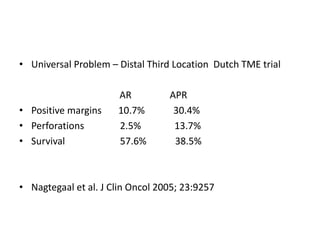
• Universal Problem – Distal Third Location Dutch TME trial
AR APR
• Positive margins 10.7% 30.4%
• Perforations 2.5% 13.7%
• Survival 57.6% 38.5%
• Nagtegaal et al. J Clin Oncol 2005; 23:9257
ELAPE – the Solution?
Br J Surg. 2007 Feb;94(2):232-8.
• Extended abdominoperineal resection with gluteus maximus flap
reconstruction of the pelvic floor for rectal cancer.
• Holm T1, Ljung A, Häggmark T, Jurell G, Lagergren J.
• Abstract
• BACKGROUND:
• Intraoperative tumour perforation, positive tumour margins, wound complications and local
recurrence are frequent difficulties with conventional abdominoperineal resection (APR) for
rectal cancer. An alternative technique is the extended posterior perineal approach with
gluteus maximus flap reconstruction of the pelvic floor. The aim of this study was to report
the technique and early experience of extended APR in a select cohort of patients.
• Between 2001 and 2005, 28 patients with low rectal cancer were treated accordingly at the
Karolinska Hospital.
• CONCLUSION:
• The extended posterior perineal approach with gluteus maximus flap reconstruction in APR
has a low risk of bowel perforation, CRM involvement and local perineal wound
complications. The rate of local recurrence may be lower than with conventional APR.
SURGICAL TECHNIQUE
-Principle
-Abdominal phase
-Perineal phase
-Reconstruction
PRINCIPLES OF SURGERY
• Extend of resection is that of described by Miles but by
employing TME principles.
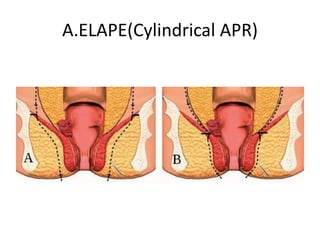
• Levator muscles are excised enbloc with
mesorectum,lower rectum & anus
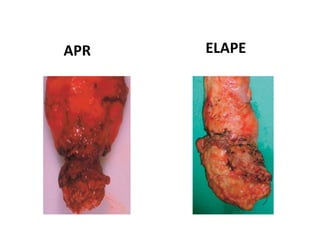
• Thereby avoiding ‘ waist of the specimen’ seen in
conventional APR
• Purpose: To reduce bowel perforation and
CRM(circumferential margin positivity)
A.ELAPE(Cylindrical APR)
APR ELAPE
ABDOMINAL PHASE
• In APR , mesorectum is mobilised upto the pelvic floor
• In ELAPE, mesorectal mobilisation is limited
Dorsally : sacrococcygeal junction
Ventrally : seminal vesicles(male),cervix(female)
Laterally : lateral ligament
PERINEAL PHASE
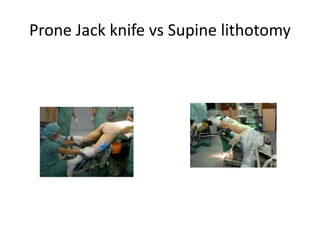
Prone Jack knife vs Supine lithotomy
Prone position preferred
• Pros: Improved visibility,
easier retraction by assistant
reduced perforation,
reduced CRM positivity
• Cons: long operative time as patient position needs to be
changed.
Unable to perform rectus or gracilis transfer
PERINEAL PHASE
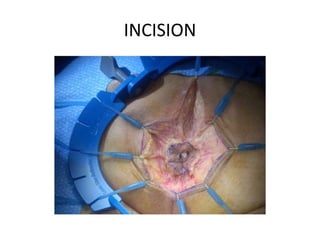
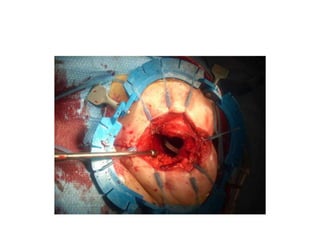
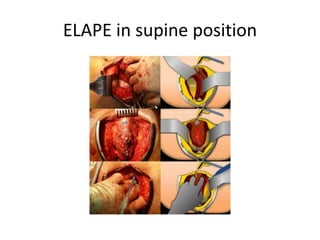
• Anus closed with purse string suture.
• Tear drop incision made encircling anus unto tip of cocyx.
• External sphincter identified and dissection continued outside
levator muscle .
• Levator muscles are followed until their origin in pelvic
sidewall (white line)
INCISION
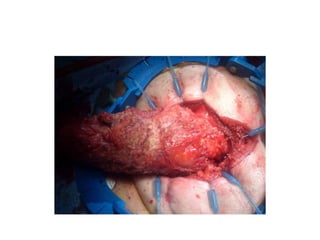
• Mesorectum entered just anterior to coccyx or through
sacrococcyxeal junction after removing coccyx.
• Pelvic floor is divided (levator)
• Dissection continues anteriorly onto the prostate /vagina
• Cylindrical specimen is excised.
ELAPE in supine position
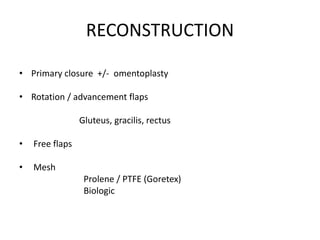
RECONSTRUCTION
• Primary closure +/- omentoplasty
• Rotation / advancement flaps
Gluteus, gracilis, rectus
• Free flaps
• Mesh
Prolene / PTFE (Goretex)
Biologic
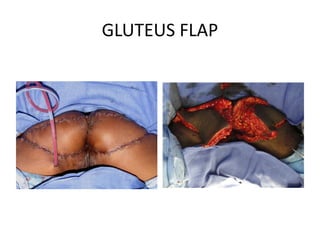
GLUTEUS FLAP
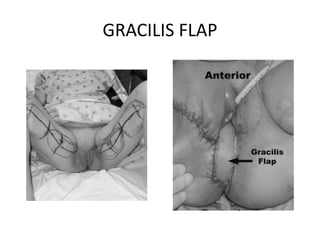
GRACILIS FLAP
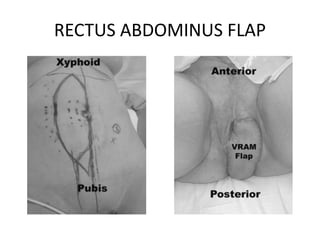
RECTUS ABDOMINUS FLAP
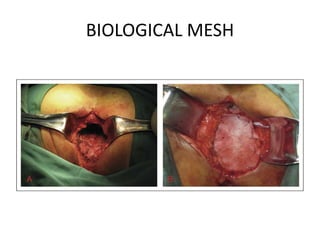
BIOLOGICAL MESH
MERITS
• Good visualisation anterior structures with plane easily seen
and dissected
• Easy control of bleeders
• Decreased perforation rate
• One surgeon
• Easy to teach
• Easy to assist
• Perineal operator does not get wet
• Possibly less blood loss
DEMERITS
• Learning curve as to how far to dissect into the pelvis
• Unaccustomed plane
• Coccygeal division leaves bare bone in a potentially contaminated
field.
• No further access to abdomen during the perineal dissection
• No difference in anterior/posterior margin only lateral margin
clearance is increased
• Perineal wound complications
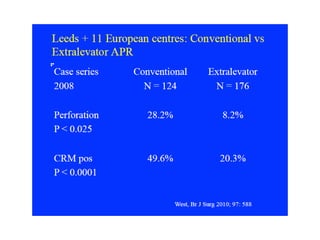
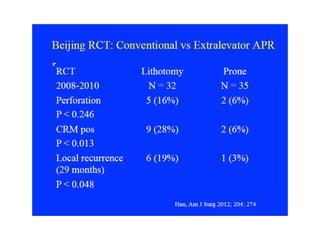
EVIDENCE BASED MEDICINE
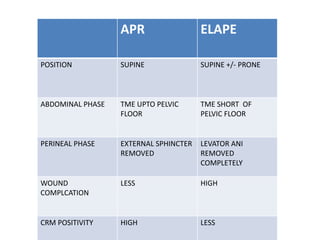
APR ELAPE
POSITION SUPINE SUPINE +/- PRONE
ABDOMINAL PHASE TME UPTO PELVIC
FLOOR
TME SHORT OF
PELVIC FLOOR
PERINEAL PHASE EXTERNAL SPHINCTER
REMOVED
LEVATOR ANI
REMOVED
COMPLETELY
WOUND
COMPLCATION
LESS HIGH
CRM POSITIVITY HIGH LESS
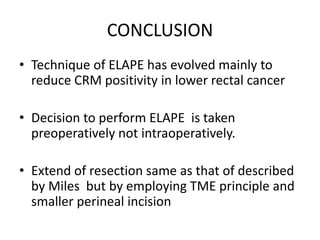
CONCLUSION
• Technique of ELAPE has evolved mainly to
reduce CRM positivity in lower rectal cancer
• Decision to perform ELAPE is taken
preoperatively not intraoperatively.
• Extend of resection same as that of described
by Miles but by employing TME principle and
smaller perineal incision
CONCLUSION
• Accepted and practised mainly in Europe still
not accepted in USA
• Initial studies have shown promosing results
• Large scale RCT needed to accept ELAPE as the
gold standard.
THANK U ……VIDEO TO FOLLOW..
THANK U

Extralevator abdominoperineal resection(elape)

  • 1.
    EXTRALEVATOR ABDOMINOPERINEAL RESECTION(ELAPE) Dr.A.Joseph Stalin M.ChPG PROF.DR.R.RAJARAMAN’S UNIT CENTRE FOR ONCOLOGY GOVT ROYAPETTAH HOSPITAL CHENNAI
  • 2.
    CONTENTS • CONCEPT OFELAPE • SURGICAL TECHNIQUE • MERITS/DEMERITS • EVIDENCE BASED MEDICINE IN ELAPE • VIDEO
  • 5.
    ELAPE- HISTORY • Firstsuccessful rectal excision by Jacques Lisfranc – 1826 – perineal approach. • Next 70 – 80 yrs rectal cancer treated through perineal approach with high morbidity and local recurrance. • 1908 – Earnest Miles described Abdomino perineal excision(APE)
  • 7.
    MILES CONCEPT • Aftera decade-long audit of his rectal resections, he noted a local recurrance rate of over 95% within 1–3 years. • He described “three zones of local spread” from rectal cancers: -Downward to perianal skin, -Lateral along levator ani and internal iliac nodes, -Upward corresponding with proximal lymphatic drainage to the mesocolon.
  • 9.
    • When performingthe operation, the abdominal phase is performed first with the patient in ‘an exaggerated Trendelenburg posture’. • Once a laparotomy has been performed, via a median incision, a loop colostomy is fashioned in the left iliac fossa with the apex of the sigmoid colon. • The sigmoid colon is then divided about 2 inches distal to the stoma site (thus creating a loop sigmoid colostomy with a blind ending distal portion). • The ‘pelvic colon’ (sigmoid colon) is then mobilized and the inferior mesenteric artery is divided below the sigmoid branches.
  • 10.
    • Attention thenturns to the rectal mobilization and ‘the remainder of the operation is now practically bloodless and should be rapidly proceeded with’. • The anterior and posterior rectal mobilization is done bluntly whereas the ‘lateral ligaments of the rectum are divided with scissor’. • The rectal mobilization continues ‘down to the upper surface of the levatores ani’. • The abdominal cavity is then lavaged with saline and closed.
  • 12.
    • The patientis now placed in the right lateral position ‘so that the perineal portion of the operation can be proceeded with’. • An incision is made from the sacro-coccygeal joint to within an inch of the anus. • A semicircular incision is then made around the anus, in such a manner as to take a wide area of skin and fat. • The coccyx is removed and the levatores ‘divided as far outward as their origin from the white line’.
  • 13.
    • Any residualattachments of the rectum to the sacrum or vagina/prostate are divided and the specimen is removed. • The ‘chasm’ is then irrigated with saline and the skin closed over two drains. • The patient is then placed in the supine position and ‘a small opening is made into the extruded bowel to allow of the escape of flatus’.”
  • 15.
    • First majormodification in 1930s with adoption of the lithotomy-Trendelenberg position popularized by Lloyd Davis. • For a large part of the rest of the century, Miles’ APE with or without lithotomy positioning remained the gold standard. • Local recurrance rate around 15%
  • 17.
    TME CONCEPT • Basedon pathological-clinical studies from the 1980s showing distal spread in the mesorectum and a significant relation between CRM involvement and local recurrence Encompasses: • Excision of complete mesorectum in mid and lower third cancers – down to the pelvic floor • Complete CRM clearance by sharp dissection
  • 19.
    Heald RJ, HusbandEM, Ryall RDH. The mesorectum in rectal cancer surgery: the clue to pelvic recurrence? Br J Surg. 1982;69:613-616.
  • 20.
    Effect of asurgical training programme on outcome of rectal cancer in the County of Stockholm. Martling et al. Lancet 2000
  • 21.
    21 st Century •The use of mechanical stapling devices , • Increasing knowledge of patterns of spread with acceptance of smaller distal margins , • Development of neoadjuvant therapies and • Application of local excision and transanal endoscopic microsurgery have led to • Sphincter-sparing surgery becoming a priority after oncological safety for most rectal cancers
  • 22.
    • APR isperformed in less than 15% of cases • INDICATION : Invasion of external sphincter. Low AR cannot be done.
  • 23.
    • The widespreadadoption of total mesorectal excision has improved outcomes in anterior resection but a similar improvement has not been evident in APE. • APE is associated with higher rates of circumferential resection margin involvement, local recurrence and reduced cancer specific survival
  • 24.
    Problem with lowerrectal cancer • Absence of mesorectal margin “cushion” • Difficult technical dissection due to lack of planes • High positive radial margin rate (~36%) for distal third rectal location
  • 25.
    • Universal Problem– Distal Third Location Dutch TME trial AR APR • Positive margins 10.7% 30.4% • Perforations 2.5% 13.7% • Survival 57.6% 38.5% • Nagtegaal et al. J Clin Oncol 2005; 23:9257
  • 27.
    ELAPE – theSolution? Br J Surg. 2007 Feb;94(2):232-8. • Extended abdominoperineal resection with gluteus maximus flap reconstruction of the pelvic floor for rectal cancer. • Holm T1, Ljung A, Häggmark T, Jurell G, Lagergren J. • Abstract • BACKGROUND: • Intraoperative tumour perforation, positive tumour margins, wound complications and local recurrence are frequent difficulties with conventional abdominoperineal resection (APR) for rectal cancer. An alternative technique is the extended posterior perineal approach with gluteus maximus flap reconstruction of the pelvic floor. The aim of this study was to report the technique and early experience of extended APR in a select cohort of patients. • Between 2001 and 2005, 28 patients with low rectal cancer were treated accordingly at the Karolinska Hospital. • CONCLUSION: • The extended posterior perineal approach with gluteus maximus flap reconstruction in APR has a low risk of bowel perforation, CRM involvement and local perineal wound complications. The rate of local recurrence may be lower than with conventional APR.
  • 28.
  • 29.
    PRINCIPLES OF SURGERY •Extend of resection is that of described by Miles but by employing TME principles. • Levator muscles are excised enbloc with mesorectum,lower rectum & anus • Thereby avoiding ‘ waist of the specimen’ seen in conventional APR • Purpose: To reduce bowel perforation and CRM(circumferential margin positivity)
  • 31.
  • 32.
  • 33.
  • 34.
    • In APR, mesorectum is mobilised upto the pelvic floor • In ELAPE, mesorectal mobilisation is limited Dorsally : sacrococcygeal junction Ventrally : seminal vesicles(male),cervix(female) Laterally : lateral ligament
  • 35.
  • 36.
    Prone Jack knifevs Supine lithotomy
  • 37.
    Prone position preferred •Pros: Improved visibility, easier retraction by assistant reduced perforation, reduced CRM positivity • Cons: long operative time as patient position needs to be changed. Unable to perform rectus or gracilis transfer
  • 38.
    PERINEAL PHASE • Anusclosed with purse string suture. • Tear drop incision made encircling anus unto tip of cocyx. • External sphincter identified and dissection continued outside levator muscle . • Levator muscles are followed until their origin in pelvic sidewall (white line)
  • 39.
  • 40.
    • Mesorectum enteredjust anterior to coccyx or through sacrococcyxeal junction after removing coccyx. • Pelvic floor is divided (levator) • Dissection continues anteriorly onto the prostate /vagina • Cylindrical specimen is excised.
  • 44.
  • 45.
    RECONSTRUCTION • Primary closure+/- omentoplasty • Rotation / advancement flaps Gluteus, gracilis, rectus • Free flaps • Mesh Prolene / PTFE (Goretex) Biologic
  • 47.
  • 48.
  • 49.
  • 50.
  • 51.
    MERITS • Good visualisationanterior structures with plane easily seen and dissected • Easy control of bleeders • Decreased perforation rate • One surgeon • Easy to teach • Easy to assist • Perineal operator does not get wet • Possibly less blood loss
  • 52.
    DEMERITS • Learning curveas to how far to dissect into the pelvis • Unaccustomed plane • Coccygeal division leaves bare bone in a potentially contaminated field. • No further access to abdomen during the perineal dissection • No difference in anterior/posterior margin only lateral margin clearance is increased • Perineal wound complications
  • 53.
  • 60.
    APR ELAPE POSITION SUPINESUPINE +/- PRONE ABDOMINAL PHASE TME UPTO PELVIC FLOOR TME SHORT OF PELVIC FLOOR PERINEAL PHASE EXTERNAL SPHINCTER REMOVED LEVATOR ANI REMOVED COMPLETELY WOUND COMPLCATION LESS HIGH CRM POSITIVITY HIGH LESS
  • 61.
    CONCLUSION • Technique ofELAPE has evolved mainly to reduce CRM positivity in lower rectal cancer • Decision to perform ELAPE is taken preoperatively not intraoperatively. • Extend of resection same as that of described by Miles but by employing TME principle and smaller perineal incision
  • 62.
    CONCLUSION • Accepted andpractised mainly in Europe still not accepted in USA • Initial studies have shown promosing results • Large scale RCT needed to accept ELAPE as the gold standard.
  • 63.
  • 64.