RETAINERS IN FPD
DR GIRISH GALAGALIDR
MDS
Dept of Prosthodontics
Navodaya Dental College
CONTENTS
 INTRODUCTION
 CLASSIFICATION OF RETAINERS
 REQUIREMENTS
 FULL VENEER CROWN 1.full metal 2.metal ceramic 3.full ceramic
Indication /contraindication
Advantages /Disadvantages
 PARTIAL VENEER CROWN RETAINERS; Types
indication /contraindication
advantages/disadvantages
 RESIN BONDED RETAINERS ;CLASSIFICATION
Indication/contraindication/Advantages
 RADICULAR RETAINERS
 SUMMARY AND CONCLUSION
INTRODUCTION
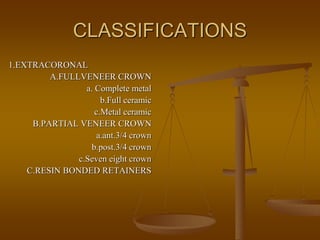
CLASSIFICATIONS
1.EXTRACORONAL
A.FULLVENEER CROWN
a. Complete metal
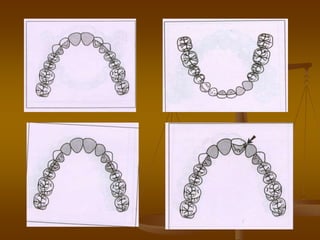
b.Full ceramic
c.Metal ceramic
B.PARTIAL VENEER CROWN
a.ant.3/4 crown
b.post.3/4 crown
c.Seven eight crown
C.RESIN BONDED RETAINERS
2.INTRACORONAL
 a.inlyas
 b.onlyas
3.RADICULAR
RETAINERS
REQUIREMENTS
1. Withstand masticatory forces
2. Restore anatomy of tooth
3. Pulp consideration
4. Esthetics
5. Hygienic
FULLMETAL CROWN
All axial surfaces of tooth included
ADVANTAGES
1.Highly retentive
2.High resistance
3.Superior strength
4 Axial contour modification
5.Occlusal modification
.
DISADVANTAGES
 1.More extensive preparation
 2.Not feasible for elec vitality test
 3.Esthetic
INDICATIONS
 Extensive coronal destruction
 Short clinical crown
 Max retentive and resistance needed
 Axial correction needed
 Endodontically treated tooth
CONTRAINDICATION
 If treatment objective can be met with
more conservative preparation
 High esthetic demand
 When less than max retentive and
resistance needed
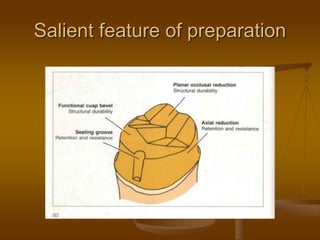
Salient feature of preparation
ALL CERAMIC CROWN
RETAINER
 Most esthetic restoration
 No metal to block light transmission,
brittle
 Not effective as retainer for FPD
 Requires connector of large dia, cross
sectional dimension and its effect on
periodontia
INDICATIONS
1.High esthetic demand
2.Teeth with proximal /facial caries
3.Sufficient coronal structure to support
4.Favourable Occlusal load distribution
5.Centric contact :on an area where
porcelain is supported by tooth str.
6.Incisal edge reasonably intact
CONTRAINDICATION
1.High caries index
2.Conservative restoration can be used
3.Insufficient tooth structure to support
4.Thin teeth facio-lingually
5.Unfavourable occlusal load distribution
6.Bruxism
7.Edge –edge occlusion
8.Short clinical crown
9.Opposing tooth occluding in cervical fifth
of lingual surface
ADVANTAGES
1.Improved esthetics
2.Good tissue response
3.Slightly more conservative than metal
ceramic restoration
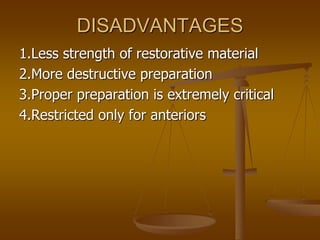
DISADVANTAGES
1.Less strength of restorative material
2.More destructive preparation
3.Proper preparation is extremely critical
4.Restricted only for anteriors
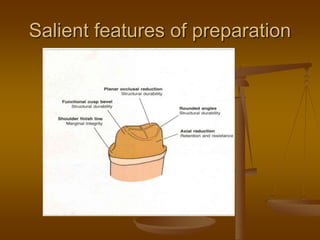
Salient features of preparation
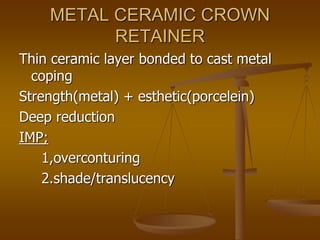
METAL CERAMIC CROWN
RETAINER
Thin ceramic layer bonded to cast metal
coping
Strength(metal) + esthetic(porcelein)
Deep reduction
IMP;
1,overconturing
2.shade/translucency
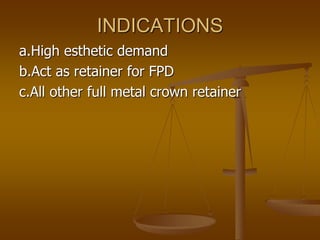
INDICATIONS
a.High esthetic demand
b.Act as retainer for FPD
c.All other full metal crown retainer
CONTRA-INDICATIONS
a.Active caries
b.Periodotally untreated teeth
c.Young patients
d.Where conservative treatment feasible
ADVANTAGES
A.Strenth +esthetics
B.Excellent retentive qualities
C.Axial form correction
D.Occlusal correction
DIS-ADVANTAGES
1.High tooth reduction
2.Perio consideration
3.Inferior esthetic-to all porcelain
4.Expensive
5.Subjectable to stress fracture
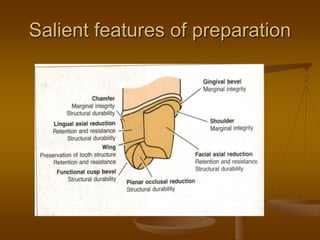
Salient features of preparation
PARTIAL VENEER CROWN
RETAINER
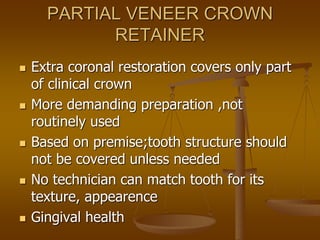
 Extra coronal restoration covers only part
of clinical crown
 More demanding preparation ,not
routinely used
 Based on premise;tooth structure should
not be covered unless needed
 No technician can match tooth for its
texture, appearence
 Gingival health
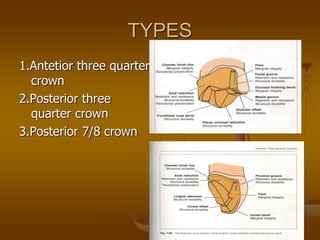
TYPES
1.Antetior three quarter
crown
2.Posterior three
quarter crown
3.Posterior 7/8 crown
INDICATIONS
 Sturdy clinical crown
 Intact buccal surface; no need of contour
 No conflict b/w axial relationship and
proposed path of withdrawal of FPD
Contra-indication
 Short clinical crown
 As retainer for long span FPD
 Anterior endodontic tooth
 Shape and alignment of teeth
 High caries index
 Thin teeth
Advantages
 Conservative tooth preparation
 Accessibility
 Less gingival involvement
 Good/complete seating of prosthesis
 Feasible;elec vitality test
Dis-advantages
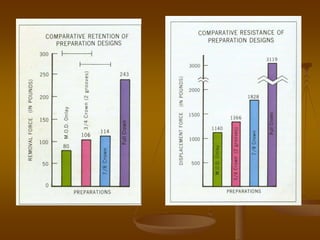
 Less retentive/resistant than full crown
 Limited path of withdrawal adjustment
 Requires dextrisity from operator
 Cannot be used on nonvital tooth
RESIN-BONDED RETAINERS
To overcome the tooth reduction required
for placement of retainer
CLASSIFICATION
1.ROCHETTE BRIDGE
2.MARYLAND BRIDGE
3.CAST METAL FPD
4.VIRGENIA BRIDGE
Advantages
 Low cost, little/less tooth preparation
 No need:anaesthesia
 Supragingival margins
 Rebonding possible
Dis-advantages
 Irreversible
 Uncertain longetivity
 No space for correction
 No alignment correction
 Difficult temporization
Indications
 Caries free abutment
 Mandibular incisor replacement
 Maxillary incisor replacement
 Period-splint
 Single posterior tooth replacement
Contra-indication
 Extensive caries
 Deep vertical overbite
 Nickel sensitivity
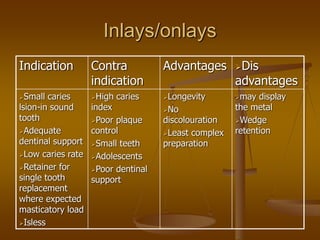
Inlays/onlays
Indication Contra
indication
Advantages Dis
advantages
Small caries
lsion-in sound
tooth
Adequate
dentinal support
Low caries rate
Retainer for
single tooth
replacement
where expected
masticatory load
Isless
High caries
index
Poor plaque
control
Small teeth
Adolescents
Poor dentinal
support
Longevity
No
discolouration
Least complex
preparation
may display
the metal
Wedge
retention
RADICULAR RETAINERS
Consists of post/core that obtains its
retention and resistance to displacement
from prepared root portion of an
endontically treated tooth
Root preparation retain core while core
establish resistance/retention for a
complete veneer crown that restores
pulpless tooth to normal form/function
These can be custom made/prefabricated
Dep:post length/shape/dia/surface confi
CRITERIA FOR SELECTION
 Alignment of abutment tooth &retention
 Appearance
 Condition of abutment tooth
 Cost
 Preservation of tooth structure
REFERENCES
 H.T.Shillingburg:fundamentals of fixed prosthodontics
3rd edn QB 2002
 Annusavice :phillips science of dental materials 11th
edition elselvier 2003
 Rosenstiel:cotemporary fixed prosthodontics 3rd edn
Mosby 2002
 D C N A: ceramics oct 1977 21;4
 M.A.Marzouk;Operative Dentistry .Modern theory and
practice 1997
 Shillingberg; fundamentals of tooth preparation for cast
metal and porcelain restoration QB 1987
Thank you

RETAINERS IN FPDppt