PRESENTER; DR. PRIYANSH YADAV
Contents
 Definition
 Introduction
 Indications
 Contraindications
 Advantages
 Disadvantages
 Classification
 Post insertion management
 Causes of failure
DEFINITION
 A prosthesis that is luted to tooth structure,
primarily enamel , which has been etched to
provide mechanical retention for the
composite resin.
INTRODUCTION
 These are prosthesis that requires minimal removal of
tooth structure , particularly for abutment teeth that are
intact and caries free.
 The primary goal of the resin bonded FPD is the
replacement of missing teeth and maximum
conservation of tooth structure.
INDICATIONS
1. For abutment with sufficient enamel to etch for retention.
2. For splinting of periodontally compromised teeth.
3. Stabilizing of dentition after orthodontic treatment.
4. Medically compromised & adolescent patients.
5. Prolonged placement of certain prosthesis for correction of craniofacial
abnormalities.
CONTRAINDICATIONS
1. Patients with sensitivity to base metal alloys.
2. When abutment requires facial esthetics.
3. Abraded teeth.
4. Inadequate enamel surface to etch.
ADVANTAGES
1. Non invasive to dentin
2. Conservative
3. Decreased tissue irritation.
4. Less chairside time.
5. Reduced cost.
DISADVANTAGES
1. Demanding technique and tooth preparation.
2. Even minor laboratory errors cannot be corrected easily.
3. Plaque accumulation.
4. Intolerable bulky contour.
5. Not ideal for replacing more than one tooth.
6. The resultant aesthetic is not good.
CLASSIFICATION
Mechanical Micro-
Mechanical
Macro-Mechanical Chemical
Rochette
bridge
Maryland
bridge
Virginia
bridge
Cast mesh
fixed partial
denture
Adhesive
bridge
Based upon type of retention
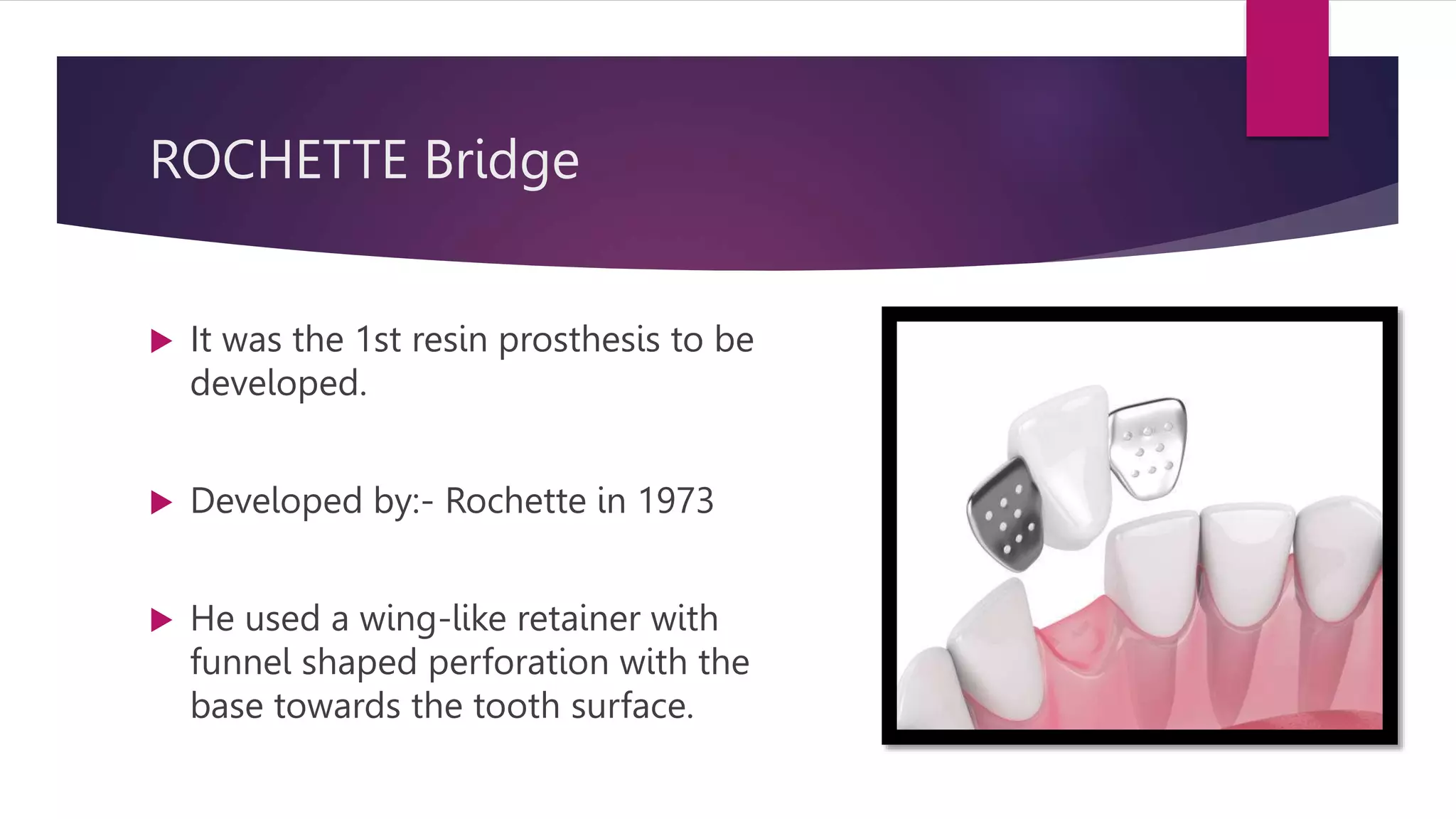
ROCHETTE Bridge
 It was the 1st resin prosthesis to be
developed.
 Developed by:- Rochette in 1973
 He used a wing-like retainer with
funnel shaped perforation with the
base towards the tooth surface.
ROCHETTE Bridge
 The diameter of the funnel was greater towards the outside by 0.5mm.
 Diameter towards outside- 1.5mm
 Diameter towards tooth surface- 1mm
 He also used silane-coupling agents for additional retention.
 The major disadvantage of this design is external stress, abrasion &
marginal leakage.
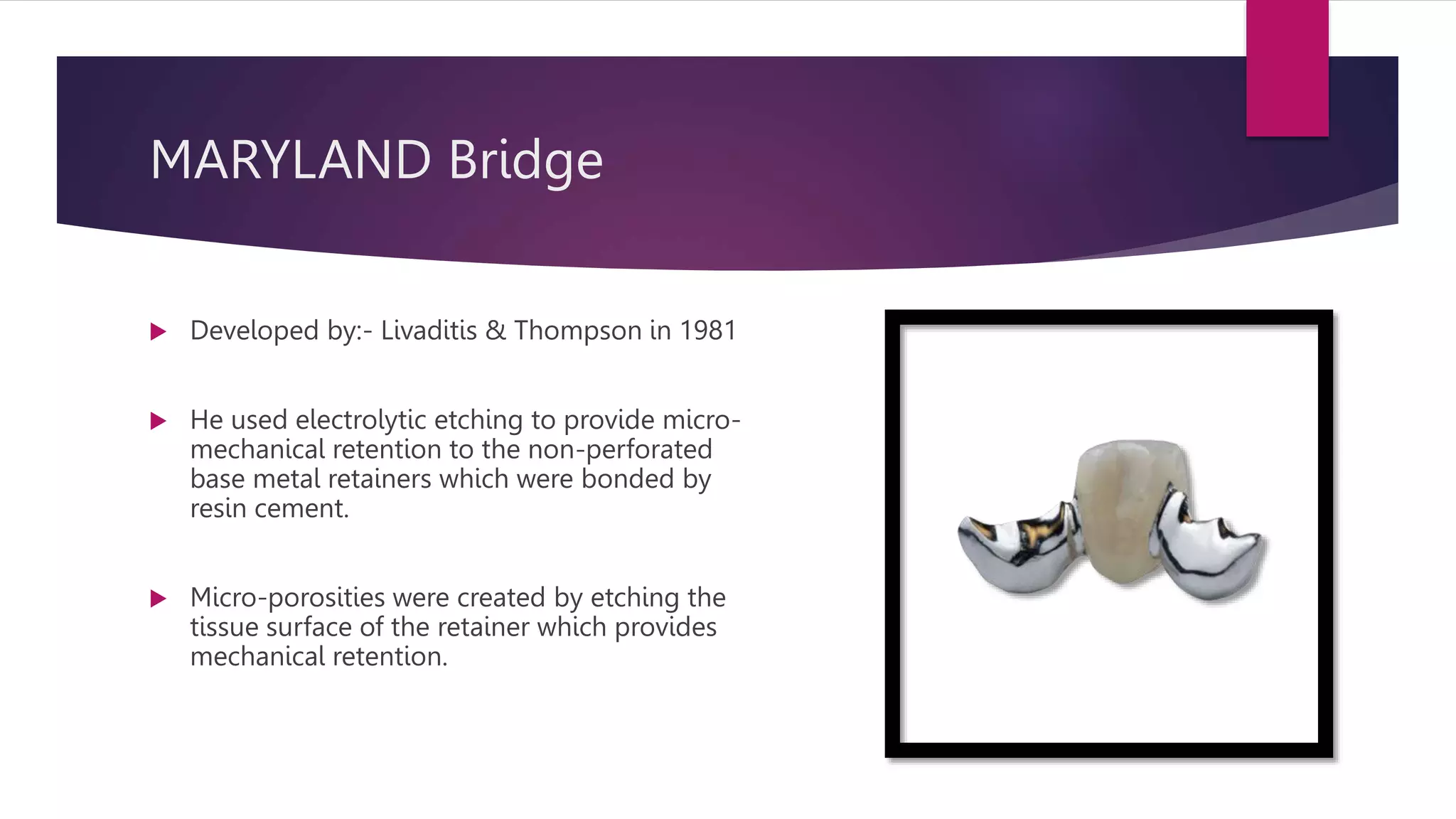
MARYLAND Bridge
 Developed by:- Livaditis & Thompson in 1981
 He used electrolytic etching to provide micro-
mechanical retention to the non-perforated
base metal retainers which were bonded by
resin cement.
 Micro-porosities were created by etching the
tissue surface of the retainer which provides
mechanical retention.
MARYLAND Bridge
 In this method, of electrolytic etching the etchant used was 3.5% solution of nitric acid.
 A current of 250mA/cm2 is supplied for 5 minutes.
 This is followed by immersion of retainer in 18% HCL in an ultrasonic cleanser for 10mins.
 Note: Before the etching is done, retainer is coated with paraffin wax in those areas that are not
to be etched.
 Advantage:- It has good retention as compared to perforated ones.
 Disadvantage:- Expensive & technique sensitive.
VIRGINIA Bridge
 Developed by:- Moon & Hudgins in 1983
 These are resin bonded fixed partial dentures which use particle roughened
retainers.
 The retainer wax patterns are fabricated using resin.
 Advantages:-
1. Even noble metal alloys can be used.
2. Surface treatment of retainer is not necessary.
VIRGINIA Bridge
Lost salt technique;
 150-250 µm salt crystals are sprinkled on the cast prior to resin
fabrication.
 The salt crystals get incorporated onto the tissue surface of the resin
pattern.
 The salt crystals are dissolved by keeping pattern in ultrasonic cleanser.
The resin pattern is invested and cast.
 Dissolved crystals will produce voids in the resin pattern.
 These voids are reproduced in the cast metal retainer and they help in
mechanical retention.
CAST MESH FPD
A nylon mesh is placed over the
tissue surface of the retainer
wax pattern.
CAST MESH FPD
 The mesh is placed on the cast before fabricating the wax pattern.
 Now, the fabrication of the pattern is done at the mesh.
 The mesh becomes incorporated and as casting is done it provides retention for
resin to metal.
 Disadvantages:-
1. Nylon mesh may not adapt well to the cast during pattern fabrication.
2. The wax may not flow between the mesh locking all the undercuts.
ADHESIVE Bridge
 Bonding of resin cement to metal is done.
 Advantages:- High bond strength, fracture toughness & good clinical success.
 Materials used for chemical bonding:-
1. Modified Bis GMA cement
2. Superbond
3. Rocatec system
 Chemical bonding between the resin and the metal retainer can be produced by chemical
etching or tin-plating or using chemical adhesives.
ADHESIVE Bridge
 Chemical etching;
A gel consisting of Nitric and Hydrochloric acids is applied to the internal surface of
the metal framework for approximately 25 minutes.
 Tin plating;
Tin has the ability to form organic complexes with several specific adhesive resins
resulting in significantly greater bond strengths. Precious alloys can be plated with tin
and used as frameworks for resin retained fixed partial denture.
 Composite resins play an important role in the bonding of the metal framework to
etched enamel.
POST INSERTION MANAGEMENT
 All resin-bonded restorations should receive
significant attention after insertion.
 Hence, frequent recall appointments should be
followed to ensure the success of the prosthesis.
CAUSES OF FAILURE
 Inappropriate patient selection
1. Mal-alignment of tooth
2. Insufficient vertical length of abutment tooth
3. Inadequate enamel for bonding
4. History of metal sensitivity
5. Decreased labio- lingual dimensions of abutments
CAUSES OF FAILURE
 Incomplete tooth preparation
1. Insufficient proximal and lingual surface reduction
2. Incomplete extension of retainer (less than 180°)
3. Lack of accommodation to mandibular protrusion
 Bonding failure
1. Contamination
2. Prolonged mixing
3. Inappropriate luting agent

Resin bonded FPD

  • 1.
  • 2.
    Contents  Definition  Introduction Indications  Contraindications  Advantages  Disadvantages  Classification  Post insertion management  Causes of failure
  • 3.
    DEFINITION  A prosthesisthat is luted to tooth structure, primarily enamel , which has been etched to provide mechanical retention for the composite resin.
  • 4.
    INTRODUCTION  These areprosthesis that requires minimal removal of tooth structure , particularly for abutment teeth that are intact and caries free.  The primary goal of the resin bonded FPD is the replacement of missing teeth and maximum conservation of tooth structure.
  • 5.
    INDICATIONS 1. For abutmentwith sufficient enamel to etch for retention. 2. For splinting of periodontally compromised teeth. 3. Stabilizing of dentition after orthodontic treatment. 4. Medically compromised & adolescent patients. 5. Prolonged placement of certain prosthesis for correction of craniofacial abnormalities.
  • 6.
    CONTRAINDICATIONS 1. Patients withsensitivity to base metal alloys. 2. When abutment requires facial esthetics. 3. Abraded teeth. 4. Inadequate enamel surface to etch.
  • 7.
    ADVANTAGES 1. Non invasiveto dentin 2. Conservative 3. Decreased tissue irritation. 4. Less chairside time. 5. Reduced cost.
  • 8.
    DISADVANTAGES 1. Demanding techniqueand tooth preparation. 2. Even minor laboratory errors cannot be corrected easily. 3. Plaque accumulation. 4. Intolerable bulky contour. 5. Not ideal for replacing more than one tooth. 6. The resultant aesthetic is not good.
  • 9.
  • 10.
    ROCHETTE Bridge  Itwas the 1st resin prosthesis to be developed.  Developed by:- Rochette in 1973  He used a wing-like retainer with funnel shaped perforation with the base towards the tooth surface.
  • 11.
    ROCHETTE Bridge  Thediameter of the funnel was greater towards the outside by 0.5mm.  Diameter towards outside- 1.5mm  Diameter towards tooth surface- 1mm  He also used silane-coupling agents for additional retention.  The major disadvantage of this design is external stress, abrasion & marginal leakage.
  • 12.
    MARYLAND Bridge  Developedby:- Livaditis & Thompson in 1981  He used electrolytic etching to provide micro- mechanical retention to the non-perforated base metal retainers which were bonded by resin cement.  Micro-porosities were created by etching the tissue surface of the retainer which provides mechanical retention.
  • 13.
    MARYLAND Bridge  Inthis method, of electrolytic etching the etchant used was 3.5% solution of nitric acid.  A current of 250mA/cm2 is supplied for 5 minutes.  This is followed by immersion of retainer in 18% HCL in an ultrasonic cleanser for 10mins.  Note: Before the etching is done, retainer is coated with paraffin wax in those areas that are not to be etched.  Advantage:- It has good retention as compared to perforated ones.  Disadvantage:- Expensive & technique sensitive.
  • 14.
    VIRGINIA Bridge  Developedby:- Moon & Hudgins in 1983  These are resin bonded fixed partial dentures which use particle roughened retainers.  The retainer wax patterns are fabricated using resin.  Advantages:- 1. Even noble metal alloys can be used. 2. Surface treatment of retainer is not necessary.
  • 15.
    VIRGINIA Bridge Lost salttechnique;  150-250 µm salt crystals are sprinkled on the cast prior to resin fabrication.  The salt crystals get incorporated onto the tissue surface of the resin pattern.  The salt crystals are dissolved by keeping pattern in ultrasonic cleanser. The resin pattern is invested and cast.  Dissolved crystals will produce voids in the resin pattern.  These voids are reproduced in the cast metal retainer and they help in mechanical retention.
  • 16.
    CAST MESH FPD Anylon mesh is placed over the tissue surface of the retainer wax pattern.
  • 17.
    CAST MESH FPD The mesh is placed on the cast before fabricating the wax pattern.  Now, the fabrication of the pattern is done at the mesh.  The mesh becomes incorporated and as casting is done it provides retention for resin to metal.  Disadvantages:- 1. Nylon mesh may not adapt well to the cast during pattern fabrication. 2. The wax may not flow between the mesh locking all the undercuts.
  • 18.
    ADHESIVE Bridge  Bondingof resin cement to metal is done.  Advantages:- High bond strength, fracture toughness & good clinical success.  Materials used for chemical bonding:- 1. Modified Bis GMA cement 2. Superbond 3. Rocatec system  Chemical bonding between the resin and the metal retainer can be produced by chemical etching or tin-plating or using chemical adhesives.
  • 19.
    ADHESIVE Bridge  Chemicaletching; A gel consisting of Nitric and Hydrochloric acids is applied to the internal surface of the metal framework for approximately 25 minutes.  Tin plating; Tin has the ability to form organic complexes with several specific adhesive resins resulting in significantly greater bond strengths. Precious alloys can be plated with tin and used as frameworks for resin retained fixed partial denture.  Composite resins play an important role in the bonding of the metal framework to etched enamel.
  • 20.
    POST INSERTION MANAGEMENT All resin-bonded restorations should receive significant attention after insertion.  Hence, frequent recall appointments should be followed to ensure the success of the prosthesis.
  • 21.
    CAUSES OF FAILURE Inappropriate patient selection 1. Mal-alignment of tooth 2. Insufficient vertical length of abutment tooth 3. Inadequate enamel for bonding 4. History of metal sensitivity 5. Decreased labio- lingual dimensions of abutments
  • 22.
    CAUSES OF FAILURE Incomplete tooth preparation 1. Insufficient proximal and lingual surface reduction 2. Incomplete extension of retainer (less than 180°) 3. Lack of accommodation to mandibular protrusion  Bonding failure 1. Contamination 2. Prolonged mixing 3. Inappropriate luting agent