DEFINITION:
Any type of device used for
stabilization or retention of
prosthesis -- GPT
RETAINERS
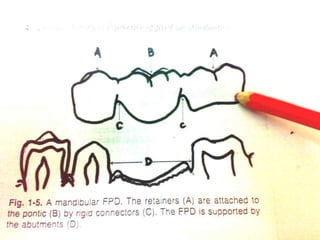
Retainer for an FPD…
 That component of an FPD which
takes support from the abutment
tooth and provides retention to
the prosthesis
SELECTION OF RETAINERS
 Retainer selection for abutment is critical
and is dictated by the followings:
1) Age
2) DMF rate
3) Edentulous space-Partial veneer crown
contraindicated in long span FPD
4) Periodontal support
5) Arch position of the tooth
6) Skeletal relationship
7) Inter occlusal & intraocclusal
condition such as crown length
8) Oral hygiene of the patient
9) Vitality of the abutment teeth---
endodontically treated teeth may
have to be restored with core &
post before designing the
retainer
10) Condition of the abutment teeth
11) Cost
12) Preservation of the tooth
structure----Buccal surface
should be conserved. Partial
veneer crown is more
conservative than full crown . All
ceramic crowns are least
conservative
Types of retainers
 Classified as:
I. Based on tooth coverage
Full veneer crown
Partial veneer crown
Conservative (minimal prep.)
retainers
II. Based on material used
All metal retainers
Metal ceramic retainers
All ceramic retainers
All acrylic retainers
Full veneer crowns
 Covers all 5 surfaces of abutment
 Most retentive of the veneer preparations
 Compared to partial veneer designs,full
veneer crown exhibits superior resistance
nd retention
 Used on those teeth whose restoration
demands max. retention.
 Variations—Metal ceramic crowns and all
ceramic crowns used in situations that
requires a good cosmetic results
 The full veneer crown should be used
when less extensive and less destructive
design have been considered and found
lacking in retention ,resistance ,coverage
or esthetics to properly restore the tooth
Partial veneer crown
 Preferred than full veneer crown because
they requires less tooth reduction
 Crown does not cover the entire abutment
 Facial surface is left intact for superior
esthetics
 Used when minimal retention is sufficient
and when abutment tooth is healthy
Contra indications
 In long span FPDs
 Endodontically treated tooth
 Dentition with active caries or
periodontal disease
 Poorly aligned abutment tooth
Advantages
 Conservation of tooth structure
 Reduced pulpal and periodontal
insult during tooth prep
 Improved access for finishing by
dentist & oral hygiene by patient
 Less of margin approximate soft
tissues subgingivally and hence
less gingival involvement than
complete coverage
 Remaining intact facial or buccal
tooth surface permits electric
vitality test
Disadvantages
 Less retention & resistance than
complete crowns
 Some metal displayed in completed
restoration—unaesthetic
 Tooth prep is difficult because only
limited
adjustments can be made in the
path of placement
Resin bonded retainers
(Maryland bridges)
 Require minimal tooth preparation
 Acid etched
 Esthetically appealing
 Economical , conservative ,
functional & do not irritate soft or
hard tissues
Indication
 As retainers of FPD for abutment
with sufficient enamel to etch
 Splinting of periodontally
compromised teeth
 Stabilizing dentition after
orthodontic treatment
Contraindication
 In patients with sensitivity to base
metal alloys
 When facial esthetic of abutment
require improvement
 Inadequate enamel surface to
bond eg;caries,existing
restoration
 Incisor with extremely thin facio-
lingual dimension
Advantages
 Non invasive to dentin with lingual
and proximal tooth preparation
including occlusal rest
 Conservative with undeniable patient
appearance
 Tissue tolerant because of
Supragingival margin,without pulpal
irritation
 Reduced cost and less chair side time
Disadvantage
 Demanding technique and tooth
prep.
 Plaque accumulation
 Bulky contour
 Restricted to single pontic
placement
 Graying out of teeth that are thin
labiolingually
Based on material used
 All metal retainers
 Metal ceramic retainers
 All ceramic retainers
All metal retainers
 Partial or full veneer crown
 Require minimal tooth
reduction
 Strong even in thin sections
Metal ceramic retainers
 Indicated on teeth that require
complete coverage & esthetic
demand
 Can accommodate cast or soldered
connectors
 Can afford high force—metal
 Require more teeth reduction
Indication
 Extensive tooth destruction as a
result of caries or trauma
 Existing previous restoration that
precludes the use of a more
conservative restoration
 Need for superior retention and
strength
 Endodontically treated tooth
Contraindication
Whenever a more
conservative retainer is
feasible
All ceramic
 Primary purpose ---to achieve
best possible esthetic results
 Risk of reduced restoration
longevity—potential for fracture
,inferior marginal adaptation than
PFM retainer
Telescopic retainers
 Used when path of insertion of FPD does
not coincide with long axis of abutment
 Design involves fabricatin of two copings
one over the other
 Internal or primary coping function to
modify the morphology of tooth –path pf
insrtn changed
 Secondary coping designed to fit over
primary
REFERENCES
1. Fundamentals of Fixed Prosthodontics
Herber T.Shillingburg
2. Contemporary Fixed Prosthodontics
Rosenstiel,Land,Fujimoto
3. Tylmans Theory and Practice of Fixed
Prosthodontics
4. Textbook of Prosthodontics-Deepak
Nallaswamy
Thanking you…..

retienar.ppt

  • 1.
    DEFINITION: Any type ofdevice used for stabilization or retention of prosthesis -- GPT RETAINERS
  • 2.
    Retainer for anFPD…  That component of an FPD which takes support from the abutment tooth and provides retention to the prosthesis
  • 4.
    SELECTION OF RETAINERS Retainer selection for abutment is critical and is dictated by the followings: 1) Age 2) DMF rate 3) Edentulous space-Partial veneer crown contraindicated in long span FPD 4) Periodontal support 5) Arch position of the tooth 6) Skeletal relationship
  • 5.
    7) Inter occlusal& intraocclusal condition such as crown length 8) Oral hygiene of the patient 9) Vitality of the abutment teeth--- endodontically treated teeth may have to be restored with core & post before designing the retainer
  • 6.
    10) Condition ofthe abutment teeth 11) Cost 12) Preservation of the tooth structure----Buccal surface should be conserved. Partial veneer crown is more conservative than full crown . All ceramic crowns are least conservative
  • 7.
    Types of retainers Classified as: I. Based on tooth coverage Full veneer crown Partial veneer crown Conservative (minimal prep.) retainers
  • 8.
    II. Based onmaterial used All metal retainers Metal ceramic retainers All ceramic retainers All acrylic retainers
  • 9.
    Full veneer crowns Covers all 5 surfaces of abutment  Most retentive of the veneer preparations  Compared to partial veneer designs,full veneer crown exhibits superior resistance nd retention  Used on those teeth whose restoration demands max. retention.
  • 10.
     Variations—Metal ceramiccrowns and all ceramic crowns used in situations that requires a good cosmetic results  The full veneer crown should be used when less extensive and less destructive design have been considered and found lacking in retention ,resistance ,coverage or esthetics to properly restore the tooth
  • 11.
    Partial veneer crown Preferred than full veneer crown because they requires less tooth reduction  Crown does not cover the entire abutment  Facial surface is left intact for superior esthetics  Used when minimal retention is sufficient and when abutment tooth is healthy
  • 12.
    Contra indications  Inlong span FPDs  Endodontically treated tooth  Dentition with active caries or periodontal disease  Poorly aligned abutment tooth
  • 13.
    Advantages  Conservation oftooth structure  Reduced pulpal and periodontal insult during tooth prep  Improved access for finishing by dentist & oral hygiene by patient
  • 14.
     Less ofmargin approximate soft tissues subgingivally and hence less gingival involvement than complete coverage  Remaining intact facial or buccal tooth surface permits electric vitality test
  • 15.
    Disadvantages  Less retention& resistance than complete crowns  Some metal displayed in completed restoration—unaesthetic  Tooth prep is difficult because only limited adjustments can be made in the path of placement
  • 16.
    Resin bonded retainers (Marylandbridges)  Require minimal tooth preparation  Acid etched  Esthetically appealing  Economical , conservative , functional & do not irritate soft or hard tissues
  • 17.
    Indication  As retainersof FPD for abutment with sufficient enamel to etch  Splinting of periodontally compromised teeth  Stabilizing dentition after orthodontic treatment
  • 18.
    Contraindication  In patientswith sensitivity to base metal alloys  When facial esthetic of abutment require improvement  Inadequate enamel surface to bond eg;caries,existing restoration  Incisor with extremely thin facio- lingual dimension
  • 19.
    Advantages  Non invasiveto dentin with lingual and proximal tooth preparation including occlusal rest  Conservative with undeniable patient appearance  Tissue tolerant because of Supragingival margin,without pulpal irritation  Reduced cost and less chair side time
  • 20.
    Disadvantage  Demanding techniqueand tooth prep.  Plaque accumulation  Bulky contour  Restricted to single pontic placement  Graying out of teeth that are thin labiolingually
  • 21.
    Based on materialused  All metal retainers  Metal ceramic retainers  All ceramic retainers
  • 22.
    All metal retainers Partial or full veneer crown  Require minimal tooth reduction  Strong even in thin sections
  • 23.
    Metal ceramic retainers Indicated on teeth that require complete coverage & esthetic demand  Can accommodate cast or soldered connectors  Can afford high force—metal  Require more teeth reduction
  • 24.
    Indication  Extensive toothdestruction as a result of caries or trauma  Existing previous restoration that precludes the use of a more conservative restoration  Need for superior retention and strength  Endodontically treated tooth
  • 25.
  • 26.
    All ceramic  Primarypurpose ---to achieve best possible esthetic results  Risk of reduced restoration longevity—potential for fracture ,inferior marginal adaptation than PFM retainer
  • 27.
    Telescopic retainers  Usedwhen path of insertion of FPD does not coincide with long axis of abutment  Design involves fabricatin of two copings one over the other  Internal or primary coping function to modify the morphology of tooth –path pf insrtn changed  Secondary coping designed to fit over primary
  • 28.
    REFERENCES 1. Fundamentals ofFixed Prosthodontics Herber T.Shillingburg 2. Contemporary Fixed Prosthodontics Rosenstiel,Land,Fujimoto 3. Tylmans Theory and Practice of Fixed Prosthodontics 4. Textbook of Prosthodontics-Deepak Nallaswamy
  • 29.